Book Review: State of Wonder

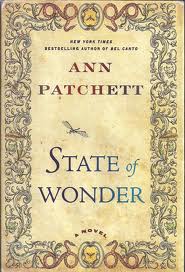
stateofwonderBad news arrives by way of Aerogram. Anders Eckham has died of a fever in a remote part of Brazil.

His colleague, Dr. Marina Singh, who does unremarkable research on cholesterol at Vogel, a large pharmaceutical firm based in Minnesota, experiences “a very modest physical collapse” when she hears the news from her unremarkable lover, Mr. Fox, the company CEO.

As these two emotionally crippled characters struggle with the news, they realize that Anders’ wife, Karen must be told. After delivering the news haphazardly, Mr. Fox concludes that Anders bungled his mission and decides to send Marina to investigate the situation in Brazil.

Dr. Annick Swenson, a former medical school professor who stopped Marina’s medical career in its tracks, is supposedly creating a fertility drug that will allow women to bear children well into old age. Excited by the prospect of this wonder drug, Vogel funded the research and gave the formidable Dr. Swenson considerable latitude. Unfortunately, the septuagenarian considers herself beyond reproach and does not feel accountable to Vogel.

The story follows Marian as she travels from the plains of Minnesota to the heart of the Amazonian rainforest. Along the way, she loses her luggage, not once but twice. Forced to dress like the natives, her skin darkens and she is even mistaken for a member of the Lakashi tribe.

While working with Dr. Swenson, Marina faces her demons. We learn of the foreign graduate-student father who abandoned his family long before “that had become the stuff of presidential history” and Marina’s dealings with “all those translucent cousins who looked at her like she was a llama who had wandered into their holiday dinner.” We hear and see her severe reaction to the anti-malarial medication she had to take while visiting India and, now Brazil. And we learn of the tragic mistake that derailed Marina’s surgical career.

Set deep in the Amazon jungle, State of Wonder is primarily an adventure tale, replete with poison arrows, snakes and cannibals. While reading I could easily visualize the ravenous mosquitoes and floating snake heads and feel the oppressive heat and powerful storms. But Ann Patchett goes beyond the adventure, skillfully weaving some of the most important social issues of our time into this provocative and ambitious novel.

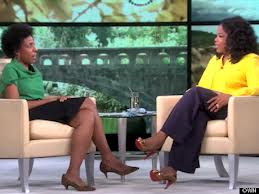
Oprah and Nate Berkus

nate

Yesterday, Nate Berkus sat down with Oprah on Super Soul Sunday to share intimate stories about the experiences that have transformed him.

He found his acorn within the oak at the age of thirteen. Getting his own room was definitely a milestone for the sensitive young man who cared about how things looked and felt. Having grown up around design and following his mother to auctions, estate and garage sales on the weekend, Nate appreciated  life in all its layers, textures and light.

While he was fortunate to have a loving and supportive family, he did not come out until his university years. Nate admitted to developing a skill set that made him dishonest and spending most of his adult life trying to get rid of it.

I was impressed and moved by how his step-father handled the situation. After discovering a letter from Nate’s lover, his step-father waited three months before having the conversation with Nate. He wanted his step-son to know that it didn’t matter and he wouldn’t be treated any differently. An excellent example of putting spiritual philosophy into spiritual action.

Nate also shared the lessons he learned from his talk show. While it was the opportunity of a lifetime, Nate realized during the second week of production that a daily program was not a good fit. Throughout the two-year run, he felt overwhelmed and exhausted. When Oprah pressed further, he admitted that ego and money factored into his original desire to have a talk show. Grateful for the experience, he now knows that he needs space and time around his decisions.

Quotable Quotes…

Everyone has the acorn within the oak that is you. (Oprah)

When you confide in your beloveds, give them the space to grieve the dreams they had for you.

If you’re not willing to stand up for who you are, then everything else does not matter.

I want your personality to come through in another language. (Cheryl Storm—French teacher)

If you cannot be authentic and true to yourself, it is hard to function.

I needed the freedom to create and design my own timeline.

Stop and take a beat before you acquire.

Book Review: Love is a Canoe

canoe2A self-help junkie, I have often wondered what it would be like to spend face-to-face time with one of my favorite gurus.

What insights could I gain from Louise Hay, Martha Beck or Wayne Dyer?

In Love is a Canoe, author Ben Schrank plays with this deep-seated desire among fans of self help/motivational literature.

Stella Petrovic, an ambitious young editor at a prestigious New York publishing house, spearheads a contest to celebrate the fiftieth anniversary of a best-selling relationship book—Love is a Canoe—written by Peter Herman. She invites married couples in trouble to share their stories. One lucky couple will spend a weekend with the author in a picturesque town in upstate New York.

Hundreds of letters arrive, most of them “hopeless and upsetting in shocking circumstances.” While reading about these unfixable marriages, Stella frets about finding suitable candidates and worries that some of that negativity may rub off on her.

Emily Babson’s letter makes the cut.

Happily married for three years to Eli Corelli, she has recently discovered his affair with an employee at his bicycle company. A long-time fan of Love is a Canoe, she admits to reading and rereading the book several times while growing up in a household with fighting parents who eventually divorced. Still devoted to the success of her marriage, she hopes that her weekend with Peter will enable her to forgive Eli.

While Peter’s own marriage with his recently deceased wife appears almost idyllic, there were cracks in that perfect facade. Peter didn’t always follow the folksy advice he gives in his book: “Good love is a quilt—light as feathers and strong as iron”; “Desire for your loved one gives you the strength to paddle on.”

I didn’t particularly like any of the main characters,  but I could easily visualize the quiet and judgmental child/woman struggling with her husband’s betrayal, the awkward outsider trying to get a handle on the clawing and back-biting in the publishing industry, and the conflicted, aging author forced to acknowledge past indiscretions.

A well-written novel that explores the chaos and messiness of relationships.

Many Winding Roads to Success

winding roads

The timing was off.

No one wanted to read about the Korean War, the forgotten war that was overshadowed by the immensely unpopular Viet Nam War.

But that didn’t prevent H. Richard Hornberger (using the pseudonym Richard Hooker) from devoting eleven years to writing about his experiences as a surgeon at the 8055th mobile army surgical hospital unit during the Korean War. His agent spent another eight years sending the manuscript to over thirty publishers who soundly rejected it. Hornberger then asked famed sportswriter W.C. Heinz to help him revise it.

A year later, MASH was acquired by William Morrow and Company.

In 1970, MASH was the third-largest grossing film that year and spawned the popular CBS series, which ran from 1972 until 1983.

Oprah and Ayana Mathis

oprahayana

After reading the first chapter of The Twelve Tribes of Hattie,  Oprah knew she had found her second Book Club 2.0 pick. On yesterday’s Super Soul Sunday, she sat down for an interview with author Ayana Mathis.

Ayana started by describing her experiences at the prestigious Iowa Writers’ Workshop. Grateful for this opportunity to work with Pulitzer Prize winner Marilynne Robinson and other up-and-coming writers, she talked openly about the hopes, dreams and frustrations that lie behind those hallowed walls. When she arrived at the workshop, she was working on another book, a fictionalized memoir. At one critique session, Robinson suggested that her characters were “insufficiently complex.” Ayana took the criticism to heart, had her ugly cry and then turned to writing short stories. Her first story was a hybrid of the first and last chapters of The Twelve Tribes of Hattie.

Inspired by Isabel Wilkerson’s The Warmth of Other Suns, Ayana set her book against the backdrop of the Great Migration.  Starting around 1916,  over six million African Americans migrated north to escape the poverty and hardships of the south. The main character, Hattie Shepherd, is a strong but flawed woman who fiercely loves her eleven children but cannot demonstrate that love. While each chapter focuses on a different child, Hattie is the glue that holds the book together.

In writing this novel, Ayana wanted her readers to encounter a fully, fleshed out black humanity. To that end, she got into the soul of each character and spent as much time as possible in their minds.

When asked about her childhood, Ayana admitted that there was little money and she and her mother often lived in neighborhoods where they couldn’t afford to pay the rent. In spite of their limited circumstances, Ayana was given an enormous amount of freedom and chose her own life path.

Extremely grateful for the success of her debut novel, Ayana admits to being permanently stunned. She still thinks of the book as a Word document.

Quotable Quotes…

Our humanity means we don’t have to be completely defined by race.

We find companions and mirrors in literature.

There is an arc of human history that bends toward social justice.

Character development is a process cultivated over time. Reward comes from reworking.

Movie Review: Quartet

At age seventy-five, Dustin Hoffman has made an outstanding directorial debut with this gentle comedy about aging musicians living at Beecham House, a British retirement house. The film is based on Italy’s Casa di Riposo per Musicisti, first chronicled in the 1984 documentary Tosca’s Kiss.

The musical seniors are rehearsing for the annual gala fundraising concert. When legendary diva Jean Horton (Maggie Smith) arrives, she creates a stir and receives a standing ovation from the other residents.

But not everyone is pleased to see her.

Reggie Paget (Tom Courtenay) still holds a grudge against his ex-wife and fellow member of a London operatic dream team. Two other members of the team, Wilf Bond (Billy Connolly) and Cissie Robson (Pauline Collins), also live at Beecham and hope to persuade Jean to join them and wow the audience with their famous quartet from Rigoletto.

The supporting actors include actual retired stars, among them opera singer Gwyneth Jones and jazz pianist Jack Honeyborne.

Hoffman has provided the perfect backdrop for creative people who refuse to slow down, despite their aging bodies and minds.

Simply delightful from start to finish.


Book Review: My Beloved World

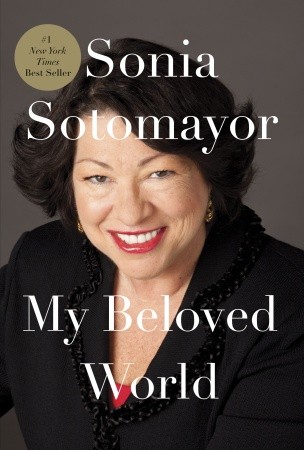
soniasotomayorA dysfunctional home with an alcoholic father and an angry mother forced Sonia Sotomayor to grow up quickly. Throw in a diagnosis of Type 1 diabetes at age seven, “a culture that pushes boys out onto the streets while protecting girls,” and a neighborhood where stairwells were filled with muggers and addicts shooting up. Not the background you would expect for the first Hispanic justice and third female justice in the Supreme Court’s 220-year history.

In her memoir, My Beloved World, Sotomayor reflects on her childhood as the daughter of Puerto Rican parents, her education, her relationships, and her brilliant career.

The self-discipline and perseverance began at a very early age. Faced with a life-threatening disease, a working mother and a father with trembling hands, Sotomayor started giving herself insulin shots at age seven. This “existential independence” set the stage for a remarkable life journey with impressive stops at Princeton, Yale Law, the Manhattan district attorney’s office, and an appointment to the bench.

Sotomayor, however, is quick to point out the obstacles and challenges along the way.

Realizing that she lacked the appropriate study skills in elementary school, she approached the smartest girl in the class and asked her how to study.  When she received a C on her first midterm paper at Princeton, she devoted each day’s lunch hour during subsequent summers to grammar exercises and learning ten new words. After a less than stellar performance at one of the top law firms in Manhattan, she trusted her instincts and applied for a job at the state department.

Unfortunately, this well-honed independence led to the break-up of her marriage to high school sweetheart, Kevin Noonan. Her husband felt she didn’t really need him; Sotomayor didn’t think of “need as an essential part of love.” While she regrets the children she never had, she lavishes love and attention on her many godchildren.

Whenever Sotomayor entered any new environment, she experienced an initial period “of fevered insecurity, a reflexive terror that I’ll fall flat on my face.” But the love and protection of her grandmother Abuelita allowed her “to imagine the most improbable of possibilities” and her mother  taught her that “a surplus of effort could overcome a deficit of confidence.”

Throughout the book, it is evident that Justice Sonia Sotomayor has a deep and sincere love for the “beloved world” that shaped her values. In sharing many of the darker experiences, she has succeeded in showing everyone, especially people in difficult circumstances, that happy endings are possible.

Movie Review: Lincoln

It is not surprising that Daniel Day-Lewis won the Golden Globe and SAG awards for best actor. And I wouldn’t be too surprised if he also won an Oscar for his outstanding portrayal of Abraham Lincoln. He doesn’t just look like Lincoln; he immerses himself and becomes Lincoln. He dominates every scene of the film, displaying the many aspects of the former president’s character. While the folksy storytelling provides the humor, the cagey politicking demonstrates a different aspect of the former president, one not usually portrayed in films.

Director Steven Spielberg confined the main story to a one-month period: January 1865, the beginning of Lincoln’s second term. He wants the 13th Amendment to the Constitution, abolishing slavery, passed in the House of Representatives, and he wants it passed right away. An ambitious plan, Lincoln refuses to be deterred by advisors who deem it impossible given the current makeup of the house.

Most of the scenes in the movie involve politicians sitting or standing in rooms while arguing. While some of these scenes were necessary to demonstrate the process, I felt there were too many of them. I would have preferred more scenes of Lincoln with his wife (Sally Field) and oldest son (Joseph Gordon-Levitt).

The stellar cast also included Tommy Lee Jones as visionary Congressman Thaddeus Stevens. Another Oscar-worthy performance. In her supporting role, Sally Field delivered an outstanding performance as the volatile Mary Todd Lincoln.