Celebrate Earth Day with Lucas Miller, the “Singing Zoologist!”
April is National Poetry Month, a month set aside to celebrate poetry and its vital place in our society. Launched by the Academy of American Poets in 1996, this month-long celebration has attracted millions of readers, students, teachers, librarians, booksellers, and poets.
Each Friday of April, I will share a favorite poetry collection.
Today’s pick is A Suit or a Suitcase by Maggie Smith, a collection described as “the work of a polished mind and an endlessly revised self…a poetry of grace.”
In a recent interview with Psychology Today, Ms. Smith offered a revealing glimpse into her creative process: “As it turns out, feeling unmoored is the perfect emotional weather for writing poems.” An unsettling observation, but one that seems to have shaped her creative work over the past five years, a period marked by her divorce and the pandemic.
Although she has published several works of prose, among them the memoir, You Could Make This Place Beautiful, and the craft guide, Dear Writer: Pep Talks & Practical Advice for the Creative Life, she calls poetry her “home genre.”
As she wrote the poems in this collection, Ms. Smith reflected on the evolution of her body across the stages of her life: childhood, young adulthood, new motherhood, and middle age. She moves easily between her inner and outer worlds as she contemplates the roles of music, nature, art, and relationships.
A series of intriguing questions emerges:
“How do I get back inside myself?
“What can I carry forward except these reminders?”
“Why not believe the shadow feels affection for the flesh?”
“Why can’t I remember some of the most harrowing moments?”
Ms. Smith has succeeded in making her keen observations and life experiences universal while allowing the poems to resonate quietly rather than demanding attention.
Here’s one of my favorite poems:
The Score
Sometimes I feel like I’m writing the score
for a film that doesn’t yet exist,
but everything that will happen
in the film will happen to me.
Is this what they call plot? This daily
picking up of the same things—
glasses, coffee cup, pen, book, keys—
and setting them back down again?
Narrative has always troubled me,
so I’ll leave that to someone else
and write the mood instead, also
approximating setting: a little piano
to suggest rain, and violin for a river,
long and thin. That key change?
A meander. If the score is plain
and sweet, it’s because the life is—
mostly. I don’t know how it ends,
but given the budget, it will end quietly.
One day I’ll find myself near a river,
and I’ll realize, This is that film,
the one I scored, and this is the scene where
rain starts falling. And in that moment
it will, and it will sound like piano.

On Wednesdays, I share posts, fables, songs, poems, quotations, TEDx Talks, cartoons, and books that have inspired and motivated me on my writing journey. I hope these posts will give writers, artists, and other creatives a mid-week boost.

In The Rules of Life, international bestselling author Richard Templar shares a personal code for living a better, happier, more successful kind of life. Here is an excerpt from Rule 7, “Be Flexible in Your Thinking”:
We all have set patterns in life. We like to label ourselves as this or that and are quite proud of our opinions and beliefs. We all like to read the same paper, watch the same sorts of TV programmes or movies, go to the same sort of shops every time, eat the same type of food that suits us, and wear the same type of clothes. And all this is fine. But if we cut ourselves off from all other possibilities, we become boring, rigid, hardened—and thus likely to get knocked about a bit.
You have to see life as a series of adventures. Each adventure is a chance to have fun, learn something, explore the world, expand your circle of experience and friends, and broaden your horizons. Shutting down to adventure means exactly that—you are shut down.
The second you are offered an opportunity to have an adventure, to change your thinking, to step outside of yourself, go for it and see what happens. If this thought scares you, remember that you can always go back into your shell the second it’s over, if you want to.
But even saying yes to every opportunity isn’t set in stone as a rule, because that would be inflexible. The really flexible thinkers know when to say ‘no’ as well as when to say ‘yes’.
If you want to know how flexible your thinking is, here are a couple of tests. Are the books by the side of your bed the same sorts of books you’ve always read? Have you found yourself saying anything like ‘I don’t know any people like that’ or ‘I don’t go to those kinds of places’? If so, then perhaps it’s time to broaden your mind and take the shackles off your thinking.
Source: The Rules of Life, p. 17

April is National Poetry Month, a month set aside to celebrate poetry and its vital place in our society. Launched by the Academy of American Poets in 1996, this month-long celebration has attracted millions of readers, students, teachers, librarians, booksellers, and poets.
Each Friday of April, I will share a favorite poetry collection.
Today’s selection, To the Women: Wise Words Every Woman Needs, has been described as “a celebration of the beauty, strength, and joy of being a woman.”
When Donna Ashworth self-published the original version of this book in 2020, she could not have anticipated how profoundly it would reshape her life. At the time, she was adrift, unsure of what she was doing, where she was going, and what she wanted. Motherhood had slowed her down and allowed her to readjust her perspective. The “rat race” had lost its promise. She was tired of running too fast all the time and never keeping up.
To her astonishment, the book resonated with women in the United Kingdom and far beyond. What followed was not just success, but a whirlwind of connection, far greater than she had hoped. The 2025 edition has been revised and updated with over seventy new poems.
I set aside an entire day to read and sit with this collection, savoring the wisdom, comfort, and inspiration of beautifully written poems such as “Be That Woman,” “Age Gracefully, “There Will Be Days,” “Remember Her,” and “To the Woman Who Thinks She Isn’t Good Enough.” Underlying each poem is the importance of listening to our innermost voices, reconsidering long-held beliefs, and embracing the call to reinvent ourselves.
An ideal gift for any season or occasion, this collection will delight and resonate deeply with the poetry readers in your circle.
Here’s one of my favorite poems:
Age Gracefully
Age gracefully, they say
but I fear that what they mean
is age quietly, slip aside
be wise but stay unseen
age gracefully, they say
but I think, they’re afraid
that we may all wear purple
and wrap silver hair in braids
age gracefully, they say
don’t succumb to the knife
but don’t let standards drop
don’t wear your clothes too tight
age gracefully, they say
but don’t be looking old
likewise, not too young
take your place, fit the mold
age gracefully, they say
but grace means, being at ease
flowing with the winds of change
so, doing as we please
age gracefully, age tastefully
age like a fine red wine
just age with your acceptance
and you’ll never fear the lines
age gracefully, my friends
whatever path you tread
walk it with your own permission
it’s your home, so make your bed.

On Wednesdays, I share posts, fables, songs, poems, quotations, TEDx Talks, cartoons, and books that have inspired and motivated me on my writing journey. I hope these posts will give writers, artists, and other creatives a mid-week boost.

Here’s a thought-provoking reflection from international speaker and bestselling author Joyce Meyer:
Being relaxed feels wonderful. Being nervous, tense, and worried are not so wonderful. Why aren’t more people relaxed? Jesus said if we are weary and overburdened, we should go to Him and He will give us rest, relaxation, and ease. Jesus wants to teach us the right way to live, which is different from the way most of the world lives.
It would be putting it mildly to say that I was an uptight woman for the first half of my life. I simply did not know how to relax, and it was due to me not being willing to completely trust God. I trusted God for things, but not in things. I kept trying to be the one in control. Even though God was in the driver’s seat of my life, I kept one hand on the wheel just in case He took a wrong turn. Relaxation is impossible without trust!
If you know you can’t fix the problem you have, then why not relax while God is working on it? It sounds easy, but it took many years for me to be able to do this. I know from experience that the ability to relax and go with the flow in life is dependent upon our willingness to trust God completely. If things don’t go your way, instead of being upset, you can believe that getting your way was not what you needed. God knew that, so He gave you what was best for you, instead of what you wanted.
If you are waiting much longer than you had hoped to , you can get frustrated, angry, and upset, or you can say, “God’s timing is perfect. He is never late. And my steps are ordered by the Lord.” Now you can relax and simply go with the flow of what is happening in your life. When it comes to things that are out of our control, we can either ruin the day or relax and enjoy it while God is working on the situation. As long as we believe, God keeps working!

On Wednesdays, I share posts, fables, songs, poems, quotations, TEDx Talks, cartoons, and books that have inspired and motivated me on my writing journey. I hope these posts will give writers, artists, and other creatives a mid-week boost.

In The Rules of Life, international bestselling author Richard Templar shares a personal code for living a better, happier, more successful kind of life. Here is an excerpt from Rule 18, “Don’t Be Afraid to Dream”:
This may seem incredibly obvious, incredibly easy but you would be surprised how many people seriously limit their dreams. They’re your dreams for heaven’s sake. There should be no limit to them. Plans have to be realistic; dreams don’t.
You are allowed to dream as high, as wide, as big, as extravagant, as impossible, as wacky, as silly, as bizarre, as unrealistically nonsensical as you want.
You are allowed to wish for anything you want as well. Look, wishes and dreams are all private affairs. There are no wish police, no dream doctors who are on the rampage, looking out for unrealistic demands. It is a private thing, between you…and that’s it. Between you and absolutely no one else at all.
The only note of caution here—and I do speak from personal experience—is to be very careful of what you do wish for, what you dream of, it might just come true. And where would you be then?
A lot of people think their dreams have to be realistic to be worth dreaming about. But that’s a plan and that is something quite different. I have plans and I take logical steps to make them come to fruition. Dreams are allowed to be so improbable that they are never likely to come true. And don’t go thinking you’ll never achieve anything by sitting around day-dreaming all day. Some of the most successful people have also been those who have dared to dream the most. It isn’t a coincidence.
Source: The Rules of Life, pp. 38-39.
Today is Dr. Suzuki’s 90th birthday. Born in Vancouver (British Columbia), he is a renowned Canadian scientist, environmentalist, university professor, and broadcaster known for his work in promoting sustainability and raising awareness about climate change.
A geneticist with a PhD in zoology, he became widely recognized for his long-running television series, The Nature of Things, in which he explained complex scientific topics. He is also the co-founder of the David Suzuki Foundation, which focuses on environmental conservation and climate solutions.
Voted one of the Top Ten Canadians, he has published more than fifty books. He is celebrating his birthday with the release of Lessons from a Lifetime: Ninety Years of Inspiration and Activism.

My favorite quotes from David Suzuki:
My parents survived the Great Depression and brought me up to live within my means, save some for tomorrow, share, and don’t be greedy, work hard for the necessities in life, knowing that money does not make you better or more important than anyone else. So, extravagance has been bred out of my DNA.
I can’t imagine anything more important than air, water, soil, energy, and biodiversity. These are the things that keep us alive.
Ultimately, we need to recognize that while humans continue to build urban landscapes, we share these spaces with other species.
Nature surrounds us, from parks and backyards to streets and alleyways. Next time you go out for a walk, tread gently and remember that we are both inhabitants and stewards of nature in our neighbourhoods.
Our personal consumer choices have ecological, social, and spiritual consequences. It is time to re-examine some of our deeply held notions that underlie our lifestyles.
Change is never easy, and it often creates discord, but when people come together for the good of humanity and the Earth, we can accomplish great things.
We are in a giant car heading towards a brick wall, and everyone’s arguing over where they’re going to sit.
We must reinvent a future free of blinders so that we can choose from real options.
Scientists have been warning about global warming for decades. It’s too late to stop it now, but we can lessen its severity and impacts.
The human brain now holds the key to our future. We have to recall the image of the planet from outer space: a single entity in which air, water, and continents are interconnected. That is our home.
Interview on The Social
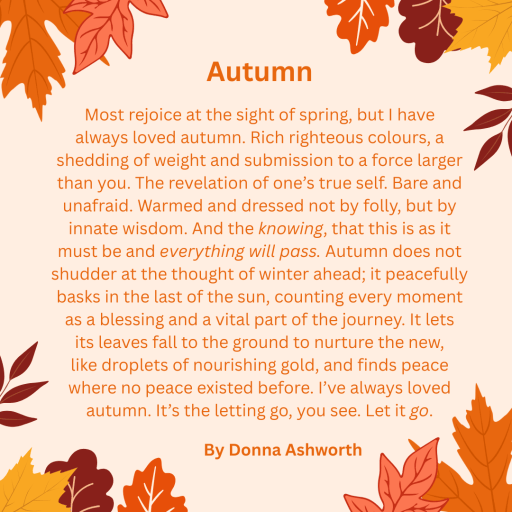
Known as the UK’s best-selling living poet, Donna Ashworth first rose to prominence during the 2020 lockdown, when her poem “History Will Remember When the World Stopped” went viral and helped raise funds for the NHS. In the years since, her work has continued to resonate, offering reflections on resilience, connection, and hope.
Here’s one of my favorites…perfect for the season:


>On Wednesdays, I share posts, fables, songs, poems, quotations, TEDx Talks, cartoons, and books that have inspired and motivated me on my writing journey. I hope these posts will give writers, artists, and other creatives a mid-week boost.

I highly recommend The Healing Power of Resilience by Dr. Tara Narula, board-certified cardiologist and chief medical correspondent for ABC News. Here’s an inspiring and thought-provoking excerpt:
Countless times I have witnessed patients beat the odds and live beyond expectations—even if it was a stretch to think they would survive just one more day. For many it is that one more day, and that one more day has so much value for them and the people who love them. Allowing for hope is a key part of how we can help people and patients build resilience. Instead of limiting our expectations of what happens next to fit within the smallest, safest perimeter, we should allow people the room to grow, to live into whatever might be possible.
Hope is difficult to define; we just know it when we feel it. One definition of hope that I like defines it as an “optimistic state of mind based on the expectation of positive outcomes in one’s life or the world.” This means to me that hope is something we can choose to cultivate. Hope is a positive motivational state based on a sense of agency (the belief that you initiate and direct actions) and action (the belief that you can find ways to achieve your goals). It’s not simply wishful thinking; it’s a belief in the possibility of a better future, coupled with the conviction that you can play a role in making that future a reality. If we believe that resilience is, rather than the ability to bounce back, the ability to bounce forward and to find peace with a new normal, hope is believing that we can make that new normal a good place to be.
Source: The Healing Power of Resilience, pp. 192-193.