April is National Poetry Month, a month set aside to celebrate poetry and its vital place in our society. Launched by the Academy of American Poets in 1996, this month-long celebration has attracted millions of readers, students, teachers, librarians, booksellers, and poets.
Each Friday of April, I will share a favorite poetry collection.
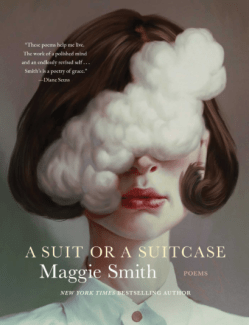 Today’s pick is A Suit or a Suitcase by Maggie Smith, a collection described as “the work of a polished mind and an endlessly revised self…a poetry of grace.”
In a recent interview with Psychology Today, Ms. Smith offered a revealing glimpse into her creative process: “As it turns out, feeling unmoored is the perfect emotional weather for writing poems.” An unsettling observation, but one that seems to have shaped her creative work over the past five years, a period marked by her divorce and the pandemic.
Although she has published several works of prose, among them the memoir, You Could Make This Place Beautiful, and the craft guide, Dear Writer: Pep Talks & Practical Advice for the Creative Life, she calls poetry her “home genre.”
As she wrote the poems in this collection, Ms. Smith reflected on the evolution of her body across the stages of her life: childhood, young adulthood, new motherhood, and middle age. She moves easily between her inner and outer worlds as she contemplates the roles of music, nature, art, and relationships.
A series of intriguing questions emerges:
“How do I get back inside myself?
“What can I carry forward except these reminders?”
“Why not believe the shadow feels affection for the flesh?”
“Why can’t I remember some of the most harrowing moments?”
Ms. Smith has succeeded in making her keen observations and life experiences universal while allowing the poems to resonate quietly rather than demanding attention.
Here’s one of my favorite poems:
The Score
Sometimes I feel like I’m writing the score
for a film that doesn’t yet exist,
but everything that will happen
in the film will happen to me.
Is this what they call plot? This daily
picking up of the same things—
glasses, coffee cup, pen, book, keys—
and setting them back down again?
Narrative has always troubled me,
so I’ll leave that to someone else
and write the mood instead, also
approximating setting: a little piano
to suggest rain, and violin for a river,
long and thin. That key change?
A meander. If the score is plain
and sweet, it’s because the life is—
mostly. I don’t know how it ends,
but given the budget, it will end quietly.
One day I’ll find myself near a river,
and I’ll realize, This is that film,
the one I scored, and this is the scene where
rain starts falling. And in that moment
it will, and it will sound like piano.

