Oprah and Deepak Chopra

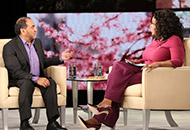
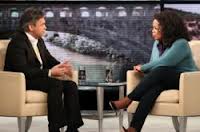
When Deepak Chopra first started meditating, he hoped to get rid of a pack-a-day smoking habit  and relieve stress. He achieved those goals and, in the process, changed the hard-wiring of his brain. While speaking with Oprah at yesterday’s Super Soul Sunday, he admitted to being emotionally free with no resentments, no guilt and no one left  to forgive.

Forty years of daily meditation has transformed his life. And now Deepak Chopra invites all of us to participate in his free 21-Day Meditation Challenge.

Why 21 days?

It takes that long to change the hard-wiring our brains and form a habit. As more neural networks are created, we start to see opportunities where others see problems. This lays the foundation for creating abundance, the main focus of the challenge. And if we continue meditating for 66 days, a groove is created in the brain.

Deepak reiterated the fact that mediation is a part of every spiritual tradition and has nothing to do with ideology or doctrine.  Very simply, meditation is a progressive quieting of the mind that allows the spirit to speak in silence.

Meditation tips from Deepak Chopra…

The best times to meditate are first thing in the morning and late afternoon between 4:00 and 5:00 p.m.

Fifteen to twenty minutes, twice a day, is enough.

Sitting is preferable to lying down.

Observe the breath, but do not manipulate it.

Visualize your dreams before, not during meditation.

Most important of all…BE COMFORTABLE.

Quotable Quotes…

My body is busy, I’m not.

Set the intention and let the universe do the rest.

The best way to get rid of your enemies is to increase their capacity for happiness.

Our genes are coding our karma.

Science is how God thinks.

We limit ourselves by defining ourselves.

I want to know what God thinks. The rest are details. Albert Einstein.

Book Review: Chai Tea Sunday

When Heather Clark was pregnant with her second child, she started writing Chai Tea Sunday, a novel inspired by her Cousin Rachel’s teaching experiences in Kenya. Moved by stories of the remarkable orphans who gave so much unconditional love, Clark put pen to paper and crafted this tender and hopeful debut novel that can be easily read in one or two sittings.

Nicky and Eric Fowler appear to have it all. The elementary school teacher and lawyer have rewarding careers and  live very comfortably in Toronto, within short driving distances of their respective families. After they suffer a devastating loss, their picture-perfect marriage falls apart.

Eric throws himself into his job and Nicky heads off to Kenya to volunteer as a teacher in an orphanage. While there, she stays with a host family headed by the enigmatic Mama Bu, a wise woman who shares chai tea and life lessons on Sunday afternoons.

I was surprised to discover that Clark has never been to Kenya. She relied exclusively on her cousin’s stories, journals, pictures and videos. She also added her own research of Africa and interviewed an Ontario court judge, a renowned fertility expert and Swahili translators

Her impeccable research skills are evident throughout the novel and add to its authenticity.

I could easily visualize the colourful Ngong market…

“Hectic rows of little stands filled with fruits and vegetables were flooded with Kenyans pushing up into each other, shaking hands or slapping each other on the back…Bright yellow bananas and mangoes were everywhere, with a few stalls offering shoppers unrefrigerated meats and eggs. Fire-engine red tomatoes were piled high into pyramid shapes, and oversized woven baskets were filled with the same bobby beans I had seen in Mama Bu’s garden. Purple eggplant lay beside various greens of cabbage, limes and snow peas, and the smell of spices wafted from the food stalls offering nutmeg, cloves and cinnamon.”

And the single classroom that housed thirty-five pupils of eight different levels…

“No kids’ paintings hung on the crumbling cement walls, the thick globs of bright red and purple brushstrokes were still drying from that morning’s art lesson…It was simply a dirty, bare room. Squished together rows of rectangle tables were used as desks. Lining the tables were benches, some broken and some not. All scrunched together in an attempt to ensure that as many students as possible could fit into the classroom.”

A portion of the proceeds will go to Artbound, a charity that provides clean water, medical care, food, and funds to build schools in developing nations.

An excellent debut! I look forward to reading Heather Clark’s next novel, to be released in 2014.

On the Sunny Side

It is easy to be negative at this time of year. The mornings are dark, the weather is unpredictable, and winter is just around the corner. The excuses are endless and, if we’re not careful, we’ll stop exercising and slip back into bad habits.

In their book, So Stressed, authors Stephanie McClellan and Beth Hamilton suggest countering the following negative thoughts with more positive messages:

I’m too exhausted even to think of moving.
I always have more energy after I exercise.

I’m just so slow.
When I started, I was out of breath very quickly. I may not be a speed demon, but I have really built up my endurance.

My whole body hurts from that last workout.
If I stretch well or take a hot bath, my muscles will be warmed up, and I’ll be feeling no pain once I start moving.

I had to skip three days because I had a virus. It’s impossible for me to stay with it. Something always gets in the way.
Each day is a new day, and I can pick up where I left off.

It’s miserable out, so I think I ‘ll just sleep in this morning.
It’s raining too hard for me to enjoy my walk. I think I’ll try that new yoga DVD.

This was the most stressful day at work in a long time. I think I’ll make myself a drink.
I haven’t been this stressed out in a long time. I bet a good workout will help me burn off this tension.

Movie Review: Argo

For the first time in decades, many of us are learning what really happened during the Iran hostage crisis of 1979. While the six Americans did find asylum in the residence of the Canadian ambassador, Ken Taylor (Victor Garber) did not act alone. C.I.A. staffer Tony Mendez (Ben Affleck) stepped in to implement a risky, out-of-the-box plan to spirit the hostages out of Iran.

Mendez went to Hollywood to ask prosthetics guru John Chambers (John Goodman) to create a fake film using a script that required a Middle Eastern setting. With the help of producer Lester Siegel (Alan Arkin), they produce a script, posters, storyboards and enough buzz to generate international attention for Argo. Posing as an associate producer, Mendez flies to Iran and provides the hostages with fake Canadian identities. He sneaks out the six in plain sight and provides many nail-biting scenes as they scout locations for the fake film.

Affleck delivers Oscar-worthy performances as actor and director in what is probably one of the best movies of 2012.

A must-see movie…you will sit at the edge of your seat throughout the entire movie.

The Next Big Thing–Patricia Anderson

Last week, I tagged good friend and fellow writer, Patricia Anderson, in  The Next Big Thing post. The idea comes from She Writes and is meant to help female authors promote their WIPs (Works in Progress). As per the rules, what follows are her answers to ten interview questions about her WIP.

What is the working title of your book?

Potholes in Paradise

Where did the idea come from for the book?

While house hunting,  people seem to be more concerned with crown mouldings and counter tops, rather than who’s living in the house next door. Remodelling and renovating are easy fixes, but an inconsiderate or obnoxious neighbour can be an immovable source of misery. Yes, I’m speaking from experience. And I’m saddened by the loss of  ‘neighbourhoods’. How many people actually know  who their neighbours are, or even care? I realize that we can’t all live on Sesame Street, but I find modern subdivisions frightening.

What genre does your book fall under?

I’m not sure what shelf I would put it on. Spoiler alert: There are no dead bodies. That eliminates most of the genres. “Amusing Family Drama” sounds more like a TV sitcom. How about a four-day experiment with “Social Realism”?

Which actors would you choose to play your characters in a movie rendition?

The protagonist is an average 42-year old, hard-working wife and mother (me, only younger). And then there are half a dozen rebellious and troublesome teenagers, and add to that a sizable group of rebellious and troublesome senior citizens. There are no fancy costumes or even makeup, just a lot of dust, mud, sunburns, bug bites and hangovers. I’d cast the movie with unknowns, and they’d all be Canadian. Well, there might be small part for William Shatner.

What is the one-sentence synopsis of your book?

Potholes in Paradise follows the antics of a dysfunctional group of seasonal residents in a trailer park in south-central Ontario.

Will your book be self-published or represented by an agency?

Still sitting on that fence.


How long did it take you to write the first draft of your manuscript?

Three long years of part-time binge writing.

What other books would you compare this story to within your genre?

I haven’t yet come across such a thing. I’m flying over unfamiliar territory.

Who or what inspired you to write this book?

I’ve spent the last five summers in a similar place: a scenic paradise riddled with enormous potholes (intentional speed traps) and an infinite supply of problems. It has been an invaluable and rich source of inspiration for story lines and character studies.

What else about your book might pique the reader’s interest?

It deals with common themes and issues, like raising teenagers, family secrets, communities, addiction, and essentially, the meaning of life.

Now, it’s Patricia’s  turn to tag some follow authors:

Cindy Carroll | Linda Johnston | Erica Williams

Mes­sage for the tagged authors and inter­ested others

Rules of The Next Big Thing

Use this for­mat for your post.

Answer the ten ques­tions about your cur­rent WIP (Work In Progress).

Tag five other writers/bloggers and add their links so we can hop over and meet them.

Ten Inter­view Ques­tions for The Next Big Thing

What is the work­ing title of your book?

Where did the idea come from for the book?

What genre does your book fall under?

Which actors would you choose to play your char­ac­ters in a movie rendition?

What is the one-sentence syn­op­sis of your book?

Will your book be self-published or represented by an agency?

How long did it take you to write the first draft of your manuscript?

What other books would you com­pare this story to within your genre?

Who or What inspired you to write this book?

What else about your book might pique the reader’s interest?

Include the link of who tagged you and this expla­na­tion for the peo­ple you have tagged.

Introducing Nadežda Rajčan

Last week, I met Nadežda Rajčan at a writing workshop. I offered to share her book, Contemporary Fairy Tales and Stories for all Ages, with all of you.

Here is the book which was envisioned in the heart and soul of our author, Dr Nadežda Rajčan, a long time before it was published. This book was created in a special part of her heart, as if with silk threads, and it now has its own myth and permanent dimension. The stories within this book needed to be told and as they came forth, they offered the listeners and readers a beautiful and imaginative revived world.

Contemporary Fairy Tales and Stories for all Ages is a collection of stories that allow the reader, or listener, to visualize the connection between the things which can be, or cannot be connected, in such a harmonious fashion. What I was especially impressed with, was the way Dr Nadežda Rajčan brought things, such as toys, computers and flowers to life. In this way, she succeeded in making everything interesting, and everybody around herself a goodhearted person.

As well, the professionally designed illustrations, and the carefully selected photographs, compliment the stories, thereby allowing children to develop their imagination. Dr Nadežda Rajčan wrote these modern fairy tales, which are full of wonders and positive emotions, as a spiritual gift to her grandchildren.

By dividing the stories into six chapters, according to certain topics, the writer leads the readers from her corner of former Yugoslavia, where she grew up, not only to many countries and continents, but also beyond – to other planets and the outer reaches of the universe. Therefore, before you start to read these fairy tales and stories, I would like to suggest that you…

Buckle your seat belts because we are taking off on a grand journey!

This review was written by Radovan Vlahović, a writer at the Banat Cultural Center in Serbia.

Contest Time


This slideshow requires JavaScript.

Last evening, I attended the  Humorous and Table Topics Speech Contests for Toastmaster Areas 62 and 66 (Guelph, Ontario).

New Life Church, with its large altar and colorful autumn displays,  provided the perfect backdrop for the contestants. We were all able to relax in the comfortable seats and listen to nine prepared speeches and seven impromptu talks.

Congratulations to the winners: Steve Noonan (Humorous Contest–Area 62), Blake Kurisko (Humorous Contest–Area 66), Rosalind Scantlebury (Table Topics–Area 62), Danve Castroverde (Table Topics–Area 66)

Movie Review: The Chaperone

Having supervised many high school dances and activities, I could easily empathize with Cora Carlisle as she tried to restrain the wild and rebellious fifteen-year-old Louise Brooks. But Cora faced an even greater challenge: she agreed to chaperone Louise for an entire month in New York City.

The two women could not be more different. While Cora’s childhood was tumultuous, she married well and led a comfortable life in Wichita, Kansas. An early “lady driver” and suffragette, she still espoused traditional values and dressed modestly, wearing high collars and constricting corsets. On the other hand, Louise defied convention by dressing provocatively and flirting with every man she met.

Often frustrated by her charge, Cora quickly realized she would have little, if any, impact on the younger woman. But that did not stop her from exploring her own orphan roots. Born in New York City at the turn of the century, Cora was placed in an orphanage run by nuns. As one of the healthier charges, she was sent off on trains throughout the Midwest. She was “part of an exodus, a mass migration that spanned over seventy years.”

While those five weeks did not change Louise, Cora underwent a major transformation and discovered new possibilities for her life. Upon her return to Wichita, she made dramatic changes to her domestic arrangement and became more involved with the social issues of her day: homosexuality, KKK, contraception, unwed mothers, Prohibition.

Author Laura Moriarty has skillfully combined fact and fiction to produce a compelling novel about two very different women in search of freedom and fulfillment.

Highly recommended for fans of historical fiction and women’s literature.