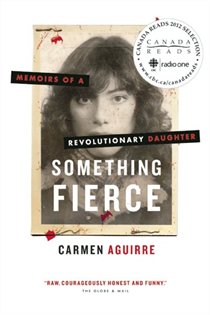
Book Review: Something Fierce by Carmen Aguirre

At last night’s book club, we had a lively discussion about Carmen Aguirre’s memoir, Something Fierce: Memoirs of a Revolutionary Daughter. While most of us were fascinated by the book and welcomed the opportunity to learn more about Chile, we had different opinions regarding the parenting of Carmen and her sister, Ale.

When Carmen was five years old, her family left Chile and began a new life in Vancouver. Six years later, her mother (Mami) decided to return and join the revolutionary movement against Pinochet’s dictatorship. Separated from her husband, Mami decided to take her two daughters with her.

What follows is Carmen’s coming of age story set against the frightening backdrop of Chile in the 1980s. Moving from city to city and country to country across South America, the children were left with a revolving door of babysitters as Mami and her partner, Bob, were on assignment. At one point in the story, Carmen is left alone too long and her money runs out. She hides in the apartment and morphs into an “agoraphobic 15-year-old skeleton with obsessive compulsive disorder.” Interestingly enough, Carmen thought life in the Resistance was normal and decided to become a revolutionary at age eighteen.

While some of the other club members made allowances for Mami, feeling that she authentically cared for her children and wanted them to experience her love and passion for Chile, I tend to agree with Ale’s comment: “Here’s a revolutionary thought: provide for your children and pay attention to them.”

In a CBC interview, Carmen spoke of her love and admiration for Mami. While Carmen would never put her own child through that experience, she did offer insight into her mother’s behavior. Born in an upper middle class home, Mami was not raised in the Resistance movement and had no clue about its effects on young children. Mami took to heart the words of her Resistance oath: “I am committed to giving my life to the cause. I will die for the cause if need be. From now on, my entire life is dedicated to the cause, which takes precedence over everything else.”

To date, very little has been written about the Chilean revolution in English literature. In writing Something Fierce, Carmen Aguirre has filled that void.

An excellent read that will  evoke strong feelings.

Book Review: Chai Tea Sunday

When Heather Clark was pregnant with her second child, she started writing Chai Tea Sunday, a novel inspired by her Cousin Rachel’s teaching experiences in Kenya. Moved by stories of the remarkable orphans who gave so much unconditional love, Clark put pen to paper and crafted this tender and hopeful debut novel that can be easily read in one or two sittings.

Nicky and Eric Fowler appear to have it all. The elementary school teacher and lawyer have rewarding careers and  live very comfortably in Toronto, within short driving distances of their respective families. After they suffer a devastating loss, their picture-perfect marriage falls apart.

Eric throws himself into his job and Nicky heads off to Kenya to volunteer as a teacher in an orphanage. While there, she stays with a host family headed by the enigmatic Mama Bu, a wise woman who shares chai tea and life lessons on Sunday afternoons.

I was surprised to discover that Clark has never been to Kenya. She relied exclusively on her cousin’s stories, journals, pictures and videos. She also added her own research of Africa and interviewed an Ontario court judge, a renowned fertility expert and Swahili translators

Her impeccable research skills are evident throughout the novel and add to its authenticity.

I could easily visualize the colourful Ngong market…

“Hectic rows of little stands filled with fruits and vegetables were flooded with Kenyans pushing up into each other, shaking hands or slapping each other on the back…Bright yellow bananas and mangoes were everywhere, with a few stalls offering shoppers unrefrigerated meats and eggs. Fire-engine red tomatoes were piled high into pyramid shapes, and oversized woven baskets were filled with the same bobby beans I had seen in Mama Bu’s garden. Purple eggplant lay beside various greens of cabbage, limes and snow peas, and the smell of spices wafted from the food stalls offering nutmeg, cloves and cinnamon.”

And the single classroom that housed thirty-five pupils of eight different levels…

“No kids’ paintings hung on the crumbling cement walls, the thick globs of bright red and purple brushstrokes were still drying from that morning’s art lesson…It was simply a dirty, bare room. Squished together rows of rectangle tables were used as desks. Lining the tables were benches, some broken and some not. All scrunched together in an attempt to ensure that as many students as possible could fit into the classroom.”

A portion of the proceeds will go to Artbound, a charity that provides clean water, medical care, food, and funds to build schools in developing nations.

An excellent debut! I look forward to reading Heather Clark’s next novel, to be released in 2014.

Introducing Nadežda Rajčan

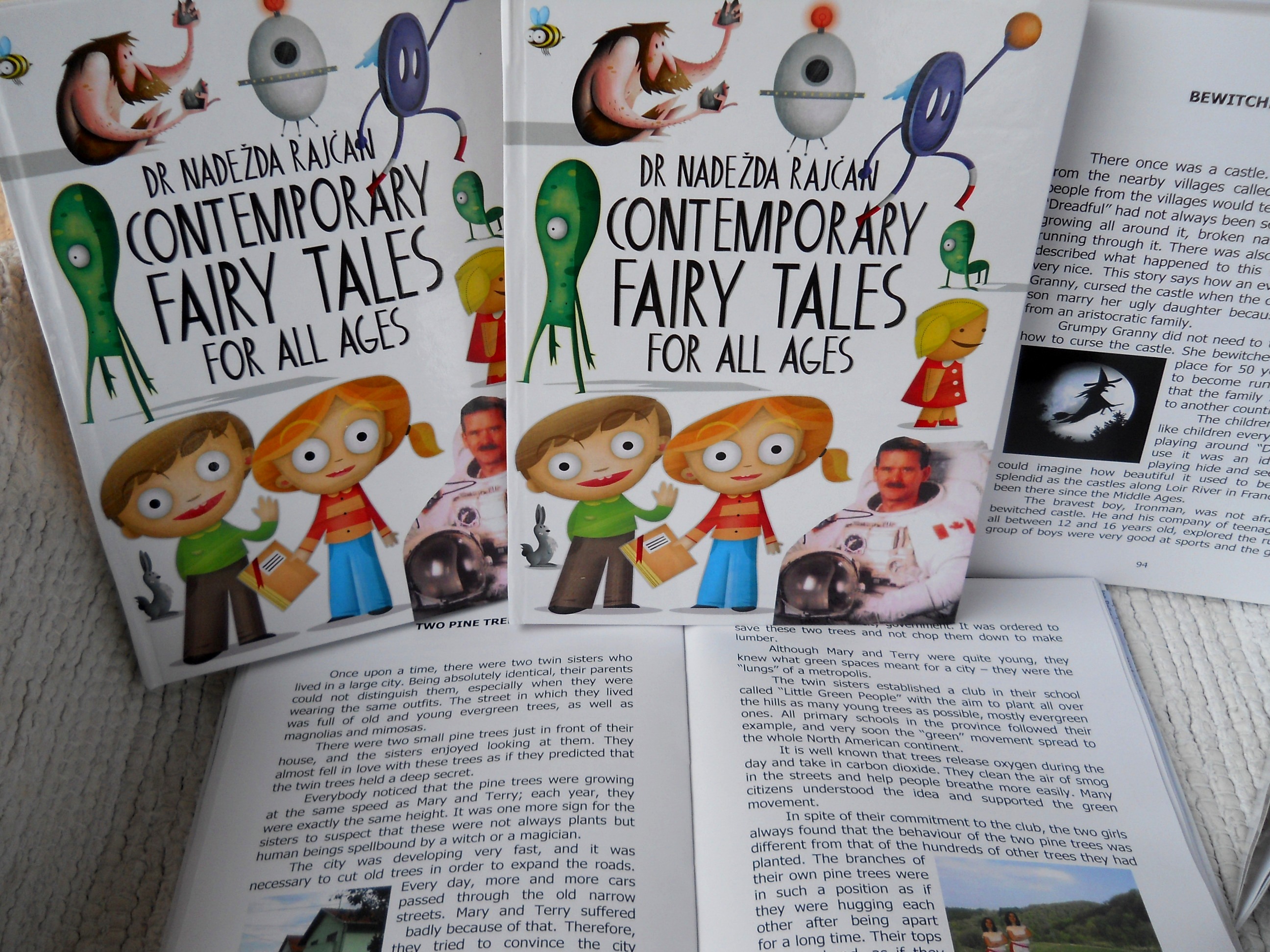
Last week, I met Nadežda Rajčan at a writing workshop. I offered to share her book, Contemporary Fairy Tales and Stories for all Ages, with all of you.

Here is the book which was envisioned in the heart and soul of our author, Dr Nadežda Rajčan, a long time before it was published. This book was created in a special part of her heart, as if with silk threads, and it now has its own myth and permanent dimension. The stories within this book needed to be told and as they came forth, they offered the listeners and readers a beautiful and imaginative revived world.

Contemporary Fairy Tales and Stories for all Ages is a collection of stories that allow the reader, or listener, to visualize the connection between the things which can be, or cannot be connected, in such a harmonious fashion. What I was especially impressed with, was the way Dr Nadežda Rajčan brought things, such as toys, computers and flowers to life. In this way, she succeeded in making everything interesting, and everybody around herself a goodhearted person.

As well, the professionally designed illustrations, and the carefully selected photographs, compliment the stories, thereby allowing children to develop their imagination. Dr Nadežda Rajčan wrote these modern fairy tales, which are full of wonders and positive emotions, as a spiritual gift to her grandchildren.

By dividing the stories into six chapters, according to certain topics, the writer leads the readers from her corner of former Yugoslavia, where she grew up, not only to many countries and continents, but also beyond – to other planets and the outer reaches of the universe. Therefore, before you start to read these fairy tales and stories, I would like to suggest that you…

Buckle your seat belts because we are taking off on a grand journey!

This review was written by Radovan Vlahović, a writer at the Banat Cultural Center in Serbia.

Movie Review: The Chaperone

Having supervised many high school dances and activities, I could easily empathize with Cora Carlisle as she tried to restrain the wild and rebellious fifteen-year-old Louise Brooks. But Cora faced an even greater challenge: she agreed to chaperone Louise for an entire month in New York City.

The two women could not be more different. While Cora’s childhood was tumultuous, she married well and led a comfortable life in Wichita, Kansas. An early “lady driver” and suffragette, she still espoused traditional values and dressed modestly, wearing high collars and constricting corsets. On the other hand, Louise defied convention by dressing provocatively and flirting with every man she met.

Often frustrated by her charge, Cora quickly realized she would have little, if any, impact on the younger woman. But that did not stop her from exploring her own orphan roots. Born in New York City at the turn of the century, Cora was placed in an orphanage run by nuns. As one of the healthier charges, she was sent off on trains throughout the Midwest. She was “part of an exodus, a mass migration that spanned over seventy years.”

While those five weeks did not change Louise, Cora underwent a major transformation and discovered new possibilities for her life. Upon her return to Wichita, she made dramatic changes to her domestic arrangement and became more involved with the social issues of her day: homosexuality, KKK, contraception, unwed mothers, Prohibition.

Author Laura Moriarty has skillfully combined fact and fiction to produce a compelling novel about two very different women in search of freedom and fulfillment.

Highly recommended for fans of historical fiction and women’s literature.

Book Review: This Beautiful Life

While the theme of This Beautiful Life is a timely one, the narrative dragged and disappointed many of the members in my book club.

The storyline follows the Bergamot family as they deal with a scandal that threatens their sense of security and identity.

Fifteen-year old Jake attends an unchaperoned party with his new friends in an affluent district of New York City. He briefly makes out with Daisy Cavanaugh, the twelve-year old hostess, but rejects her offer of sex. The next morning, Jake wakes up and finds an email in his inbox. Daisy has made and sent him a sexually explicit video. Flattered and confused, Jake forwards the email to a friend, who then forwards it to another friend. Within hours, the video has gone viral.

As Liz and Richard—Jake’s parents—react to the video, they reveal the cracks in their relationship. Art historian Liz resents giving up a teaching position so that Richard could move up in academia. The once busy and fulfilled mother now spends her days overseeing the life of her children. She is unhinged by the scandal and feels like a “modern-day Hester Prynne” as she moves through the world of the Manhattan upper classes. Richard, on the other hand, is consumed by his executive role in a large New York university and reluctantly handles “this thing with his kid.”

Many of us felt that the adults made poor choices as they tried to help their son navigate this brave, new world where privacy and shame are so easily compromised. We would also have liked more chapters devoted to Daisy. While she is described as “rich, spoiled and deprived,” we are not introduced to her parents and see very little of her after the original incident. So many questions come to mind: If she was that upset, why was she giving out autographs at school? Did she get counseling? How did her parents react?

I found the ending scenes rushed and crammed with ten years of future happenings. Author Helen Schulman could have left some of these details to our imagination.

Book Review: Gone Girl

I have always wondered what would happen if two narcissists married each other. Would one narcissist dominate and succeed in out-manipulating the other? Could the relationship survive the common marital concerns about money, in-laws and parenthood?

In Gone Girl, Amy and Nick Dunne’s marriage collapsed long before their fifth wedding anniversary.  After falling madly in love, these two beautiful, dysfunctional people watched each other’s dark sides emerge as they suffered through job loss, financial difficulties and relocation to a small Missouri town.

On the morning of their anniversary, Amy disappears and Nick indulges in an endless series of lies, deceits and inappropriate behavior leading the police, townspeople and media to suspect him of wrongdoing. More chinks in his armor emerge as he follows the anniversary treasure hunt laid out by his wife before she disappeared.

The book alternates between Nick’s story and Amy’s diary, leaving the reader uncertain who, if anyone, to trust. Can we believe the town’s golden boy who disarms and charms with his smile? Is Amy, the alpha-girl perfectionist, really a victim?

Best-selling author Gillian Flynn leads us through a twisted, disturbing and sometimes horrifying path with this well-plotted thriller. While the ending is totally unexpected and somewhat anticlimactic, this book is irresistible.

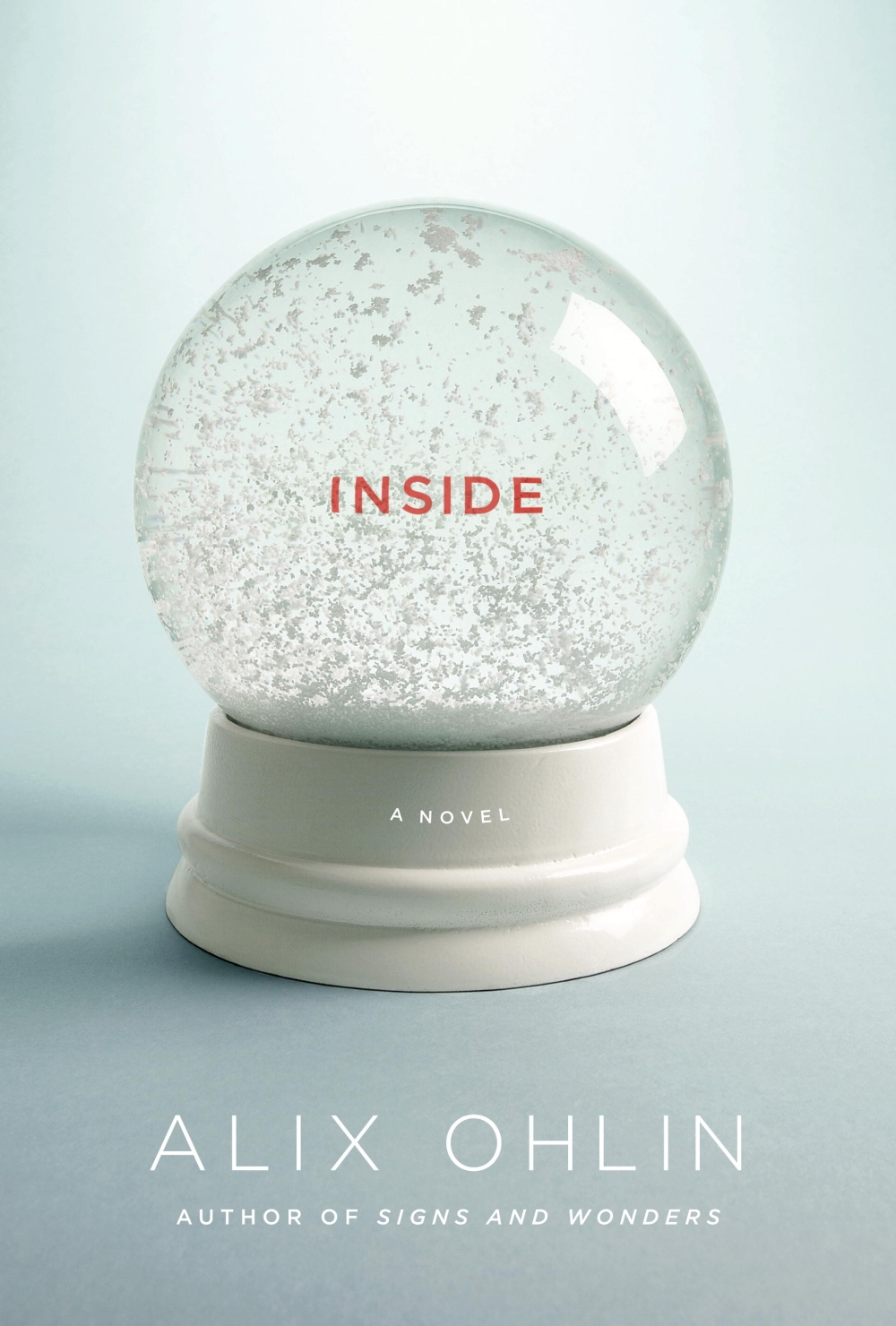
Inside by Alix Ohlin

The novel starts on a tragic note.

Grace, a female therapist, finds a man half buried in the snow. Having bungled his suicide, Tug breathes a heavy sigh as Grace rescues him. Later, Grace develops feelings for this charismatic stranger and pursues him.

In the meantime, her troubled patient, Annie, runs away from home and reinvents herself as an actress in New York. The beautiful and self-involved Annie ends up befriending a young, pregnant runaway who takes willingly and gives little in return.

Mitch, Grace’s ex-husband, leaves the stifling comfort of Montreal for Iqualuit, a place where “he felt the gorgeous pleasure of being away. No matter what happened here, for good or bad, it wasn’t home, and there was a luxurious freedom in that.” Unfortunately, more bad than good did happen as Mitch struggled to help an adolescent dealing with a family tragedy.

As the lives of these three people intersect in unexpected ways over the course of ten years, we learn what it means to be a Good Samaritan and the emotional complications that can result.  As these characters search for approval and validation,  they question their choices and  eventually discover why it’s so important to help each other. Often, it felt like I was reading a series of linked short stories in different times and locations. But in spite of the changing POVs and broken-time sequence, the narrative flowed smoothly.

An excellent read and worthy of the Giller long-list nomination.

The Virgin Cure

Mixed feelings as we discussed The Virgin Cure at last night’s book club.  

While no one really loved the book, many of us liked it enough to consider reading Ami McKay’s highly successful debut novel, The Birth House, and the third in the series, to be released at a later date.

The Virgin Cure was inspired by McKay’s great-great grandmother, Dr. Sadie Fonda Macintosh, who practiced street medicine in the slums. McKay had intended to write the book in her grandmother’s voice, but while writing, she began to hear the words of a very different character, a twelve year old girl named Moth.

Moth’s opening line is a riveting one: “Mama sold me the summer I turned twelve.” Her fortune-telling mother had run out of ways to keep afloat in the slums of 19th century Manhattan. So, she sold Moth for an undisclosed price to a wealthy sadistic woman named Mrs. Wentworth. Brutally beaten and frightened, Moth manages to escape, but when she returns home, she discovers that her mother has mysteriously disappeared.

Homeless and at risk, she finds refuge in a home for higher class prostitutes. There, she finds life as an “almost whore” tolerable. She makes friends with the other young women in the home and meets the remarkable Dr. Sadie who is concerned with the plight of these child sex workers.

When Dr. Sadie enters the picture, point of view alternates between Moth and the doctor. I found these viewpoint changes very abrupt and I would have enjoyed reading more about Dr. Sadie’s story. What drove a wealthy woman to leave her family and spend her time among the poor and disadvantaged? McKay could easily have devoted entire chapters to the doctor and provided us with more insight into her motivation.

Many of us expected to read more about the virgin cure.  McKay describes this particular cure sought by infected men who believed they could be  cured by having sex with a virgin, but it is not the real focus of this book.

McKay’s research skills are impeccable. She has provided more than enough details to create a strong sense of place and further enhanced the narrative with snippets of news and trivia from the time period.

Meeting Your Rhinoceros

Each month, I look forward to reading Martha Beck’s column in Oprah Magazine. The Harvard-educated psychologist uses her extraordinary storytelling ability to help her readers create more satisfying and meaningful life experiences.

In Finding Your Way in a Wild New World, Beck urges us to embrace our wildness and carve out different lives for ourselves as she addresses two basic questions: “How the hell did I get here?” and “What the hell should I do now?”

Having read her previous bestsellers—Finding Your Own North Star, Steering by Starlight, Expecting Adam—I knew enough not to expect another pop cultural self-help book. And I wasn’t disappointed. This book has all the ingredients necessary to create positive change in your life, whether you are new to the spiritual path or a seasoned traveler.

Beck walks the walk and she crosses an ocean to do so. The book is based on her experiences in Londolozi, a game preserve in South Africa. Throughout the book, she talks about her encounters with the animals and the lessons she learned along the way.

Her excellent command of the language is evident in the following descriptions: “The rhino, half hidden behind a thorn bush, cocks her primordial-looking head—which is roughly the size of a grocery cart—and swivels her satellite-dish ears toward us” and “Because cheetah’s tongues are like industrial-grade sandpaper, it’s physically excruciating; with every kiss, the cheetah seems to be removing significant layers of skin.”

She does not hesitate to point out her own personal foibles, reflecting a self deprecating sense of humour. After providing us with the healthy ingredients for a green “gorilla” smoothie, she adds the following instructions: “Throw all this stuff in a blender, where it will form a lovely still life of deeply saturated color. Then push the button and wait until the whole thing looks as if you already ate it, then threw up. Really, it might not be pretty, but your body will love it.”

This book is intended for wayfinders, “people who feel an internal call to heal any authentic part of the world, beginning with their own true nature.” Throughout the book, Beck talks about gathering a team of these people. She demonstrates four simple tools for transformation—wordlessness, oneness, imagination, creation—and includes step-by-step instructions and guided reflections designed to get us out of our mental ruts.

As Martha Beck Beck says, “If you’re a born mender, you’ll pursue this in spite of yourself. And as you find it, you’ll automatically become the change you wish to see in the world, healing the true nature of the people and things around you.”

It’s the kind of book you don’t read in one sitting. Instead, you reflect on each chapter and then at the end, go back and reread it, gaining new insights along the way.

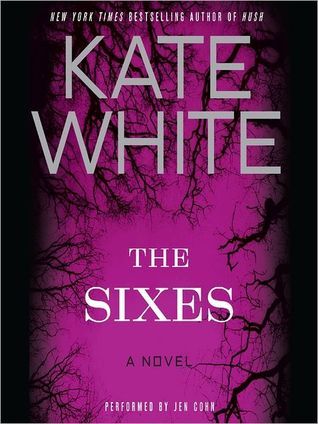
Book Review: The Sixes

While I enjoyed reading Kate White’s best-selling career bible, Why Good Girls Don’t Get Ahead…but Gutsy Girls Do, I was pleasantly surprised to discover that the high-profile editor of Cosmopolitan also has a passion for writing fiction.

The sixth of seven novels, The Sixes is a stand-alone psychological thriller. From the first page onward, I was engrossed in the story and had trouble putting the book down, disrupting my sleep patterns for several nights.

Celebrity writer Phoebe Hall is hiding in small town Pennsylvania. After her long-time boyfriend abruptly ends their relationship and she is accusing of plagiarism, her best friend and college president Glenda Johns offers her a teaching position.

Phoebe was hoping to keep her head down while she planned her next book. Instead, Glenda asks her to investigate the Sixes, a secret society on campus. This crop of mean girls has taken feminism to a dangerous extreme and may even be responsible for several grisly murders on campus.

As Phoebe becomes a target of their hateful pranks, she starts reliving some of the horror from her own boarding school years. At one point, she wonders if any of those tormenters have followed her to Pennsylvania. She also suspects her love interest, a psychology professor who is guarding his own secrets.

So many red herrings, twists and turns in this novel.  I was kept guessing right until the end.

An excellent read!