Inspired by Vicki Delany

Fifteen years ago, Vicki Delany started writing on Sunday afternoons. Living in Oakville, she was working full-time as a computer programmer and raising three daughters on her own. In spite of those challenges, she managed to write three suspense novels that were published to critical acclaim by Poisoned Pen Press of Scottsdale, Arizona.

In 2007, she took advantage of early retirement, sold her house and travelled around North America for an entire year. Afterward, she settled in rural Prince Edward County. Somehow, this prolific writer found the time to write twelve more books during the past five years. Her latest in the Klondike gold Rush Series, A Cold White Sun is forthcoming in 2013 and Gold Web in 2014.

Last evening, she led an informative and entertaining workshop on “Creating Realistic Characters” at  the Waterloo Community Arts Centre.

Some of her tips…

A good mystery novel isn’t really about the crime. It should be chock full of psychology.

Separate yourself from the character. If she resembles you too much, you will find it difficult to make her face conflict.

Always ask…What is the worst thing that can happen to the protagonist?

Make the conflict personal for all your characters.

Sidekicks work well if they’re opposite to the protagonist.

When creating a villain/antagonist, ask…What sort of person believes the solution to their problems lies in killing someone?

The villain must be believable. Avoid falling into melodrama and stereotypes.

A good villain could be a flawed hero.

Don’t provide too many details about secondary characters who appear only once.

Every suspect must have a reason to lie. In order to know why they are lying and what they are lying about, you have to know a lot about their background and personality.

Send your completed manuscripts to publishers in Canada and the United States.
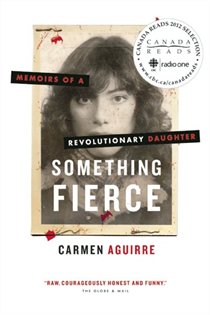
Book Review: Something Fierce by Carmen Aguirre

At last night’s book club, we had a lively discussion about Carmen Aguirre’s memoir, Something Fierce: Memoirs of a Revolutionary Daughter. While most of us were fascinated by the book and welcomed the opportunity to learn more about Chile, we had different opinions regarding the parenting of Carmen and her sister, Ale.

When Carmen was five years old, her family left Chile and began a new life in Vancouver. Six years later, her mother (Mami) decided to return and join the revolutionary movement against Pinochet’s dictatorship. Separated from her husband, Mami decided to take her two daughters with her.

What follows is Carmen’s coming of age story set against the frightening backdrop of Chile in the 1980s. Moving from city to city and country to country across South America, the children were left with a revolving door of babysitters as Mami and her partner, Bob, were on assignment. At one point in the story, Carmen is left alone too long and her money runs out. She hides in the apartment and morphs into an “agoraphobic 15-year-old skeleton with obsessive compulsive disorder.” Interestingly enough, Carmen thought life in the Resistance was normal and decided to become a revolutionary at age eighteen.

While some of the other club members made allowances for Mami, feeling that she authentically cared for her children and wanted them to experience her love and passion for Chile, I tend to agree with Ale’s comment: “Here’s a revolutionary thought: provide for your children and pay attention to them.”

In a CBC interview, Carmen spoke of her love and admiration for Mami. While Carmen would never put her own child through that experience, she did offer insight into her mother’s behavior. Born in an upper middle class home, Mami was not raised in the Resistance movement and had no clue about its effects on young children. Mami took to heart the words of her Resistance oath: “I am committed to giving my life to the cause. I will die for the cause if need be. From now on, my entire life is dedicated to the cause, which takes precedence over everything else.”

To date, very little has been written about the Chilean revolution in English literature. In writing Something Fierce, Carmen Aguirre has filled that void.

An excellent read that will  evoke strong feelings.

Movie Review: Bernie

A crime treat.

I love oxymorons and this one aptly describes the film based on the story of convicted murderer Bernhardt “Bernie” Tiede.  In 1996,  38-year-old Tiede shot 81-year-old Marge Nugent in the back three times as they were preparing to go out for lunch in Carthage, Texas.

Director and screenwriter Richard Linklater effortlessly spins this tale with an A-list cast of actors: Jack Black (Bernie), Shirley MacLaine (Marge Nugent), and Matthew McConaughey (District Attorney).

To add to the authenticity, actual townies speak up at regular intervals, giving us insight into a beloved assistant funeral director who befriended everyone, even the meanest and richest widow in town. Bernie  could do no wrong and the townspeople turned a blind eye to his homosexuality, comparing him to Jesus and the twelve apostles. Didn’t those bachelors spend all their time together?

I was impressed by McConaughey’s performance as the relentless district attorney who ignored public sentiment and prosecuted Bernie.

I agree with one critic—“A pleasant little movie about a pleasant little murderer.”


Oprah and Eckhart Tolle

Yesterday, Oprah invited Eckhart Tolle to catch up, reflect and have a Super Soul Sunday conversation.

Throughout the telecast, Eckhart was in excellent form as he reviewed many of the topics in his books, The Power of Now and The New Earth. His main purpose in writing these books was to cause an awakening. If we don’t awaken, the problems caused by  unawakened minds will increase and multiply.

He provided insightful and, sometimes humorous, answers to questions from Oprah and the viewers.

Q. How do you accept an unpleasant situation, if change is not possible?

A. You must accept a situation, even if change is not possible. The basis for effective enlightenment is to come in alignment with the present situation. When you accept the “isness” of life, greater intelligence arises. If you are angry and resist the unpleasant situation,  you will remain stuck in it.

Q. How do you calm the voice in your head?

A. This question implies you know that your mind can’t stop. This is a good first step. Take the energy away from these thoughts, by asking yourself if you can feel the energy in your hands. Wait and you will feel it. Then move to your legs and other body parts. The inner body serves as a wonderful anchor for a sense of presence. This allows you to be distracted from your other thoughts.

Q. How does one clear the mind of bad memories?

A. Recognize that these memories are thoughts only in your head. They are not realities because they have already happened.

Q. How do you have fun?

A. I enjoy the present moment wherever I am and that’s fun for me.

Q. Are you happy?

A. I am in a state of peaceful aliveness.

Q. What do you believe in?

A. I believe in nothing in particular. LOL

Q. What are you grateful for?

A. I am grateful for always this moment…the now, no matter what form it takes.

Quotable Quotes…

You are not your thoughts. You are the awareness of thoughts disguised as a person.

Only spirit can recognize spirit.
If you identify with every thought in your head, you are not ready to hear the message.

Guilt is a strong way for the ego to strengthen itself.

You don’t have to believe every thought that comes into your head.

The answer doesn’t always come in words. It often reveals itself as awareness.

Stillness is the language that God speaks. Everything else is a bad translation.

The Joy of Yawning

According to the authors of the book, How God Changes Your Brain, yawning is one of the best-kept secrets in neuroscience.  Dr. Andrew Newberg and therapist, Mark Robert Waldman believe that yawning should be integrated into all exercise and stress reduction programs.

Brain-scan studies have shown that yawning activates the precuneus, a tiny structure in the folds of the parietal lobe. The precuneus plays a central role in consciousness, self-reflection, and memory retrieval. This is one of the hardest hit areas by Alzheimer’s and other age-related diseases. Yawning also helps regulate the temperature and metabolism of your brain.

Evidence has shown that yawning helps individuals on military assignment perform their tasks with greater accuracy and ease.  And Olympic athletes yawn before performing.

So, if you want to maintain a healthy brain, yawn…

When you wake up.

When you are confronting a difficult problem at work.

When you prepare to go to sleep.

Whenever you feel anger, anxiety, or stress.

Before giving an important talk.

Before you take a test.

While you meditate or pray.

You may have to fake six or seven yawns before a real one will emerge.

Movie Review: The Vow

Inspired by a true story, The Vow deals with an unusual life challenge.

Soul mates Paige (Rachel McAdams) and Leo (Channing Tatum) meet and fall in love in Chicago. After a short time together, they are involved in a near-fatal car accident. Leo recovers, but Paige remains in a coma. When she wakes up, she doesn’t remember anything about the accident or Leo.

Recalling only her parents and the life she led in their home, Paige gravitates toward those comfortable memories. Anxious to repair the rifts in their relationship (unknown to Paige), her parents (Sam Neill and Jessica Lange) encourage her to leave Leo.

Leo tries to make Paige fall in love with him again, but experiences increasing frustration with the situation. Paige is more comfortable with her old friends, past interests and ex-fiancé.

While at times predictable, the movie still held my interest as Leo doggedly searched for the key that would unlock Paige’s memory.

Light and entertaining!


Oprah and Deepak Chopra

When Deepak Chopra first started meditating, he hoped to get rid of a pack-a-day smoking habit  and relieve stress. He achieved those goals and, in the process, changed the hard-wiring of his brain. While speaking with Oprah at yesterday’s Super Soul Sunday, he admitted to being emotionally free with no resentments, no guilt and no one left  to forgive.

Forty years of daily meditation has transformed his life. And now Deepak Chopra invites all of us to participate in his free 21-Day Meditation Challenge.

Why 21 days?

It takes that long to change the hard-wiring our brains and form a habit. As more neural networks are created, we start to see opportunities where others see problems. This lays the foundation for creating abundance, the main focus of the challenge. And if we continue meditating for 66 days, a groove is created in the brain.

Deepak reiterated the fact that mediation is a part of every spiritual tradition and has nothing to do with ideology or doctrine.  Very simply, meditation is a progressive quieting of the mind that allows the spirit to speak in silence.

Meditation tips from Deepak Chopra…

The best times to meditate are first thing in the morning and late afternoon between 4:00 and 5:00 p.m.

Fifteen to twenty minutes, twice a day, is enough.

Sitting is preferable to lying down.

Observe the breath, but do not manipulate it.

Visualize your dreams before, not during meditation.

Most important of all…BE COMFORTABLE.

Quotable Quotes…

My body is busy, I’m not.

Set the intention and let the universe do the rest.

The best way to get rid of your enemies is to increase their capacity for happiness.

Our genes are coding our karma.

Science is how God thinks.

We limit ourselves by defining ourselves.

I want to know what God thinks. The rest are details. Albert Einstein.

On the Sunny Side

It is easy to be negative at this time of year. The mornings are dark, the weather is unpredictable, and winter is just around the corner. The excuses are endless and, if we’re not careful, we’ll stop exercising and slip back into bad habits.

In their book, So Stressed, authors Stephanie McClellan and Beth Hamilton suggest countering the following negative thoughts with more positive messages:

I’m too exhausted even to think of moving.
I always have more energy after I exercise.

I’m just so slow.
When I started, I was out of breath very quickly. I may not be a speed demon, but I have really built up my endurance.

My whole body hurts from that last workout.
If I stretch well or take a hot bath, my muscles will be warmed up, and I’ll be feeling no pain once I start moving.

I had to skip three days because I had a virus. It’s impossible for me to stay with it. Something always gets in the way.
Each day is a new day, and I can pick up where I left off.

It’s miserable out, so I think I ‘ll just sleep in this morning.
It’s raining too hard for me to enjoy my walk. I think I’ll try that new yoga DVD.

This was the most stressful day at work in a long time. I think I’ll make myself a drink.
I haven’t been this stressed out in a long time. I bet a good workout will help me burn off this tension.

Movie Review: Argo

For the first time in decades, many of us are learning what really happened during the Iran hostage crisis of 1979. While the six Americans did find asylum in the residence of the Canadian ambassador, Ken Taylor (Victor Garber) did not act alone. C.I.A. staffer Tony Mendez (Ben Affleck) stepped in to implement a risky, out-of-the-box plan to spirit the hostages out of Iran.

Mendez went to Hollywood to ask prosthetics guru John Chambers (John Goodman) to create a fake film using a script that required a Middle Eastern setting. With the help of producer Lester Siegel (Alan Arkin), they produce a script, posters, storyboards and enough buzz to generate international attention for Argo. Posing as an associate producer, Mendez flies to Iran and provides the hostages with fake Canadian identities. He sneaks out the six in plain sight and provides many nail-biting scenes as they scout locations for the fake film.

Affleck delivers Oscar-worthy performances as actor and director in what is probably one of the best movies of 2012.

A must-see movie…you will sit at the edge of your seat throughout the entire movie.