Poetry Collection Review: What Kind of Woman

April is National Poetry Month, a month set aside to celebrate poetry and its vital place in our society. Launched by the Academy of American Poets in 1996, this month-long celebration has attracted millions of readers, students, teachers, librarians, booksellers, and poets.

Each Friday of April, I will share a favorite poetry collection.
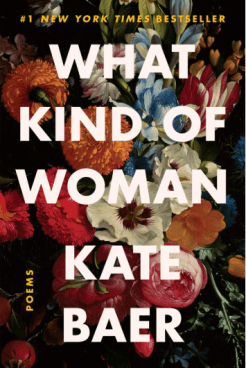
Today’s pick is What Kind of Woman by Kate Baer, “a stunning and honest debut poetry collection about the beauty and hardships in being a mother, a wife, and a woman.”

When this debut collection was published in 2020, it climbed to the top of the New York Times Best Seller List. Divided into three parts (Woman, Wife, Mother), the poems stretch from five lines to a page and a half. While the entire collection could be read in one sitting, its insights and advice will linger long afterward.

I found myself gravitating toward the “advice” poems in each section, often feeling the urge to pause and take notes. I also questioned my own impulse to seek—or give—guidance and realized that while advice is easily dispensed, it is rarely absorbed. Often, that advice reveals more about the speaker than the listener.

In the poem “Robyn Hood,” Ms. Baer begins by asking “Imagine if we took back our diets” and then recommends taking back the time wasted on “grand delusions” and “the curve of our form” and focusing instead on “the power of loose arms and assurance.”

In the “Wife” section, Ms. Baer doesn’t mince words in the poem “For the Advice Cards at Bridal Showers.” She offers this blunt truth: “When someone asks for the secret to a happy marriage, remember you don’t know.”

In the “Mother” section, the advice becomes more pointed. In “For the Advice Cards at Baby Showers,” she writes:

“Baby socks don’t matter, but more importantly—
neither does advice. This is not a performance
for your friend or your mother or the woman
in line who tells you about coats.”

In this slim volume, Ms. Baer gives voice to a wide spectrum of the female experience. Readers may find themselves reflected in these poems—sometimes comforted, sometimes unsettled. Women of all ages will find several (if not many) poems that resonate. As for men, they may gain insights if they choose to read the poems with open hearts and minds.

Here’s one of my favorite poems:

Robyn Hood

Imagine if we took back our diets,
our grand delusions, the time spent
thinking about the curve of our form.
Imagine if we took back every time we
called attention to one or the other: her
body, our body, the bad shape of things.

Imagine the minutes that would stretch
into hours. Day after day, stolen back like
a thief.

Imagine the power of loose arms and
assurance. The years welcomed home
in a soft, cotton dress.
Poetry Collection Review: A Suit or a Suitcase

April is National Poetry Month, a month set aside to celebrate poetry and its vital place in our society. Launched by the Academy of American Poets in 1996, this month-long celebration has attracted millions of readers, students, teachers, librarians, booksellers, and poets.

Each Friday of April, I will share a favorite poetry collection.

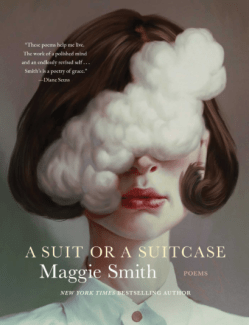
Today’s pick is A Suit or a Suitcase by Maggie Smith, a collection described as “the work of a polished mind and an endlessly revised self…a poetry of grace.”
In a recent interview with Psychology Today, Ms. Smith offered a revealing glimpse into her creative process: “As it turns out, feeling unmoored is the perfect emotional weather for writing poems.” An unsettling observation, but one that seems to have shaped her creative work over the past five years, a period marked by her divorce and the pandemic.

Although she has published several works of prose, among them the memoir, You Could Make This Place Beautiful, and the craft guide, Dear Writer: Pep Talks & Practical Advice for the Creative Life, she calls poetry her “home genre.”

As she wrote the poems in this collection, Ms. Smith reflected on the evolution of her body across the stages of her life: childhood, young adulthood, new motherhood, and middle age. She moves easily between her inner and outer worlds as she contemplates the roles of music, nature, art, and relationships.

A series of intriguing questions emerges:

“How do I get back inside myself?

“What can I carry forward except these reminders?”

“Why not believe the shadow feels affection for the flesh?”

“Why can’t I remember some of the most harrowing moments?”

Ms. Smith has succeeded in making her keen observations and life experiences universal while allowing the poems to resonate quietly rather than demanding attention.

Here’s one of my favorite poems:

The Score

Sometimes I feel like I’m writing the score
for a film that doesn’t yet exist,

but everything that will happen
in the film will happen to me.

Is this what they call plot? This daily
picking up of the same things—

glasses, coffee cup, pen, book, keys—
and setting them back down again?

Narrative has always troubled me,
so I’ll leave that to someone else

and write the mood instead, also
approximating setting: a little piano

to suggest rain, and violin for a river,
long and thin. That key change?

A meander. If the score is plain
and sweet, it’s because the life is—

mostly. I don’t know how it ends,
but given the budget, it will end quietly.

One day I’ll find myself near a river,
and I’ll realize, This is that film,

the one I scored, and this is the scene where
rain starts falling
. And in that moment

it will, and it will sound like piano.

Poetry Collection Review: If Adam Picked the Apple

April is National Poetry Month, a month set aside to celebrate poetry and its vital place in our society. Launched by the Academy of American Poets in 1996, this month-long celebration has attracted millions of readers, students, teachers, librarians, booksellers, and poets.

Each Friday of April, I will share a favorite poetry collection.

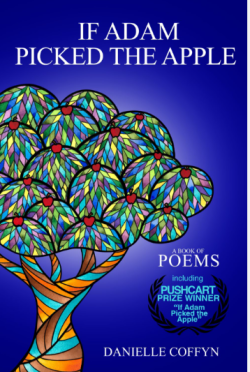
Today’s pick is If Adam Picked the Apple by Danielle Coffyn, a collection described as “a celebration of resilience.”
I was first drawn to its beautiful cover with its warm, cheerful color palette and a playful, whimsical tone that mirrors the thought-provoking “what-if?” at the heart of the title. From the start, I sensed this would not be a passive reading experience.

Reading the poems confirmed that instinct. This is a collection that lingers and invites reflection, sometimes demands it. I found myself rereading the poems, not because I didn’t understand them the first time, but because each revisit revealed something new. An overlooked phrase, a sharper edge, an inconvenient truth.

What struck me was how a single line or verse could stop me, sometimes with a chuckle, sometimes with a pause, and sometimes with an ache. Each poem seems to hold at least one line that insists on being remembered:

“I no longer wish to masquerade as mozzarella—
revered for her mild scent, her pristine complexion.
I want to mature like a wheel of camembert.” (I Don’t Want to Age Gracefully)

“No boy is worth watering down your intelligence.
Read. Write. Fire up your tongue.” (Reclamation for My Twelve-Year-Old-Self)

“They are surrounded by us,
millions of shark women
camouflaged as goldfish.” (Sharks)

“We were promising as children, gifted girls
with potential
. Our options were boundless,
within reason.” (For the Unconventional Woman)

“They forgot we are protective balm,
fierce, dandelion women;
rooted, resilient,
destined to bloom.” (Lion’s Teeth)

Released in 2025, this timely collection encourages women to embrace their uniqueness and embark on journeys of self-discovery and empowerment.

Here’s one of my favorite poems:

If Adam Picked the Apple

There would be a parade,
a celebration,
a holiday to commemorate
the day he sought enlightenment.
We would not speak of
temptation by the devil, rather,
we would laud Adam’s curiosity,
his desire for adventure
and knowing.
We would feast
on apple-inspired fare;
tortes, chutneys, pancakes, pies.
There would be plays and songs
reenacting his courage.

But it was Eve who grew bored,
weary of her captivity in Eden.
And a woman’s desire
for freedom is rarely a cause
for celebration.

Poetry Collection Review: To the Women

April is National Poetry Month, a month set aside to celebrate poetry and its vital place in our society. Launched by the Academy of American Poets in 1996, this month-long celebration has attracted millions of readers, students, teachers, librarians, booksellers, and poets.

Each Friday of April, I will share a favorite poetry collection.

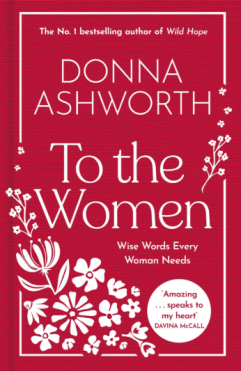
Today’s selection, To the Women: Wise Words Every Woman Needs, has been described as “a celebration of the beauty, strength, and joy of being a woman.”
When Donna Ashworth self-published the original version of this book in 2020, she could not have anticipated how profoundly it would reshape her life. At the time, she was adrift, unsure of what she was doing, where she was going, and what she wanted. Motherhood had slowed her down and allowed her to readjust her perspective. The “rat race” had lost its promise. She was tired of running too fast all the time and never keeping up.

To her astonishment, the book resonated with women in the United Kingdom and far beyond. What followed was not just success, but a whirlwind of connection, far greater than she had hoped. The 2025 edition has been revised and updated with over seventy new poems.

I set aside an entire day to read and sit with this collection, savoring the wisdom, comfort, and inspiration of beautifully written poems such as “Be That Woman,” “Age Gracefully, “There Will Be Days,” “Remember Her,” and “To the Woman Who Thinks She Isn’t Good Enough.” Underlying each poem is the importance of listening to our innermost voices, reconsidering long-held beliefs, and embracing the call to reinvent ourselves.

An ideal gift for any season or occasion, this collection will delight and resonate deeply with the poetry readers in your circle.

Here’s one of my favorite poems:

Age Gracefully

Age gracefully, they say
but I fear that what they mean
is age quietly, slip aside
be wise but stay unseen

age gracefully, they say
but I think, they’re afraid
that we may all wear purple
and wrap silver hair in braids

age gracefully, they say
don’t succumb to the knife
but don’t let standards drop
don’t wear your clothes too tight

age gracefully, they say
but don’t be looking old
likewise, not too young
take your place, fit the mold

age gracefully, they say
but grace means, being at ease
flowing with the winds of change
so, doing as we please

age gracefully, age tastefully
age like a fine red wine
just age with your acceptance
and you’ll never fear the lines

age gracefully, my friends
whatever path you tread
walk it with your own permission
it’s your home, so make your bed.

Poetry Collection Review: How to Fly (In Ten Thousand Easy Lessons)

April is National Poetry Month, a month set aside to celebrate poetry and its vital place in our society. Launched by the Academy of American Poets in 1996, this month-long celebration has attracted millions of readers, students, teachers, librarians, booksellers, and poets.

Each Friday of April, I will share a favorite poetry collection.

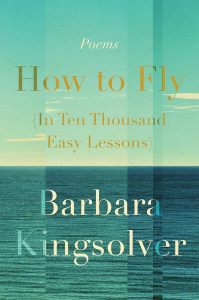
Today’s pick is How to Fly (In Ten Thousand Easy Lessons) by Barbara Kingsolver, a collection described as “reflections on the practical, the spiritual, and the wild.”

Having enjoyed reading Kingsolver’s novels, I was delighted to discover that she also writes poetry. In this collection, she explores everyday life with warmth and insight.
The book opens with a series of “how to” poems that range from the intimate—marriage and divorce—to the unexpected, like shearing a sheep or doing nothing at all. Her poem “How to Survive This” was featured in The New York Times during the pandemic.

The second set, “Pellegrinaggio,” follows a family trip to Italy with her mother-in-law. I could easily visualize the following scene in “On the Train to Sicily:”

“In a family compartment we take the long
road south, down the coast and across the channel
to the patria of her father. She is so tired.
We’ve lifted her onto the sill of this urbane clatter,
tucked ourselves in a cupboard of relative
peace, but now her small frame finds no resting
place on the great square seats. We offer
pillows, sips of water. She only says, Don’t worry.

Next come four sets of poems about making peace (or not) with our families and friends, aging, grief, and mortality. The final set celebrates the natural world–ruthless ants, clever shellfish, coral reefs, haunting deserts, and ghost-flowers. While reading this set, I was reminded of Mary Oliver’s poems.

I recommend taking your time to read and reflect on each poem. Seven sets in seven days—one possibility. Or simply devour them in one or two gulps and then return to the ones that resonate most with you.

One of my favorites:

How to Do Absolutely Nothing

Rent a house near the beach, or a cabin
but: Do not take your walking shoes.
Don’t take any clothes you’d wear
anyplace anyone would see you.
Don’t take your rechargeables.
Take Scrabble if you have to,
but not a dictionary and no
pencils for keeping score.
Don’t take a cookbook
or anything to cook.
A fishing pole, ok
but not the line,
hook, sinker,
leave it all.
Find out
what’s
left.

It’s National Optimism Month!

March is National Optimism Month—a time to embrace the power of positive thinking and its impact on our lives. Established in 2016, this initiative is backed by research in positive psychology, which highlights the benefits of adopting an optimistic mindset. Studies show that optimism can lead to improved health, increased life satisfaction, and greater resilience in the face of adversity.

Simple Strategies

1. Post uplifting quotes, stories, or personal reflections on social media. A little positivity can go a long way in brightening someone’s day.

2. Decorate your home or workplace with vibrant posters featuring inspiring messages. Daily visual reminders can boost motivation and uplift your mood.

3. Join a local charity or volunteer at an animal shelter, soup kitchen, or community garden. Acts of kindness not only help others but also bring a deep sense of joy and purpose.

4. Curate a collection of songs that energize and uplift you. Share it with friends and family, and take time to dance, sing along, or simply enjoy the feel-good vibes.

5. Jot down three things for which you are grateful. This simple daily habit can rewire your brain to focus on the good, fostering a more optimistic outlook on life.

Favorite Quotes

“I’m an incurable optimist, and I’m a great believer in never looking back. Life is too short, and new challenges are exciting.” Cherie Blair

“The difference between an optimist and a pessimist? An optimist laughs to forget, but a pessimist forgets to laugh.” Tom Bodett

“Optimism is essential to achievement and it is also the foundation of courage and true progress.” Nicholas M. Butler

“A pessimist sees the difficulty in every opportunity; an optimist sees the opportunity in every difficulty.” Winston Churchill

“I am an optimist. I choose to be. There is a lot of darkness in our well, there is a lot of pain. You can choose to see that, or you can choose to see the joy. If you try to respond positively to the world, you will spend your time better.”
Tom Hiddleston

“Optimism is the faith that leads to achievement. Nothing can be done without hope and confidence.” Helen Keller

“Optimism doesn’t mean that you are blind to the reality of the situation. It means that you remain motivated to seek a solution to whatever problems arise.”
Dalai Lama

“Go out of your way to talk optimistically about everything.”
Norman Vincent Peale

“I am confident that, in the end, common sense and justice will prevail. I’m an optimist, brought up on the belief that if you wait to the end of the story, you get to see the good people live happily ever after.” Cat Stevens

“I have become my own version of an optimist. If I can’t make it through one door, I’ll go through another door – or I’ll make a door. Something terrific will come no matter how dark the present.” Rabindranath Tagore

Any other strategies or favorite quotes to share?