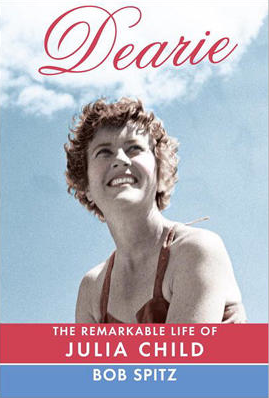
Dearie: The Remarkable Life of Julia Child

When Bob Spitz was asked to escort an older woman in Sicily, he replied, “I don’t do that kind of work.” But he changed his mind when he heard the woman was Julia Child, admitting that he had a huge crush on the six-foot three-inch cooking icon.

During that month in Sicily, Julia poured out her entire life to Spitz, and he was smart enough to run a tape recorder. He took a nine-year detour to write The Beatles and then spent four years writing and researching Dearie: The Remarkable Life of Julia Child. The result is a beautifully crafted book which was released earlier this month. An excellent way to mark the centenary of Julia Child’s birth.

While there have been many other books and movies about Julia Child, Spitz has managed to breathe new life into her story, providing us with fresh information and insights into her remarkable character.

After graduating from Smith College, Julia was a lost soul. Her marks were less than stellar and she did not demonstrate any special talents. Her adviser commented, “She would do well in some organized charity or social service work…In any case, Julia’s family is wealthy. She will not need a job I do not believe.”

In her diary, Julia wrote, “I felt I had particular and unique gifts that I was meant for something, and was like no else.” She had to weather many misadventures before those gifts started to materialize and did not hit upon her true calling until the age of forty.

In other books and the movie Julie and Julia, great emphasis is placed on her marriage to soul mate, Paul Child. I was surprised to learn that it was not love at first sight, but a gradual deepening of affection. In an early letter, Paul wrote, “I believe she would marry me, but isn’t the right woman from my standpoint.” He questioned “the lack of worldly knowledge, the sloppy thinking, the wild emotionalism, the conventional framework.” They also appeared to be physically mismatched. Nevertheless, they married and enjoyed a decades-long love.

While in Paris, she learned French, attended the Cordon Bleu and spent hours honing her cooking techniques.  What was even more remarkable is the fact that she didn’t learn how to cook until age forty. She was all thumbs in the kitchen and had to be walked through the most basic tasks. One nephew commented, “The joke was she could burn water if she boiled it.”

It took six years for Julia and her collaborators to write Mastering the Art of French Cooking. As Julia and Paul moved through Europe, she continued testing and retesting each recipe until perfection was achieved. When Mastering the Art of French Cooking hit the stores, it was a phenomenal success. It also helped launch Julia’s career in public television at age fifty.

Julia remained independent all her life, actively living and cooking until her death at age 92.

Definitely a page turner–all 500+ pages!

Book Review: Spilled Blood

It is every parent’s worst nightmare—A son or daughter accused of murder.

In Spilled Blood, award-winning author Brian Freeman skillfully weaves several plot lines around this disturbing premise, and in the process, creates a heart-pounding psychological thriller.

When lawyer Chris Hawk arrives in the small Minnesota town of St. Croix, he is ready to defend his teenage daughter, Olivia, who has been accused of murdering Ashylnn, the beautiful daughter of wealthy Florian Steele. While he believes in her innocence, others—including his estranged wife—have their doubts.

In the prologue, Freeman introduces myriad reasons for this gruesome crime. As Olivia plays Russian Roulette with Ashlynn’s life, we are privy to the victim’s thoughts: “All of the hurt, loss, jealousy, bitterness, humiliation, frustration, and anger of the past three years had converged on this moment. It was Kimberly dying. It was the lawsuit failing. It was tit-for-tat violence that had erupted between the two towns over the past year. Olivia had found someone to take the fall for everything she’d suffered.”

While investigating, Chris uncovers many secrets that lie within the two rural towns linked by the Spirit River. Chilling threats from a psychopath known only as Aquarius. A pornography ring. A cancer cluster. An unwanted pregnancy and the resulting abortion. The author leaves a trail of clues leading to an unexpected but logical climax.

Freeman likes to put ordinary people in situations that force them to cross lines. While reading, I wondered just how far the minister would go to protect his son. Would the brother of a notorious thug say or do anything to protect the girl he secretly desired? Why would a rich man’s daughter drive alone through a ghost town?

The pacing is superb. Brian Freeman ends each chapter with a twist or cliff hanger, compelling many of us to read well beyond the midnight hour.

An excellent read!

Book Review: The Lifeboat

Grace Winter is an unlikely protagonist for Charlotte Rogan’s debut novel, The Lifeboat.

In the opening scene, she is standing with her mouth open in the middle of a downpour. When reprimanded by her lawyers, she admits to being “thirsty for rain and salt water, for the whole boundless ocean of it.” Afterward, she is unable to restrain her laughter and is asked to eat her meal in the cloakroom of a restaurant. While contemplating the pros and cons of an insanity defense, one of the lawyers gives her a diary and asks her to recreate the twenty-one days she spent in a crowded lifeboat during the summer of 1914.

In a dispassionate voice, Grace tells her story.

Happy to be sailing on the Empress Alexandra with her new husband Henry, Grace looked forward to starting their new life together in New York. When the ocean liner suffered a mysterious explosion, Henry secured a place for Grace in a lifeboat, which is over capacity. Throughout the book, different characters comment on Grace’s life of privilege and the unusual circumstances that led to her inclusion on that crowded lifeboat.

Grace, however, had humble beginnings, enduring the trauma of her father’s suicide and her mother’s subsequent breakdown. She lured wealthy banker Henry Winter away from his long-term fiancée, admitting that she felt no guilt in freeing “him from both tradition and from emotional restraint” and, in the process, securing her own future.

As the castaways battle the elements and each other, it becomes evident that some must be sacrificed for the majority to survive. A brewing power struggle between a ruthless, experienced sailor and a persuasive matron further complicates the situation. Throughout the ordeal, Grace remains passive and is easily manipulated by the stronger characters.

Once I started reading, I couldn’t put the novel down. In spite of my ambivalence toward Grace, I was fascinated by the other personalities and how they reacted when pushed beyond their limits of endurance. To be truthful, I did not find any of the characters likeable. I tend to agree with Grace’s description: “We were stripped of all decency. I couldn’t see there was anything good or noble left once food and shelter were taken away.

Rogan found the germ of this story while reading one of her husband’s old legal texts. She was particularly intrigued by the account of two drowning sailors who came upon a plank that could only support one person. After considering the question—Is it murder for one of them to push the other off—Charlotte Rogan started writing The Lifeboat.

Book Review: The Hypnotist’s Love Story

Hypnotherapist Ellen O’Farrell is enjoying her fourth date with Patrick Scott, a self-employed suburban surveyor. When he says, “There’s something I need to tell you,” Ellen immediately tenses and expects the worst. To her surprise, she learns that Patrick has a female stalker, Saskia. More intrigued than frightened, Ellen could barely “keep the undercurrent of joy out of her voice” as she commiserated with Patrick. Ellen wants to get into the woman’s mind and discover what motivates her behaviour. What Ellen doesn’t know is that she has already met her. Saskia has been masquerading as one of Ellen’s clients.

While I still shudder at any mention of that infamous movie, Fatal Attraction, I did not feel the same level of fear as I read The Hypnotist’s Love Story. In Saskia, Moriarty has succeeded in creating a compelling character who tugs at our heart strings. I was surprised to find myself sympathizing with the stalker and hoping that she would turn her life around.  Moriarty also adds grey nuances to Ellen’s character.  The moral and compassionate practitioner is often tempted to act unethically and use hypnosis to uncover Patrick’s true feelings.

I felt ambivalent toward Patrick and wondered why he wasn’t taking out a restraining order. Did he feel guilty about cutting Saskia off only a month after her mother’s death? And why do Patrick’s mother and son rush to Saskia’s defense whenever Patrick criticizes her?

I enjoyed the larger cast of characters which includes Ellen’s feisty mother, Ann, and the two godmothers who raised her in what Ellen describes as “a lesbian commune, except they were all straight.”

A delightful summer read.

Book Review: Calling Invisible Women

I assumed the invisibility would be theoretical and was surprised to discover that Clover Hobart, the protagonist of the novel, is actually invisible. She wakes up one morning, looks in the mirror and cannot see her image. To her chagrin, her husband and two children do not notice. For an entire month, she continues to live with them, cooking dinners, cleaning the house and attending to their needs while they ignore the obvious. No one looks too closely—not even her personal physician. When Clover complains about her invisibility, he comments, “You wouldn’t believe how often I hear that.”

She finds support in her friend and neighbor, Gilda, who advises her not to take her family’s self-absorption too personally. Her yogini mother-in-law offers practical advice, “Don’t sit around hoping that someone’s going to notice that you’re missing. Invisibility can be an impediment or a power depending on what you decide to do with it.”

After Clover joins a weekly support group for invisible women, she learns that the condition was caused by a lethal combination of three drugs: hormone replacement, calcium supplement and antidepressant. Clover stops taking the drugs and, after discovering that she has an invisible thermostat, she stops wearing clothes.  Clover and her new friends participate  in a series of escapades that add to the humor in this light-hearted novel.

About the author…

Shortly after celebrating her 60th birthday,  Jeanne Ray noticed that the magazine covers of popular magazines featured beauty and sex tips primarily for women aged twenty to fifty. The retired nurse decided to launch a second act as a writer, using  50 and 60something women as protagonists. Her first novel, Julie and Romeo, featured a love story between two sexagenarians. Calling Invisible Women is her fifth novel.

Oprah and Cheryl Strayed

After reading Cheryl Strayed’s powerful memoir, Wild, Oprah was so inspired that she decided to reinvent her book club. As part of Super Soul Sunday, Oprah invited the author to her house in Santa Barbara where they sat beneath the redwoods in her front yard. For almost ninety minutes, the two women discussed the novel and Cheryl’s need to spend three months traveling the 1100 mile Pacific Crest Trail by herself.

The Backstory

At age 22, Cheryl’s life took a downward turn. After her 45-year-old mother died of cancer, Cheryl’s wild love turned into wild sorrow and then she went wild into her life. Hungry for affirmation, she sought the company of other men and did heroin.

Three years later, Cheryl’s car broke down on a snowy night. She went into a camping store to buy a shovel to literally dig herself out. While waiting to pay, she glanced at a guidebook about the Pacific Crest Trail. The next day, she returned to buy the book. Six months later, she started her hike from the Mojave Desert to Oregon.

The Challenges

While Cheryl was not a stranger to the wilderness, she had no experience as a long distance hiker. Throughout the interview, Oprah commented that she would have given up at many points along the trail.

Cheryl’s backpack was more than half her weight and she could barely stand up on the first day of the trek.

Her boots were too small and a constant source of pain. She lost six toenails. At one point, Cheryl threw away the boots, wrapped her feet in duct tape and continued.

Cheryl ran out of water several times.

One evening, Cheryl spent the night under the stars. In the morning, she woke up and felt cool, wet hands on her body. She was entirely covered in black frogs.

While she wasn’t afraid of the animals, she experienced fear when encountering several male hunters who made suggestive comments.

She had only twenty cents left at the end of the hike.

The Lessons

God is not a grantor of wishes.

I needed to carry the weight I couldn’t bear.

The universe will take whatever it takes and not give anything back.

I found solace in trail magic–unexpected sweet happenings that stand out in relation to the challenges of the trail (e.g. sunsets).

Big things happened because I was not going to let fear hold me back.

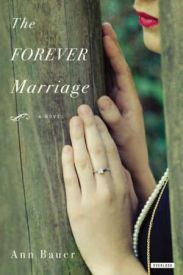
Book Review: The Forever Marriage

The story begins on an unsettling note.
A narcissistic woman has waited over twenty years for her husband to die so she could start living her life. As she sits at his death bed, she daydreams about her librarian lover and all the wonderful things she will be doing once her husband is gone.

In The Forever Marriage, Ann Bauer introduces an unlikely protagonist, one some readers may find unsympathetic. This sentiment was also shared by the many publishing houses—large, mid-size, tiny prairie—that rejected the original manuscript. On her blog, Bauer admits that she lost count of all the rejections that flooded in.

I liked this book and welcomed the honest portrayal of a flawed middle-aged woman reflecting on her past choices and present circumstances.

During her teen years, beautiful and spoiled Carmen came up with her own secret for success: “Don’t do anything half-assed and forget what other people think.” After her mother died and her father lost his job, this formula stopped working for her. Practically destitute and lacking any true direction, she allowed herself to be pursued by wealthy Jobe Garrett, a grown-up version of “those knobby math club boys with strange faces and bodies like wire hangers who seemed to exist only at school.” She accepted his parents’ financial and emotional support, forging a close relationship with Olive Barrett who enthusiastically welcomed and accepted her awkward son’s choice of mate. Later, Carmen admitted that she decided to have children mainly to please her kind and generous mother-in-law.

After Jobe’s death, Carmen is free to continue her affair and live comfortably on the proceeds of the life insurance policy. But her freedom is compromised once she is diagnosed with breast cancer. As Carmen faces her mortality, she re-examines her relationships with her family and friends. Her journey to self-discovery is not an easy one, and there are many uncomfortable moments as she wrestles with her regrets and considers her options for an uncertain future.

An excellent read.

Book Review: The Alzheimer’s Prevention Program

In The Alzheimer’s Prevention Program, Dr. Gary Small and his wife, Gigi Vorgan, lay out a plan to prevent, delay and diminish the symptoms of Alzheimer’s disease for those of us at risk, which is almost everyone if we live long enough.

Small and Vorgan start by offering several do-it-yourself assessment tools that help us establish our own baseline assessments. This is an important step in the process and not to be overlooked. The authors are convinced that “once people know their baseline, they often see the correlation between their brain health and their daily behaviours, and that motivates them to adjust their lifestyle.”

After establishing our baselines, we can build on our strengths and address our weaknesses. Many of the strategies suggested by Small and Vorgan can be easily incorporated into our daily lives. It is reassuring to read that it is not necessary to spend hours on difficult puzzles or activities that serve only to increase our stress levels. The authors stress that “an effective Alzheimer’s prevention program not only has to help improve memory and mental acuity quickly, but it also has to be fun and easy to use.” We should be training not straining the brain

I enjoyed the mental workouts and appreciated the gentle humour in the authors’ instructions. My favourite is their memory training regimen, Look, Snap, Connect. Start by focusing your attention on what you want to recall later. Next, form a mental snapshot of the information. Create visual associations to connect your mental snapshots for later recall.

Using unrelated words such as skateboard, grandmother, dishes, elf, and football field, Small and Vorgen encourage us to create an outrageous and memorable story and then try to remember the words ten minutes later. Their example: My grandmother made me pancakes before she skateboarded past the football field, where she saw an elf juggling some dishes. Try it. It works!

Of all the lifestyle habits they suggest, Small and Vorgan have noticed that people seem most resistant to changing their diet. And that is the area where we will achieve the most compelling benefits. Without treatment and lifestyle modifications, high levels of sugar or glucose in the blood could increase the risk of Alzheimer’s and other age-related diseases.

After reading self-help books, many of us nod in agreement and plan to make changes later. In this book, Dr. Small and Gigi Vorgan provide a seven-day jump-start program that tells us when, what and how to eat, exercise, stimulate our brains, and practice stress reduction so that each of these elements can easily become part of our daily routines.

No excuses…start now!

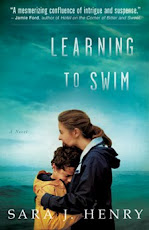
Book Review: Learning to Swim

I was hooked after reading the first two paragraphs of this debut novel which has been described as a “thrilling thriller with a whiff of Rebecca.”

If I’d blinked, I would have missed it.

But I didn’t and I saw something fall from the rear deck of the opposite ferry. It could have been a bundle of trash; it could have been a child-sized doll. Either was more likely than what I thought I saw: a small wide-eyed human face, in one tiny frozen moment as it plummeted toward the water.

So many questions whirled through my mind as I read that well-crafted opening. Would I jump in, call for help or dismiss what I had seen?

The novel begins with freelance writer Troy Chance diving into the icy waters of Lake Champlain to save a boy tossed from a ferry traveling in the opposite direction. Instead of going directly to the police, Troy takes him home with her and sets in motion a chain of events that turn her quiet, predictable life upside down.

First, she must learn to communicate with Paul, the quiet, French-speaking boy whose silence speaks louder than his words. She applies her journalistic skills to finding and locating his father, Philippe, in Ottawa.  But she doesn’t stop there. She becomes obsessed with the mystery of who tossed the boy from the ferry and continues the investigation on her own.

Henry uses the first person point of view to give us an intimate look into Troy’s mind as she travels between the two countries in this well-crafted tale of kidnapping, murder, wealth, deception, and romance.

A former freelance journalist and sports editor, Sara J. Henry has written a compelling novel which has garnered her praise and acclaim from the publishing world. She is the winner of the 2012 Agatha Award for best first novel and the Mary Higgins Clark Award. She has also been nominated for the Barry and Anthony Awards for best first novel.

The sequel, A Cold and Lonely Place, will be released in November of this year. In the meantime, pick up Learning to Swim and set aside large blocks of reading time. You won’t be able to put the book down.

Book Review: The Shoemaker’s Wife

This is the novel that Adriana Trigiani was born to write.

Growing up, she enjoyed listening to her grandparents’ love story and would often jot down notes. In a recent interview, Trigiani commented on the many scraps of paper and dinner napkins she had filled with information about this “dance with fate” between Lucia (the seamstress) and Carlo (the shoemaker).

In writing The Shoemaker’s Wife, Trigiani wanted her readers to have the same experience she had when the stories were told to her by the woman who lived them.

Ciro Lazzari meets Enza Ravenelli while he is digging the grave for her youngest sister. There is an initial attraction between the teenagers, but fate intervenes when Ciro is forced to leave the Alps and immigrate to New York. Later, Enza’s family faces financial disaster and she travels with her father to New York to secure their future.

In New York, Ciro apprentices under a master shoemaker on Mulberry Street and Enza takes a factory job in Hoboken. Fate intervenes again and reunites them, but their reunion is short-lived. Ciro has volunteered to serve in World War I and Enza begins an impressive career as seamstress at the Metropolitan Opera House. While working there, Enza meets Enrico Caruso and becomes part of the Manhattan social scene. When Ciro returns, they reconnect and leave New York to create a new life in northern Minnesota. Success and heart-breaking tragedy follow.

Adriana Trigiani’s research skills are impeccable. In addition to her notes, she referred to her grandmother’s journals and travelled as far as the Italian Alps to capture the historical aspects of the story. With the help of interns, she obtained a vast amount of artifacts, among them copies of ship manifests, train tickets and silk tags from garments created by her grandmother.

Spanning three decades, from the 1910s to the end of World War II, this multi-generational epic story will resonate with anyone who enjoys historical fiction.

An excellent read!