Book Review: Tell It to the Trees

This is not a feel-good book. 

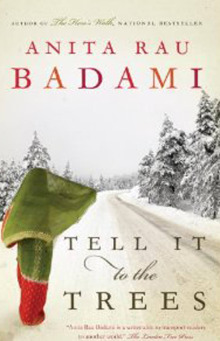
Set outside the fictitious town of Merrit’s Point in northern British Columbia during the 1970s, the story begins with the discovery of a tenant’s frozen body in the backyard of the Dharma family’s isolated home. Montreal-based writer Anita Rau Badami uses four shifting narrators to slowly unveil the sequence of events that led to this tragic death.

We hear from Varsha, the troubled teenage daughter, who was abandoned by her birth mother. Her stepmother, the sweet and gentle Suman, dreams of escaping from Vikram, her abusive husband, while managing the bleak reality of her life with excessive cooking and cleaning. Hemant, the sensitive seven-year old son, is haunted by ghosts and feels burdened by the many secrets floating in the multi-generational Indian home. We also hear from the dead tenant, Anu Krishnan, through her journals.

When Anu Krishnan first arrived at the Dharam home, she enjoyed Suman’s delicious Indian cooking and sat for hours listening to the tales told by Akka, the family matriarch. She welcomed the isolation and felt inspired to write short stories. Soon, however, the perfect facade of the Dharma family unravels and Anu becomes wrapped up in the drama.

The family’s chilling secrets start to come out, despite everyone’s efforts to maintain appearances. While Akka complains about their life in Jehannum (hell), she is fiercely protective of the family and urges the children to hold it in. If the secrets threaten to come out, Varsha and Hemant must tell only the trees.

Another character occupies center stage in this novel: Winter. In a recent interview, Badami admitted to this guilty little secret, “I dread the white nothingness that creeps into my soul and stays there for six long months…It’s not the cold that gets to me as much as the lack of colour. Having grown up in India where colour is overwhelmingly present, my longing of it reaches its zenith during our winters.”

Her dislike of the Canadian winters is apparent in the vivid descriptions throughout the novel. When Suman arrives in Canada, it is late March, “a time when the ground is knee-deep in snow, and your breath hangs like a ghost before your face.” Later, Suman names her son Hemant for winter, the season in which he was born.

Anita Rau Badami skilfully describes the cycle of abuse and how it is passed down through the generations. Many of us have asked the questions: Why doesn’t the woman just leave? Why does she continue to make excuses for the man’s behaviour?

This book provides the answers.

Nuggets from Bishop T.D. Jakes

Oprah said it best. “He isn’t a preacher. He’s a prophet.”

On Monday night, Bishop T. D. Jakes was featured on Oprah’s Life Class. The founder of the 30,000-member Potter’s House Church in Dallas ignited the members of the studio and worldwide audience with his insightful comments. I am looking forward to reading his latest book, Let It Go.

In the meantime, I am  reflecting upon his many nuggets of wisdom.

My Top Five…

5. Don’t allow your situation to become your world when it’s just a launching pad into the next dimension of your life.

4. Don’t ask permission for what you are directed to do.

3. You cannot embrace your destiny if you’re holding on to your history.

2. Don’t let other people put a period where God has put a comma.

1. You need to be around people who make deposits not withdrawals.

What is your favorite nugget?

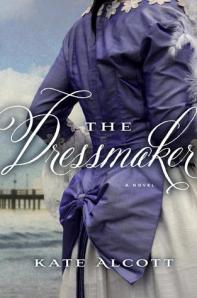
Book Review: The Dressmaker

Why did only one lifeboat make an attempt to save those dying on the water?

This question sparked Kate Alcott’s interest and the result is The Dressmaker, a riveting novel which peers into the lives of those who survived the sinking of the Titanic.

The story is mainly about Tess Collins, a wannabe dressmaker who was forced by circumstances to become a housemaid. Deciding she could no longer tolerate the conditions of her life, she packed her bags and headed for the dock where the Titanic was set to sail for its maiden and only voyage. She talks her way into going on the boat as a maid for the famous dress designer, Lady Lucille Duff Gordon. Four days later, Tess finds herself in a lifeboat with the unsinkable “Molly Brown.”

Thanks to James Cameron, we are all familiar with the Titanic story. But this book provides insight into what happened when less than eight hundred survivors arrived in New York City. Alcott addresses the aftermath of this tragedy by using documentation of real testimony, skillfully recreating the senatorial hearings and the public outcry that followed many of the revelations. I could actually imagine myself in the room as Lady Duff Gordon and the seamen tried to justify ordering a lifeboat to leave with fifty seats empty. And I could empathize with another survivor as she revealed the details of her husband’s suicide.

I was left wondering how I would act in a similar situation. Would I be courageous and try to help those drowning in the water? Would I welcome extra people into my lifeboat, all the while wondering if it would sink? Or would I let someone else make the decision to sail safely away?

Dinner with Writers Ink

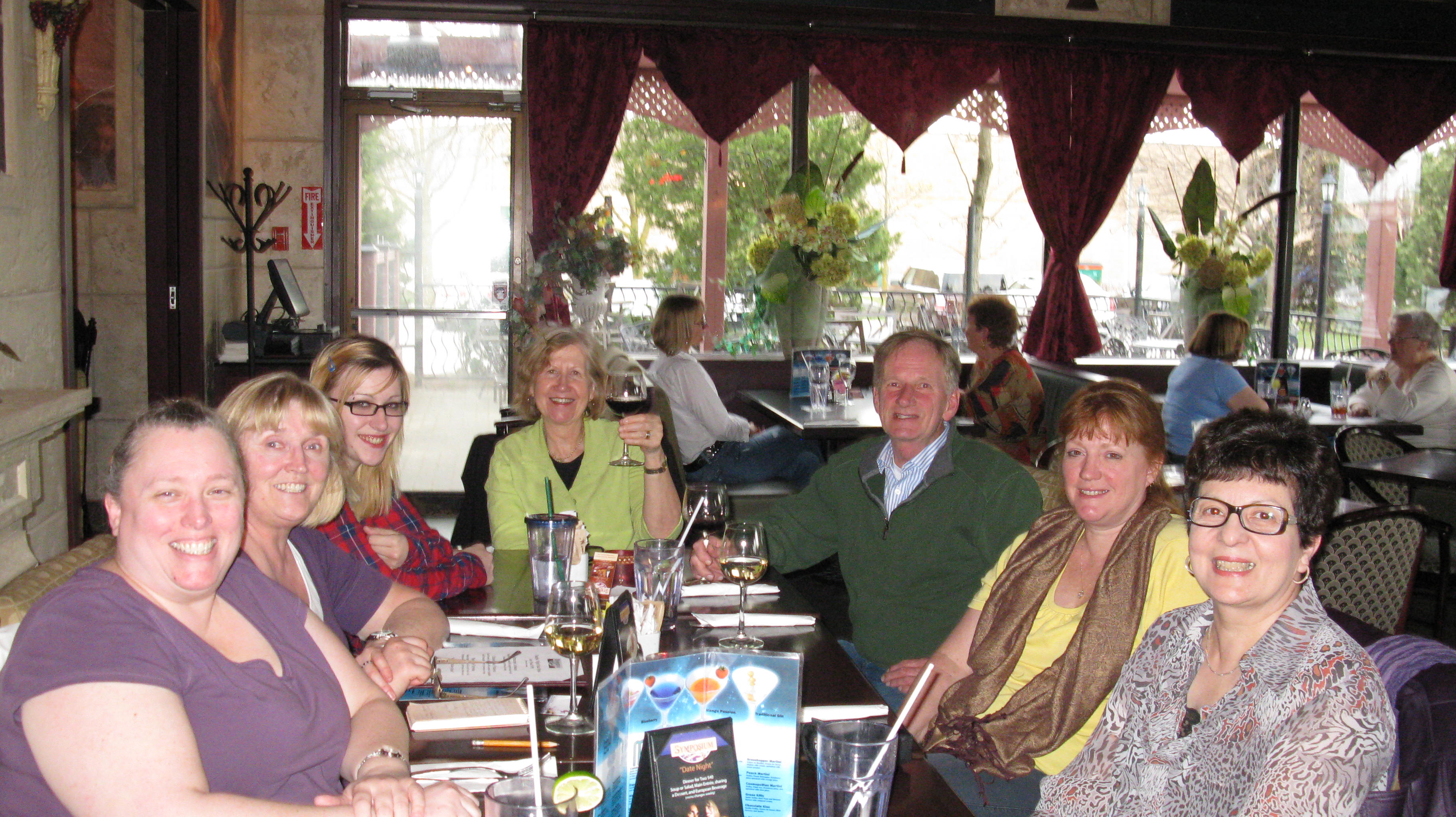
Last evening, seven of us gathered at Symposium Restaurant for our April dinner meeting. We are celebrating the second anniversary of  Guelph Writers Ink.

A bit of history…

After completing Dennis Fitter’s creative writing course, a group of us decided to meet on a monthly basis to discuss our writing journeys. We came up with the following mission statement: We will inspire and encourage each other to write on a regular basis. Last year, Cindy Carroll and several members of Guelph Write Now joined us.

Lots of discussion and advice floated around the table as we discussed epublishing vs traditional publishing, agents, manuscripts and social media. Patricia Anderson, Linda Johnston and I have decided to bite the bullet and start tweeting before the next dinner meeting. No more excuses!!!

Congratulations to Linda Johnston–winner of the door prize.

A reminder…Dennis Fitter’s book, Mexico City, is now available.

Book Club Night

Yesterday evening, eleven of us gathered to discuss Rebecca Skloot’s bestseller, The Immortal Life of Henrietta Lacks. Not my usual fare, but I was intrigued by this biography of a poor black woman whose cells were taken without her knowledge.

In 1951, Henrietta Lacks, a mother of five in Baltimore, was diagnosed with cervical cancer.  Before administering radium for the first time, the attending doctor cut two dime-size samples of tissue, one cancerous and one healthy, from Henrietta’s cervix. The doctor gave the tissue to George Gey, a scientist who was trying to establishing a continuously reproducing, or immortal, human cell line for use in cancer research. While all previous human samples had failed, Henrietta’s cancerous tissue continued to grow and has yielded an estimated 50 million metric tones of HeLa cells (hee-lah is an abbreviation of Henrietta’s name) since that time. Her cells have helped develop the polio vaccine, gene mapping, in vitro fertilization and more.

Skloot, an award winning writer who specializes in narrative science writing, took over a decade to research and write the book. During that time, she became enmeshed in the lives of Henrietta’s descendants, especially her daughter, Deborah, who was devastated to learn about her mother’s cells. Skloot also brought to light the dark history of experimentation on African Americans

We all agreed that the book raises many questions about biothethics. How should research be conducted? Who should benefit from it? Why didn’t John Hopkins offer some kind of compensation to the Lacks’ family? As Deborah so poignantly commented, “If our mother had done so much for medicine, how come her family can’t afford to see no doctors?”

Movie Review: The Hunger Games

I couldn’t believe the hype that surrounded this film. For the past month, I have heard it mentioned on almost every talk show and newscast.

While I don’t usually read or watch dystopic science fiction, I was curious. I wanted to see for myself if it was indeed the movie of 2012.

Yesterday, I joined the millions of other moviegoers who decided to view this film on its opening weekend.

The storyline is a compelling one.

Katniss Everdeen, played by Jennifer Lawrence, is a 16-year-old girl living in Panem, a post-apocalyptic North America. In a brutal annual lottery called the Reaping, two competitors–one boy and one girl between the ages of 12 and 16– are selected from each region to fight in the Hunger Games.  Only one person can survive and his/her district will receive riches and favor from the ruling class. Katniss bravely volunteers to step in for her terrified younger sister, Prim (Willow Shields).  Katniss and her partner, Peeta Mellark (Josh Hutcherson) struggle to hold on to their humanity as they deal with conflicted feelings in this fight-to-the-death competition on live television.

Survivor. Slumdog Millionaire. The Amazing Race. As I watched the film, these programs came to mind. While the film is set in the distant future, there are many unsettling parallels to the present.

Disturbing. Riveting. Memorable. These are some of the adjectives I would use to describe this futuristic tale of adventure. I may actually pick up Suzanne Collins’ second and third books in this trilogy.


It’s a Cozy!

Whenever I tell people the title of my book—A Season for Killing Blondes—they all smile. Even the blondes.

And when I mention that it’s a cozy, they look puzzled and often ask, “What’s a cozy?”

I explain.

A cozy is a mystery which includes a bloodless crime and contains little violence, sex, or coarse language. The sleuth is usually female and not a medical examiner, detective or police officer. She could be a librarian, florist, teacher, homemaker, caterer…Whatever her occupation, the reader becomes emotionally involved and connected to the sleuth and all the other characters in the book.

It’s a “fun read” that engages the reader. By the end of the story, the criminal is punished and order is restored to the community.

Miss Marple and Jessica Fletcher are examples of cozy mystery sleuths.

cozymysteries1

A New Beginning

While I have blogged before, this is my first website. I am grateful to John Agress, my instructor at ed2go, for his well-structured lessons and encouragement throughout the course. I enjoyed creating this hybrid site and experimenting  with WordPress.

In this blog, I intend to write (and rant) about my writing journey, recent books and movies, and the many winding roads of my retirement.

I welcome all your comments, especially those from other writers and retirees.