Movie Review: Les Misérables

Set against the backdrop of post-Revolution nineteenth-century France, Les Misérables is an epic musical featuring a set of A-list actors, among them Hugh Jackman, Anne Hathaway, Russell Crowe and Amanda Seyfried. Nominated for four Golden Globe awards, the musical is definitely a contender for just as many, if not more, Oscars.

The film centers on the life of Jean Valjean (Jackman), a man serving a nineteen-year sentence for stealing a loaf of bread to feed his sister’s child. After Valjean is granted parole, he is taken in by a kind bishop who supports and forgives him despite the former’s theft of valuable church items. As Valjean prospers, he still manages to attract problems and the renewed scrutiny of his former jailer (Crowe). Unable to save the persecuted prostitute Fantine (Hathaway), Valjean resolves to provide for her daughter Cosette, played by Isabelle Allen and later, Amanda Seyfried.

Director Tom Hooper’s decision to have the actors sing live on stage was an excellent one. So many wonderful and memorable numbers…

During the opening scene, the convicts sing “Look down, look down, you’ll always be a slave” while hauling a huge, battered ship into dry-dock under the watchful eye of Javert as he sings “Do not forget me, 24601” to Valjean.

Hathaway’s take on “I Dreamed a Dream” is one of the film’s show-stopping events.

The corrupt innkeepers played by Sacha Baron Cohen and Helena Bonham Carter provide comic relief in their rendition of “Master of the House.”

Later, their daughter Eponine (Samantha Parks) beautifully sings “On My Own” when she discovers that her love interest Marius (Eddie Redmayne) yearns for Cosette.

An excellent holiday film!


Movie Review: The Guilt Trip

A long-time fan of Barbra Streisand, I look forward to all her movies.

In her latest, The Guilt Trip, seventy-year-old Streisand plays a convincing fifty-something Joyce Brewster, the perpetually nagging mother of struggling inventor Andy (Seth Rogen).

After hearing his mother’s confession about a lost love, Andy impulsively invites her to accompany him on his cross-country sales trip. Throughout the trip, Joyce continues to smother and baby Andy as they deal with inclement weather, cheap hotels, a strip club, gambling at a Vegas casino, hitchhikers and a provocative book-on-disc. In between, Andy makes a series of awkward pitches to companies. My favorite scene involved Joyce scarfing down an enormous steak (size of a small poodle according to Andy) at a Texas eatery and attracting the attention of a handsome cowboy.

While I had hoped for more humor, I did enjoy Barbra Streisand’s performance in this short, 96-minute film. She still has that flair for comedic acting and she looks amazing, even in close-up.

Movie Review: Life of Pi

In Life of Pi, based on the Man Booker Prize winning novel by Yann Martel, a teenager and a Bengal tiger spend 227 days on a raft in the middle of the Pacific Ocean.

Like the book, the film is divided into three segments.

In the first segment, we are introduced to the central character, Pi Patel (Suraj Sharma). Growing up in Pondicherry, the French part of India, Pi enjoyed an idyllic life as the child of a zookeeper (Adil Hussain). An inquisitive and adventurous child, Pi dabbled in different faiths—Hinduism, Christianity, Islam—and played with the wild animals in his father’s zoo. Economic issues force the Patel family and their zoo animals to leave India and set sail for Canada. The Japanese freighter encounters rough seas and sinks near the Marinas Trench. The only survivors are Pi and four animals: a zebra, a hyena, an orangutan and a tiger.

During the second segment of the film, we watch as three of the animals are devoured by the tiger and Pi takes refuge in an improvised raft which is tethered to the lifeboat. To survive, Pi must forge an uneasy alliance with the Bengal tiger, aka Richard Parker. The special effects used to create Richard Parker are simply amazing. And director Ang Lee does not stop there. The scenes involving the flying fish and a whale exploding skyward from the ocean are equally impressive.

I found the film’s third segment anticlimactic. While Pi’s survival was never in question—he is the narrator of the film—there was no need to provide an “alternative” narrative from a hospital bed in Mexico. More film time could have been devoted to the Patel zoo, Pi’s budding romance in India or life in modern-day Canada.


Book Club Night

bookclubWhen I joined the book club, I didn’t expect to like all the selections. I welcomed the challenge of cross-reading and hoped to discover books I would not normally pick up on my own.

This month’s selection, however, disappointed me. In fact, I was unable to finish reading it. Among the other members, three enjoyed it immensely, two had lukewarm reviews and one other woman read only half of it.

The discussion was a lively one. The fans of the book praised the author’s use of dialect and enjoyed the references to jazz music, while the rest of us found the German-American slang tiresome and thought some of the characters were not fleshed out enough.

The book, in question: Half-Blood Blues by Esi Edugyan. Winner of the 2011 Scotiabank Giller Prize. Man Booker Prize Finalist 2011. Shortlisted for the Governor General’s Literary Award for Fiction.

The storyline is a compelling one.

In 1939, an interracial jazz band called the Hot Time Swingers has been forbidden to play in Berlin. After the Nazis deport the Jewish piano player, the other members—Chip, Sid, Hiero—flee to Paris. There, they meet and audition for Louis Armstrong. While at a café, Hiero is arrested. The young twenty-year old son of a French African solder and white German mother is considered a despised Rhineland bastard. And to make matters worse, he does not have a visa.

As the novel alternates between the war years and 1992, we learn more about the relationships between the three band mates: the pettiness, jealousies, treacheries and split-second decisions that cannot be taken back.

While I did not enjoy the book, I was fascinated by Esi Edugyan’s writing journey. Unable to find a publisher for her second novel, she considered abandoning writing and perhaps, studying law. But first, she accepted residencies in Iceland, Hungary, and France. While living in Germany, she immersed herself in the culture and was inspired to write Half-Blood Blues. It was first published in the United Kingdom and later picked up by Porter Books in in Canada. After that  publishing company closed its doors, her agent found a new home for the novel with Thomas Allen.

Movie Review: Sparkle

I agree with USA Today reporter Claudia Puig’s review: “Sparkle is a fitting curtain call for Houston.”

It was one of the main reasons I decided to watch this film. A long-time fan of Whitney Houston, I was shocked and saddened by her death in February of this year. While she didn’t sing until near the end of the film, her voice and choice of lyrics—the gospel hymn, “His Eye is on the Sparrow”—was extremely moving.

Unfortunately, the rest of the film did not deliver.

A remake of the 1976 film starring Irene Cara, the film focuses on big-dreamer Sparkle (Jordin Sparks) and her two sisters (Carmen Ejogo and Tika Sempter). After Stix (Derek Luke) falls for Sparkle and her impressive song-writing talent, he persuades her to form an all-girl group with her sisters. Houston plays the part of Emma, the girls’ overbearing mother, who turned toward the church after experiencing her own challenges in the music industry.

While I enjoyed listening to former American Idol champion Jordin Sparks sing, I was not impressed by her acting ability. Damaged and vulnerable Sister (Ejogo) is the real showstopper as she takes center stage in her micro minis and provocative moves. Offstage, she scrambles for her next fix and deals with an abusive husband.


Oprah and Elie Wiesel

oprahelie

Holocaust survivor. Political activist. Nobel Laureate. Best-selling author of 57 books. In spite of this outstanding roster of achievements, Elie Wiesel still asks himself: What have I done? Is it enough?

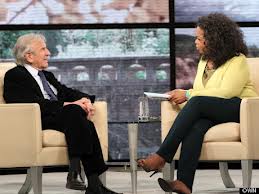
Yesterday on Super Soul Sunday, he sat down with Oprah to talk about his recent open heart surgery and his riveting new memoir, Open Heart, a love poem to his wife, Marion, and his grandchildren.

Throughout the hour-long telecast, the octogenarian spoke of the grace and cruelty he has experienced throughout his life. While at Auschwitz, he found it difficult to understand God’s silence and the world’s silence. At age thirty, he broke his own silence and wrote “Night” the bestseller that was translated into thirty languages and sold to millions around the world. Later, he and his wife began the Elie Wiesel Foundation for Humanity.

In recent years, he experienced the loss of his entire life savings and $15 million of the foundation’s money because of Bernie Madoff. When he received the news, he turned to his wife and said, “We have seen worse.” The financial loss did not make him pessimistic or desperate. Instead, he spoke in glowing terms about the hundreds of Americans who sent small donations to the foundation afterward.

I was moved by his comparison of Alzheimer’s disease to a book. Each day, a page is torn out until all that remains are the covers of the book.

Oprah described the interview as a prayer and was deeply moved by his takeaway for all of us:

Whatever you do in life, think higher and feel deeper.

So many wonderful quotes…I’m putting Open Heart on my 2013 reading list.

• Every second counts and every moment matters.

• Hadn’t I lived with death, even in death?

• Illness may diminish me, but it won’t destroy me.

• Life is not a fist. Life is an open hand waiting for some other hand to enter it.

• Indifference enables everything which is bad for life.

• I define myself more by my questions than by my answers.

• To listen to a witness is to become a witness.

• Every moment is a new beginning. Every handshake a promise.

• If life is not an offering to the other, what are we doing on this earth?

Great Idea! But is it a book?

editing1While browsing on the Storywell website,the title of this workshop caught my attention.

So, I decided to drive out to The Button Factory in Waterloo to hear freelance editor and publishing consultant Nicole Langlois discuss non-fiction publishing in Canada.

As former managing editor at Harper Collins, Nicole is very knowledgeable about how publishing decisions are made. She discussed different books in Quill and Quire and went through the Big Four questions that all publishers consider…

1. Does this project have a self-selecting book-buying audience and who makes up that audience? (Focus on measurable groups who are interested in your topic; use facts and figures wherever possible.)

2. What will this book say of significance to those within this audience? (It’s the Aquarius Factor—uniqueness—that separates you from an almost always crowded marketplace.)

3. Will this audience, once made aware of this book, go out and buy it? (An especially good question if women aren’t part of your target audience.)

4. Is this the right author and the right time to publish this book? (It’s all about platform.)

Nicole stressed the importance of building an author platform and the essential elements of all non-fiction proposals. She referred to Mike Nappa’s book, 77 Reasons Why Your Book Was Rejected, and Thinking Like Your Editor: How to Write Great Serious Nonfiction by Susan Rainer and Alfred Fortunato throughout the workshop.

Food for thought…

Publishing contracts are based on the number of books sold in the first year. Can you sell 5000 copies in that time?

Negative stories are hard to sell.

The best time to start promoting your book is three years before it comes out. (Seth Godin)

Blurbs are the life blood of the publishing industry.

Find the editor who is sympathetic to your voice.

Work hard… Hope for a lucky break…Enjoy the process!


Life, with Cancer: The Lauren Terrazzano Story

lauren2Journalist Lauren Terrazzano had two life goals: win a Pulitzer Prize and write a book.

In 1996, the fearless young journalist shared the Pulitzer Prize with her team at Newsday for their coverage of the TWA Flight 800 crash. Unfortunately, she was not able to achieve her second goal. At age thirty-nine, Lauren’s life was cut short by lung cancer just three years after her diagnosis.

But that dream did not die with Lauren.

Her father, Frank Terrazzano picked up the torch and, with the help of co-author Paul Lonardo, wrote Life, with Cancer: The Lauren Terrazzano Story. In writing this book, Terrazzano wanted to honor his daughter’s memory as a dedicated and well-respected social journalist who was a voice for the voiceless.

So many wonderful examples of Lauren’s investigative reporting….

When she reported on the lack of adequate security at New York nursing homes, new legislation was introduced and she received a commendation from Governor George Pataki.

While her cancer was in remission, she accompanied four young men on a helicopter mission to hurricane ravaged parts of Guatemala. She reported her experiences in an article that was widely syndicated in the United States.

In the fall of 2006, the cancer returned, but Lauren decided to fight it with words. After receiving a weekly column entitled, Life, with Cancer, she shared her experiences in the hope erasing the stigma associated with lung cancer. She wrote with humor when she discussed “the dumb things people say to those who are ill” and with anger as she wrote about the complicity of tobacco companies.

In a recent interview, Lonardo admitted he was skeptical at first, but after learning more about Lauren, he realized that “it was her life story—not just her death story” and the book would inspire young female journalists.

A wonderful tribute, filled with sensitivity and love, from a father to his only child.