A Writer’s Life

Yesterday evening, I returned to the Guelph Public Library (Westminster Square Branch) to lead a discussion on the creative life with a lively group of writers and wannabe writers, who braved the cold, blustery temperatures. I shared my experiences and advice on finding inspiration, establishing daily rituals, dealing with writer’s block, and getting published.

I was impressed by the depth and breadth of questions and comments. The group was a diverse one with interests in writing poetry, fiction, memoirs, and self-help books.

Thanks to librarians Karen Cafarella and Deb Quaile for organizing and facilitating this event.

L-R: Erin El Masry, Joanne Guidoccio, Deb Quaile, Karen Cafarella


On Success and Failure

On Wednesdays, I share posts, fables, songs, poems, quotations, TEDx Talks, cartoons, and books that have inspired and motivated me on my writing journey. I hope these posts will give writers, artists, and other creatives a mid-week boost.

Whenever I need a strong dose of reality, I listen to the following TED Talk by Elizabeth Gilbert. The best-selling author of Eat, Pray, Love (Over 11 million copies were sold), Elizabeth was catapulted into instant success. But there is life after success, and sometimes it takes the form of failure. In this entertaining Talk, Elizabeth shares her brushes with success and failure.


A Matter of Logic Vs. Creativity?

I’m happy to welcome multi-published author Catherine E. McLean to this blog. Today, Catherine discusses the importance of self-editing and shares her latest release, Revision is a Process.

Here’s Catherine!

One of my favorite quotes is by Yoda of Star Wars, who said “Do or do not, there is no try.” This adage was driven home to me when I attended a workshop where the instructor had us “try to pick up a pen.” Well, you either pick up the pen or you don’t. There is no “try” or middle ground. It’s do or do not.

This adage can be applied to self-editing. There is no trying to edit, you have to ruthlessly self-edit. If you don’t, the reader, editor, or agent cannot interpret what you wrote or form the same images in their mind that you envisioned. As a result, your story won’t be enjoyable or marketable.

Okay, so most writers would rather write story after story than “get the words right.” However, getting those words as right as possible shouldn’t be equated to a root canal. What has to change is the writer’s perception, which means understanding that revision is a process. That process can be made simple, effective, and efficient.

The next step in self-editing is to put some time between the creation of the tale and the self-editing. You see, once a story has been drafted, most writers cannot distance themselves from the enjoyment of their own plot and characters. When they go to edit, they lapse into reading and enjoying the story anew. So, how much time should pass between draft and edits? For some writers, it can be days, for others it might be months or years.

It should also be understood that there is a war going on between the right-brain’s creativity and the left-brain’s logicalness. Here’s the thing, logic will always — ALWAYS — win over creativity. That’s because creativity is chaos and the human brain strives to make sense of things (and not go insane). And never forget, your reader is a very logical person that must be convinced to suspend their disbelief in fantasy or fictional worlds and premises.

So, how do you switch from creativity to logic when you need to self-edit? Consider attaching something physical to reinforce the desire to edit. For instance, wear an “editor’s visor,” which is green and was used in the late 18th and early 19th centuries by copy editors. Those visors are now called Casino Poker Dealer or Croupier Visors, costing under $10 (for colored ones, look at golf and sun visors). Then again, a paper hat will suffice (and you can write “EDITOR” on it for more emphasis).

Another method is to have a special place set aside for strictly editing work. That place is where the imagination is not allowed to create story. For instance, I have an office upstairs where I craft my stories. I go downstairs to my dining room to edit. I now a writer who takes his work to a bookstore to edit (and have coffee, too!). Another writer takes their work to the library. Having such a specific place bolsters the desire to edit, not create.

I’m a curious person. How do you switch from being creative to editor-mode?
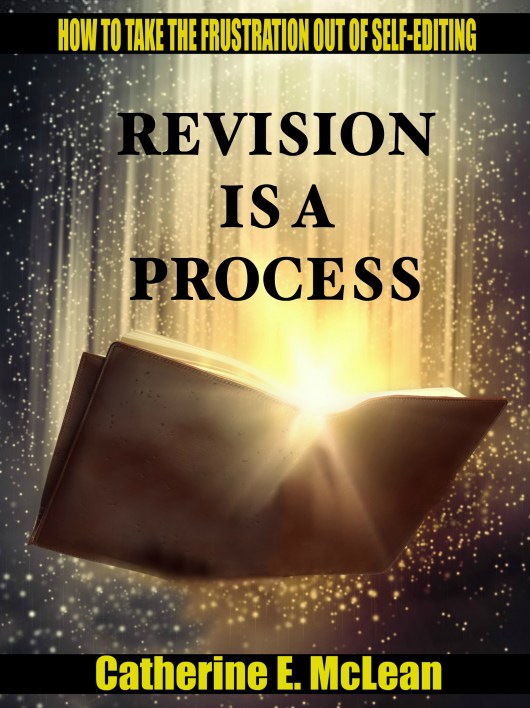
Links for REVISION IS A PROCESS

Table of Contents | Excerpt

Buy Links

Amazon | Barnes & Noble

Bio

Catherine E. McLean’s short stories have appeared in hard cover and online anthologies and magazines. Her books include JEWELS OF THE SKY (sci-fi adventure), KARMA & MAYHEM (paranormal fantasy romance), HEARTS AKILTER (a fantasy/sci-fi romance novella), and ADRADA TO ZOOL (a short story anthology). She lives on a farm nestled in the foothills of the Allegheny Mountains of Western Pennsylvania. In the quiet of the countryside, she writes tales of phantasy realms and stardust worlds (fantasy, futuristic, and paranormal romance-adventures). She is also a writing instructor and workshop speaker. Her nonfiction book for writers is REVISION IS A PROCESS – HOW TO TAKE THE FRUSTRATION OUT OF SELF-EDITING.

Links

Website | Website for Writers | Blog | Facebook | Twitter | Email


More #NaNoWriMo Tips

On Wednesdays, I share posts, fables, songs, poems, quotations, TEDx Talks, cartoons, and books that have inspired and motivated me on my writing journey. I hope these posts will give writers, artists, and other creatives a mid-week boost.

In last Wednesday’s post, I shared five tips that helped me survive and thrive during NaNoWriMo 2016.

Here are five more tips:

1. Relax and TELL. For years, I’ve heard editors and workshop facilitators repeat the mantra: SHOW DON’T TELL. What a relief to focus on getting the scene on paper in any form and then prettying it up later.

2. Leave notes in the text. Plot and dialogue are my strengths while descriptive detail is one of my weaknesses. Instead of belaboring the setting and other details, leave notes about what’s missing. i.e. Description of waterfront or restaurant. Don’t stop to check the internet for anything.

3. Journal when stuck. Author and course facilitator, Catherine Chant recommends journaling about our character’s feelings to elicit more details and move the storyline along. The character could write her response stream-of-conscious style or write a letter describing a problem. Even if the journal entry is edited out of the story, the words still count.

4. Stop before the ideas run out. At the end of each day’s stint, write a sentence or two about what happens next. This will provide a starting point for the following day.

5. Turn off the internal editor. I need to keep in mind Anne Lamott’s advice and “write a crappy first draft.” Forget about spelling, punctuation, and grammar. Don’t delete anything. In short, give myself permission to write badly.


Starting #NaNoWriMo

On Wednesdays, I share posts, fables, songs, poems, quotations, TEDx Talks, cartoons, and books that have inspired and motivated me on my writing journey. I hope these posts will give writers, artists, and other creatives a mid-week boost.

One year ago, I began my first NaNoWriMo journey. At first apprehensive, I slowly built up confidence and achieved a final goal of 50,940 words. During the winter and spring months, I edited and polished the manuscript that was later accepted for publication. In the spring of 2018, The Wild Rose Press will release A Different Kind of Reunion.

Today, I’m starting my second NaNoWriMo journey. Still apprehensive but much more confident. Here are five tips that helped me survive and thrive during NaNoWriMo 2016.

1. Announce your plans. At first, I wanted to keep my involvement secret, but after reading about the positive reinforcement that a support group can provide, I decided to share the news with everyone in my circle. In addition to other writers—online and offline—I also told the non-writers. I was looking for encouragement, not advice. Simply asking: “How’s that novel coming along?” will help keep me on track.

2.Write at peak times. To find a routine that works consistently, I need to write when the muse strikes. I have discovered that the following times yield the most creative results: 9:30 a.m. to 11:30 a.m. and 7:00 p.m. to 10:00 p.m.

3. Work ahead. Sneaking in an extra 300 words (or more) early in the month can build up word counts and compensate for missed days when illness and other commitments affect the quality and quantity of the writing.

4. Turn off the television and all electronic gadgets during peak creative times to ensure there are no distractions.

5. Embrace both linear and non-linear paths. While I prefer to write linearly—one chapter at a time—skipping over to a more interesting scene can help stimulate right-brain thinking.

My Writer’s Toolbox

Welcome to the G.O.T.H. Series!

On Wednesdays, I share posts, fables, songs, poems, quotations, TEDx Talks, cartoons, and books that have inspired and motivated me on my writing journey. I hope these posts will give writers, artists, and other creatives a mid-week boost.

Thirty-one years of teaching adolescents thickened my skin considerably, but I faced different challenges when I embarked on a writing career. I had to learn how to deal effectively with rejection letters from agents and publishers, critiques from editors, and less-than-favorable reader reviews. Most important of all, I had to acquire that coveted rhino skin. Here are five strategies in my writer’s toolbox:

Get the Back Story

Whenever I attend readings, I pay special attention to the author’s back story. I like hearing the details about his or her writing journey and the challenges encountered along the way. Occasionally, I pick up valuable nuggets of advice that help me along my own journey. For example, Guelph writer Nicholas Ruddock (The Parabolist) established his platform by entering and placing in short story contests. When New York Times bestselling author Louise Penny couldn’t find a Canadian or American agent, she crossed the pond and approached a British agent.

Read Bad Reviews

If I have enjoyed reading a book, I look up the one-star reviews on Amazon. That’s right, I gravitate toward the negative. While shaking my head at the nitpicking and negative comments, I realize that no author is immune from criticism. Not even authors of best-selling novels can please everyone.

Eliminate the Negative

Some writers file and keep all their rejection letters. I suspect they refer to these letters often and get discouraged all over again. It is important to keep accurate records, but it is not necessary to keep these negative reminders around for future reference. After reading a rejection letter, I update the information on a spreadsheet and delete the file.

Throw More Irons Into the Fire

We’ve all heard the advice. Send out the manuscript and then immediately start on another one. Easier said than done. After writing 70K words and looking at multiple drafts of that manuscript, the thought of starting all over again can be daunting. Instead, I like to work on shorter pieces: book reviews, short stories, articles, and more blog posts. Entering contests and taking online writing courses also keep my skills sharp. It is important not to sit around waiting for a response. Some action—any action—is needed.

Get Support

I belong to Crime Writers of Canada, Sisters in Crime, Guppies, and Romance Writers of America. I also participate in discussion boards for The Wild Rose Press and Soul Mate Publishing Authors. I try to attend writing workshops, panels and readings offered within a fifty-mile radius. While interacting with these authors, I receive valuable advice and feedback about my work.


Nuts and Bolts of Writing

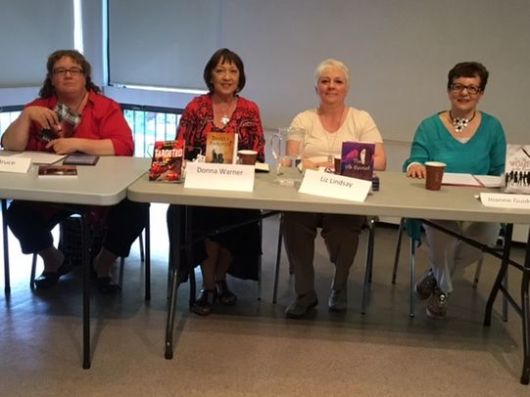
L-R Alison Bruce, Donna Warner, Liz Lindsay, Joanne Guidoccio

Yesterday evening, I participated in a lively panel discussion with three other mystery writers at the main branch of the Guelph Public Library. We are all published authors and members of Crime Writers of Canada.

We gave mini-presentations on our favorite nuts and bolts of writing—The Right Opening, Character Development, Self-Editing, Building Your Author Brand—and read excerpts from our recent novels. During the Q & A sessions, we delved into a variety of topics, among them short stories, writing and critique groups, conferences, and contests.

Thanks to librarians Andrea Curtis and Deb Quaile for organizing and facilitating this event.

To learn more about Guelph Partners in Crime, visit our websites:

Alison Bruce

Joanne Guidoccio

Liz Lindsay aka Jamie Tremain

Donna Warner


Finding Inspiration

When I decided to pursue my writing dream, I imagined one of the nine daughters of Zeus and Mnemosyne visiting each morning, taking my hand, and guiding me to the computer. There, she would remain, offering words of encouragement until I produced my daily quota of words.

That was the fantasy.

The reality was very different.

I was unprepared for the tyranny of the blank page. While everything was in place—business cards, new computer, dreams of a runaway best-seller—my writing muscles refused to budge.

Continue reading on Brenda Whiteside’s blog.

Dealing with Dialogue Tags

Glancing back at some of my earlier work, I cringe at my use of “said bookisms” such as roared, admonished, exclaimed, queried, and hissed. I was trying to avoid overusing the word “said” and searched for suitable alternatives. I realize now that substituting those words made it sound like I enjoyed using my thesaurus. Instead, I was annoying the reader and drawing attention away from the dialogue.

From different workshop facilitators, I’ve learned that I don’t have to interpret the dialogue, or worse, tell the reader how the words are said. If the dialogue is strong enough, “he said” and “she said” will do. Like other parts of speech—the, is, and, but—that are used several times on each page, “said” is invisible and allows the reader to concentrate on the action and dialogue.

Continue reading on the Sisterhood of Suspense Blog.


Email Power!

Can you compose efficient and effective emails?

emailpower1

When I heard this question, my first impulse was to say, “Yes, of course.” But glancing through my in-box, I realized I wasn’t that efficient or effective. While I don’t ramble or use ambiguous language, I could improve the tone of my emails.

In her book, Playing Big, Tara Mohr devotes an entire chapter to “Communicating with Power.” She stresses the importance of identifying those “little things” that “walk the fine line of saying something without coming on too strong, but in fact they convey tentativeness, self-doubt, or worse, self-deprecation.”

Continue reading on the Sisterhood of Suspense blog.