
Category Archives: Nature
Life Tips from Dandelions
On Wednesdays, I share posts, fables, songs, poems, quotations, TEDx Talks, cartoons, and books that have inspired and motivated me on my writing journey. I hope these posts will give writers, artists, and other creatives a mid-week boost.

Here’s a thought-provoking perspective from the Mind Fuel Daily Blog:
We can’t think of a few plants as famous as the dandelion. Who as a child didn’t blow on its soft puffball and watch the seeds float away? Unfortunately, dandelions don’t have the greatest reputation and are considered a nuisance by countless landscapers and gardeners.
But once you get to learning about dandelions, you’ll find they have a number of lessons to offer. Whether you find this plant a pesky presence or just another a beautiful part of nature, we’ve rounded up all the surprising life tips this flower has to teach.
Weeds…or Wishes?
Sometimes, the only difference between a flower and a weed is a matter of perspective. Some people look at dandelions and see a weedy menace. Others smile at its yellow blossom and look forward to making wishes with its puffy seeds. With dandelions, as in life, your attitude shapes everything. Choose to see the flower that grants wishes instead of weeds.
Be Useful
The dandelion is incredibly versatile. From stem to root, it’s entirely edible. Not only that, but it’s also been used for everything from folk medicine to dye. Dandelions also improve soil quality, leaving behind nitrous and other nutrients. Not too shabby for such a common plant, huh? The dandelion teaches us no matter how unassuming or ordinary we may seem; we actually have a whole lot to contribute to the world.
Adapt
Dandelions adapt easily and are able to grow in all sorts of soil types and conditions. And not just grow but flourish. This is partly why they’re so prevalent. In fact, dandelions are “pioneer plants”, those plants that are among the first to repopulate the soil after it’s been disturbed (like after a wildfire). In other words, dandelions make do even in the roughest situations. We know you can too.
Embrace Change, Let Go When Necessary
So many are familiar with the dandelion’s evolution from a yellow blossom to a white puffball. Once that soft tuft appears, the dandelion will soon release its seeds into the wind. Dandelions know that change is simply part of life, and just as important, they know when to let go.
Travel Far
Did you know? Dandelions seeds can travel up to five miles in the wind. That may not seem like much, but it’s pretty impressive when you learn that dandelions have nearly conquered the world. A brief history of this flower reveals they were once exclusive to Eurasia. Now? They grow on six different continents. Take a cue from the dandelion: go far and be willing to take on any new terrain.
Be Tenacious
Of course, dandelions are so commonly known as weeds because they are so pervasive and persistent. If you mow or cut them, they simply come back. Rip their roots out, and any remaining roots will simply grow more dandelions. While some might see this as a nuisance, we think this a prime lesson in determination! Be like the dandelion, be tenacious.
Source: Mind Fuel Daily Blog
Five Life Lessons from a Butterfly
On Wednesdays, I share posts, fables, songs, poems, quotations, TEDx Talks, cartoons, and books that have inspired and motivated me on my writing journey. I hope these posts will give writers, artists, and other creatives a mid-week boost.
Here’s an inspiring post about butterflies from the Mind Fuel Daily blog:
These tiny, fluttering creatures are really teachers in disguise. Here are five bits of life wisdom, inspired by the beautiful butterfly.
Be patient. All good things come with time. We are growing, even when we cannot feel it. With great patience come great rewards.
Be open to change. Be willing to be transformed. Without change, nothing beautiful would happen. You have to give up who you are to become who you might be.
Be light and free. Have some fun. Float from each open door to the next. Look for the color, humor and joy in daily life.
Be spontaneous. Go wherever your wings take you. Fly forward with confidence. Have the courage to seize new opportunities.
Be in the moment. Look around. Enjoy the flowers, the sun and the breeze. The present moment is a gift for us to enjoy.
Source: Mind Fuel Daily Blog
Announcing Guelph’s Official Bird…
The Black-Capped Chickadee has been chosen as Guelph’s official bird. Honorable mentions go to Chimney Swift and Green Heron.
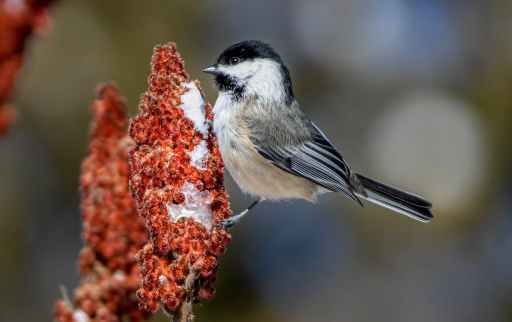
A bold, inquisitive bird, the Black-Capped Chickadee can adapt to almost any environment and may even feed from friendly “human” hands. Small and short-billed with a black cap and throat, the chickadee communicates with its flock-mates using fifteen different calls. The best known is the chickadee-dee-dee that gives the bird its name.
The Black-Capped Chickadee is also the provincial bird of New Brunswick and state bird of Massachusetts and Maine.
Here are ten more interesting facts:
1. Chickadees usually mate for life.
2. These birds build nests in holes, mainly dead trees or rotten branches.
3. The females lay six to eight white eggs, marked with reddish-brown spots. Eggs are incubated for 12 to 13 days, until they hatch. Chicks grow quickly and fledge in 14 to 18 days.
4. Their wing beats are about 27 times per second. In comparison, a hummingbird’s wing beats are 80 beats per second.
5. The chickadee possesses excellent spatial memory. During the warmer months, it hides seeds and other foods in different spots. The bird can remember the hiding places a month after catching the food.
6. These birds observe and adapt the food-finding behavior of successful flock-mates. Unproductive activity is ignored.
7. On cold winter nights, the chickadees can reduce their body temperatures by as much as 12 degrees Celsius (from their normal temperature of 42 degrees Celsius) to conserve energy.
8. A frequent visitor to bird feeders, the chickadee is a ravenous eater, especially just before dusk. It can gain as much as ten percent of its body weight each day.
9. Research has shown that the survival rate of chickadees doubles when they have access to feeders during cold weather. In the winter, these birds require twenty times more food than they do in the summer.
10. Their favorite foods: sunflower seeds, suet, and coconut.
Happy Earth Day!

Source: Imagine It! A Handbook for a Happier Planet by Laurie David + Heather Reisman
Shortlisted for Guelph’s Official Bird
A Brief Recap
In February, the City of Guelph began the application process for the Bird Friendly City designation. To date, only four cities in Canada—Vancouver, London, Toronto, Calgary—have been designated a Bird Friendly City by Nature Canada.
The City of Guelph staff teamed up with experts from two local groups— Bird Safe Guelph and Nature Guelph Bird Wing—to produce a list of eight birds that represent Guelph. The first round of voting ended Friday, April 1st.
The following birds have been shortlisted for the title of Guelph’s official bird:
Chimney Swift | Black-Capped Chickadee | Green Heron


It is now time to vote for the final candidate and help Guelph achieve the coveted Bird Friendly City designation.
Vote here before Friday, April 22.
Help Make Guelph a Bird Friendly City
Plans are in the works to make Guelph a Bird Friendly City!
A bit of backstory…
There are three billion fewer birds in North America today than fifty years ago. Many of these losses have been caused by domestic cats, window and car collisions, and habitat loss.
Nature groups, municipal officials, and community groups are teaming up with Nature Canada to make our urban environments safer havens for birds.
A certification standard has been developed to certify cities as a “Bird Friendly City.” Certification is a badge of honor and a source of community pride. It helps raise awareness about local birds and inspires residents to take simple protective actions.

Nature Canada’s Goal for 2022: Certify at least thirty eligible Canadian cities as a Bird Friendly City by World Migratory Bird Day (Saturday, May 14, 2022).
To date, only four cities in Canada—Vancouver, London, Toronto, Calgary—have been designated a Bird Friendly City by Nature Canada.
Locally in Guelph…
City of Guelph staff teamed up with experts from two local groups—Bird Safe Guelph and Nature Guelph Bird Wing—to produce a list of eight birds that represent Guelph.
Residents are asked to vote for their favorite bird by Friday, March 11.
The three birds with the most votes will move to a second round of voting on Friday, April 1. The bird with the most votes by Friday, April 22 will become Guelph’s official bird for the Bird Friendly City designation. In the event of a tie, Bird Safe Canada will choose the winning bird.
Visit https://www.haveyoursay.guelph.ca/bird-city to place your vote. Take the survey or upload a photo to indicate which bird should represent Guelph.
Here are the birds (in alpha order)
Belted Kingfisher | Black-Capped Chickadee | Chimney Swift |
Common Merganser | Eastern Screech Owl | Green Heron | Peregrine Falcon | Pileated Woodpecker


In Praise of Canada’s National Bird
Not everyone is happy with the Royal Canadian Geographical Society’s nomination for our national bird. Last week, some Canadians shared disbelief and–at times–outrage in articles and online.
“I’ve never seen one.”
“What??!! Really??? Not the mighty loon?”
“Canada already has a national bird…the Canada geese.”
“That bird didn’t even win the popular vote!”
“So now we have an Electoral College of Ornithologists.”
“Why are we using American spelling for our bird?”
The back story…
In 2015, the Royal Canadian Geographical Society began its search for a national bird. Almost 50,000 votes were cast online, surprising the editorial staff of the Society’s Canadian Geographic Magazine.
Editor Aaron Kylie commented, “We had thousands of comments, and the comments aren’t just a sentence. They’re paragraphs, they are full pages and they are very impassioned, passionate, personal stories about people’s connections to a specific bird they wanted to put forward as the national bird.”
The top three birds…
Common Loon
13,995 votes

Snowy Owl
8,948 votes

Gray Jay
7,918 votes
After a public debate and deliberations by an expert panel, the third-place Gray Jay was selected as Canada’s official national bird. Next step: Federal Government approval.
The rationale…
Ornithologist David Bird pointed out that the loon is already Ontario’s provincial bird and the snowy owl is Quebec’s bird. He added, “My feeling is that when we chose the flag of Canada, we did not elevate the provincial flag from Ontario or Quebec…We chose something fresh and new. And that’s what I think we need to do with a national bird.”
About the Gray Jay…
• A robin-sized cousin of the raven and crow, the gray jay has the same brain-to-body ratio as dolphins and chimpanzees.
• Gray jays can be found in every province and territory of Canada. They live in the boreal forests and subalpine regions of the country so you won’t find them south of the 401. Instead, consider visiting Algonquin Park, the mountains in British Columbia, or the backwoods of Newfoundland or New Brunswick.
• Unlike Canadian geese and other birds that migrate south in the winter, gray jays live in Canada year-round. They thrive in winter and can incubate eggs in temperatures as low as minus 30 Celsius. Resilient and enterprising, they often bring up their young in cold and food-deprived conditions.
• Friendly and inquisitive, gray jays will approach and land on a human hand, hoping to find nourishment.
• Each fall, gray jays store thousands of morsels of food in different hiding places, and for months afterward they can remember the location of each cache. It’s not surprising they are often labelled the smartest birds on the planet.
My thoughts…
While reading and listening to all this bird talk, I couldn’t resist putting on my teacher hat. Gray jays remind me of the good students (not always A-students) who come to class each day, prepared and ready to learn. They don’t complain or throw tantrums when things don’t go their way. Instead, they adapt and make the best of changed circumstances. They may not win all the awards, but they are often short-listed.
Good students and Gray Jays get my vote!
Regarding American Spelling…
Gray Jay is the species’ official name. Journalistic publications must honor the proper names of birds and animals even when they conflict with Canadian spellings. (Grey is the Canadian/British spelling of Gray)
Or we could simply call the gray jay by its other name: Whiskey Jack, a name derived from Wisakedjak, a cultural hero and trickster of Cree and Algonquin cultures.
A closer look at Gray Jay aka Whiskey Jack…

 Joanne Guidoccio