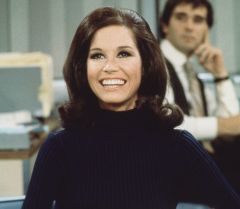
 Visionary. Groundbreaking Actress. Producer. TV Legend. Passionate advocate for the Juvenile Diabetes Research Foundation. So many accolades come to mind whenever Mary Tyler Moore’s name is mentioned.
Yesterday, Mary died at the age of eighty.
While I have only vague recollections of the Dick Van Dyke show, I was addicted to the Mary Tyler Moore show and looked forward to each week’s episode. Impressed and inspired by Mary Richards, television’s first single career woman, I would often ask myself–What would Mary do?–whenever I encountered a workplace challenge. I was saddened when the series ended in 1977, but I continued to watch the reruns for several years afterward.
Short Clips from MTM Show…
Mary Richards: I’m an experienced woman. I’ve been around… Well, all right, I might not have been around, but I’ve been… nearby.
___________________________________________________________
Lou Grant: You know, Mary, you’ve got spunk.
Mary Richards: Why, thank you, Mr. Grant.
Lou Grant: I hate spunk.
___________________________________________________________
Mary Richards: Oh Rhoda, chocolate doesn’t solve anything.
Rhoda Morgenstern: No Mare, cottage cheese solves nothing; chocolate can do it all!
___________________________________________________________
Mary Richards: Well, what’s the cut-off point Mr. Grant? I mean, is… is there some number? You know, I’d really like to know. How many men is a woman allowed to have before she becomes *that* sort of woman?
Lou Grant: Six.
___________________________________________________________
Mary Richards: A woman doesn’t have to have a baby if she doesn’t want to.
Lou Grant: Well, I say a man’s entitled to have a baby if he wants to.
Mary Richards: [Chuckles] Well, Mr. Grant, on behalf of women everywhere let me say we’d sure like to be there when he has it.
Ted Baxter: She got you there, Lou.
___________________________________________________________
Mary Richards: Mr. Grant? Could I say what I wanted to say now? Please?
Lou Grant: Okay, Mary.
Mary Richards: Well I just wanted to let you know that sometimes I get concerned about being a career woman. I get to thinking that my job is too important to me. And I tell myself that the people I work with are just the people I work with. But last night I thought what is family anyway? It’s the people who make you feel less alone and really loved.
[she sobs]
Mary Richards: And that’s what you’ve done for me. Thank you for being MY family.
___________________________________________________________
Favorite Quotes from Mary Tyler Moore…
You can’t be brave if you’ve only had wonderful things happen to you.
Take chances, make mistakes. That’s how you grow. Pain nourishes your courage. You have to fail in order to practice being brave.
I’m not just a survivor…I’m a flourisher.
Having a dream is what keeps you alive. Overcoming the challenges makes life worth living.
Chronic disease like a troublesome relative is something you can learn to manage but never quite escape.
I live in a kind of controlled awareness. I wouldn’t call it fear, but it’s an awareness. I know I have a responsibility to behave in a certain way. I’m able to do that.
There are certain things about me that I will never tell to anyone because I am a very private person. But basically, what you see is who I am. I’m independent, I do like to be liked, I do look for the good side of life and people. I’m positive, I’m disciplined, I like my life in order, and I’m neat as a pin.
I’ve had the fame and the joy of getting laughter – those are gifts.

 Like most people, I have experienced profound, life-threatening fear over the years – meeting a grizzly bear on a walking trail at Lake Louise, spinning out on ice on Highway 401, a bomb threat on a commercial airplane. So I get that fear – the “unpleasant emotion caused by the threat of danger, pain, or harm” – is a warning signal to put your brain and body on hyperalert so that you can more effectively deal with the threat.
 Lisa loves sharing information that will have a positive impact on the world. Her first article was published in Vitality Magazine in 2002 and this monthly personal growth blog has been online since January 2011. Her work has also been published in Business Venture, Enterprise Magazine, and, City Parent Magazine.




 When facing a cancer diagnosis it can be helpful to find a support group. Connecting with people who are experiencing the same things and can share in your struggles and triumphs can be immensely important for a patient’s mental and emotional health. These groups prevent patients from feeling isolated and the people they encounter may be able to offer helpful insights.
 Words have power: they bring us hope, connect us across generations and geography, and can be an outlet for our internal struggles. The written word can be a
  Although it may sound cliche, friends and family truly are an essential support system. Many of us are not used to asking for help or admitting when we feel defeated. Reaching out to the people you’re close to can help relieve any feelings of solitude and supplement a cancer-focused support group. In addition to emotional support, loved ones also have the unique ability to make us laugh and distract us from hardship. Friends and family can also offer support by accompanying patients to their doctor visits and acting as another set of ears at the appointments.
 Joanne Guidoccio