
Read Jane’s review of A Season for Killing Blondes.
Molte grazie!
 A fan of self-help literature, I look forward to each year’s crop of inspirational and motivational books. Right now, Better Than Before: Mastering the Habits of Our Everyday Lives is at the top of my Favorites List.
New York Times best-selling author Gretchen Rubin has expertly woven research, anecdotes, and personal insights in this excellent study of habit formation. She does not provide a one-size-fits-all approach or prescribe specific habits. Instead, she explores how to develop sustainable habits that will help us achieve our own versions of Everyday Life in Utopia (a chapter title suggested by her daughter Eleanor).
Rubin starts by outlining The Four Tendencies—Upholder, Obliger, Questioner, Rebel—and then suggests appropriate strategies in the Pillars of Habits section. While the concepts of Monitoring, Foundation, Scheduling, and Accountability are not new, they are presented using a lively, conversational style aimed at increasing self-knowledge.
I paid special attention to the following strategies:
Foundation Four – Begin with habits that help us sleep, move, eat and drink right, and unclutter. These habits will serve as the foundation for forming other good habits.
Power Hour – To deal with the small, one-time tasks (e.g. creating a photo album) that Rubin kept putting off, she decided once a week, for one hour, she would work on these chores.
Clean Slate – Fresh starts such as a new apartment, job or school and changes in personal relationships wipe the slate clean and can help us launch a new habit with less effort. But a clean slate can also disrupt good habits or break positive routines.
Lightning Bolt – While this is a very effective strategy, it cannot be invoked. A new idea triggered by an inspirational book, milestone birthday, pregnancy or another event can instantly transform habits.
Blast Start – When small steps are not working, a blast start can help us take the first step. This kind of shock treatment cannot be maintained, but it can give momentum to a new project.
Bright-Line Rule – A clearly defined rule or standard that eliminates any need for decision-making can help us achieve greater clarity. E.g. Answering every email within 24 hours.
Throughout the book, Gretchen Rubin shares her own successes and challenges along with those of family members, friends, and blog followers. Intrigued and inspired by the low-carb diet she adopted and the ripple effect it created within her circle, I picked up a copy of Why We Get Fat and What to Do About It by Gary Taubes.
And I couldn’t resist classifying myself: I am an Upholder, Abstainer, Marathoner, Finisher, and Owl.
Where to find Gretchen Rubin…
Website | Twitter | Facebook | Linked In | Amazon
Read Majanka Verstraete’s review of Between Land and Sea on the I Heart Reading blog.
Thank you Majanka!
As an author on my own road to reinvention, I’m always on the lookout for stories about women who boldly seek adventures that propel them into second acts. I was thrilled to discover Claire Cook’s delightful novels and read about her extraordinary journey.
Reinvention is a recurring theme in Claire’s life and novels.
 She wrote her first novel at age 45 in a minivan while her children were at swim practice. Five years later, she walked down the red carpet at the Hollywood premiere of Must Love Dogs, the film adaptation of her second book.
After eleven best-selling novels and numerous speaking engagements, Claire has written a nonfiction book, Never Too Late: Your Roadmap to Reinvention (without getting lost along the way).
Using her trademark humor and wit, Claire tells her own story and that of other reinventors while providing tips on finding that sweet spot, staying on track, securing a support system, building a platform, and overcoming perfectionism.
You don’t have to be a writer or midlifer to appreciate this book. It will appeal to any woman who feels stymied or dissatisfied with her present circumstances. And by the end of the book, the reader will be able to answer Claire’s thought-provoking question: “What would you like your life to be in five years and what’s getting in your way?”
Quotable Quotes
Karma is a boomerang.
You don’t have to be good at it—that takes time and hard work. But you have to love it enough to want to be good at it.
If Plan A doesn’t work, the alphabet has 25 more letters (204 if you’re in Japan!).
If failure comes with a lesson, take it. If it doesn’t, put it behind you and move on.
There were only three things standing in my way all that time: me, myself and I.
Dreams don’t have an expiration date. Not even a best by date. If it’s still your dream, it’s still your dream.
Where to find Claire…
Read Trina Adr’s review of Between Land and Sea
on the Smart Girls Love SciFi and Paranormal Romance Blog.
Thank you Trina!
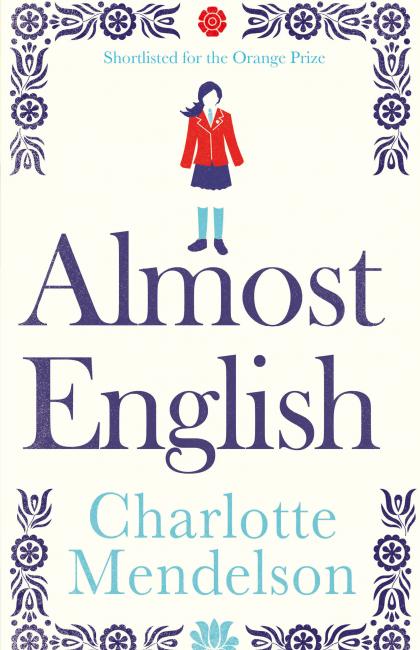 “Almost English is about the ugly years and a startlingly plain adolescent.”
While Author Charlotte Mendelson’s description is definitely apt, the novel is actually held together by two protagonists—mother and daughter—facing their own crises in West London during the 1980s.
Sixteen-year-old Marina is being raised by her emotionally fragile mother Laura and three elderly Hungarian relatives in a cramped basement flat filled with strange traditions and even stranger foods.
Longing to escape this tiny Hungarian enclave, Marina goes off to Combe Abbey, a posh, traditional English boarding school, hoping to reinvent herself and “set off towards the glorious adulthood which awaits her.”
Desperately homesick, Marina feels more of a misfit than ever as she tries to conform to English ways and customs. Several comedic episodes follow when she is invited to a classmate’s country home.
Struggling to deal with her own painful secrets and dilemmas, Laura wonders if she is on the brink of a nervous breakdown or simply having “a disappointing life.” Abandoned by a handsome and spoiled husband, Laura moves in with her mother-in-law where she lives uncomfortably for over a decade. The insecure and often distracted forty-two-year-old fails to notice that Marina is desperately in need of an intervention.
The scenes involving the endearing trio of aged Hungarian women provide much of the domestic humor. Their conversations are sprinkled with “darlinks” and “von-darefuls” and their extravagant gestures create constant drama, much to Marina’s chagrin.
A delightful read, Almost English is worthy of its Man Booker Prize nomination.
Thanks to Harper Collins Canada for my review copy.
 “A masterless student, learning from all but attached to none.”
I couldn’t help but smile at this description of author Patsie Smith. From the start, it is clear the book does not espouse any one school of thought. Instead, using clear and practical language, Smith shares lessons she has learned along her own twenty-seven-year journey.
Divided into two sections—“Before Awakening” and “After Awakening”—each chapter begins with stick artwork and ends with a short reflection.
While the book could be easily read in one sitting, it is better to take time with each chapter, absorbing the succinct and powerful messages. Only then, will you experience the many “Aha!” moments inherent in this book.
Some of my favorite “Aha!” moments…
“The biggest cause of the blindness and shriveling of our spirit is our analytical mind.”
“The words of the Buddha are like a raft built to cross the river. When the purpose is completed, the raft must be left behind if we are to travel further.”
“Sometimes life has its own way of working things out through the power of doing less or doing nothing at all.”
I enjoyed this book thoroughly and will return to it often, keeping in mind Patsie Smith’s advice: “Growing your spirit requires feeding it every day with wisdom, teachings and direct learning experience.”
I received this book as a Goodreads giveaway.
 The young women in The Paris Winter are battling against poverty, overbearing relatives and other constraints that existed in early twentieth century Paris.
The protagonist, Maud Heighton, is a middle-class Englishwoman, determined to continue with her study of art, even if she has to go hungry during another Paris winter.
We are given glimpses of the desperation she must have endured the previous winter when “she had been feeding herself too little, been too wary of lighting the fire when the damp crawled off the river” and her illness “had swallowed francs by the fistful.”
When Tanya (Tatiana Sergeyevna Koltsova), a rich and beautiful Russian classmate, invites her to take a stroll, Maud feels the first “curl of hope in her belly under the hunger.”
Tanya and Yvette, one of the life models, introduce Maud to a part-time position as a live-in lady’s companion. Maud’s health improves and she becomes a better artist—her lines are more confident and her use of color grows bolder. Maud is finally able to hold her head up high as she walks from the Rue de Seine to her classes.
This honeymoon period abruptly ends as the narrative takes a dark turn and meanders through an underworld filled with opium, diamonds, murder and revenge.
Different aspects of the three young women emerge as they experience the salons, slums, and sewers of the city during the Great Paris Flood of 1910.
Maud can no longer hide a strong fighting spirit behind her English manners. As artist Suzanne Valadon points out: “I’ve seen you sleeping with your jaw clenched so tight the muscles on your neck stand out and your fists pulling the sheets apart.”
Beautiful and spoiled Tania finally stands up to her chaperones, firmly stating her intention to modernize and carve a different path.
And most surprising of all, Yvette, a child of the streets, redefines what it means to be a guardian angel: “The whole point of a guardian angel was that they were with you whether you deserved it or not, that they stayed with you, that even if they could not save you, they were there.”
Imogen Robertson has written a dark and intriguing historical novel about a different Paris, one not so romantic or enchanting.
 Very little is known about Minna Bernays, the other woman in Sigmund Freud’s household.
While she was speculated to have been his mistress, this controversial claim was dismissed by Freudian scholars.
All that changed during the summer of 2006.
A German sociologist discovered proof that Sigmund Freud and Minna Bernays had spent two weeks in August 1898 at a fashionable resort in Switzerland. An old ledger clearly showed that they occupied Room 11 on the third floor.
In Freud’s Mistress, authors Karen Mack and Jennifer Kaufman present a fictionalized account of that affair. Using Freud’s biographies, letters and scholarly texts as source material, the authors succeed in creating a corset-ripper set in Victoria-era Vienna.
Overeducated and often underemployed, Minna is abruptly fired and finds herself practically destitute and out of options. In desperation, she writes her sister Martha and asks for help.
Determined to stay only for a short while, Minna looks forward to the “uncomplicated and intellectual” relationship she had previously enjoyed with her brother-in-law. But she quickly discovers that “the Freud she had known for years had transformed into someone else.”
As their lively late-night chats become more intimate, Minna finds herself torn between an explosive love affair and loyalty to Martha. She also has to deal with Sigmund’s mercurial moods. It was shocking to read just how aloof and dismissive he could be.
More devastating was the effect on Minna: “The distress of his cold shoulder was constant. It took away her appetite and her ability to appreciate anything. Sometimes she would feel it throbbing in her neck and traveling down her arm. Other times, she clenched her teeth so hard she gave herself a migraine. Even reading was no respite. It could be her imagination, but more often than not, she worried that perhaps he was tiring of her.”
Eventually, the sexual side of the relationship wanes, but Minna, Martha and Sigmund continue to share a household.
An excellent read for anyone who enjoys historical fiction.
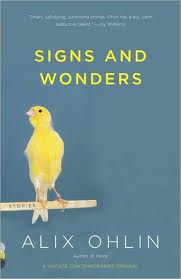
I agree with the reviewers who described this collection of sixteen short stories as a gift. And I would also describe the stories as gifts of unexpected love, love that does not appear in its usual wrappers.
While Alix Ohlin’s conflicted characters are struggling to make sense of their relationships, they are surprised to discover love in situations they thought they would never choose or even welcome into their lives.
In the title story, the protagonist suddenly realizes she hates her husband of 26 years. Ready to divorce him, an unfortunate accident turns her well-orchestrated life upside down, forcing her to face the prospect of tending him indefinitely.
While sitting in a hospital waiting room with her daughter and the second wife, a divorced woman discovers she still has feelings for her ex-husband.
Reena agrees to accompany her aunt on “The Cruise,” a post-divorce ritual that unleashes a torrent of feelings.
After connecting with the one who got away in “Who Do You Love?” Janet re-examines all her relationships and reaches an unexpected conclusion.
Alix Ohlin is gifted storyteller with an amazing eye for detail. Some of my favorite descriptions…
“She’d gotten married in a flurry of sex and promises, wearing a white dress so hideously confectionary that she felt like a parody of herself, a joke told in crinoline and lace, and even that made her happy, because it was silly and she knew they’d laugh about it later.”
“Our boss, Eric, was an elderly bohemian who wore pilled woolen cardigans and too-short pants, and spent afternoons in his office reading manuscripts while twirling his beard between his thumb and index finger, making a little curl that stood out from his chin. By five o’clock his beard would be a tufted mess of curls, all fluffed out like the feathers of some preening bird. Because of this, Sarah and I called him the titmouse.”

