Writer on Fire

On Wednesdays, I share posts, fables, songs, poems, quotations, TEDx Talks, cartoons, and books that have inspired and motivated me on my writing journey. I hope these posts will give writers, artists, and other creatives a mid-week boost.

Here’s a timely essay from author Hope Clark’s Friday newsletter:

Writers love to write. Some want to tell stories. Some want to tell THEIR stories. Some want to reach out and spread their stories around the world. Some want either to make money or not write. Some write whether the stories sell or not. There are so many types of writers, with so many nuances of those types, that one can almost say no two writers are alike.

“Find out who you are. And do it on purpose.” Dolly Parton

There’s writing. Then there’s writing with direction. Neither is wrong. However, there is something exciting about pointing your writing in a direction with a goal to reach whatever is on the horizon. In other words, a writer does have the option of taking charge of their writing instead of letting the writing do the driving. Having a map for your writing can be quite exciting.

There is nothing so empowering as to be in charge.

There is also nothing so scary as to be in charge.

Decision-making is scary, and it takes research, drive, and willpower to direct that energy. That decision-making can mean defining who you are as a writer, what you write, and where you want to be after a certain period of time.

“If you don’t like the road you’re walking, start paving another one.” Dolly Parton

Yes, the quotes are from Dolly Parton, because after all, she is a creative spirit who wisely chose how to direct her energies . . . and did well doing it. Not a bad role model.

Own yourself, own your writing, and decide how you can be happy with the results. It’s in your hands.

Source: Hope Clark
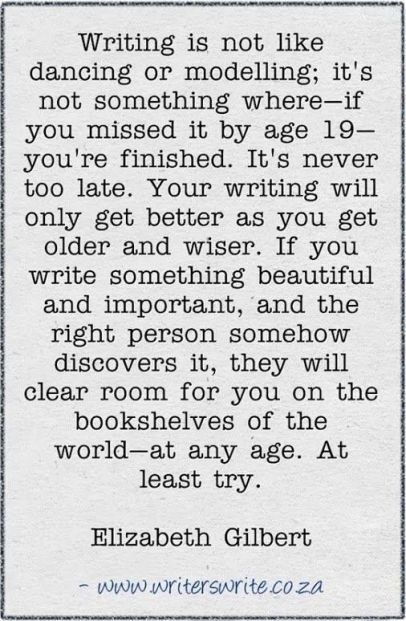
Advice from Elizabeth Gilbert

On Wednesdays, I share posts, fables, songs, poems, quotations, TEDx Talks, cartoons, and books that have inspired and motivated me on my writing journey. I hope these posts will give writers, artists, and other creatives a mid-week boost.

Inspirational advice for all writers and wannabe writers from best-selling author Elizabeth Gilbert:

10 Tricks for Good Writing

On Wednesdays, I share posts, fables, songs, poems, quotations, TEDx Talks, cartoons, and books that have inspired and motivated me on my writing journey. I hope these posts will give writers, artists, and other creatives a mid-week boost.

One of the most popular and prolific writers of our time, Elmore Leonard wrote over two dozen novels, most of them bestsellers, such as Glitz, Get Shorty, Maximum Bob, and Rum Punch. Unlike most genre writers, however, Leonard is taken seriously by the literary crowd.

What’s Leonard’s secret to being both popular and respectable? Perhaps, you’ll find some clues in his ten tricks for good writing:

1. Never open a book with weather.

2. Avoid prologues.

3. Never use a verb other than said to carry dialogue.

4. Never use an adverb to modify the verb “said” . . . he admonished gravely.

5. Keep your exclamation points under control. You are allowed no more than two or three per 100,000 words of prose.

6. Never use the words suddenly or all hell broke loose.

7. Use regional dialect, patois, sparingly.

8. Avoid detailed descriptions of characters.

9. Don’t go into great detail describing places and things.

10. Try to leave out the part that readers tend to skip.

He says, “My most important rule is one that sums up the ten. If it sounds like writing, I rewrite it.”

Excerpted from the New York Times article, “Easy on the Adverbs, Exclamation Points and Especially Hooptedoodle,” July 16, 2001.

10 Excellent Tips from Chuck Wendig

On Wednesdays, I share posts, fables, songs, poems, quotations, TEDx Talks, cartoons, and books that have inspired and motivated me on my writing journey. I hope these posts will give writers, artists, and other creatives a mid-week boost.

In his informative guide, Damn Fine Story, New York Times best-selling author Chuck Wendig shares 50 storytelling tips in the Appendix. Here are ten excellent tips about character development:

1. Characters are not role models, and stories are not lectures.

2. We care about characters we understand, so it’s your job to make us understand your characters.

3. Characters must earn their victories.

4. Characters also earn their failures and losses.

5. If your characters are getting in the way of your plot, good. Let them. They are the plot. They are the subject, so let the tale unfold in their wake, not in their absence.

6. Likeability is less important a factor in your characters than relatability. It’s not about wanting to sit down and have a beer with them; it’s about being able to live with them for the breadth of a whole novel. Forget liking them, but do remember that we have to live with them. If all else fails: Just make them interesting.

7. Characters must make mistakes. But they cannot only make mistakes. They must have triumphs, too. A story isn’t an endless array of failure and disaster—we must have some sense of success to understand why success must, above all else (and against all odds), not be lost. Further, characters who only make mistakes become intolerable to us. We start to actively root for their failure if we cannot see in them the potential for success.

8. The best villains are the ones we adore despite how much we hate and fear them. We should adore them, and we should understand them.

9. Characters don’t know what the plot is. So don’t ever expect them to follow it. We can feel when characters are forced from their own program because authors are overwriting them with the Plot Program. It feels gross. Characters only know what they want and what they’re willing to do or lose to get it.

10. Characters are more interesting when they are smart and capable instead of dumb and pliable.

Source: Damn Fine Story pp. 218-225.

Writing as Restoration

On Wednesdays, I share posts, fables, songs, poems, quotations, TEDx Talks, cartoons, and books that have inspired and motivated me on my writing journey. I hope these posts will give writers, artists, and other creatives a mid-week boost.

In a recent post on Writers Unboxed, author KL Burd shares his perspective on the restorative powers of writing. Here’s an excerpt from that post:

Writing has the power to restore, not only within your life but the lives of others as well. That’s why our words, our art, our craft is so powerful. It can be used to tear down or build up. It can be used to enslave and entrap. To inspire and set free.

There are two ways that you can bring restoration through your art. The first is to write your story. It can be fiction or nonfiction, but there’s a certain freedom that comes from putting your story to paper and letting it burst forth into life. You open your world to others and invite them in. There’s healing in knowing that you are not alone.

The second way is the same as the first:

Write your story.

This time, however, you have to go to the place where your human skill and imagination collides. You have to take whatever hope you have, be it small or large, and cast it — like an anchor — into the future. Take your imagination and dream up what your story can be, what it will be. Use your imagination to create your future reality.

Read the rest of the article here.

On Writing Naturally

On Wednesdays, I share posts, fables, songs, poems, quotations, TEDx Talks, cartoons, and books that have inspired and motivated me on my writing journey. I hope these posts will give writers, artists, and other creatives a mid-week boost.

In her book, Journal to the Self, Kathleen Adams shares the following advice:

Writing naturally means that you make it up as you go along.

Writing naturally means that you trust your inner wisdom to guide you to the places you need to go.

Writing naturally means that you freely create your diary world with confidence and ease.

Writing naturally means that you give yourself permission to play, and to cry, and to cuss, and to celebrate, and to be fully, vibrantly alive.

Writing naturally means that you allow yourself to use your journal as a blank canvas onto which the rich and intricate portrait of your life can be painted as it organically emerges.

There is only one person who can write the story of your life, with all its foibles, follies, treasures, and tears. That person is you.

Writing naturally means that you let yourself be you.

Source: Journal to the Self by Kathleen Adams

What Will You Do When Your Characters Misbehave?

When I first heard this question at a creative writing workshop, I was tempted to say that I intended to firmly hold onto the reins. A neophyte with no literary credits to my name, I couldn’t imagine characters actually misbehaving on the page. Thankfully, I paused and waited for more seasoned writers to respond.
What followed was an animated discussion about a ghostly character who suddenly appeared and replaced the original protagonist, new characters who emerged out of a conversation, and a male character who decided to change gender. In each case, the writers allowed the disruptors to alter the course of the narrative.

A bit woo-woo for my taste, but I concluded that writers—for the most part—were a motley bunch.

Continue reading on Debra Goldstein’s blog.

The Four Tendencies for Writers

Earlier this month, I participated in a WFWA (Women’s Fiction Writers Association) webinar with writer Brigitte Russell. An educator, Brigitte has a PhD in history and has taught at both K-12 and post-secondary levels. In her work for the New Mexico Public Education Department, she has also delivered numerous in-person and webinar trainings for teachers and school administrators.

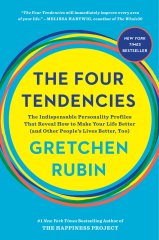
I was thrilled to discover that the webinar was based on the New York Times bestselling book, The Four Tendencies, by Gretchen Rubin. A longtime fan, I have also read Better Than Before, Happier at Home, and The Happiness Project.

Continue reading on the Soul Mate Authors blog.