All About Book Ideas

On Wednesdays, I share posts, fables, songs, poems, quotations, TEDx Talks, cartoons, and books that have inspired and motivated me on my writing journey. I hope these posts will give writers, artists, and other creatives a mid-week boost.

British author Lucy Mitchell has a delightful blogging voice that brings a smile and a thought-provoking pause to my day. I have bookmarked several of her posts for future reference. Here’s one of my favorites:

Book ideas are strange things. Some turn into books, some disappear during the drafting stages and some act as a catalyst for something else in your life. I believe book ideas come into your life for a reason, a season or a lifetime. The job for you, the writer or author, is to work out which one you are dealing with.

I can put all the book ideas I have had over the years into the following camps.

Book ideas that come into your life for a season.

This camp is full of the ideas I have had for books over the years which have not gone anywhere. Let me tell you this is a busy place. They all flew into my writer brain at high speed and left pretty much after I’d tried to get to know them. My writer relationship with them was frantic and passionate. However, they were simply creative flings.

Book ideas that come into your life for a lifetime.

This is a tough camp to get into. These are the ideas that became actual books. They are a hardy bunch who managed to stay with me through the months and years of painful drafting. There were times I wanted to delete them and run away but these ideas were persistent and never gave up.

Book Ideas that come into your life for a reason.

Now, this is my favourite camp. This is where things get interesting. As this is a busy camp, I have split it out into 3 sub groups.

The book idea that acts as the catalyst for a life change.

This is the book idea which comes into your life to spark some sort of life change. The act of writing the idea triggers something deep inside of you. These ideas are like inner keys to parts of you which have been locked up for years or have never been opened. In this camp we have book ideas which come into your life to help you become a writer and follow a new creative path. Book ideas which come into your life to signify a relationship or friendship wasn’t working. Book ideas which come into your life to show you that maybe your life is heading in the wrong direction. I have experienced a lot of these.

The book idea that teaches you something about writing.

Some ideas for books come to teach us something about our writing. A lot of the time these ideas don’t bring success. Failure is a great teacher. There are always lessons to be learned in failure and it’s because of these ideas. We now know who to blame. Ha ha! They were sent to teach us that our plot sagged, our characterisation could have been improved, there were no laugh out loud moments and our attempt sucked.

The book idea that morphs into a brilliant book idea.

These ideas are the unsung heroes. They come into our writing lives, lead us down one path and then transform before our eyes. Suddenly you realise they are showing you something else. Something bigger and better.

If you are struggling with a book idea at the moment figure out the reason why it has come into your writing life.

You can follow Lucy’s blog here.

Finish What You Start

On Wednesdays, I share posts, fables, songs, poems, quotations, TEDx Talks, cartoons, and books that have inspired and motivated me on my writing journey. I hope these posts will give writers, artists, and other creatives a mid-week boost.

In a recent post on the Writer Unboxed blog, author Rachel Toalson shared the professional benefits of finishing what we start. Here’s an excerpt from that post:

Finishing our projects cultivates our professional skills and contributes to our mastery of the writing discipline. It’s an important part of putting in the work and gaining the expertise we need as writers. It gives us so many (so many!) opportunities to learn from our mistakes and make small shifts in the way we create and write.

That means the next time we sit down to write a book, we’ll do it better—because we have one, two, three, twenty-five under our belt.

We add to our overall body of work when we finish our projects. Who doesn’t desire a large body of work? A number of finished projects, in whatever stage they’re “finished” (even first drafts; we’ll count those), provides proof of our competence and dedication—we saw this many projects through to the end. How remarkable.

I have folders and folders of finished first drafts on my computer—all proving I’m working consistently at my craft and dedicated to building a volume of work. All reminding me, when I lose faith in myself, that I can do this, and I will again.

That’s the heart of it—we can do this, and we will again.

With all these benefits to finishing the projects we start, why do we still find ourselves struggling to write “The End”?

Source: Writer Unboxed

We Get to Surprise Ourselves

On Wednesdays, I share posts, fables, songs, poems, quotations, TEDx Talks, cartoons, and books that have inspired and motivated me on my writing journey. I hope these posts will give writers, artists, and other creatives a mid-week boost.

In her latest book, Dear Writer, New York Times bestselling author Maggie Smith breaks down creativity into ten essential elements. Here’s an uplifting excerpt:

Writers are here to risk, to find new territory. We have to be very careful not to censor ourselves when we draft, not to impose order on the piece too early. So what if you’ve always written poems in meter? So what if all your stories are in first person? So what if you’ve never written a lyric essay? Or if you’ve only written essays? No one is born excelling at anything. Most babies aren’t even particularly good at the basics: eating and sleeping.

Don’t worry too much about the form as you get the raw material down; that would be like making a container at the same time as trying to fill it.

I’ve been thinking about how our work—and our lives—can stretch and change shape to accommodate more than we might think. About how writing and living both require imagination. We can’t change the past, but the rest is up for grabs. We get to make it up. We get to decide today, tomorrow, and on and on what we will try, do, and be.

On the page and off, we get to surprise ourselves.

Source: Dear Writer, pp. 76-77.

In Service of Your Writing

On Wednesdays, I share posts, fables, songs, poems, quotations, TEDx Talks, cartoons, and books that have inspired and motivated me on my writing journey. I hope these posts will give writers, artists, and other creatives a mid-week boost.

In her latest book, Dear Writer: Pep Talks & Practical Advice for the Creative Life, New York Times bestselling author Maggie Smith breaks down creativity into ten essential elements. Here’s an uplifting excerpt:

Taking care of yourself is taking care of your creativity. Taking care of yourself as a whole human being is taking care of the writer in you.

But if you still have that “you should be writing every day” voice in your ear, do it! Write every day if you can. If you’re someone who benefits from ritual—same time, same place, same beverage, same music—then lean into that! But if you can’t work in such a regular way, for whatever reason—whether you’re feeling depleted or uninspired, or life’s rhythms and demands aren’t conducive to it right now—I’m inviting you to try this instead: Commit to doing at least one thing in service of your writing every day.

This one thing can be a small thing. You might scrawl some notes in a notebook or revise an existing piece. You might chip away at a book proposal. You might research journals or presses, query an agent, or submit work. You might request books at your local library for a project or do some background reading. Yes, reading counts. Thinking counts. And since I find that I do some of my best thinking in the shower, yes, showering counts too.

Or you might give yourself space—to think, to dream, to take a long noticing walk, to make connections, to pay attention.

Source: Dear Writer by Maggie Smith, pp. 7-8

Learn What Works for You

On Wednesdays, I share posts, fables, songs, poems, quotations, TEDx Talks, cartoons, and books that have inspired and motivated me on my writing journey. I hope these posts will give writers, artists, and other creatives a mid-week boost.

In a recent post on the Writer Unboxed blog, author D. L. White shared advice for new writers. Here’s an excerpt from that post:

Read. An author who doesn’t read is like a chef who never eats food. An artist who never goes to a gallery. Where do you discover new technique and new inspiration and let other people’s success motivate you? Where do you find community with readers and other authors? Read! In your genre for study (and of course enjoyment), outside of your genre for breadth of knowledge and to be able to say you read widely. I call all of that dessert. I like dessert.

Make sure you get some dessert!

I am also not a ‘write every day’ person, but determine at what cadence you’ll write and take that seriously. Plan it out, don’t make excuses, show up for yourself. Three-month break, one month of prep, thirty days of writing like a wild person, then edit? That’s how it’s gonna have to be. Learn what works for you, and lean into that, and don’t try to write like X author because you are not that author with their brain and personality and strengths. Learn yours and use them to your advantage.

Read the rest of the post here.

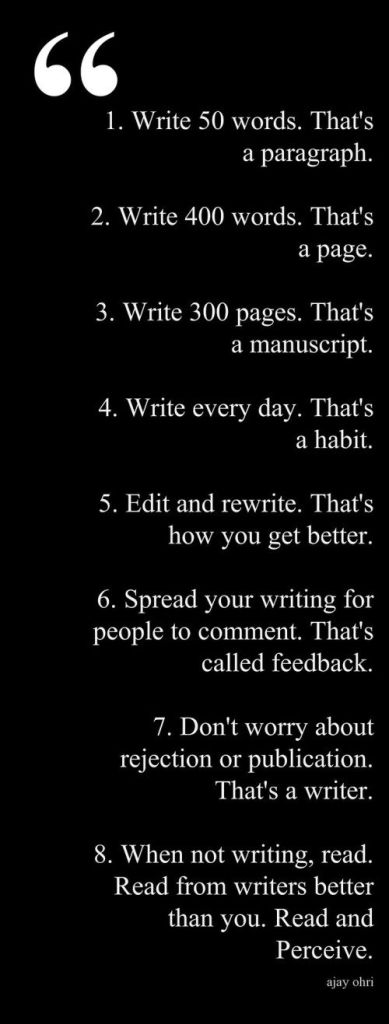
12½ Writing Rules

On Wednesdays, I share posts, fables, songs, poems, quotations, TEDx Talks, cartoons, and books that have inspired and motivated me on my writing journey. I hope these posts will give writers, artists, and other creatives a mid-week boost.

If you’re stuck and need a few writing rules…


On Writing Consistently

On Wednesdays, I share posts, fables, songs, poems, quotations, TEDx Talks, cartoons, and books that have inspired and motivated me on my writing journey. I hope these posts will give writers, artists, and other creatives a mid-week boost.

In a recent post on the Writer Unboxed blog, author Rachel Toalson shared the personal benefits of finishing what we start. Here’s an excerpt from that post:

Confidence is a huge benefit, isn’t it? Writers regularly struggle with self-doubt. Am I good enough? Can I do this? Do I have what it takes to be successful in this industry?

Seeing a project through to the end helps us overcome our persistent self-doubt. We prove that we are good enough (though that never changes; even if we don’t finish our projects, we are always good enough). We can do this. We have what it takes.

Sure, the finished project may not look quite like what we wanted and envisioned, but we persevered, and that’s what really matters—because revision is where the magic happens anyway (so be sure to start and finish that piece of the project, too). We can be proud of our efforts at whatever stage we start and finish.

Finishing our projects consistently also develops our creative discipline, which helps us overcome writing resistance. Remember the dopamine? We want to do the things that give us pleasure.

Writing is a discipline. Just like I train my body and endurance as a runner and I get out there and slog through even my unenjoyable runs, we train our minds and creativity and sharpen our writing skills by writing consistently—and seeing a project through to the end.

And lastly, finishing our projects underlines our own credibility. We can have faith in ourselves that not only can we do it, but also we will do it.

Source: Writer Unboxed.

Virtual Book Tour: The Angel Scroll by Penelope Holt

I’m happy to welcome writer and editor Penelope Holt. Today, Penelope shares excellent writing advice and her new release, The Angel Scroll.

Here’s Penelope!

So I’ve Got This Writing Quirk…

“Vigorous writing is concise!” So say Strunk and White in their book, Elements of Style, a useful if dated primer and guide for would-be writers. Concise is a word I was forced to take to heart in writing for business, where advertising copy and boilerplate often demand a strict word count and pared-down prose.

Embrace the Frag

As an editor, I learned that writers will often use five words when one will do. I embraced “the frag”—a sentence fragment that used to be a big no-no but is now a staple of breezy bloggers and content creators.

Fine Sanding a Piece

I discovered that my favorite part of writing is the fine sanding of later drafts. Making the writing more muscular. Balancing short and longer sentences to create just the right cadence. Stripping out extraneous words that are not earning their keep. Simplifying, streamlining, and cutting away the fat to give the story a sleek, lean, toned, and muscular shape.

Beware of Cutting Muscle

So business writing has taught me important lessons about crafting and curating words to express the essence of an idea. But a skill taken too far can hinder versus help. Oh no! Sometimes, I step back from a piece and realize I’ve cut away too much, lost important enhancements and embellishments that enrich a description or make a scene come alive. The writing is too sleek. There’s nothing for the reader to linger over, no place to get happily lost. It’s all too stripped down and efficient. Great for business. Bad for fiction. My word diet has gone too far and it’s time to bulk up. Here’s where I get the chance to go back into the story and find opportunities to express more nuance of feeling, linger on the details of an encounter between characters, and luxuriate in describing an evocative scene.

Balancing Rich and Lean

As a fiction writer, it’s a challenge to know when to be brief. When to keep the action moving with minimal words—dynamic writing that infuses a story with energy and momentum. And when to balance such brevity with writing detours that expand on an important moment, or to add those clever, signature details that make the writing original and alive in the reader’s mind’s eye.

Blurb

ONE ANCIENT PROPHECY, TWO HEARTBROKEN LOVERS, AND A WORLDWIDE SCAVENGER HUNT FOR THREE MIRACULOUS PAINTINGS.

After her husband’s death, New York artist Claire Lucas has baffling dreams and waking visions as she channels an enigmatic and healing painting of a holy man in India at the deathbed of a young woman. When widowed antiquarian Richard Markson announces that Claire’s canvas is one-third of three paintings prophesied by the Angel Scroll, a recently discovered Dead Sea parchment, she is pulled into an international scavenger hunt to find the stolen scroll and the paintings it predicts.

As she pursues the paintings with Richard across historic and holy sites in America, Israel, and Europe, Claire encounters a series of remarkable teachers. A Buddhist, a Benedictine monk, and a professor of early goddess worship all provide rich explanations for the artist’s compelling and perplexing psychic experiences — until she assembles the incredible triptych and deciphers its inspirational message for the modern world.

Excerpt

Hilde. Simply to think of her was to feel her presence, vibrant, beautiful, inviting. She had brought color, excitement, and warmth to his somber life of rigid routines and serious study. No matter how hard he tried, Richard couldn’t stop the memory of Hilde’s beautiful face and perfect body from moving through his memory a hundred times a day. He saw her blond hair, cut in a shimmering, sophisticated bob. He pictured how she pushed the hair on one side behind her ears and stroked her neck, as if to remind him how exciting her touch was. He remembered how she would arouse him by absentmindedly caressing him throughout the day. She gave him lingering kisses hello in the morning, and trailed her fingers in a light touch across his back when he was lost in study. She sometimes ran her palm down his arm with an exciting pressure as they talked. And at night, her hands felt for him hungrily beneath the sheets, as he wrapped himself around the beautiful body he had craved all day and finally took his pleasure.

Richard had memorized every inch of his wife’s lithe, petite frame that radiated so much sex appeal. She was vivacious, the center of attention in any group, but languid and seductive when they were alone. Mostly it was her laugh, throaty and full of easy warmth, that haunted him. Her cornflower blue eyes would brighten, and her lovely face would soften and transform itself with an even lovelier smile to accompany that unforgettable laugh. How could he speak of Hilde when it hurt so much just to think about her?

Author Bio and Links

Penelope Holt was born and educated in England and now lives in New York. She is a novelist, playwright, business writer, and marketing executive, whose work has been performed at the Edinburgh Fringe Festival, York Arts Center, and New York’s American Folk Theater. In addition to writing fiction, The Angel Scroll, and The Apple, based on the controversial Herman Rosenblat Holocaust romance, Holt is a prolific writer, editor, and co-author of non-fiction, including Business Intelligence at Work A Personal Operating System for Career Success, Singing God’s Work, the story of the Harlem Gospel Choir, and many other works. She is married with two children.

Amazon Buy Link

Giveaway

One randomly chosen winner via Rafflecopter will win a $25 Amazon/Barnes & Noble gift card. Find out more here.

Follow Penelope on the rest of her Goddess Fish tour here.


Deal with Feelings

On Wednesdays, I share posts, fables, songs, poems, quotations, TEDx Talks, cartoons, and books that have inspired and motivated me on my writing journey. I hope these posts will give writers, artists, and other creatives a mid-week boost.

Whenever I need a boost, I reread Write Smart, Write Happy by award-winning author Cheryl St. John. Here’s an uplifting excerpt:

Each time I sit down at my computer, I read something inspirational to get started. And I tell myself something positive. I’m writing a best-selling book. I’m writing an award-winning book. Readers are going to love this story. Do I feel silly saying things like that out loud? Not at all. Too many positive things have come to pass thanks to this kind of inspirational talk.

Do I still have doubts? Of course I do. Every time I receive a particularly ugly line edit. Every time I stand up to speak in front of people. Every time I get to the middle of my current book. Every time I stretch my writing a step further. Every time I have a proposal rejected.

But every accomplishment is a confidence builder, and those outweigh the negatives by far.

Deal with feelings. Get your thoughts and emotions under control. I heard somewhere that if a computer were built to have the capacity of the human mind, it would take the space of the Empire State Building to house it. And yet we only use a portion of our brains. We live in a society that believes we’re all victims; nobody’s responsible for their actions, feelings, or thoughts. Well, I don’t know about you, but I’m responsible for me. I may not be able to change my past or change other people, but I can change how I feel and how I react to situations. I can change my behavior. You can too.

Source: Write Smart, Write Happy by Cheryl St. John, p. 260