Is Your Writing Muse in a Snit?

When Guelph writer Linda Johnston informed everyone on her Twitter feed that she had written 17,000 words in three weeks, we all congratulated her and wanted to know the secret of her success. I enjoyed following her tweets regarding this sudden burst of creativity.

June 26

My writing muse has returned from her snit and is in full swing. She has fused me to the computer.

July 13

My muse dictates how much I write. I just do her bidding.

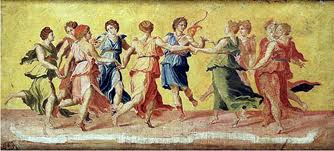
I imagined one of the nine daughters of Zeus and Mnemosyne visiting Linda each morning, taking her hand and guiding her to the computer. There, she remains offering words of encouragement until Linda produces her daily quota. Later, I discovered that Linda received inspiration from a more concrete source: Sarah Domet’s book, 90 Days to Your Novel.

Patricia Anderson, another Guelph writer, found a muse that enables her to write prolifically and enjoy a vacation at the same time. At the end of June, she sets off for her trailer in Algonquin Park where she spends the summer working on her novel (without distractions).

While researching several famous writers, I discovered some unusual muses.

Alexander Dumas color coordinated his paper. He used blue paper for novels, yellow paper for poetry and rose-colored pages for nonfiction.

Mark Twain and Truman Capote write lying down.

Ernest Hemingway sharpened dozens of pencils before starting to write.

Willa Cather read the Bible before writing each day.

Before picking up his pen, John Donne liked to lie in an open coffin. (I wonder about this one!)

In my case, I like to stick to my morning ritual of easing into the writing. After breakfast, I linger over coffee as I check my emails, Twitter and other social media. Once I finish drinking  two cups of coffee, I start writing. When I hit a writer’s block, I follow Julia Cameron‘s advice from her inspirational books—The Artist’s Way, Walking In the Wind, The Prosperous Heart—and get myself back on track. I  enjoy the morning pages, twenty-minute walks and artist’s dates.

Any other muses out there? I’d love to hear about the eccentric ones.

How Much Dialogue is Too Much?

When I first heard the expression, “You can go blind listening to that story,” I took a second look at the prose in question.  I quickly agreed that the long stretches of unbroken dialogue were tiresome and cut off all senses with the exception of hearing.

And then I revisited my own writing.

I love dialogue and often fear that I overuse it.

While dialogue serves many important functions, it is only one element of fiction. It definitely has its place, but it shouldn’t take over the story.

How much dialogue is too much?

At a recent dinner meeting of Guelph Writers Ink, Cindy Carroll suggested that thirty percent of the novel should be dialogue. Elsewhere, I read that the percentage should be closer to fifty.

Truthfully, I don’t think there is a magic number out there. Instead, I try to keep in mind that characters who talk too much can be just as annoying as real people who dominate conversations.

In their upcoming thriller, Some Kind of Peace, Scandinavian authors Camilla Grebe and Åsa Träff skillfully weave dialogue and narrative to create tension. This is especially apparent in the therapy sessions where psychologist Siri Bergman interacts with her patients.

If I focus only on the dialogue, I would probably stop reading the book.

Dialogue Only Excerpt

“I’m happy for your sake, Sara. Truly. How long have you known this man?”

“Oh, a few weeks. But we’ve been seeing each other a lot. He gave me this bag.” She held up a Gucci bag. “He takes me out to dinner. He’s nice to me.”

Sara looks at me, waiting for validation.

“Sara, you’re a grown-up and hardly need my approval before you start a relationship.”

Actual Excerpt

“I’m happy for your sake, Sara. Truly. How long have you known this…man?”

Sara looks down at the carpet, resting her upper body against her knees and rocking slowly back and forth.

“Oh, a few weeks. But we’ve seen each other a lot. He gave me this bag,” she adds, and as if to prove the legitimacy of the relationship, she holds up an oversized, monogram-patterned Gucci bag.

“He takes me out for dinner.”

I say nothing.

“He’s nice to me.”

Sara shrugs and looks questioningly at me, waiting for validation.

“Sara, you’re a grown-up and hardly need my approval before you start a relationship,” I say, but my tone of voice reveals how worried I really am.

It doesn’t seem right. A middle-aged, successful man courts a young girl with bright green nail polish, a charming borderline personality, and arms and legs zebra-striped with scars from razor blades and knives. I realize to my own surprise that I’m afraid he will exploit Sara.

Any thoughts out there?

What’s in a Name?

Last week, the topic of pseudonyms came up on the Sisters in Crime discussion board. Several members expressed an interest in using pen names and wanted more information about the legalities involved.

I was surprised to see so much interest in the topic. I have always associated pseudonyms with female writers such as Mary Anne Evans/George Eliot who used a male name to ensure that her work would be accepted by publishers and the public.

While researching the topic, I discovered more reasons for using pen names:

Authors who regularly write in more than one genre use different pen names. Romance writer Nora Roberts writes erotic thrillers under the pen name J.D. Robb.

A pen name may be used if the author believes that his/her name does not suite the genre. Western novelist Pearl Gray dropped his first name and changed the spelling of his last name to become Zane Grey.

In some countries, authors use pen names to write about controversial topics that could be politically unsafe.

Writers of romance novels are often advised to use pen names to protect themselves against stalkers.

In the past, prolific authors were asked to use pen names to prevent flooding the market with too many books in one year. Stephen King published four novels under the pseudonym Richard Bachman. After critics commented on style similarities, the books were reprinted with Stephen King’s name.  One of his books, Thinner, sold twenty times more copies after the changes were made.

Some writers wish to keep their writing career separate from their everyday life. Comic book writer Stan Lee was born Stanley Lieber. He used the pen name Stan Lee because he intended to save his real name for more serious literature. His career as a novelist never materialized so he changed his name legally to Stan Lee.

A collective name or house name is used with series fiction such as the Nancy Drew, Hardy Boys, and Bobbsey Twins series. The first book in each series was written by one writer, but subsequent books were written by ghost writers.

Collaborative authors like to have their books published under one name. Alice Alfonsi and Marc Cerasini write their Coffeehouse Mystery series using the pseudonym Cleo Coyle.

Regarding the legalities…

You don’t have to file any forms or hire a lawyer.  Simply put the phrase “writing as” on your manuscript and let the publisher know your real name to ensure that you receive payment for your work.

Any other interesting pseudonyms out there?

Nailing That First Page

At last night’s dinner meeting for Guelph Writers Ink, we discussed a variety of topics, among them the all-important first page of a novel. Opinions varied around the table with most of us agreeing that the first page must introduce the protagonist and include a crisis or conflict of some kind. While it is important to set the scene, it should be done without getting bogged down in too many descriptions.

Those of us who write crime fiction must also consider the following question: Is it necessary to place the dead body on the first page of a novel?

In a recent article, bestselling author Louise Penny offered the following advice: “If you’re writing your first work of crime fiction, place the body near the beginning of your book—preferably on the first page, perhaps the first sentence. In later books this won’t be as necessary, but agents and editors like it established early, so readers know what they’re getting.”

I am a fan of Louise Penny and inclined to follow her advice. She has walked the walk and achieved literary success with her mystery series. Her first novel, Still Life, was turned down by 50 publishers and agents before it found a home with British literary agent Teresa Chris.

In my WIP, I had originally introduced the dead body at the bottom of the second page. But after reading Louise’s article and getting advice from other writers, I reworked the first chapter and placed the dead body in the first sentence.

Any other thoughts out there?

Dealing with Dialogue Tags

Looking back at some of my earlier work, I cannot help but cringe at my use of “said bookisms” such as roared, admonished, exclaimed, queried, and hissed. I was trying to avoid overusing the word “said” and looked for suitable alternatives. I realize now that using all those words only made it sound like I enjoyed using my thesaurus. I was annoying the reader and drawing attention away from the dialogue.

It is not necessary to help the reader interpret the dialogue, or worse, tell the reader how the words are said instead of showing him. If the dialogue is strong enough, “he said” and “she said” will do. Like other parts of speech—the, is, and, but—that are used several times on each page, “said” is invisible to the reader and allows him to concentrate on the action and dialogue.

To add variety, I have been working on using action to vary the tags. I am also trying to simplify the narrative and use taut dialogue to build up tension.

The following excerpt from Kaleidoscope,  Gail Bowen’s latest in the Joanne Kilbourn Mystery series,  illustrates the effective use of dialogue:

The news I was about to deliver was harsh, and Taylor and Zack both knew it. Zack reached across the table and took our daughter’s hand.

“So how bad is it?” he asked.

“It’s bad,” I said. “Everything in the east half of the house is pretty well gone. The bedrooms are all right. The police wouldn’t let us look at the basement, but I think it’s safe to assume there’ll be structural damage there.”

“So, what’s left?” Taylor asked, her voice small.

“Your mother’s paintings are still on loan to that retrospective, so they’re safe. And the Scott Plear and your abstract were in our bedroom, so they’re fine. Nothing in your bedroom was touched.”

“But the room where the pool was is gone?” she asked.

I nodded.

“So the fresco I painted on the wall is gone?”

“Yes.”

“And the self-portrait I gave Dad for Christmas?”

“It was in the family room.”

“And the family room is gone?” Taylor’s eyes brimmed with tears, but she set her mouth in a determined line and turned to Zack. “I’ll paint another one.”

The Amateur Sleuth

sleuthWhen I decided to write a murder mystery, I gravitated toward the cozies. A longtime fan of Miss Marple, Nancy Drew and Jessica Fletcher, I felt comfortable with introducing an amateur sleuth instead of a private detective or other law enforcement officer.

My protagonist, Gilda Greco, is a career development practitioner. After winning a nineteen million dollar lottery, Gilda leaves her longtime teaching career and opens a career counselling office aimed primarily at helping boomers launch their second acts. While I haven’t won a lottery (yet), I am a retired high school teacher with a post-graduate diploma in career counselling. It made sense to create a sleuth who has my  background and skill set. Whenever Gilda discovers a body or encounters an obstacle, I  ask myself what I would in that situation. Writing in the first person also helps me get into Gilda’s head.

While researching my book, I discovered the need for getting the facts straight, especially with regard to official law enforcement.  Detectives and private investigators do not readily share information, so it is necessary for the sleuth to use her intelligence and curiosity  to uncover clues and motives. Traditionally, the amateur sleuth does save the day, but I was careful not to portray the local police force as too misguided or incompetent.