Listen to Your Inner Critic

I realize this is contrary to all the advice that’s out there. But there is something to be gained by analyzing the selected thoughts of our inner critic and taking action.

How can you distinguish those selected thoughts?


Very simply, take note of all sentences that start with “Someone should…”

Continue reading on the Sisterhood of Suspense blog.

Effective Frequency

On Wednesdays, I share posts, fables, songs, poems, quotations, TEDx Talks, cartoons, and books that have inspired and motivated me on my writing journey. I hope these posts will give writers, artists, and other creatives a mid-week boost.

Whenever I connect with fellow writers, the conversation often ends up focusing on the promotion of our books. A common lament: I don’t want to annoy potential readers with too many ads, tweets, and newsletters.

And then the inevitable question follows: How many tweets (ads, newsletters, emails, etc.) are too many?

I have yet to hear a definitive answer from anyone–online or IRL.

So, when I came across this PDF file, I knew I had to share it.


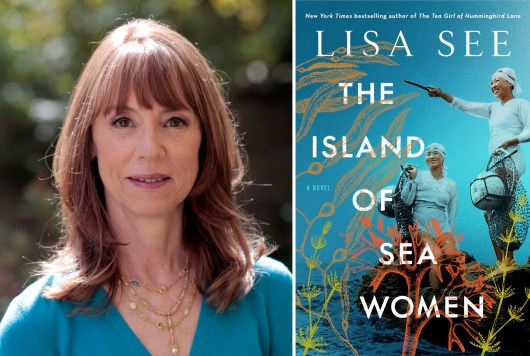
Lisa See Visits Kitchener

Yesterday, I attended “An Evening with Lisa See” at the central branch of the Kitchener Public Library. This 85 Queen Event was well attended by fans of the best-selling author of On Cold Mountain, Flower Net, The Interior, Dragon Bones, Snow Flower and the Secret Fan, Peony in Love, Shanghai Girls, and The Tea Girl of Hummingbird Lane.

Lisa See’s latest novel, The Island of Sea Women, was released earlier this month.

Kitchener reader, blogger, and dedicated volunteer Lizz DiCesare joined Lisa for an armchair conversation.

After announcing that she didn’t plan to read aloud, Lisa launched into the back story behind The Island of Sea Women.

Ten years ago, Lisa was sitting in the waiting room of a doctor’s office when she came across a short article about the haenyeo, female divers on Jeju Island off the South Korean coast. She ripped the page from the magazine and took it home.

After eight years of thinking about a possible story, she experienced a sense of urgency. Realizing that the work tradition would die within fifteen years, she decided to spend two years researching and writing the book.

While visiting Jeju Island, Lisa had a “full senses immersion” into the culture. She interviewed women in their 70s, 80s, and 90s and collected anecdotes about the matrifocal society of the island.

For generations, women divers supported their families by free-diving deep into the ocean to harvest its bounty. They possessed the abilities to hold their breaths for prolonged periods and withstand cold temperatures. Their husbands stayed home to raise the children and do menial chores.

Having read several of Lisa’s novels, I am familiar with her extraordinary attention to detail and focus on female relationships. She has always been intrigued by stories that have been lost, forgotten, or deliberately covered up.

The Island of Sea Women is sitting on my nightstand…I can’t wait to start reading!


Don’t Hesitate…Act!

I’m happy to welcome Soul Mate author Barbara Nolan to the Second Acts series. Today, Barbara shares the events that triggered her second act and her debut novel, Beyond Paradise.

Here’s Barbara!
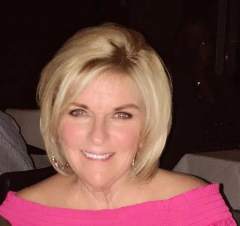
My first act centered around my family. Raising my three children who are now adults with children of their own.

There was no one specific trigger or need for change as I had been writing off and on for most of my adult life. I always said I would become serious about my writing and I believe that the passing of my father and the tragic events of 911 in the same year motivated me to take action. I furthered my education, and received a degree in Creative Writing from New York University. At NYU I worked with many talented professors who mentored me while editing and critiquing my work. Their knowledge and guidance helped me gain the confidence to move forward.

I am now an author with Soul Mate Publishing and my debut novel, Beyond Paradise, was published on December 12, 2018.

My best advice is not to wait if you have a dream. I wish that I had followed through with my dream earlier, but wherever you are in life, don’t hesitate, act.

Blurb

Jonny Vallone, the dark, brooding owner of Manhattan nightclub, Beyond Paradise, doesn’t need any more complications in his life, or women. Then savvy con artist Cheryl Benson, barges into his office and spits out a confession that would make most men run for cover.

Cheryl’s fast-paced, out-of-control life is closing in, and her only hope against a ruthless crime boss is bad boy Jonny and his powerful connections. Her knight in black Brioni has a body made for sin with enough baggage to fill a 747, but when a near-fatal attack throws the two together, they implode in a night of steamy, sheet-gripping passion.

Jonny can’t resist the beautiful blonde with the pleading green eyes plus he has his own agenda with the underworld thug who owns a piece of his soul.

Their wild ride whisks them from the high-powered glitz of Manhattan to the sultry beaches of Miami in a desperate attempt to break free of their shady pasts while trying to tame their fiery passion and the dangerous deceptions swirling around them.

Excerpt

“I’ve got you.” He pushed a stray hair away from her face and kissed her, wanting to taste more of her, be part of her, sink into her sweetness and make all her fears go away.

His eager hands roamed up her back. A decent man would’ve paced himself, given her space, but he’d never been a decent man when desire overwhelmed him. He nipped his way down her slender neck, loving the feel of her skin against his lips. He knew what he wanted. He’d wanted it ever since he’d seen her at the Oasis.

He fumbled with the hem of her T-shirt, and she covered his hand with hers.

“You want me to stop?” His words caught between a sigh and a gasp.

She pushed his hands away, tugged her shirt over her head and flung it onto the couch.

For one tantalizing second her eyes dared him with desires as overpowering and primal as his. Standing, he snatched her hand, jerked her up, and pulled her toward the bedroom, nudged the door open with his foot, then kicked it closed.

A heat boiled in the pit of his stomach and shot through his veins, melting him from the inside out. One part of him wanted to take time and explore every inch of her, while the part that controlled him wanted to tumble her to the bed.

“This isn’t a game.” He meant it as a warning, but the lust in his voice made it sound more like a challenge.

“I know.” She gasped as he snaked his hands around her waist. “‘Cause games have rules.”

buynow

Where to find Barbara…

Website | Amazon | Twitter | Goodreads | Instagram | BookBub | Facebook

Joanne here!

Barbara, Thanks for sharing your insights and advice. Too often, we wait too long and fail to act on our dreams. Best of luck with sales.

Dealing with the Facts

On Wednesdays, I share posts, fables, songs, poems, quotations, TEDx Talks, cartoons, and books that have inspired and motivated me on my writing journey. I hope these posts will give writers, artists, and other creatives a mid-week boost.

Years ago, I read Marshall Goldsmith’s book, MOJO: How to Get It, How to Keep It, How to Get It Back If You Lose It. At the time, I was dealing with some personal challenges and needed to get myself back on track. Here’s one passage that continues to resonate with me.

Waiting for the facts to change–instead of dealing with the facts as they are–is a common response to a setback. It’s the response of the owner of a dying business who refuses to cut costs or lay off workers during a continued downturn because a turnaround is just around the corner. It’s the response of a shopkeeper in a decaying part of town who gamely sticks to his product line and his way of doing business even as customers disappear, revenue shrinks, and neighboring stores shut down. The area will come back, he thinks; it can’t simply vanish.

When people wait for discomfiting facts to change into something more to their liking, they’re basically engaging in wishful thinking. It’s the opposite of over-committing because it leads to underacting (or under-committing and not acting at all). Instead of doing something, you’re frozen in place while you wait for a more comforting set of facts to appear. In a world that’s constantly rushing forward, this is akin to moving backward. That’s a mojo killer.

When the facts are not to your liking, ask yourself, “What path would I take if I knew that the situation would not get better?” Then get ready to do that. If the world changes in your favor, you haven’t lost anything. If the facts do not change, you are more ready to face the new world.

Source: MOJO: How to Get It, How to Keep It, How to Get It Back If You Lose It by Marshall Goldsmith


An Inspiring #85Event with Lisa LaFlamme and Michelle Shephard

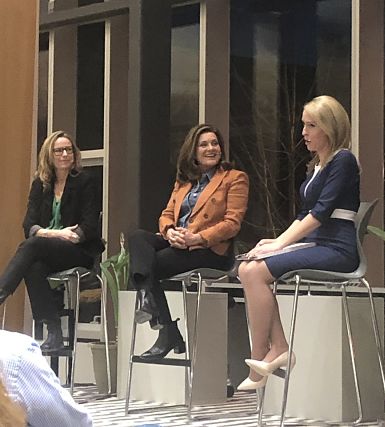
Friday evening, I drove to the central branch of the Kitchener Public Library to hear two trailblazers—Lisa LaFlamme and Michelle Shephard–speak about their careers and the challenges of women in the media.

As Chief News Anchor and Senior Editor of CTV National News since 2011, Lisa LaFlamme is well-known throughout the country. She received a very warm welcome in Kitchener, which happens to be her hometown.

An award-winning journalist, best-selling author, and filmmaker, Michelle Shephard is an investigative reporter with the Toronto Star.

Rosie Del Campo, co-host and producer of CTV Kitchener News at 5, moderated the inspirational and informative conversation that kept all of us well entertained.

L-R: Michelle Shephard, Lisa LaFlamme, Rosie Del Campo

Both women enjoyed writing during their childhood and teen years.

In Grade 9, Lisa made an appointment with her guidance counselor to discuss a possible career in writing. The woman advised her to take physics, a subject she has never had to fall back upon during her 30+ career. She enrolled in the Communications program at the University of Ottawa and obtained a job at CTV Kitchener (then named CKCO). Prior to obtaining the Anchor chair, Lisa spent a decade on the road as National Affairs Correspondent, covering everything from elections to natural disasters to wars.

After Michelle received her Bachelor of Arts degree, she considered law school, even applying to write LSAT, but ended up in journalism school. Upon graduation, she obtained a position at the Toronto Star. 9/11 was the turning point in her career. The previous day, she had covered a story about a purse snatcher in Scarborough. As soon as she heard the news, she set out for Ground Zero. Covering 9/11 began her career as a national security reporter.

Both women possess that rare combination of curiosity, passion, and fearlessness that has enabled them to survive and thrive in war zones and their workplaces. They believe that gender works to their advantage in other countries, allowing them to access other women and share their stories. Something that male journalists cannot do.

I was shocked by some of the experiences shared. The most memorable: Women in some parts of the world must take their children into their hospital beds or prison cells if they become ill or incarcerated. Childcare is not a husband’s responsibility.

In spite of the many dangers, Lisa describes the war zone as a very simple life. You have to stay alive and tell a story. You don’t have to worry about doing housework, picking up children, running errands, or any of the many daily activities of “normal” life.

Looking back at their professional lives, both women spoke about the many changes, in particular, the increase in full-time female reporters. But men still dominate in the boardroom.

When an audience member asked about sources for news items, Lisa noted that most of the experts are male. She has made concerted efforts to find female doctors, lawyers, and other experts but has encountered resistance. While many women will express their opinions in the print media, they are reluctant to appear on television. Lisa cites concern with their appearance as a factor.

Both women addressed the dark side of social media. After receiving daily threats during the 2015 election, Lisa curtailed her use of Twitter. She uses it primarily as a news feed. Michelle believes that social media is bad for all women but far worse for women of color.

Lisa feels very strongly about the escalating poison of social media. “We need to find ways to corral this poison and shut it down. We are in charge of what we read and watch. We give too much power to social media.”

When asked about their mentors, Lisa named her mother and sisters while Michelle gave the nod to a close friend in the audience. Their workplace mentors have been primarily males. Both women admitted they received a lot of help and support on their respective journeys. And they’re both actively mentoring younger generations of journalists.


Reawaken Your Creativity

On Wednesdays, I share posts, fables, songs, poems, quotations, TEDx Talks, cartoons, and books that have inspired and motivated me on my writing journey. I hope these posts will give writers, artists, and other creatives a mid-week boost.

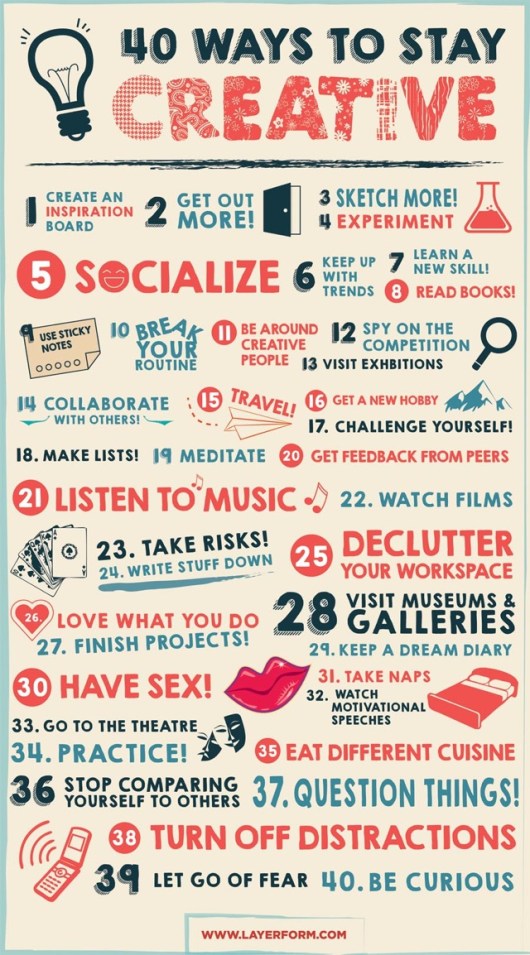
At this time of year, it can be difficult to motivate ourselves. If you’re experiencing the winter doldrums, try reawakening your creativity with one of these suggestions.


Inspired by Rebecca Traister

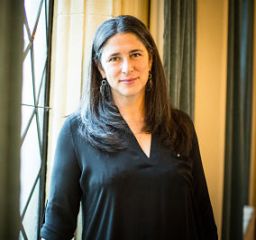
Friday evening, I attended “Good and Mad with Rebecca Traister” at the central branch of the Kitchener Public Library.

This Premiere 85 Queen Event was well-attended by fans (predominantly women) of the award-winning journalist and best-selling author of Big Girls Don’t Cry, All the Single Ladies, and Good and Mad: The Revolutionary Power of Women’s Anger.

After a brief introduction, an animated armchair conversation with Associate Professor Aimée Morrison followed.

Aimée began with the question: “Why are women afraid to get angry?”

Without missing a beat, Rebecca answered, “We fear the expression of anger.” She then went on to explain that feeling anger is a response to all sorts of unfairness—from the familial to the political—and is entirely rational.

This runs contrary to what many women have experienced throughout their lives. The message—If you are nice and polite, things will change—is reinforced while female expressions of anger are labeled emotional and hysterical. Women often put their relationships, careers, and lives at risk when showing anger.

On the other hand, powerful white men are granted rationality. Their anger is considered legitimate.

Later, this prompted the following question from an audience member: “How can we express anger in a world that wasn’t built to accept it?”

Rebecca admitted that we can’t change the world, but we can connect with others who are angry. Major social movements have occurred because people came together and organized.

Building community was the advice repeated throughout the evening. At no point did Rebecca suggest individual women let the anger loose. She did, however, allude to her own unique situation, joking that she lives in a biodome. She is literally being paid and rewarded professionally to be angry.

Rebecca is also reaping the health benefits of expressing that anger. During the four months she wrote Good and Mad, she experienced one of the physically healthiest periods of her adult life. She ate and slept well, exercised more than usual, and had great sex.

Quotable quotes from Rebecca Traister…

I’m deeply suspicious of all calls for civility.

If you keep your anger inside, you are isolated.

When you voice your anger, you become audible and visible. Others listen and join in the conversation.


On Becoming a Warrior

When Lynda Carter assumed the role of Diana Prince/Wonder Woman in the 1970s television series, I made a point of watching each program. Eyes glued to the screen, I waited with anticipation for the inevitable displays of Amazonian power. I especially liked watching Diana fling the magic lasso and use her golden belt and bracelets to deflect bullets.

She was the ultimate warrior, one that I hoped someday to emulate.

Alas, I was the ultimate non-athlete who shied away from athletic challenges and activities. In my workplace and interpersonal relationships, I preferred to adopt a non-confrontational stance that served me well (or appeared to serve me well) for almost five decades.

Continue reading on Brenda Whiteside’s blog.