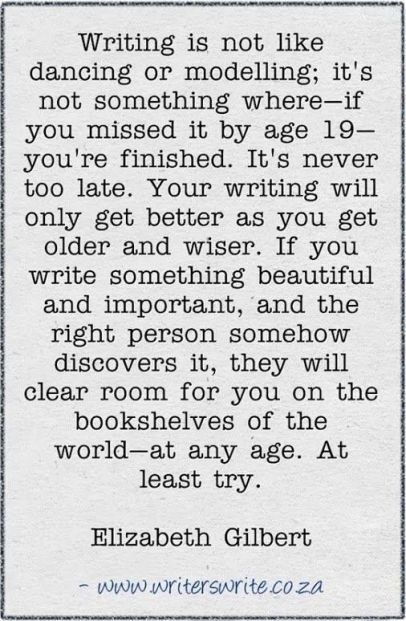
Blooming Has No Deadline

On Wednesdays, I share posts, fables, songs, poems, quotations, TEDx Talks, cartoons, and books that have inspired and motivated me on my writing journey. I hope these posts will give writers, artists, and other creatives a mid-week boost.

Here is an inspirational excerpt from You’ve Got This! by best-selling author Margie Warrell:

If you’re in your forties or fifties or sixties or far beyond, refuse to let the number of years you’ve been alive be your excuse for not taking the actions you might wish you’d taken years ago; the actions that would add a whole new dimension to your life today. As Rich Kaarlgard wrote in Late Bloomers, “Blooming has no deadline. Our future story is written in pencil, not carved in stone. It can be changed. There is no fixed chronology to self-determination, no age limit for breakthroughs.”

Julia Child was 49 when she wrote her first cookbook.

Laura Ingalls Wilder didn’t start writing until her forties, and didn’t pen Little House on the Prairie until she was in her sixties.

Vera Wang was 39 before she started designing clothes.

Colonel Harland Sanders was in his sixties when he started Kentucky Fried Chicken.

Diana Nyad was 64 when, after four failed attempts spanning 36 years, she finally achieved her long-held ambition of swimming the infamous channel of shark-ridden waters from Cuba to Florida (without a shark cage).

So whatever your age, whatever your situation, whatever the setbacks you’ve faced or the heartaches you’ve nursed or the stories you’ve told yourself about who you are and what you can do (or what you cannot do), decide right now that you will not settle for a life (career, relationships, etc.) that doesn’t light you up. More so, that you will set your sights on whatever vision—however humble or scarily huge—that does light you up. Research shows that while we lose some abilities as we grow older, the benefits of those we gain far exceed any that are lost. So rather than ask, “What can I accomplish despite my struggles?” ask yourself, “What can I accomplish because of them?”

Source: You’ve Got This! pp. 50-51

Why the Small Story Matters

On Wednesdays, I share posts, fables, songs, poems, quotations, TEDx Talks, cartoons, and books that have inspired and motivated me on my writing journey. I hope these posts will give writers, artists, and other creatives a mid-week boost.

Chuck Wendig’s informative guide, Damn Fine Story, contains a mix of personal stories, pop fiction examples, and excellent advice about storytelling. Here’s one of my favorite excerpts:

We don’t really care about the big story. We think we do. We think we care about the Empire versus the Rebel Alliance, we think we care about Spider-Man versus the Vulture, we think we care about Buffy versus the Vampires.

But we don’t. Not really. Not deeply.

What we care about is the small story embedded in there, the small story that’s the beating heart of the larger one. We care about the characters and their personal drama. We care about their families, their loved ones, their struggles to feel normal, their attempts to do right in the face of wrong. We care about Buffy wanting to fall in love and hang out with her friends and not fail out of school. We care that the villains fighting Spider-Man are often connected to him personally, and that they reflect some aspect of his troubled journey from a geeky high school student to a city-saving mutant. We care about the friendships that form between Luke, Leia, and Han.

We care because they care.

We care because their story is our story. Our story is one of friendships and family, of love lost and jealousy made, of birth and death and everything in-between.

A big story without a small story has all the substance of a laser light show. It’s pretty. It’s dazzling. And it’s very, very empty.

Look for the little story.

Look for the story about people.

Source: Damn Fine Story, pp. 79-80.

It Takes Momentum

On Wednesdays, I share posts, fables, songs, poems, quotations, TEDx Talks, cartoons, and books that have inspired and motivated me on my writing journey. I hope these posts will give writers, artists, and other creatives a mid-week boost.

Here’s an inspiring excerpt from What It Takes by award-winning entrepreneur Zahra Al-harazi:

When there are not enough hours in the day, when I feel totally overwhelmed, or when I feel lost or helpless, I organize.

In the calm of an organized mind, I move like a lioness in the Serengeti, taking down antelopes one by one. I get work done with incredible efficiency. A flood of serotonin improves my outlook and I revel in achievement—any achievement. Micro progress leads to macro progress. Antelopes lead to zebras and wildebeest. Rearranging my kitchen cupboards leads to hundred-page business plans.

Sitting on the sofa in yoga pants leads nowhere good. It’s not even fair to the yoga pants.

So, make a list and check things off. That last part is important—don’t skip it.

Start with whatever’s in front of you that’s sucking your focus dry; move on to easy stuff that adds up fast: make phone calls, pay bills, put in a load of laundry, throw out the aging produce in your fridge; then attack the wildebeest.

It won’t stand a chance.

Source: What It Takes by Zhara Al-harazi, page 316

A Radical New Challenge for Writers

On Wednesdays, I share posts, fables, songs, poems, quotations, TEDx Talks, cartoons, and books that have inspired and motivated me on my writing journey. I hope these posts will give writers, artists, and other creatives a mid-week boost.

Award-winning author Julie Carrick Dalton shares a unique perspective in a recent post on the Writer Unboxed blog. Here’s an excerpt from that post:

Writers are often asked ‘Why do you write?’ in interviews, Q&As, and dinner parties (when we used to go to dinner parties.) Why do I write? For me, the answer is easy. I love to write. I have a million stories in my head. I enjoy being part of the literary community. Writing makes me feel good. I want to inspire people. I want to entertain readers, make them feel something. I have plenty of answers—all of which are true—to the question ‘Why do you write?’

This summer I discovered that for me, the more relevant question is this: When should I not write?

I suspect there are plenty of writers out there who feel like me. Pandemic stress is heavy. We’re worried about our families and friends. We’re trying to be smart and safe in the middle of a global crisis, but also trying to live our lives with some semblance of normalcy. We’re trying to hit deadlines, and hoping we don’t let anyone down.

Every time we log onto social media, someone is telling us to write faster, earlier, longer, to get our butt in a chair, finish that book, sell that book, write another book.

I’m proposing a radical new challenge: Don’t write. (At least not all the time.)

Don’t put your butt in that chair. Don’t show up to your laptop every single day. Give yourself permission to not write sometimes. Who knows, maybe it will make you a better writer—or at least a more grounded one.

Source: Writer Unboxed Blog

Writer on Fire

On Wednesdays, I share posts, fables, songs, poems, quotations, TEDx Talks, cartoons, and books that have inspired and motivated me on my writing journey. I hope these posts will give writers, artists, and other creatives a mid-week boost.

Here’s a timely essay from author Hope Clark’s Friday newsletter:

Writers love to write. Some want to tell stories. Some want to tell THEIR stories. Some want to reach out and spread their stories around the world. Some want either to make money or not write. Some write whether the stories sell or not. There are so many types of writers, with so many nuances of those types, that one can almost say no two writers are alike.

Find out who you are. And do it on purpose.” Dolly Parton

There’s writing. Then there’s writing with direction. Neither is wrong. However, there is something exciting about pointing your writing in a direction with a goal to reach whatever is on the horizon. In other words, a writer does have the option of taking charge of their writing instead of letting the writing do the driving. Having a map for your writing can be quite exciting.

There is nothing so empowering as to be in charge.

There is also nothing so scary as to be in charge.

Decision-making is scary, and it takes research, drive, and willpower to direct that energy. That decision-making can mean defining who you are as a writer, what you write, and where you want to be after a certain period of time.

If you don’t like the road you’re walking, start paving another one.” Dolly Parton

Yes, the quotes are from Dolly Parton, because after all, she is a creative spirit who wisely chose how to direct her energies . . . and did well doing it. Not a bad role model.

Own yourself, own your writing, and decide how you can be happy with the results. It’s in your hands.

Source: Hope Clark

A Lie That Holds Us Back

On Wednesdays, I share posts, fables, songs, poems, quotations, TEDx Talks, cartoons, and books that have inspired and motivated me on my writing journey. I hope these posts will give writers, artists, and other creatives a mid-week boost.

A longtime fan of bestselling authors and coaches Marc and Angel Chernoff, I look forward to receiving their daily emails. Here’s a recent message that will resonate with all age groups:

“Starting over is not an option!”

That’s a lie many of us hold on to until the bitter end.

The idea of starting over being a bad thing is baked right into the fabric of our society’s education system. We send our children to a university when they’re 17 or 18, and basically tell them to choose a career path they’ll be happy with for the next 40 years. “But what if I choose wrong?” I remember thinking to myself. And that’s exactly what I did, in more ways than one.

Over the years, however, through bouts of failure and hardship, I’ve learned the truth through experience: you can change paths quite often in life. Yes, starting over is almost always feasible, and it’s oftentimes a pretty darn good choice too. Of course, it won’t be easy, but neither is being stuck with a lifelong career you naively chose when you were a teenager. And neither is holding on to something that’s not meant to be, or something that’s already gone.

The truth is, almost no one wins a game of chess by only moving forward; sometimes you have to move backward to put yourself in a position to win. And this is a perfect metaphor for life. Sometimes when it feels like you’re running into one dead end after another, it’s actually a sign that you’re not on the right path. Maybe you were meant to hang a left back when you took a right, and that’s perfectly fine…

Let go of what’s been done and grow from it!

Of course, that’s much easier said that done. One of the absolute hardest lessons in life is letting go – whether it’s guilt, anger, love or loss. Change is never easy – you fight to hold on and you fight to let go. But letting go is generally the healthiest path forward. It clears out toxic thoughts and choices from the past and paves the way to make the most positive use of the present. You’ve got to emotionally free yourself from some of the things that once meant a lot to you, so you can move beyond the past and the pain it brings you. Again, it takes hard work to let go and refocus yourself, but it’s worth every bit of effort you can muster!

Truth be told, inner peace begins the moment you take a new breath and choose not to allow uncontrollable past events or decisions to dominate you in the present. You are what you choose to become in this moment. Let go, breathe, and begin…

Note: I highly recommend subscribing to Marc & Angel’s website.

Advice from Elizabeth Gilbert

On Wednesdays, I share posts, fables, songs, poems, quotations, TEDx Talks, cartoons, and books that have inspired and motivated me on my writing journey. I hope these posts will give writers, artists, and other creatives a mid-week boost.

Inspirational advice for all writers and wannabe writers from best-selling author Elizabeth Gilbert:

Happy National Live Creative Day!

Today is National Live Creative Day, a day set aside to dream, discover, and invent. Consider resurrecting an old hobby, participating in a favorite pastime, or exploring a new passion.

If you’re feeling stuck, here are ten quotes to spark your imagination:

“You can’t use up creativity. The more you use the more you have.”
Maya Angelou

“What keeps life fascinating is the constant creativity of the soul.”
Deepak Chopra

“Creativity is intelligence having fun.” Albert Einstein

“Creativity requires the courage to let go of certainties.” Erich Fromm

“Creativity is just connecting things. When you ask creative people how they did something, they feel a little guilty because they didn’t really do it, they just saw something. It seemed obvious to them after a while.” Steve Jobs

“The creative adult is the child who survived.” Ursula Leguin

“You can’t wait for inspiration, you have to go after it with a club.” Jack London

“There is a fountain of youth: it is your mind, your talents, the creativity you bring to your life and the lives of people you love. When you learn to tap this source, you will truly have defeated age.” Sophia Loren

“Others have seen what is and asked why. I have seen what could be and asked why not.” Pablo Picasso

“The worst enemy to creativity is self-doubt.” Sylvia Plath

Four Hard Choices That Make You Happier in the Long Run

On Wednesdays, I share posts, fables, songs, poems, quotations, TEDx Talks, cartoons, and books that have inspired and motivated me on my writing journey. I hope these posts will give writers, artists, and other creatives a mid-week boost.

A longtime fan of bestselling authors and coaches Marc and Angel Chernoff, I look forward to receiving their daily emails. Here’s some excellent advice for these challenging times:

You need to do hard things to be happy in life. Because the hard things ultimately build you up and change your life.

And, strengthening the mind is the hardest thing you need to do for yourself…

Think about the most common difficulties we as human beings deal with in our lives—from lack of presence to lack of exercise to unhealthy diets to procrastination, and so forth. In most cases, difficulties like these are not caused not by a physical ailment, but by a weakness of the mind.

Just like every muscle in the body, the mind needs to be exercised to gain strength. It needs to be worked consistently to grow and develop over time. If you haven’t pushed yourself in hundreds of little ways over time, of course you’ll crumble on the one day that things get really challenging.

But it doesn’t have to be that way. You have a choice today…

1. You can choose to be present when it would be easier to pick up your phone.

2. You can choose to do a workout when it would be more comfortable to sit around.

3. You can choose to create something special when it would be quicker to consume something mediocre.

4. You can choose to invest in yourself when it would take less effort to procrastinate.

You can prove to yourself that you have the guts to get in the ring and wrestle with life.

Mental strength is built through lots of small, daily victories. It’s the individual choices we make day-to-day that build our “mental strength” muscles. We all want this kind of strength, but we can’t wish our way to it. If you want it, you have to create positive daily rituals—mind-strengthening rituals—in your life that reinforce what you desire.

Note: I highly recommend subscribing to Marc & Angel’s website.