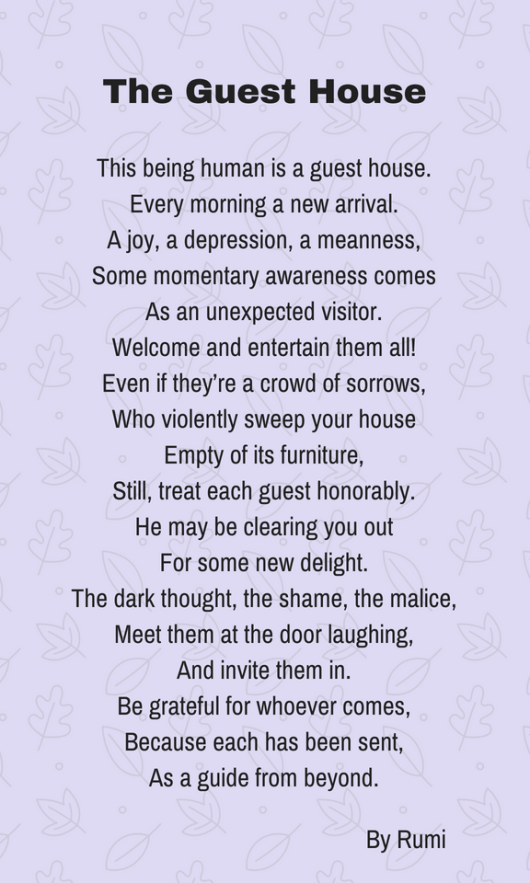
The Guest House by Rumi

On Wednesdays, I share posts, fables, songs, poems, quotations, TEDx Talks, cartoons, and books that have inspired and motivated me on my writing journey. I hope these posts will give writers, artists, and other creatives a mid-week boost.

Over 700 years ago, an Afghan man had to flee his homeland. In exile, Jal ad-Din Muhammad Rumi wrote volumes of exquisite poetry abut life, love, and loss. Here’s one of my favorites:


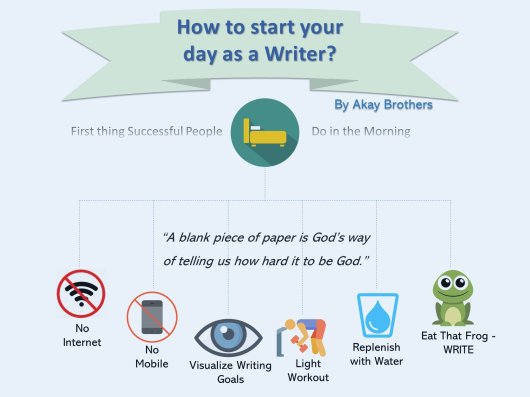
How to Start Your Day as a Writer

On Wednesdays, I share posts, fables, songs, poems, quotations, TEDx Talks, cartoons, and books that have inspired and motivated me on my writing journey. I hope these posts will give writers, artists, and other creatives a mid-week boost.

I’d like to say that I follow all the directives in the following poster and have daily productive mornings. Realistically, I aim for at least three. My struggles: No Internet and Replenish with Water. I can’t resist checking my email and social media. As for my beverage of my choice…I prefer to replenish with two cups of Chatty Matty coffee.


On the Muddy Road

On Wednesdays, I share posts, fables, songs, poems, quotations, TEDx Talks, cartoons, and books that have inspired and motivated me on my writing journey. I hope these posts will give writers, artists, and other creatives a mid-week boost.

When we dwell on past events (and transgressions), we remain stuck and unable to enjoy the gifts of the dynamic present. In the following Zen parable, one monk struggles with a rigid sense of right and wrong.

Tanzan and Ekido were once traveling together down a muddy road. A heavy rain was still falling.

Coming around a bend, they met a lovely girl in a silk kimono and sash, unable to cross the intersection.

“Come on, girl” said Tanzan at once. Lifting her in his arms, he carried her over the mud.

Ekido did not speak again until that night when they reached a lodging temple. Then he no longer could restrain himself. “We monks don’t go near females,” he told Tanzan, “especially not young and lovely ones. It is dangerous. Why did you do that?

“I left the girl there,” said Tanzan. “Are you still carrying her?”


The Untold Story of Charles M. Schultz

On Wednesdays, I share posts, fables, songs, poems, quotations, TEDx Talks, cartoons, and books that have inspired and motivated me on my writing journey. I hope these posts will give writers, artists, and other creatives a mid-week boost.

A while back, a good friend sent me this video about a man who persevered despite his circumstances. An inspiration for all of us!


Moving Mind

On Wednesdays, I share posts, fables, songs, poems, quotations, TEDx Talks, cartoons, and books that have inspired and motivated me on my writing journey. I hope these posts will give writers, artists, and other creatives a mid-week boost.

This short Zen story reminds us about the importance of mindfulness:

Two men were arguing about a flag flapping in the wind.

“It’s the wind that is really moving,” stated the first one. “No, it is the flag that is moving,” contended the second.

A Zen master, who happened to be walking by, overheard the debate and interrupted them. “Neither the flag nor the wind is moving,” he said, “It is MIND that moves.”


5 Rules for a Happy Life

On Wednesdays, I share posts, fables, songs, poems, quotations, TEDx Talks, cartoons, and books that have inspired and motivated me on my writing journey. I hope these posts will give writers, artists, and other creatives a mid-week boost.

A fan of Dame Helen Mirren, I enjoyed listening to these highlights from her Commencement Sheet at Tulane University on May 20, 2017 in New Orleans. As always, Dame Helen inspires and entertains with her timely advice.


The Other Side

On Wednesdays, I share posts, fables, songs, poems, quotations, TEDx Talks, cartoons, and books that have inspired and motivated me on my writing journey. I hope these posts will give writers, artists, and other creatives a mid-week boost.

I love Zen stories…here’s another one of my favorites:

One day a young Buddhist on his journey home came to the banks of a wide river. Staring hopelessly at the great obstacle in front of him, he pondered for hours on just how to cross such a wide barrier.

Just as he was about to give up his pursuit to continue his journey he saw a great teacher on the other side of the river. The young Buddhist yells over to the teacher, “Oh wise one, can you tell me how to get to the other side of this river”?

The teacher ponders for a moment looks up and down the river and yells back, “My son, you are on the other side.”

Source: Zen Stories


On Daring Greatly

On Wednesdays, I share posts, fables, songs, poems, quotations, TEDx Talks, cartoons, and books that have inspired and motivated me on my writing journey. I hope these posts will give writers, artists, and other creatives a mid-week boost.

In the introduction to Daring Greatly, author Brené Brown shares her perspective on “The Man in the Arena,” the famous excerpt from Theodore Roosevelt’s “Citizenship in a Republic” speech. I find myself rereading the following segment whenever I’m facing a challenging situation.

“When we spend our lives waiting until we’re perfect or bulletproof before we walk into the arena, we ultimately sacrifice relationships and opportunities that may not be recoverable, we squander our precious time, and we turn our backs on our gifts, those unique contributions that only we can make.

Perfect and bulletproof are seductive, but they don’t exist in the human experience. We must walk into the arena, whatever it may be–a new relationship, an important meeting, our creative process, or a difficult family conversation–with courage and the willingness to engage. Rather than sitting on the sidelines and hurling judgment and advice, we must dare to show up and let ourselves be seen. This is vulnerability. this is daring greatly.”


The Man in the Arena

On Wednesdays, I share posts, fables, songs, poems, quotations, TEDx Talks, cartoons, and books that have inspired and motivated me on my writing journey. I hope these posts will give writers, artists, and other creatives a mid-week boost.

I feel goosebumps whenever I hear or read the following excerpt from “Citizenship in a Republic.” Theodore Roosevelt delivered this inspiring and motivating speech at the Sorbonne in Paris, France, on April 23, 1910.

“It is not the critic who counts; not the man who points out how the strong man stumbles, or where the doer of deeds could have done them better.

The credit belongs to the man who is actually in the arena, whose face is marred by dust and sweat and blood; who strives valiantly; who errs, who comes short again and again,

because there is no effort without error and shortcoming; but who does actually strive to do the deeds; who knows great enthusiasms, the great devotions; who spends himself in a worthy cause;

who at the best knows in the end the triumph of high achievement, and who at the worst, if he fails, at least fails while daring greatly, so that his place shall never be with those cold and timid souls who neither know victory nor defeat.”


Life Lessons from Maeve Binchy

On Wednesdays, I share posts, fables, songs, poems, quotations, TEDx Talks, cartoons, and books that have inspired and motivated me on my writing journey. I hope these posts will give writers, artists, and other creatives a mid-week boost.

When I attended my first critique group, one of the writers commented: “Your stories remind me of Maeve Binchy’s books. Have you read them?”

Read them!?

I have devoured the sixteen novels and four collections of short stories written during her lifetime. I’m especially fond of Book #17, A Week in Winter, released six months after her untimely death in 2012.

Like many of her fans, I mourn the fact that there will not be another Maeve Binchy novel. I will also miss Maeve’s wonderful advice.

Here are my favorite life lessons from Maeve Binchy:

Be supportive

Maeve was blessed with parents who thought “all their geese were swans.” As an overweight child who did not excel athletically, Maeve appreciated the warmth and positive feedback she received. Later, she met and married Gordon Snell, a writer who also believed that Maeve could do anything.

In her novels, Maeve extended this positive reinforcement to her characters. She once explained: “I don’t have ugly ducklings turning into swans in my stories. I have ugly ducklings turning into confident ducks.”

Accept all gifts

In the early 1960s, Maeve worked in a Jewish school in Dublin where she taught French to Lithuanian children. At the end of the academic year, the parents gave her a trip to Israel as a present. At the time, Maeve had no spending money, but she went on the trip anyway and worked in a kibbutz—plucking chickens and picking oranges.

To reassure her parents, she regularly describing her adventures. Impressed with her writing, her father cut off the “Dear Daddy” bits and sent the letters to The Irish Times. Equally impressed, the editor published her letters as travel articles and later hired her as a columnist.

Visualize

When Maeve began writing stories and novels, she was still working as a journalist. She woke up each day at five-thirty and worked for three hours at the typewriter before going to work. To motivate herself on those dark mornings, she started to visualize the launch party for her first book. She imagined large crowds of people gathering and paying her compliments.

After several rejections, her first novel (Light a Penny Candle ) was accepted, but the publisher had no intention of hosting a launch party. Maeve didn’t miss a beat. She spent two hundred pounds, one-fifth of her advance, and organized her own party in a room over a pub, complete with wine and crisps. She invited family, friends, booksellers, and the publisher “who cringed with the shame of it all.” In the end, it was such a good experience that Maeve sat down and wrote another book.

Share

Success is not a pie where everyone who gets a slice has somehow diminished what’s left for everyone else. Maeve believed that success was “more like a cairn, a heap of stones where the more each person gets, the more it adds to the general body of work out there.” She urged aspiring writers to “borrow” the techniques of successful writers and present them in their own unique voices.

And, most important of all, keep at it.