Praying by Mary Oliver

On Wednesdays, I share posts, fables, songs, poems, quotations, TEDx Talks, cartoons, and books that have inspired and motivated me on my writing journey. I hope these posts will give writers, artists, and other creatives a mid-week boost.

This month, I’m sharing my favorite poems by Mary Oliver. I discovered today’s poem in Devotions, a collection spanning more than five decades of Mary Oliver’s literary career.

Praying

It doesn’t have to be
the blue iris, it could be
weeds in a vacant lot, or a few
small stones; just
pay attention, then patch

a few words together and don’t try
to make them elaborate, this isn’t
a contest but the doorway

into thanks, and a silence in which
another voice may speak.


The Summer Day by Mary Oliver

On Wednesdays, I share posts, fables, songs, poems, quotations, TEDx Talks, cartoons, and books that have inspired and motivated me on my writing journey. I hope these posts will give writers, artists, and other creatives a mid-week boost.

This month, I’m sharing my favorite poems by Mary Oliver. I was first introduced to her poetry when a friend shared the last two lines of the following poem.

The Summer Day

Who made the world?
Who made the swan, and the black bear?
Who made the grasshopper?
This grasshopper, I mean-
the one who has flung herself out of the grass,
the one who is eating sugar out of my hand,
who is moving her jaws back and forth instead of up and down-
who is gazing around with her enormous and complicated eyes.
Now she lifts her pale forearms and thoroughly washes her face.
Now she snaps her wings open, and floats away.
I don’t know exactly what a prayer is.
I do know how to pay attention, how to fall down
into the grass, how to kneel down in the grass,
how to be idle and blessed, how to stroll through the fields,
which is what I have been doing all day.
Tell me, what else should I have done?
Doesn’t everything die at last, and too soon?
Tell me, what is it you plan to do
with your one wild and precious life?


The Swan by Mary Oliver

On Wednesdays, I share posts, fables, songs, poems, quotations, TEDx Talks, cartoons, and books that have inspired and motivated me on my writing journey. I hope these posts will give writers, artists, and other creatives a mid-week boost.

This month, I’m sharing my favorite poems by Mary Oliver. Her creativity is stirred by nature, and her poems are filled with imagery from her daily walks near her home. In an interview, she commented. “I go off to my woods, my ponds, my sun-filled harbor, no more than a blue comma on the map of the world but, to me, the emblem of everything.”

The Swan

Did you too see it, drifting, all night, on the black river?
Did you see it in the morning, rising into the silvery air –
An armful of white blossoms,
A perfect commotion of silk and linen as it leaned
into the bondage of its wings; a snowbank, a bank of lilies,
Biting the air with its black beak?
Did you hear it, fluting and whistling
A shrill dark music – like the rain pelting the trees – like a waterfall
Knifing down the black ledges?
And did you see it, finally, just under the clouds –
A white cross Streaming across the sky, its feet
Like black leaves, its wings Like the stretching light of the river?
And did you feel it, in your heart, how it pertained to everything?
And have you too finally figured out what beauty is for?
And have you changed your life?


Celebrating National Poetry Month

On Wednesdays, I share posts, fables, songs, poems, quotations, TEDx Talks, cartoons, and books that have inspired and motivated me on my writing journey. I hope these posts will give writers, artists, and other creatives a mid-week boost.

April is National Poetry Month, a month set aside to celebrate poetry and its vital place in our society. Today, and for the next three Wednesdays, I will be sharing my favorite poems by Mary Oliver. The winner of numerous awards, among them the Pulitzer Prize, she has been described as “far and away, this country’s best-selling poet.”(New York Times).

The Journey

One day you finally knew
what you had to do, and began,
though the voices around you
kept shouting
their bad advice–
though the whole house
began to tremble
and you felt the old tug
at your ankles.
“Mend my life!”
each voice cried.
But you didn’t stop.
You knew what you had to do,
though the wind pried
with its stiff fingers
at the very foundations,
though their melancholy
was terrible.
It was already late
enough, and a wild night,
and the road full of fallen
branches and stones.
But little by little,
as you left their voices behind,
the stars began to burn
through the sheets of clouds,
and there was a new voice
which you slowly
recognized as your own,
that kept you company
as you strode deeper and deeper
into the world,
determined to do
the only thing you could do–
determined to save
the only life you could save.


On Working Very Hard

On Wednesdays, I share posts, fables, songs, poems, quotations, TEDx Talks, cartoons, and books that have inspired and motivated me on my writing journey. I hope these posts will give writers, artists, and other creatives a mid-week boost.

I enjoy reading Zen stories, especially when I feel overwhelmed with too many tasks and deadlines. Here’s one of my favorites:

A martial arts student went to his teacher and said earnestly, “I am devoted to studying your martial system. How long will it take me to master it.”

The teacher’s reply was casual, “Ten years.”

Impatiently, the student answered, “But I want to master it faster than that. I will work very hard. I will practice everyday, ten or more hours a day if I have to. How long will it take then?”

The teacher thought for a moment. “20 years.”

Source: 10 Short Zen Stories


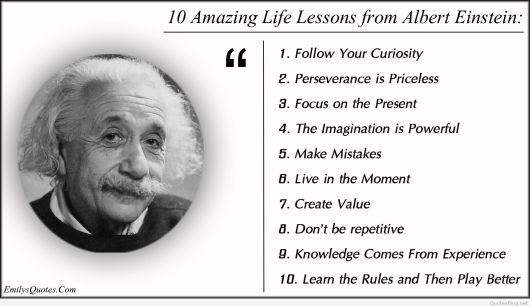
10 Amazing Life Lessons from Albert Einstein

On Wednesdays, I share posts, fables, songs, poems, quotations, TEDx Talks, cartoons, and books that have inspired and motivated me on my writing journey. I hope these posts will give writers, artists, and other creatives a mid-week boost.

Born on March 14, 1879, Albert Einstein is considered one of the most influential physicists of the 20th century. The German mathematician and physicist developed the special and general theories of relativity and went on to win the Nobel Prize for physics in 1921. His work had a major impact on the development of atomic energy.

In 1999, Canadian scientists studied his brain and discovered that his inferior parietal lobe, the area that processes spatial relationships, 3D-visualization and mathematical thought, was 15 percent wider than in people with normal intelligence. It is not surprising that he had a passion for inquiry.

Here are 10 of his life lessons…


In Praise of Indirect Paths

On Wednesdays, I share posts, fables, songs, poems, quotations, TEDx Talks, cartoons, and books that have inspired and motivated me on my writing journey. I hope these posts will give writers, artists, and other creatives a mid-week boost.

It’s easy to get discouraged when Plan A doesn’t work out, especially if considerable time, effort, and money is involved. But that shouldn’t stop any of us from implementing a Plan B, C…Z. Here are some examples of people who took indirect paths to success.


The Secret to Serenity

On Wednesdays, I share posts, fables, songs, poems, quotations, TEDx Talks, cartoons, and books that have inspired and motivated me on my writing journey. I hope these posts will give writers, artists, and other creatives a mid-week boost.

When I received this Zen parable in an email attachment, I couldn’t resist a smile. And I knew I had to share it.

Enjoy!

A harried Type A businessman went to a yogi, high on the top of a hill.

“They say you have the secret to serenity,” the businessman puffed, mopping at his brow. “I have high blood pressure, I am stressed beyond belief, and I am at the end of my rope. Teach me the secret.”

The yogi smiled beatifically (as yogis tend to do.) He then rummaged around and presented the man with a large bottle. Inside the bottle was a live duck, swimming placidly in the water trapped inside.
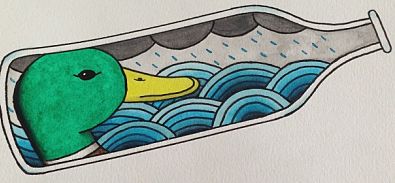
duckinbottle

“This will teach you,” the yogi said. “Get the duck out of the bottle, without breaking the bottle, or killing the duck.”

The businessman was baffled, but he’d faced tough challenges before. Swearing to have it solved in two weeks, he took the bottle and went about solving the problem.

In two weeks, he returned, looking more frazzled than before. “There has to be some trick,” he groused. “This is impossible. There has to be a cheat or something.”

The yogi simply smiled, then told him to come back in two weeks.

In another two weeks, the man looked half insane. His eyes were bulging, his clothes were unkempt, and he was furious. “I am going to smash this bottle and wring the duck’s neck if you don’t tell me how to get it out!”

The yogi simply smiled, and told him again: “Come back in two weeks.”

Another two weeks, and the man returned. This time, he was the picture of calm.

“I figured it out,” he said. “The secret to serenity. I finally got it.”

He then handed the intact bottle to the yogi, with the duck still swimming inside.

He grinned. “It’s not my bottle. And it’s not my duck.”

On Becoming Aware and Present

On Wednesdays, I share posts, fables, songs, poems, quotations, TEDx Talks, cartoons, and books that have inspired and motivated me on my writing journey. I hope these posts will give writers, artists, and other creatives a mid-week boost.

In 2008, I participated in a ten-part series presented by Oprah Winfrey and spiritual teacher Eckhart Tolle. Oprah and Eckhart took millions of viewers on a chapter-by-chapter journey through A New Earth: Awakening to Your Life’s Purpose (Eckhart’s seminal work).

Their intention: To teach viewers how to focus and become more aware and present.

Since that time, I have reread A New Earth several times and also picked up Eckhart Tolle’s other book, The Power of Now. I highly recommend both books.

Whenever Oprah hosts Eckhart on Super Soul Sunday, I make a point of watching and taking notes. I was inspired and entertained by the following interview segment from the November 12, 2012 broadcast:

Oprah: How do you accept an unpleasant situation, if change is not possible?

Eckhart: You must accept a situation, even if change is not possible. The basis for effective enlightenment is to come in alignment with the present situation. When you accept the “isness” of life, greater intelligence arises. If you are angry and resist the unpleasant situation, you will remain stuck in it.

Oprah: How do you calm the voice in your head?

Eckhart: This question implies you know that your mind can’t stop. This is a good first step. Take the energy away from these thoughts, by asking yourself if you can feel the energy in your hands. Wait and you will feel it. Then move to your legs and other body parts. The inner body serves as a wonderful anchor for a sense of presence. This allows you to be distracted from your other thoughts.

Oprah: How does one clear the mind of bad memories?

Eckhart: Recognize that these memories are thoughts only in your head. They are not realities because they have already happened.

Oprah: How do you have fun?

Eckhart: I enjoy the present moment wherever I am and that’s fun for me.

Oprah: Are you happy?

Eckhart: I am in a state of peaceful aliveness.

Oprah: What do you believe in?

Eckhart: I believe in nothing in particular. LOL

Oprah: What are you grateful for?

Eckhart: I am grateful for always this moment…the now, no matter what form it takes.