Writing in the Time of COVID-19

On Wednesdays, I share posts, fables, songs, poems, quotations, TEDx Talks, cartoons, and books that have inspired and motivated me on my writing journey. I hope these posts will give writers, artists, and other creatives a mid-week boost.

Each Friday afternoon, I receive Funds for Writers, a free weekly newsletter from C. Hope Clark. Here’s a timely and thought-provoking reflection from a recent newsletter:

Before the COVID era, we moved like fish, the current and demands of survival directing us here and there to do what keeps us alive as writers. During this era, we aren’t certain what to do because the entire industry isn’t sure what to do. Even self-publishing, which was so sure of itself before the virus, hasn’t decided how to recuperate.

Now is the perfect time to decide who you intend to be as a writer.

But you don’t know what writing will be wanted, which publishers will still be alive, what topics will be in demand and which will have fallen off a cliff. But that is a good thing. You have no parameters. You have no directives. You have nobody telling you to write this or write that.

Now is probably the best, most wide-open time in your life to write what moves you.

I was told by a zillion people in my early years that nobody wanted to read Carolina Slade. Nobody liked a rural mystery. She was too quirky. I just turned in the fifth manuscript to the publisher, and a producer is working with a movie writer on a script.

The world doesn’t want more of the same. When it recovers from this virus, and when it starts shifting into a different normal way of life, there will be few rules of thumb. All will be different. That’s why you should start working on defining yourself now. Set goals. Work daily on those goals until they become habit. Suddenly you are a different person than before. . . probably closer to who you really are, because you have no shackles and no reins. You’re finally doing what you wanted to do.

Sign up to receive Hope’s newsletter here.
Writing Tips: Stephen King and Virginia Woolf

On Wednesdays, I share posts, fables, songs, poems, quotations, TEDx Talks, cartoons, and books that have inspired and motivated me on my writing journey. I hope these posts will give writers, artists, and other creatives a mid-week boost.

Narrator Matilda Butler shares inspiration and writing tips from Stephen King and Virginia Woolf.


Believe in You

On Wednesdays, I share posts, fables, songs, poems, quotations, TEDx Talks, cartoons, and books that have inspired and motivated me on my writing journey. I hope these posts will give writers, artists, and other creatives a mid-week boost.

Whenever I need a quick pick-me-upper, I listen to these motivational messages from Debbie Allen. Background music is by Patrick Ki.


Change One Thing

On Wednesdays, I share posts, fables, songs, poems, quotations, TEDx Talks, cartoons, and books that have inspired and motivated me on my writing journey. I hope these posts will give writers, artists, and other creatives a mid-week boost.

In this time of COVID-19, it is so easy to become overwhelmed by our circumstances. Focusing on what is within our control and taking tiny steps toward future goals can help us gain perspective.

This excerpt from Cassie Werber‘s article provides more details:

In order to make any change in one’s life—whether it’s to get out of debt, become fit enough to run a marathon, or get on better with your family—start with a single change. It should be small; not a goal, but a tiny first step. It could be to run for ten minutes; to spend two minutes drawing; to prepare a healthy work lunch for one day a week. It could be to stay in hard conversations for a moment after you want to leave, and spend that moment trying to listen.

Leo Babauta (founder of Zen Habits) advises that to turn changes into habits, it’s important to make the change tiny, and let it embed: he suggests making one change every four to six weeks. Having experimented on himself, he also advises addressing one thing at a time, rather than trying to solve work, love, health, or family problems simultaneously. He’s boiled down all his teachings into what he calls one “algorithm…a series of steps that you can apply to make any change, no matter what your situation”:

1. Start very small.

2. Do only one change at a time.

3. Be present and enjoy the activity (don’t focus on results).

4. Be grateful for every step you take.

The beauty of the method is that its smallness removes the problems that result from many self-help recommendations and resolutions: too often they leave people quickly overwhelmed by the task in hand, or swamped by a sense of failure. The change should be so small it’s not hard to do. What takes rigor, for people drenched in stimuli and commitments, is identifying something that is truly small enough.

Source: The Zen Rule for Being Happy: Change One Thing

Poetry In the Time of COVID-19

On Wednesdays, I share posts, fables, songs, poems, quotations, TEDx Talks, cartoons, and books that have inspired and motivated me on my writing journey. I hope these posts will give writers, artists, and other creatives a mid-week boost.

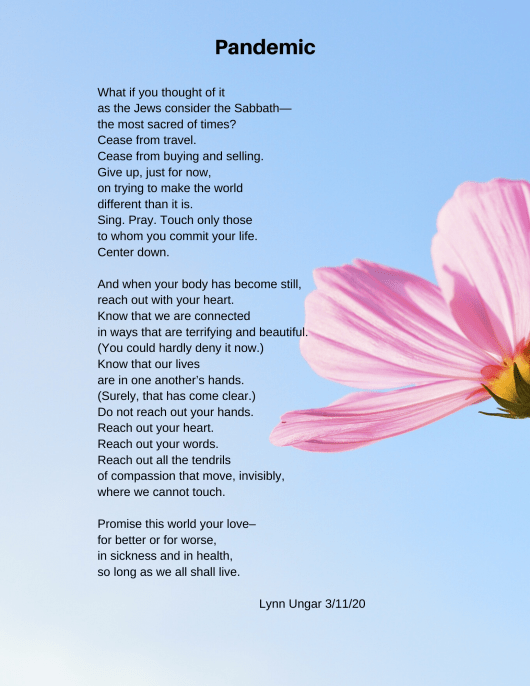
April is National Poetry Month, a month set aside to appreciate poets, past and present. Today, I’m sharing a timely poem from Lynn Ungar.

Read more about Lynn Ungar and her poems here.

Creating in the Time of Quarantine

On Wednesdays, I share posts, fables, songs, poems, quotations, TEDx Talks, cartoons, and books that have inspired and motivated me on my writing journey. I hope these posts will give writers, artists, and other creatives a mid-week boost.

On Monday, Julianna Baggott, best-selling author of over twenty books, shared an inspirational post on the Writer Unboxed blog. Here’s an excerpt that resonated with me:

Don’t beat yourself up if this is hard. You should be rethinking your priorities; and it might be difficult — in light of all that’s going on — to prioritize your craft. The other day, I wrote a paragraph — that was it and not a hard paragraph — and I was pretty sure I deserved a parade.

Also if the work feels forced or faked or simply awful to make, remember that when this work is actually finished, no one (not even you, most likely) will remember whether you wrote it on a great writing day when everything felt organic, hitting full stride, or awful. The writing will exist and sometimes that’s all that you should ask of a first draft. It will have been rewritten — no matter how it was conceived. Sculptors begin with lump of clay. We have to sit down and make the lump. So do your future self a favor and create even when you’re faking it.

Read the rest of Julianna’s blog post here.

Be At Peace Today

On Wednesdays, I share posts, fables, songs, poems, quotations, TEDx Talks, cartoons, and books that have inspired and motivated me on my writing journey. I hope these posts will give writers, artists, and other creatives a mid-week boost.

I receive a daily dose of inspiration from bestselling authors and coaches Marc and Angel Chernoff. Here’s a timely segment from Monday’s email:

The mind is our biggest battleground—you know it’s true. It’s the place where the strongest conflict resides. And with COVID-19 occupying so much of our present attention, we need now more than ever to keep ourselves in check.

In the game of life, we all receive a unique set of unexpected limitations and variables in the field of play. The question is: How will you respond to the hand you’ve been dealt? You can either focus on the lack thereof or empower yourself to play the game sensibly and resourcefully, making the very best of every outcome as it arises, even when it’s heartbreaking and hard to accept.

Obviously, with the COVID-19 virus spreading rapidly right now, we are all facing a hard reality. And while human lives are the primary concern, it is also prudent to consider the impact it may have on your mental health. Truth be told, we occupy an uncertain moment in time, on the cusp of a potentially historic event. It’s important to think of ways to mentally and emotionally prepare yourself.

Remind yourself that when you can’t control what’s happening in the world around you, you must challenge yourself to control the way you respond to what’s happening. Because that’s where your power is!

Thus, we all have some incredibly important choices to make…

We can choose how we spend our time in the days and weeks ahead. We can choose gratitude and grace. We can choose whom we socialize with—and perhaps more importantly, whom we don’t (social distancing). We can choose to love and appreciate the people in our lives for exactly who they are. We can choose to love and appreciate ourselves, too. We can choose how we’re going to respond to life’s surprises and disappointments (COVID-19 being one of them), and whether we will see them as curses or opportunities for personal growth.

And, perhaps most importantly, we can choose to think better about our present circumstances, and let go of what we can’t control, so we can consciously make the best of what’s ahead of us.

When we THINK BETTER, we LIVE BETTER, and peace becomes us.

Note: I highly recommend subscribing to Marc & Angel’s website.


Lose More to Win More

On Wednesdays, I share posts, fables, songs, poems, quotations, TEDx Talks, cartoons, and books that have inspired and motivated me on my writing journey. I hope these posts will give writers, artists, and other creatives a mid-week boost.

In his new release, You Are Awesome, New York Times bestselling author Neil Pasricha, shares the following secret to his success:

When I was a little kid, my dad bought me The Complete Major League Baseball Statistics, a frayed paperback with a green cover. I treasured it and kept it in my room for years. I flipped through it so many times.

As I paged through the numbers, I started to notice something interesting.

Cy Young had the most wins of all time in baseball (511).

Cy Young had the most losses, too (316).

Nolan Ryan had the most strikeouts (5,714).

Nolan Ryan had the most walks, too (2,795).

Why would the guy with the most wins also have the most losses? Why would the guy with the most strikeouts also have the most walks?

It’s simple.

They just played the most.

They just tried the most.

They just moved through loss the most.

It’s not how many at-bats you take.

The wins pile up when you pile on the number of times you step up to the plate.

Lose more to win more.

Source: You Are Awesome, pp 143-144

Manifest “Tiny, Little Miracles” In Your Life

On Wednesdays, I share posts, fables, songs, poems, quotations, TEDx Talks, cartoons, and books that have inspired and motivated me on my writing journey. I hope these posts will give writers, artists, and other creatives a mid-week boost.

In the following segment from a Super Soul Sunday session with Oprah, Michael Beckworth explains how intention can help manifest the kind of life you want to live.