
The Seinfeld Strategy

On Wednesdays, I share posts, fables, songs, poems, quotations, TEDx Talks, cartoons, and books that have inspired and motivated me on my writing journey. I hope these posts will give writers, artists, and other creatives a mid-week boost.

In her recent release, The 4% Fix, bestselling author Karma Brown shares time-management and goal-setting strategies that have worked for her as well as for others. Here’s one strategy recommended by Jerry Seinfeld:

Brad Isaac was a young comedian just starting out when one night he ended up at a club where Jerry Seinfeld was performing. He was able to catch up with the king of comedy backstage and asked Seinfeld if he had any tips for a newbie on the comedy circuit.

The story goes that Seinfeld told Isaac the way to be a better comic was to write better jokes, and the way to write better jokes was to write every day. Every day. He told Isaac to get a wall calendar and hang it somewhere he would see it regularly, then, with a red marker, put a big X through each day he wrote. He explained that, after a few days, Isaac would see a chain of those X marks, and after a few weeks, that long chain would be pretty satisfying. Isaac’s only job, Seinfeld told him, was to not break the chain.

This has been referred to as the “Seinfeld Strategy.” One of the main reasons it works is because it removes the pressure of focusing on a huge accomplishment (for Isaac, to deliver the best ever comedic performance, à la Jerry Seinfeld) and moves your gaze instead to a smaller, more manageable and results-based goal: write every day. It’s process-based rather than performance-based, so it isn’t about how “on” Isaac might feel during a performance, or how motivated he is, but rather about growing the chain of X days. A simple, habit-focused task.

Source: The 4% Fix by Karma Brown
One Brutal Truth that Ultimately Makes Life Beautiful Again

On Wednesdays, I share posts, fables, songs, poems, quotations, TEDx Talks, cartoons, and books that have inspired and motivated me on my writing journey. I hope these posts will give writers, artists, and other creatives a mid-week boost.

A longtime fan of bestselling authors and coaches Marc and Angel Chernoff, I look forward to receiving their daily emails. Here’s a recent message that may resonate with anyone who is struggling to achieve their goals.

If you want something in life, you also have to want the costs of getting it.

Most people want the reward without the risk. The shine without the grind. But you can’t have a destination without a journey. And a journey always has costs…

So instead of thinking about what you want, first ask yourself:

“What am I willing to give up to get it?”

Or, for those inevitably hard days:

“What is worth suffering for?”

Seriously, think about it…

If you want the six-pack abs, you have to want the sore muscles, the sweaty clothes, the morning or afternoon workouts, and the healthy meals.

If you want the successful business, you have to also want the long days, the stressful business decisions, and the possibility of failing several times to learn what you need to know to succeed.

And the same general philosophy holds true for HEALING any source of pain in your life – you have to want to WORK through the pain, step by step.

Regardless of what you want the next chapter of your life to look like, you have to consistently DO things that support this idea. An idea, after all, isn’t going to do anything for you until you do something productive with it. In fact, as long as that great idea is just sitting around in your head, it’s doing far more harm than good. Your subconscious mind knows you’re procrastinating on something that’s important to you. The required work that you keep postponing causes stress, anxiety, fear, and usually more procrastination – a vicious cycle that continues to worsen until you interrupt it with positive ACTION. That’s the brutal truth!

The best action you can take right now, though, is changing how you THINK about the actions you need to take…

And there is a path. Marc and I have walked this path ourselves many times. A decade ago, in quick succession, we dealt with several significant, unexpected losses and life changes back-to-back, including losing my brother to suicide, losing a mutual best friend to cardiac arrest, financial unrest, and more. The weight of these dire circumstances had us STUCK to say the least, and we were avoiding the very actions we needed to take to heal and move forward. But, by changing our thinking, these circumstances became the proving ground for achieving renewed happiness and beauty in our lives.

The key is to understand that no matter what happens, or what challenges you face, you can choose your response, which dictates pretty much everything that happens next. Truly, the greatest weapon you have against pain, anxiety, negativity and stress is your ability to choose one present thought and action over another – to train your mind to make the best of what you’ve got in front of you, even when the journey is harder than you expected.

Yes, YOU CAN change the way you think and respond to life! And once you do, you can master a new way to be.

Note: I highly recommend subscribing to Marc & Angel’s website.


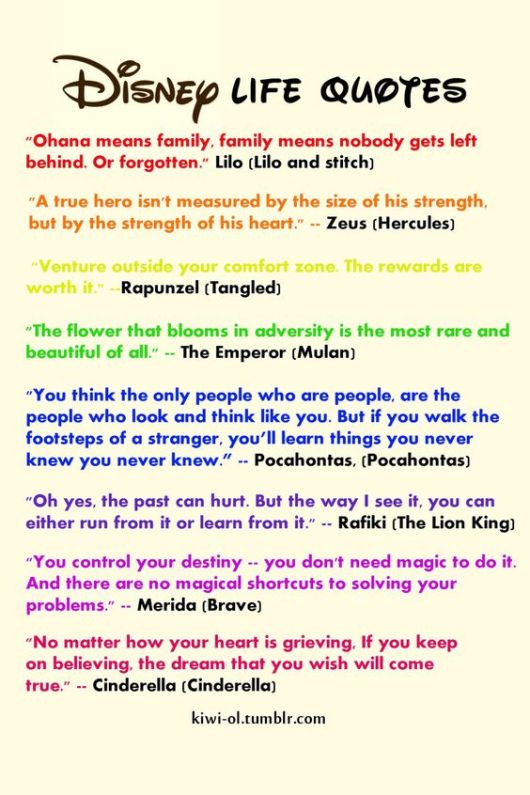
8 Disney Life Quotes

On Wednesdays, I share posts, fables, songs, poems, quotations, TEDx Talks, cartoons, and books that have inspired and motivated me on my writing journey. I hope these posts will give writers, artists, and other creatives a mid-week boost.

Take a few minutes to reflect upon these Disney life quotes. Do any resonate with you at this time?


Life quote that resonates with me…

Venture outside your comfort zone. The rewards are worth it. Rapunzel (Tangled)

Which life quote speaks to you?

Two Ways to Quiet the Negative Voice Inside YOU

On Wednesdays, I share posts, fables, songs, poems, quotations, TEDx Talks, cartoons, and books that have inspired and motivated me on my writing journey. I hope these posts will give writers, artists, and other creatives a mid-week boost.

I receive a daily dose of inspiration from bestselling authors and coaches Marc and Angel Chernoff. Here’s an excerpt from a recent email:

Why do we think negatively when we know better?

Because thinking negatively, expecting “the worst,” seeing the downside of positive situations, and even downright expecting failure, all convey a kind of backwards-thinking, emotional insurance policy. It goes something like, “If I expect a tragedy, then I won’t be disappointed when it takes place.”

Of course, this is NOT what we truly want or need in our lives. So how can we stop talking ourselves into these thinking traps? Let’s take a look at two powerful ways to quiet the negative inner voice that leads us astray:

1. Start focusing on the grey area between the extremes.

Life simply isn’t black or white – 100% of this or 100% of that – all or nothing. Thinking in extremes like this is a fast way to misery, because negative thinking tends to view any situation that’s less than perfect as being extremely bad. For example:

• Rather than the rainstorm slowing down my commute home from work, instead “it wasted my whole evening and ruined my night!”
• Rather than just accepting the nervousness of meeting a new group of people, “I know these people are not going to like me.”

Since 99.9% of all situations in life are less than perfect, black and white thinking tends to make us focus on the negative – the drama, the failures, and the worst-case scenarios. Sure, catastrophes occur on occasion, but contrary to what you may see on the evening news, most of life occurs in a grey area between the extremes of bliss and devastation.

2. Stop looking for negative signs from others.

Too often we jump to conclusions, only to cause ourselves and others unnecessary worry, hurt, and anger. If someone says one thing, don’t assume they mean something else. If they say nothing at all, don’t assume their silence has some hidden, negative connotation.

Thinking negatively will inevitably lead you to interpret everything another person does as being negative, especially when you are uncertain about what the other person is thinking. For instance, “He hasn’t called, so he must not want to talk to me,” or, “She only said that to be nice, but she doesn’t really mean it.”

Assigning meaning to a situation before you have the whole story makes you more likely to believe that the uncertainty you feel (based on lack of knowing) is a negative sign. On the flip-side, holding off on assigning meaning to an incomplete story is a primary key to overcoming negative thinking. When you think more positively, or simply more clearly about the facts, you’ll be able to evaluate all possible reasons you can think of, not just the negative ones. In other words, you’ll be doing more of: “I don’t know why he hasn’t called yet, but maybe… he’s actually extremely busy at work today.”

Being able to distinguish between what you imagine and what is actually happening in your life is an important step towards living a happier life.

Note: I highly recommend subscribing to Marc & Angel’s website.


Circle of Love

On Wednesdays, I share posts, fables, songs, poems, quotations, TEDx Talks, cartoons, and books that have inspired and motivated me on my writing journey. I hope these posts will give writers, artists, and other creatives a mid-week boost.

In his book, Think Like a Monk, Jay Shetty provides the following insight on a verse from a well=known poem:

A well-known poem by Jean Dominique Martin says, “People come into your life for a reason, a season or a lifetime.” These three categories are based on how long that relationship should endure.

One person may enter your life as a welcome change. Like a new season, they are an exciting and enthralling shift of energy. But the season ends at some point, as all seasons do. Another person might come in with a reason. They help you learn and grow, or they support you through a difficult time. It almost feels like they’ve been deliberately sent to you to assist or guide you through a particular experience, after which their central role in your life decreases. And then there are lifetime people. They stand by your side through the best and worst of times, loving you even when you are giving nothing to them.

When you consider these categories, keep in mind the circle of love. Love is a gift without any strings attached. This means that with it comes the knowledge that not all relationships are meant to endure with equal strength indefinitely. Remember that you are also a season, a reason, and a lifetime friend to different people at different times, and the role you play in someone else’s life won’t always match the role they play in yours.

Source: Think Like a Monk by Jay Shetty, pp. 230-231


Our Thoughts Rule

On Wednesdays, I share posts, fables, songs, poems, quotations, TEDx Talks, cartoons, and books that have inspired and motivated me on my writing journey. I hope these posts will give writers, artists, and other creatives a mid-week boost.

I receive a daily dose of inspiration from bestselling authors and coaches Marc and Angel Chernoff. Here’s an excerpt from a recent email:

A puppy thinks: “Hey, these people I live with feed me, love me, provide me with a warm, dry home, pet me and take good care of me…

… THEY MUST BE GODS!”

A kitten thinks: “Hey, these people I live with feed me, love me, provide me with a warm, dry home, pet me and take good care of me…

… I MUST BE A GOD!”

Same situation, different thinking.

To a great extent, we make our own life stories by our thoughts. The reality we ultimately create is a process of our daily thinking. And when our daily thinking is right, our daily actions can’t be wrong in the long run.

Note: I highly recommend subscribing to Marc & Angel’s website.


Good Enough is Good Enough

On Wednesdays, I share posts, fables, songs, poems, quotations, TEDx Talks, cartoons, and books that have inspired and motivated me on my writing journey. I hope these posts will give writers, artists, and other creatives a mid-week boost.

I highly recommend The Gift: 12 Lessons to Save Your Life by eminent psychologist and Holocaust survivor Dr. Edith Eger. Here’s an excerpt that I like to read whenever I experience a writing block:

Often when we’re stuck it’s not that we don’t know what to do. It’s that we’re afraid we won’t do it well enough. We’re self-critical. We hold high standards. We want others’ approval—most of all, our own—and think we can earn it by being Superman or Superwoman. But if you’re perfectionistic, you’re going to procrastinate, because perfect means never.

Here’s another way to think about it. If you’re perfectionistic, you’re competing with God. And you’re human. You’re going to make mistakes. Don’t try to beat God, because God will always win.

It doesn’t take courage to strive for perfection. It takes courage to be average. To say, “I’m okay with me.” To say, “Good enough is good enough.”

Source: The Gift, pp. 143-144

Choose Yourself Today

On Wednesdays, I share posts, fables, songs, poems, quotations, TEDx Talks, cartoons, and books that have inspired and motivated me on my writing journey. I hope these posts will give writers, artists, and other creatives a mid-week boost.

A longtime fan of bestselling authors and coaches Marc and Angel Chernoff, I look forward to receiving their daily emails. Here’s a recent message that articulates the importance of self-love.

Ready to get real? There are certain people and situations that aren’t meant to fit into your life no matter how much you want them to. It’s tough to hear, I know, but maybe a happy ending doesn’t include anyone or anything else right now. Maybe it’s just you, on your own, picking up the pieces and starting over, freeing yourself for something more. Maybe a happy ending is simply letting go.

Do your best to let go — to be free. Don’t get to the end of this week and find that you lived only the length of it; live the width of it as well. When it comes to living as a passionate, inspired human being, the only challenge greater than learning to walk a mile in someone else’s shoes, is learning to walk a lifetime comfortably in your own. Follow your heart, and take your mind with you. When you are truly comfortable in your own skin, not everyone will support you, but you won’t care about it one bit.

In the end, loving yourself is about enjoying your life, trusting your own feelings, taking chances, losing and finding happiness, cherishing the memories, and learning from the past. Sometimes you simply have to stop worrying, wondering, and doubting. Have faith that things will work out, maybe not exactly how you planned, just how it’s meant to be.

This, of course, is much easier said than done. But please give yourself a chance.

You may have been beaten down by adversity, or sidetracked by rejection, but you are not broken. So, don’t let anyone or anything convince you otherwise. Heal yourself by refusing to belittle yourself. Choose to stand out, to do what you know in your heart is right at this moment. Choose to appreciate yourself for who you are, accepting your scars entirely and sincerely. Make self-love a daily ritual.

Truth be told, you won’t always be a priority to others, and that’s why you need to be a priority to yourself. Learn to respect yourself, take care of yourself, and become your own support system. Your needs matter. Start meeting them. Don’t wait on others to choose you.

Choose yourself today.

Note: I highly recommend subscribing to Marc & Angel’s website.

Become the Lake

On Wednesdays, I share posts, fables, songs, poems, quotations, TEDx Talks, cartoons, and books that have inspired and motivated me on my writing journey. I hope these posts will give writers, artists, and other creatives a mid-week boost.

In his bestselling book, Think Like a Monk, Jay Shetty shares the following story about the importance of perspective.

“What brings you to me?” asked an old, wise woman of the young man who stood before her.

“I see joy and beauty around me, but from a distance,” the young man said. “My own life is full of pain.

The wise woman was silent. She poured a cup of water for the sad young man and handed it to him. Then she held out a bowl of salt.

“Put some in the water,” she said.

The young man hesitated, then took a small pinch of salt.

“More. A handful,” the old man said.

Looking skeptical, the young man put a scoop of salt in his cup. The old woman gestured with her head, instructing the young man to drink. He took a sip of water, made a face, and spat it on the dirt floor.

“How was it?” the old woman asked.

“Thanks, but no thanks,” said the young man rather glumly.

The old woman smiled knowingly, then handed the young man the bowl of salt and led him to a nearby lake. The water was clear and cold. “Now put a handful of salt in the lake,” she said.

The young man did as he was instructed, and the salt dissolved into the water. “Have a drink,” the old woman said.

The young man knelt at the water’s edge and slurped from his hands.

When he looked up, the old woman again asked, “How was it?”

“Refreshing,” said the young man.

“Could you taste the salt?” asked the old woman.

The young man smiled sheepishly. “Not at all,” he said.

The old woman knelt next to the man, helped herself to some water and said, “The salt is the pain of life. It is constant, but if you put it in a small glass, it tastes bitter. If you put it in a lake, you can’t taste it. Expand your senses, expand your world, and the pain will diminish. Don’t be the glass. Become the lake.”

Source: Think Like a Monk by Jay Shetty, p. 218