It Takes Momentum

On Wednesdays, I share posts, fables, songs, poems, quotations, TEDx Talks, cartoons, and books that have inspired and motivated me on my writing journey. I hope these posts will give writers, artists, and other creatives a mid-week boost.

Here’s an inspiring excerpt from What It Takes by award-winning entrepreneur Zahra Al-harazi:

When there are not enough hours in the day, when I feel totally overwhelmed, or when I feel lost or helpless, I organize.

In the calm of an organized mind, I move like a lioness in the Serengeti, taking down antelopes one by one. I get work done with incredible efficiency. A flood of serotonin improves my outlook and I revel in achievement—any achievement. Micro progress leads to macro progress. Antelopes lead to zebras and wildebeest. Rearranging my kitchen cupboards leads to hundred-page business plans.

Sitting on the sofa in yoga pants leads nowhere good. It’s not even fair to the yoga pants.

So, make a list and check things off. That last part is important—don’t skip it.

Start with whatever’s in front of you that’s sucking your focus dry; move on to easy stuff that adds up fast: make phone calls, pay bills, put in a load of laundry, throw out the aging produce in your fridge; then attack the wildebeest.

It won’t stand a chance.

Source: What It Takes by Zhara Al-harazi, page 316

A Radical New Challenge for Writers

On Wednesdays, I share posts, fables, songs, poems, quotations, TEDx Talks, cartoons, and books that have inspired and motivated me on my writing journey. I hope these posts will give writers, artists, and other creatives a mid-week boost.

Award-winning author Julie Carrick Dalton shares a unique perspective in a recent post on the Writer Unboxed blog. Here’s an excerpt from that post:

Writers are often asked ‘Why do you write?’ in interviews, Q&As, and dinner parties (when we used to go to dinner parties.) Why do I write? For me, the answer is easy. I love to write. I have a million stories in my head. I enjoy being part of the literary community. Writing makes me feel good. I want to inspire people. I want to entertain readers, make them feel something. I have plenty of answers—all of which are true—to the question ‘Why do you write?’

This summer I discovered that for me, the more relevant question is this: When should I not write?

I suspect there are plenty of writers out there who feel like me. Pandemic stress is heavy. We’re worried about our families and friends. We’re trying to be smart and safe in the middle of a global crisis, but also trying to live our lives with some semblance of normalcy. We’re trying to hit deadlines, and hoping we don’t let anyone down.

Every time we log onto social media, someone is telling us to write faster, earlier, longer, to get our butt in a chair, finish that book, sell that book, write another book.

I’m proposing a radical new challenge: Don’t write. (At least not all the time.)

Don’t put your butt in that chair. Don’t show up to your laptop every single day. Give yourself permission to not write sometimes. Who knows, maybe it will make you a better writer—or at least a more grounded one.

Source: Writer Unboxed Blog

Writer on Fire

On Wednesdays, I share posts, fables, songs, poems, quotations, TEDx Talks, cartoons, and books that have inspired and motivated me on my writing journey. I hope these posts will give writers, artists, and other creatives a mid-week boost.

Here’s a timely essay from author Hope Clark’s Friday newsletter:

Writers love to write. Some want to tell stories. Some want to tell THEIR stories. Some want to reach out and spread their stories around the world. Some want either to make money or not write. Some write whether the stories sell or not. There are so many types of writers, with so many nuances of those types, that one can almost say no two writers are alike.

Find out who you are. And do it on purpose.” Dolly Parton

There’s writing. Then there’s writing with direction. Neither is wrong. However, there is something exciting about pointing your writing in a direction with a goal to reach whatever is on the horizon. In other words, a writer does have the option of taking charge of their writing instead of letting the writing do the driving. Having a map for your writing can be quite exciting.

There is nothing so empowering as to be in charge.

There is also nothing so scary as to be in charge.

Decision-making is scary, and it takes research, drive, and willpower to direct that energy. That decision-making can mean defining who you are as a writer, what you write, and where you want to be after a certain period of time.

If you don’t like the road you’re walking, start paving another one.” Dolly Parton

Yes, the quotes are from Dolly Parton, because after all, she is a creative spirit who wisely chose how to direct her energies . . . and did well doing it. Not a bad role model.

Own yourself, own your writing, and decide how you can be happy with the results. It’s in your hands.

Source: Hope Clark

A Lie That Holds Us Back

On Wednesdays, I share posts, fables, songs, poems, quotations, TEDx Talks, cartoons, and books that have inspired and motivated me on my writing journey. I hope these posts will give writers, artists, and other creatives a mid-week boost.

A longtime fan of bestselling authors and coaches Marc and Angel Chernoff, I look forward to receiving their daily emails. Here’s a recent message that will resonate with all age groups:

“Starting over is not an option!”

That’s a lie many of us hold on to until the bitter end.

The idea of starting over being a bad thing is baked right into the fabric of our society’s education system. We send our children to a university when they’re 17 or 18, and basically tell them to choose a career path they’ll be happy with for the next 40 years. “But what if I choose wrong?” I remember thinking to myself. And that’s exactly what I did, in more ways than one.

Over the years, however, through bouts of failure and hardship, I’ve learned the truth through experience: you can change paths quite often in life. Yes, starting over is almost always feasible, and it’s oftentimes a pretty darn good choice too. Of course, it won’t be easy, but neither is being stuck with a lifelong career you naively chose when you were a teenager. And neither is holding on to something that’s not meant to be, or something that’s already gone.

The truth is, almost no one wins a game of chess by only moving forward; sometimes you have to move backward to put yourself in a position to win. And this is a perfect metaphor for life. Sometimes when it feels like you’re running into one dead end after another, it’s actually a sign that you’re not on the right path. Maybe you were meant to hang a left back when you took a right, and that’s perfectly fine…

Let go of what’s been done and grow from it!

Of course, that’s much easier said that done. One of the absolute hardest lessons in life is letting go – whether it’s guilt, anger, love or loss. Change is never easy – you fight to hold on and you fight to let go. But letting go is generally the healthiest path forward. It clears out toxic thoughts and choices from the past and paves the way to make the most positive use of the present. You’ve got to emotionally free yourself from some of the things that once meant a lot to you, so you can move beyond the past and the pain it brings you. Again, it takes hard work to let go and refocus yourself, but it’s worth every bit of effort you can muster!

Truth be told, inner peace begins the moment you take a new breath and choose not to allow uncontrollable past events or decisions to dominate you in the present. You are what you choose to become in this moment. Let go, breathe, and begin…

Note: I highly recommend subscribing to Marc & Angel’s website.

Advice from Elizabeth Gilbert

On Wednesdays, I share posts, fables, songs, poems, quotations, TEDx Talks, cartoons, and books that have inspired and motivated me on my writing journey. I hope these posts will give writers, artists, and other creatives a mid-week boost.

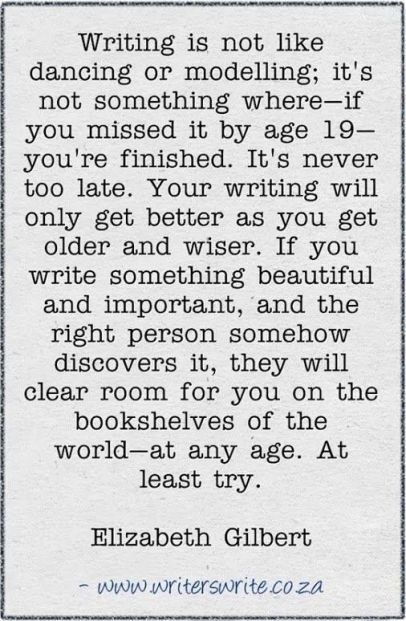
Inspirational advice for all writers and wannabe writers from best-selling author Elizabeth Gilbert:

Four Hard Choices That Make You Happier in the Long Run

On Wednesdays, I share posts, fables, songs, poems, quotations, TEDx Talks, cartoons, and books that have inspired and motivated me on my writing journey. I hope these posts will give writers, artists, and other creatives a mid-week boost.

A longtime fan of bestselling authors and coaches Marc and Angel Chernoff, I look forward to receiving their daily emails. Here’s some excellent advice for these challenging times:

You need to do hard things to be happy in life. Because the hard things ultimately build you up and change your life.

And, strengthening the mind is the hardest thing you need to do for yourself…

Think about the most common difficulties we as human beings deal with in our lives—from lack of presence to lack of exercise to unhealthy diets to procrastination, and so forth. In most cases, difficulties like these are not caused not by a physical ailment, but by a weakness of the mind.

Just like every muscle in the body, the mind needs to be exercised to gain strength. It needs to be worked consistently to grow and develop over time. If you haven’t pushed yourself in hundreds of little ways over time, of course you’ll crumble on the one day that things get really challenging.

But it doesn’t have to be that way. You have a choice today…

1. You can choose to be present when it would be easier to pick up your phone.

2. You can choose to do a workout when it would be more comfortable to sit around.

3. You can choose to create something special when it would be quicker to consume something mediocre.

4. You can choose to invest in yourself when it would take less effort to procrastinate.

You can prove to yourself that you have the guts to get in the ring and wrestle with life.

Mental strength is built through lots of small, daily victories. It’s the individual choices we make day-to-day that build our “mental strength” muscles. We all want this kind of strength, but we can’t wish our way to it. If you want it, you have to create positive daily rituals—mind-strengthening rituals—in your life that reinforce what you desire.

Note: I highly recommend subscribing to Marc & Angel’s website.
10 Tricks for Good Writing

On Wednesdays, I share posts, fables, songs, poems, quotations, TEDx Talks, cartoons, and books that have inspired and motivated me on my writing journey. I hope these posts will give writers, artists, and other creatives a mid-week boost.

One of the most popular and prolific writers of our time, Elmore Leonard wrote over two dozen novels, most of them bestsellers, such as Glitz, Get Shorty, Maximum Bob, and Rum Punch. Unlike most genre writers, however, Leonard is taken seriously by the literary crowd.

What’s Leonard’s secret to being both popular and respectable? Perhaps, you’ll find some clues in his ten tricks for good writing:

1. Never open a book with weather.

2. Avoid prologues.

3. Never use a verb other than said to carry dialogue.

4. Never use an adverb to modify the verb “said” . . . he admonished gravely.

5. Keep your exclamation points under control. You are allowed no more than two or three per 100,000 words of prose.

6. Never use the words suddenly or all hell broke loose.

7. Use regional dialect, patois, sparingly.

8. Avoid detailed descriptions of characters.

9. Don’t go into great detail describing places and things.

10. Try to leave out the part that readers tend to skip.

He says, “My most important rule is one that sums up the ten. If it sounds like writing, I rewrite it.”

Excerpted from the New York Times article, “Easy on the Adverbs, Exclamation Points and Especially Hooptedoodle,” July 16, 2001.

You’re Never Too Old to Grow in Your Thinking

On Wednesdays, I share posts, fables, songs, poems, quotations, TEDx Talks, cartoons, and books that have inspired and motivated me on my writing journey. I hope these posts will give writers, artists, and other creatives a mid-week boost.

Here’s a thought-provoking entry from Joyce Meyer’s devotional, Trusting God Day by Day.

Dr. Caroline Leaf, a leading brain scientist/learning specialist and committed Christian, notes in her teaching on the brain: “The Word and science believe that the mind and the brain are one.” The way you think is voluntary—you can control your thoughts. I want you to give your brain a new job and begin to teach your mind to work for you instead of against you.

One important way to do this is to make the intentional decision that you will begin to think positively. I realize your brain won’t be able to fulfill the new role completely overnight. You may be asking it to undergo a radical transformation, and that will take time. So, give it a little grace, but determine that with your diligence and God’s help, your brain will go to work for you instead of against you and become a powerful, positive force in your life.

I like what Dr. Leaf says—that the human brains takes “eighteen years to grow and a lifetime to mature.” Don’t miss this point. Although every other organ in the body is fully formed when a person is born, and simply gets bigger, the brain actually takes a full eighteen years to be fully formed. After that, it continues to mature until the day a person dies. This means, no matter how old you are, your brain is still maturing. This is great news because it means you do not have to be stuck in any old or wrong thought patterns. Your brain is still maturing, so you can still mature in your thinking.

Source: Trusting God Day by Day, pp. 149-150

Instead of Fearing Change, Get Excited About Progress

On Wednesdays, I share posts, fables, songs, poems, quotations, TEDx Talks, cartoons, and books that have inspired and motivated me on my writing journey. I hope these posts will give writers, artists, and other creatives a mid-week boost.

Tuseet Jha shares the following wisdom on the Tiny Buddha blog:

In that moment when we are facing or going through a lot of changes, we have the opportunity to recognize and get excited about the progress we can make, but instead, we often choose fear.

When we focus on the excitement of progress, change feels a lot less scary and we feel inspired to take action. Because like survival, curiosity is one of our greatest instincts. We get energized when we imagine fun new possibilities and focus on what we can control to create them instead of worrying about what’s out of our hands.

Next time you’re faced with a change you didn’t choose, instead of asking…

Why me?
What did I do to deserve this?
Why now? I am not ready for this…

Ask yourself:

How is this pushing me to progress?
What new experiences and opportunities will this bring?
What can I do to be ready for this?

It’s all a matter of perspective. Viktor Frankl, the famous Holocaust survivor understood this better than anybody else. In his book, he writes:

“Between stimulus and response, there is a space. In that space is our power to choose our response. In our response lies our growth and our freedom.”

Source: Tiny Buddha Blog