Virtual Book Tour: The New Enchantress

I’m happy to welcome Sunayna Prasad to my blog. Today, Sunayna shares her recent release, The New Enchantress.

Blurb

Cursed by a sorcerer’s hex, Alyssa McCarthy finds herself in a fight she can’t afford to lose, or everything she knows will be lost!

After she finishes her final year of junior high, fourteen-year-old Alyssa faces an uncertain future in more ways than one when a sorcerer casts a hex that leaves her with involuntary magical powers that are too dangerous to remove.

Unable to control her newly gained abilities Alyssa’s end-of-middle-school sleepover ends in disaster when she knocks her friends unconscious when her powers go out of control. If Alyssa can’t learn to master her magic soon, she will be cursed to forget her loved ones and serve as the warlock’s slave for all of eternity.

Her only hope is to focus on controlling her emotions if she is to break the curse. However, the difficulties of adolescence, along with the perils and growing disasters she faces, make Alyssa struggle even more. From putting her friends’ lives at risk to losing their trust, she continues to fear what will become of her if she fails.

Will Alyssa be able to break the hex and become the enchantress that she was meant to be, or will she become enslaved to the sorcerer forever?

Excerpt

Alyssa could not risk performing sorcery anymore after ridding herself in autumn of the powers that a warlock had forced upon her. A skeleton called Errol had jinxed her with involuntary magic, landing her in lots of trouble, including near-expulsion from school. He had claimed that it’d been the only way for him to regain his old, human looks. Alyssa had needed to boost her confidence and bravery levels in order to overthrow Errol. That had taken a few weeks.

She would not allow this new hex to force her to remain home all summer. Otherwise, she’d have to miss travel camp at the end of this month and a trip to New York City with Alex in August.

Her palms heated, and beams shot out, bouncing against the ceiling and splitting in different directions. One tipped the bookshelf, and all the books tumbled out onto the wooden floor. It merged with the other shaft, smashed into the desk—knocking everything down—and disappeared in a snap.

Alyssa stared, her fist clenching and her face reddening. Without admonishment, another glimmer flew out of her hands and hit her bed, causing everything to tumble into the air. The blankets crumpled, and a few pillows were tossed onto the rug by the mattress. The ray vanished.

Alyssa gazed into her palms because that catastrophe reminded her of the enchantments she’d performed in the fall.

“Ugh!” She covered her face.

The downstairs door shut, suggesting that Alex had returned from walking Scooter, the yellow lab.

“Alyssa, is everything okay?” he asked.

“No!” She sat on her bed, not wanting to remake it, even though Alex required it when she didn’t have school. I’m never going to get through this stupid mess.

Author Bio and Links

Sunayna Prasad enjoys writing fantasy books for children, as well as cooking, creating artwork, watching online videos, and blogging. She has also written The Frights of Fiji and A Curse of Mayhem. She is passionate about modern-day life in fantasy stories, worldbuilding, and even humor. She is constantly brainstorming new ideas and using her creativity.

Sunayna graduated from college in 2017 and lives in New York.

Website | Facebook | Twitter | Amazon Author Page | Amazon Buy Link

Giveaway

Sunayna Prasad will be awarding a $25 Amazon/Barnes & Noble gift card to a randomly drawn winner via Rafflecopter during the tour. Find out more here.

Follow Sunayna on the rest of her Goddess Fish tour here.

Honoring Female Inventors – Part 3

May is National Inventors Month, a month set aside to recognize the curiosity and imagination of people who innovate and create.

The May 13 blog post highlighted the following female inventors: Jeanne Villepreux-Power, Margaret Knight, Josephine Cochrane, Mary Anderson, and Sarah Breedlove. You can read the post here.

The May 20 blog post highlighted the following female inventors: Melitta Bentz, Beulah Louise Henry, Ruth Graves Wakefield, Grace Hopper, and Virginia Apgar. You can read the post here.

Here are five more innovative women from across history:

Marie Van Brittan Brown (1922 – 1999)

American nurse Marie Van Brittan Brown was concerned about safety whenever she was home alone. The crime rate in her neighborhood of Queens, New York had been increasing, and police response time was slow. Working with her husband (an electrician), Brown created a system of four peepholes and a movable camera that connected wirelessly to a monitor in their bedroom. A two-way microphone allowed conversation with someone outside, and buttons could sound an alarm or remotely unlock the door. In addition to obtaining a patent in 1969, Brown received an award from the National Science Committee. Her innovative idea became the groundwork for modern home security systems.

Patricia Bath (b. 1942)

Patricia Bath was the first black person to serve as an ophthalmology resident at New York University and the first woman on staff at the Jules Stein Eye Institute. She was also the first African-American female doctor to receive a patent for medical purposes. She invented the Laserphaco Probe, a medical device that quickly and painlessly uses a laser to dissolve cataracts, then irrigates and cleans the eye to make inserting a replacement lens quick and easy. She is also the inventor of community ophthalmology, a new discipline dedicated to ensuring that all members of the population have access to eye and vision care.

Anna Stork and Andrea Sreshta

When the devastating earthquake hit Haiti in 2010, Anna Stork and Andrea Sreshta were graduate students at Columbia University’s School of Architecture. They were assigned a project to help with disaster relief in one of their classes. After speaking to a relief worker, Stork and Sreshta decided to create an inflatable, waterproof, and solar-powered light. The LuminAID Solar Light can be packed flat, charges in six hours to provide light for sixteen, and features a handle, making it easy to carry. They used a crowdfunding campaign to make the first 1,000 lights and later started a Give Light Project: one light is donated for every light purchased. They have also provided lights to Nepal and to Syrian refugees.

Ayla Hutchinson

After watching her mother cut her finger while splitting kindling, New Zealand teen Ayla Hutchinson decided to invent a device to make cutting kindling safer. She invented the Kindling Cracker as a science fair project. The cast-iron device uses a built-in ax blade in a safety cage. The cage holds the wood while you hit it with a hammer, easily splitting the log into pieces. After receiving a positive response to her prototype, she developed the idea further. Her father helped her start a company to manufacture it. Within two years, tens of thousands of Kindling Crackers were sold across New Zealand. In 2015, a distribution agreement with a major US tool company helped sell 22 tons of Kindling Crackers in North America.

Answer the Miracle Question

On Wednesdays, I share posts, fables, songs, poems, quotations, TEDx Talks, cartoons, and books that have inspired and motivated me on my writing journey. I hope these posts will give writers, artists, and other creatives a mid-week boost.

In her book, 13 Things Mentally Strong Women Don’t Do, psychotherapist Amy Morin shares the following technique:

Asking, “If you woke up tomorrow and a miracle had occurred, how would you know things were better?” is a solution-focused therapy technique. It’s one of my favorite ways to help people start identifying their own solutions.

Pose that question to yourself. Imagine what your life would be like if things changed for the better. How would you know things were better? What would you be doing differently? Then, go do those things.

If your “miracle” involves something that can’t really happen, such as spending time with a relative who passed away, think of other people who could give you some comfort.

Many women wait until they feel different to become different. After all, women are more inclined to feel first, rather than act first. But sometimes, changing your behavior first is the key to feeling differently about yourself. You don’t magically feel more confident if you aren’t challenging yourself. Or you won’t suddenly experience a burst of motivation unless you are already working toward a goal. Don’t wait until you feel different to become different. Change your behavior first and you’ll change how you feel.

Source: 13 Things Mentally Strong Women Don’t Do by Amy Morin, p. 280

Honoring Female Inventors – Part 2

May is National Inventors Month, a month set aside to recognize the curiosity and imagination of people who innovate and create.

Last Friday’s post highlighted the following female inventors: Jeanne Villepreux-Power, Margaret Knight, Josephine Cochrane, Mary Anderson, and Sarah Breedlove. You can read the post here.

Here are five more innovative women from across history:

Melitta Bentz (1873 – 1950)

German entrepreneur Melitta Bentz was frustrated with the coffeemakers of her time. The percolators often over-brewed coffee, the espresso-style machines left grounds in the drink, and the linen bag filters were difficult to clean. She experimented with different materials and finally found a solution: blotting paper from her son’s school exercise book. She inserted the blotting paper inside a brass pot perforated with a nail, obtained a patent, and set up a business to manufacture the filters. She sold hundreds of filters within a year, including 1,200 at the 1909 Leipzig Fair alone. By 1928, her company employed dozens of people. Beloved for her generous bonuses and work schedules, she also created “Melitta Aid,” a social fund for her company’s workers. The Melitta Group is still making coffee, coffee makers, and filters today.

Beulah Louise Henry (1887 – 1973)

American inventor Beulah Louise Henry submitted her first patent for a vacuum ice cream freezer while still a college student in 1912. In 1924, she moved to New York and founded two companies to sell her many inventions. She is known for 110 inventions and 49 patents. In the 1930s and 1940s, she shifted her attention to improving existing machines, including typewriters. One of her patents was for a “protograph,” a typewriter that created an original and four identical copies without using carbon paper. She spent the 1950s and 1960s working as a consultant for companies.

Ruth Graves Wakefield (1903 – 1977)

A university graduate, American entrepreneur Ruth Graves Wakefield began her career touring as a dietician. In 1930, she and her husband bought the Toll House Inn, which became famous for Wakefield’s delicious and innovative desserts. One day, she took an ice pick to a block of chocolate and added it to the cookie dough. The chocolate chip cookie was born! When she added the recipe for the cookie in her best-selling cookbook, the Nelson Chocolate Company noticed a spike in demand for their semi-sweet chocolate. They approached Wakefield and obtained the rights to the recipe.

Grace Hopper (1906 – 1992)

When mathematician Grace Hopper began her computer science career, all programs were written in numerical code. Determined to make programming more accessible, Hopper invented the first compiler in 1952, enabling teaching computers to “talk.” Her colleagues initially dismissed the compiler, informing Hopper that “computers could only do arithmetic.” She later co-invented the COBOL computer language, the first universal programming language used in business and government. During Hopper’s naval career, she achieved the rank of Rear Admiral by special Presidential appointment and was nicknamed “Amazing Grace.” Quotable quote from Hopper: “The most important thing I’ve accomplished, other than building the compiler, is training young people. I keep track of them as they get older and I stir’em up at intervals so they don’t forget to take chances.”

Virginia Apgar (1909 – 1974)

A pioneering anesthesiologist and the first female full professor at Columbia University College of Physicians and Surgeons, Virginia Apgar realized that medical personnel had no standardized way of assessing the health of newborns. So, she developed a clear set of criteria that were easy communicate. The Apgar Score provides a handy mnemonic for areas to assess: Appearance, Pulse, Grimace, Activity, and Respiration. Apgar was also the author of the 1972 book, Is My Baby All Right? This book provided parents with a guide to birth defects, a taboo topic of the times. Quotable quote from Apgar: “Nobody, but nobody, is going to stop breathing on me.”

Announcing Guelph’s Official Bird…

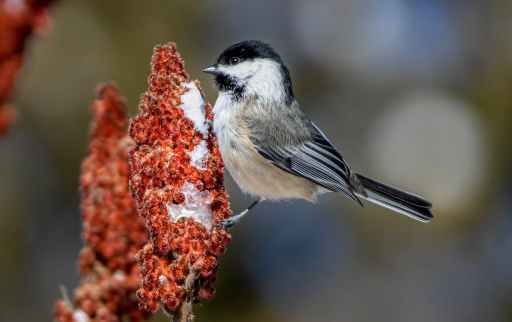
The Black-Capped Chickadee has been chosen as Guelph’s official bird. Honorable mentions go to Chimney Swift and Green Heron.

A bold, inquisitive bird, the Black-Capped Chickadee can adapt to almost any environment and may even feed from friendly “human” hands. Small and short-billed with a black cap and throat, the chickadee communicates with its flock-mates using fifteen different calls. The best known is the chickadee-dee-dee that gives the bird its name.

The Black-Capped Chickadee is also the provincial bird of New Brunswick and state bird of Massachusetts and Maine.

Here are ten more interesting facts:

1. Chickadees usually mate for life.

2. These birds build nests in holes, mainly dead trees or rotten branches.

3. The females lay six to eight white eggs, marked with reddish-brown spots. Eggs are incubated for 12 to 13 days, until they hatch. Chicks grow quickly and fledge in 14 to 18 days.

4. Their wing beats are about 27 times per second. In comparison, a hummingbird’s wing beats are 80 beats per second.

5. The chickadee possesses excellent spatial memory. During the warmer months, it hides seeds and other foods in different spots. The bird can remember the hiding places a month after catching the food.

6. These birds observe and adapt the food-finding behavior of successful flock-mates. Unproductive activity is ignored.

7. On cold winter nights, the chickadees can reduce their body temperatures by as much as 12 degrees Celsius (from their normal temperature of 42 degrees Celsius) to conserve energy.

8. A frequent visitor to bird feeders, the chickadee is a ravenous eater, especially just before dusk. It can gain as much as ten percent of its body weight each day.

9. Research has shown that the survival rate of chickadees doubles when they have access to feeders during cold weather. In the winter, these birds require twenty times more food than they do in the summer.

10. Their favorite foods: sunflower seeds, suet, and coconut.

Deciding to Follow-Through

On Wednesdays, I share posts, fables, songs, poems, quotations, TEDx Talks, cartoons, and books that have inspired and motivated me on my writing journey. I hope these posts will give writers, artists, and other creatives a mid-week boost.

On Fridays, I receive Hope Clark’s newsletter, Funds for Writers. Here’s a thought-provoking essay from a recent email:

Steven Pressfield (the author of The War of Art) speaks about the difficulty of pushing through and reaching THE END of whatever you are writing. It could be a poetry chapbook. It could be a memoir. It could be fiction of any genre or any word count. It could be a how-to on cabinetmaking or a children’s picture book. A lot of writers struggle with perfecting an effort and reaching THE END.

Why? Because that is the point where you let others read it . . . and get feedback. That is when you submit for publication . . . and get feedback. The feedback is the thrill and the agony of writing, and sometimes we feel safer just saying we’re still writing it, because that is the world in which we feel safest.

What are we afraid of?

-Being told it’s just okay. Or worse, that it’s bad, but frankly, once we hear it’s okay the meaning is the same.

-Prematurely releasing your darling in the world. But who’s to say when it’s premature?

-Learning after all that time invested that we really do not know what we are doing. It’s called being a phony.

Look across social media. When an author talks about typing THE END, or submitting to the publisher, or having a release date, a lot of the public admire first and foremost the fact that the author got to that point. You think it. I think it. Everyone thinks it.

There’s a reason that authors continually get asked the questions: “What is your work regimen?” and “Where do you get your ideas?” Successful freelancers get asked similar questions. The basic underlying question is “How do you make it all the way through . . . then do it again?”

It’s magic. It’s a genetic gift. It’s a unique upbringing.

No, it’s deciding to follow-through. And nothing on this earth gets in your way in doing this but you.

Sign up to receive Hope Clark’s newsletter here.

Blurb Blitz: Big Shot

I’m happy to welcome author Kirsten Weiss. Today, Kirsten shares her new release, Big Shot.

Blurb

Small Town. Big Murder.

The number one secret to my success as a bodyguard? Staying under the radar. But when a wildly public disaster and a dead client blew up my career and reputation, it turned my perfect, solo life upside down.

I thought my tiny hometown of Nowhere would be the ideal out-of-the-way refuge to wait out the media storm.

It wasn’t.

My little brother had moved into a treehouse. The obscure mountain town had decided to attract tourists with the world’s largest collection of big things… Yes, Nowhere now has the world’s largest pizza cutter. And lawn flamingo. And ball of yarn…

And then I stumbled over a dead body.

All the evidence points to my brother being the bad guy. I may have been out of his life for a while—okay, five years—but I know he’s no killer. Can I clear my brother before he becomes Nowhere’s next Big Fatality?

A fast-paced and funny cozy mystery series, buy Big Shot now to take advantage of the special pre-order price of 99 cents.

Murder mystery game included in the back of the book!

Excerpt

My low heel caught on something, and I stumbled backward.

Normally, this wouldn’t have been an issue. I was fairly light on my feet. But a howling mass of gray fur flew around the corner of the building at the same moment. I threw up my hands to protect myself and thudded into something hard and muscular.

Powerful arms wrapped around my chest. And since my hands were protecting my face, the arms grabbed a very sensitive spot. Two sensitive spots, actually.

“Watch it,” a masculine voice rumbled.

I jerked away, and he released me. Embarrassed and indignant, I whirled and glared into a pair of green eyes full of mirth.

My gaze moved upward to his dark, curling hair. For the first time since the accident, I felt like I was in the real world. He was real.

He was also at least six-foot-two, because he was four inches taller than me. He looked like the Greek god of war—not the Ares from the marble statues, the one from that old TV show, Xena, Warrior Princess (my secret hero). The effect was in no way diminished by his white t-shirt and jeans stained at the knees.

“There are easier ways to get to know me,” he said.

Buy Links

Kindle | Apple Books | Nook | Google Play | Kobo

NOTE: The book will be on sale for $0.99 during the tour.

Author Bio and Links

Kirsten Weiss writes laugh-out-loud, page-turning mysteries. Her heroines aren’t perfect, but they’re smart, they struggle, and they succeed. Kirsten writes in a house high on a hill in the Colorado woods and occasionally ventures out for wine and chocolate. Or for a visit to the local pie shop.

Kirsten is best known for her Wits’ End, Perfectly Proper Paranormal Museum, and Tea & Tarot cozy mystery books. So if you like funny, action-packed mysteries with complicated heroines, just turn the page…

Website | Facebook | Instagram

Giveaway

Kirsten Weiss will be awarding a $10 Amazon/Barnes & Noble gift card to a randomly drawn winner via Rafflecopter during the tour. Find out more here.

In addition to the Rafflecopter, the author is running a pre-order promotion on her website.

Follow Kirsten on the rest of her Goddess Fish tour here.
Honoring Female Inventors

May is National Inventors Month, a month set aside to recognize the curiosity and imagination of people who innovate and create.

Today and for the next two Fridays, I will be highlighting innovative women who have imagined, developed, tested, and perfected their creations.

Jeanne Villepreux-Power (1794 – 1871)

The French naturalist started her scientific studies on the island of Sicily. While studying the paper nautilus (an unusual octopus that spends its life drifting the oceans near the surface), Jeanne Villepreux-Power decided to test a popular hypothesis. It was believed that the nautilus took its shell from another organism. She created the first glass aquarium to observe the nautilus in controlled conditions and proved that it made its own shell. She also designed a glass apparatus within a cage for studying shallow water creatures and a cage-like aquarium that could be raised and lowered to different depths.

Margaret E. Knight (1828 – 1914)

A Maine resident, 30-year-old Margaret Knight built a machine that folded and glued paper to create a flat-bottomed paper bag. When the paper bags became popular, a man stole the idea. In court, he argued that a woman “could not possibly understand the mechanical complexities.” Knight won her case and went on to invent over 100 different machines. She patented 20 of them, including a rotary engine, a shoe-cutting machine, and a window frame with a sash.

Josephine Cochrane (1839 – 1913)

After servants chipped her heirloom dishes, American inventor Josephine Cochrane invented a mechanical dishwasher that held dishes securely in a rack. At the same time, the pressure of a water sprayer cleaned them. In 1883, her husband died and left her with substantial debt. Determined to pay off her debts, Cochrane obtained a patent in 1886 and began marketing her dishwasher to hotels. In those days, women did not cross hotel lobbies alone. She later commented, “I thought I should faint at every step, but I didn’t—and I got an $800 order as my reward.” In 1893, her dishwasher was exhibited at the World Columbian Exposition in Chicago. In 1915, her company was bought by Kitchen Aid.

Mary Anderson (1866 – 1953)

An Alabama resident, real estate developer and rancher, Mary Anderson visited New York City in 1902. When she rode in a trolley car, she noticed the driver had to open the panes of the front window to see through falling sleet. Back in Alabama, she set to work on a solution. Her device used a lever inside the vehicle to control a rubber blade on the windshield. Despite its effectiveness, car manufacturers dismissed Anderson’s invention. One Canadian firm commented, “We do not consider it to be of such commercial value as would warrant its sale.” In 1922, Cadillac became the first manufacturer to include a windshield wiper on all its vehicles. Soon afterward, wipers became standard equipment.

Sarah Breedlove (1867 – 1919)

While working as a laundress, Sarah Breedlove observed that many black women struggled with hair loss and scalp diseases. The reasons: a lack of indoor plumbing and harsh ingredients in hair products. She developed her own life of hair care products specifically designed for African American hair. Hoping to evoke Parisian luxury, she branded the products with her new identity of Madam C. J. Walker. Later, she set up a college to train “hair culturists,” creating employment opportunities for thousands of African American women. Breedlove became the first female self-made millionaire in the United States.