The Secret to Serenity

When I received this Zen parable in an email attachment, I couldn’t resist a smile. And I knew I had to share it.

Enjoy!

A harried Type A businessman went to a yogi, high on the top of a hill.

“They say you have the secret to serenity,” the businessman puffed, mopping at his brow. “I have high blood pressure, I am stressed beyond belief, and I am at the end of my rope. Teach me the secret.”

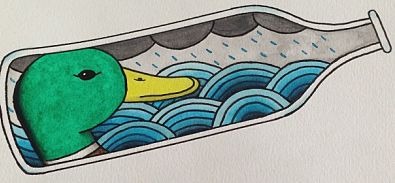
The yogi smiled beatifically (as yogis tend to do.) He then rummaged around and presented the man with a large bottle. Inside the bottle was a live duck, swimming placidly in the water trapped inside.

duckinbottle

“This will teach you,” the yogi said. “Get the duck out of the bottle, without breaking the bottle, or killing the duck.”

The businessman was baffled, but he’d faced tough challenges before. Swearing to have it solved in two weeks, he took the bottle and went about solving the problem.

In two weeks, he returned, looking more frazzled than before. “There has to be some trick,” he groused. “This is impossible. There has to be a cheat or something.”

The yogi simply smiled, then told him to come back in two weeks.

In another two weeks, the man looked half insane. His eyes were bulging, his clothes were unkempt, and he was furious. “I am going to smash this bottle and wring the duck’s neck if you don’t tell me how to get it out!”

The yogi simply smiled, and told him again: Come back in two weeks.

Another two weeks, and the man returned. This time, he was the picture of calm.

“I figured it out,” he said. “The secret to serenity. I finally got it.”

He then handed the intact bottle to the yogi, with the duck still swimming inside.

He grinned. “It’s not my bottle. And it’s not my duck.”

serenity

10 Mermaid Sightings Before 1800

mermaidhistoryBefore writing Between Land and Sea, I researched mermaid sightings. I expected to find only a handful of examples and was surprised by the lengthy list and vivid descriptions that emerged. So much so, that I’ve devoted several posts to this topic.

Today, I will focus on ten documented sightings before 1800.

1. First Century AD: Roman author, naturalist and philosopher Pliny the Elder wrote about the Nereids that were found dead on the seashore. He described their bodies as rough and scaly like fish and then went on to share other supporting evidence: “I have, too, some distinguished informants of equestrian rank, who state that they themselves once saw in the ocean of Gades a sea-man.”

2. Between 1040 and 1105: Rabbi Shlomo Yitzchaki wrote about mermaids in the Talmud: “There are fish in the sea with which half is in the form of man and half in the form of fish, called sereine in Old French.”

3. During the same period, Moshav Zekeinim provided the following details about mermaids (Sirens) in a commentary on the Torah: “This refers to the creature in the sea which is similar in part to a person, from the navel upwards, and it is similar to a woman in all aspects in that it has breasts and long hair like that of a woman, and from the navel downwards, it is a fish. And it sings beautifully, with a pleasant voice.”

4. 13th Century: The King’s Mirror, a Norwegian educational text originally intended to provide King Magnus Lagabote with advice on various subjects, included the following description of a creature found off the shores of Greenland: “Like a woman as far down as her waist, long hands, and soft hair, the neck and head in all respects like those of a human being. The hands seem to be long, and the fingers not to be pointed, but united into a web like that on the feet of water birds. From the waist downwards, this monster resembles a fish, with scales, tail, and fins…This monster has a very horrible face, with broad bow and piercing eyes, a wide mouth and double chin.”

5. 1389: In his book, Eastern Travels of John Hesse, the author described the perils encountered during his voyages. He wrote: “We came to a stony mountain, where we heard syrens singing, mermaids who draw ships into danger by their songs. We saw there many horrible monsters and were in great fear.”

6. 1403: During a heavy storm, a mermaid drifted inland through a broken dyke on the Dutch coast. At first afraid but later intrigued, several local women and their servants befriended the mermaid. They took the mermaid home and tried to domesticate her, clothing and feeding her dairy products and meats. After a number of thwarted escapes into the sea, the mermaid resigned herself to her new life and died fifteen years later. John Swan, an English minister, described her story in Speculum Mundi, a book released in 1635.

7. 1493: After spotting three mermaids rising from the sea, Christopher Columbus wrote in the ship’s journal: “They were not as beautiful as they are painted, although to to some extent they have a human appearance in the face.” He noted that he had seen similar creatures off the coast of West Africa.

8. 1608: After two of his company reported a mermaid sighting, explorer Henry Hudson wrote in the ship’s journal: “Two crew members–Thomas Hilles and Robert Rayner–sighted a mermaid at 75o7’N (Russia) and shouted at the rest of the crew to come and look…From the navel upward her back and breast were like a woman’s, as they say that saw her; her body as big as one of ours; her skin very white and long hair hanging down behind, of colour black. In her going down, they saw her tail, which was like the tail of a porpoise, and speckled like a mackerel.”

9. 1614: Captain John Smith, of Pocahontas fame, reported a mermaid off the cost of Massachusetts: “The upper part of her body perfectly resembled that of a woman, and she was swimming about with all possible grace near the shore. It had large eyes, rather too round, a finely shaped nose (a little too short), well-formed ears, rather too long, and her long green hair imparted to her an original character by no means unattractive.”

10. 1797: While walking on the shore of Sandside Bay (Scotland), schoolteacher William Munro spotted a mermaid sitting upon a rock. In his letter to Dr. Torrance in Glasgow, he wrote: “…my attention was arrested by the appearance of a figure resembling an unclothed human female, sitting upon a rock extending into the sea, and apparently in the action of combing its hair, which flowed around its shoulders, and of a light brown colour…The cheeks ruddy, the eyes blue, the mouth and lips of a natural form, resembling those of a man; the teeth I could not discover, as the mouth was shut; the breasts and abdomen, the arms and fingers of the size in which the hands were employed, did not appear to be webbed, but as to this I am not positive.” The complete letter appeared in The Times of London on September 8, 1809.

Writers Have to Write

Welcome to my Second Acts Series!

Today, we have author Susan Coryell sharing a lifelong passion for writing and the long, winding road to publication.

Here’s Susan!

susancoryellWe writers know who we are; writers have to write. That about sums up my “Second Act” in life.

What happens when a full-time career/working mom knows she is a writer and feels the need to write with simply no way of making time to do so? I believe it was the late Erma Bombeck, a writer of humorous columns, who laughed at her own solution to the problem: “There is a lot of untapped time between midnight and five a.m.”

Not only was I an active working mother—I fancied myself the busiest mom in the East. Full-time public school teacher, department chair, soccer mom, Sunday school teacher, night-student in grad school, mother of three and wife of a small business owner (who worked 80-hour weeks)—to name a few of my titles. Oh, did I mention I was trying to write a novel?

Miraculously, I somehow completed what I now call my “Disney Novel.” The young adult mystery involved twin boys, one a pitcher and one a catcher, who telepathized their signals on the ball diamond. Though probably not publishable, the work proved to me that I could write a story consisting of 50,000 or more words—with a beginning, middle and end. You’d think I would have been satisfied, happy to prove myself and move on with life on Muppet Manor with my family. Right?

eaglebaitAlas, Doubleheader only whetted my appetite to write more, more, more. So, I began working on another young adult novel—this one an anti-bully book with a 14-year-old male protagonist. I worked only on my summers “off” from teaching—posting daily notices on my closed office door that suggested my kids should not disturb me unless they were “bleeding profusely.” It took three years to complete Eaglebait.

While sponsoring a middle school literary magazine at Columbia Press Scholastic awards (yes, I also was in charge of the lit mag at my school), I said to myself, “Hey, you’re in New York. Let’s try to find a literary agent.” Luck prevailed and on the second day at Columbia, I met a guy who knew about a great agency in Chicago for YA books . They took on Eaglebait, secured a contract with Harcourt, and my writing journey began to take shape. Or, so I thought.

Even though Eaglebait won some impressive awards, Harcourt pulled it after 14 months, with no explanation. And, though I had plenty of other writing ideas, I threw in the literary towel until retirement years later. It was just too difficult what with the children merging into teenager-hood.

But then…my Second Act!

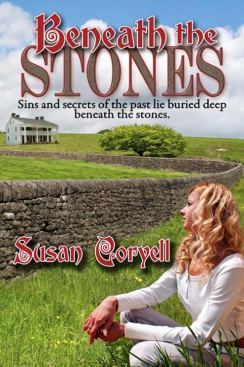
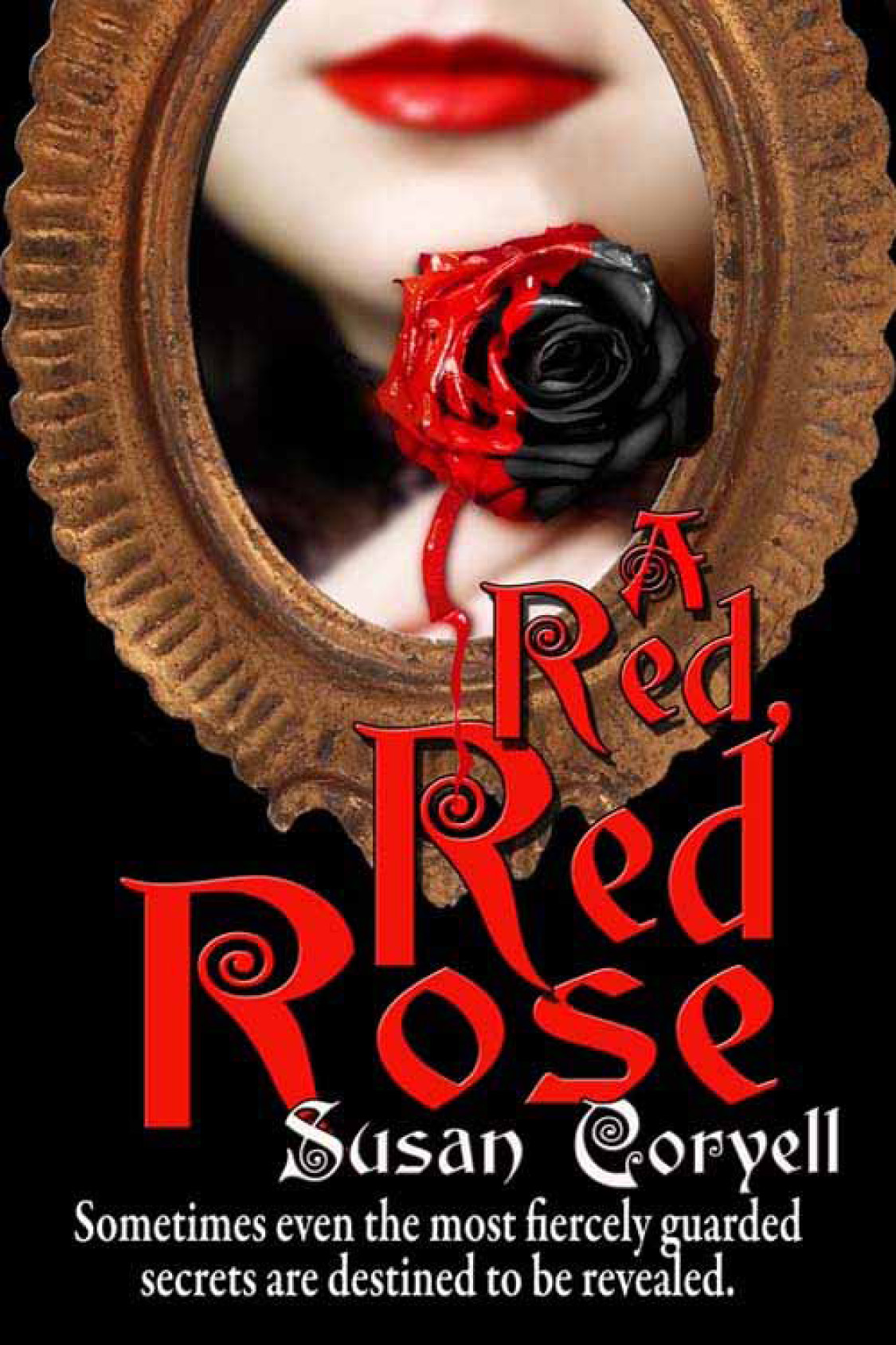
Retirement to a lakeside cottage was a godsend for this writer. I mucked around for several years doing free-lance for a pittance and writing a lot of local press for nothing. Not that I was wasting my “talent,” but I longed to plunge into novel writing again. That’s where I am at my creative best. And so, I picked up on a mystery/Gothic idea I had contemplated some years back—adjusted the setting to fit my retirement locale—and I have never turned back. The Wild Rose Press published A Red, Red Rose in 2013 and the sequel, Beneath the Stones this past April of 2015. I am currently writing the third novel in the series—as yet unnamed. In between writing these cozy mystery/Southern gothics, I was able to update Eaglebait with cyber-bullying and publish it through Amazon in e-book format.
untitledbeneaththestones

If there is a moral to my story, I believe it would be: Since writers know who we are and writers have to write, we must never lose faith; the window for writing will open somehow, some way, some time. I found my muse in the loft of a lake house 20+ years after my novel debut—a Second Act, for sure.

My heartfelt thanks to Joanne for inviting me to guest on her awesome blog!

Bio

A career educator, Susan has taught students from 7th grade through college-level. She earned a BA degree in English from Carson-Newman College and a Masters from George Mason University. She is listed in several different volumes of Who’s Who in Education and Who’s Who in Teaching. Susan belongs to Author’s Guild, Virginia Writers, and Lake Writers. She loves to talk with budding writers at schools, writers’ conferences and workshops. Her young adult anti-bully novel EAGLEBAIT is in its third edition for print and e-book, updated with cyber-bullying. EAGLEBAIT won the NY Public Library’s “Books for the Teen Age,” and the International Reading Association’s “Young Adult Choice.”

A RED, RED ROSE, first in a cozy mystery/Southern Gothic series, was nominated for a literary award with the Library of Virginia. BENEATH THE STONES, the sequel, was released in April of 2015.

The author has long been interested in concerns about culture and society in the South, where hard-felt, long-held feelings battle with modern ideas. The ghosts slipped in, to her surprise.

When not writing, Susan enjoys boating, kayaking, golf and yoga. She and her husband, Ned, love to travel, especially when any of their seven grandchildren are involved.

Where to find Susan…

Website | Blog | Facebook | Twitter | Amazon

Joanne here!

Susan, thanks for sharing your inspiring journey. Good luck with all your literary endeavors.
Clean Jokes for Toastmasters

12346918_s

Use one of these jokes at your next meeting.

*********************

On his deathbed, a miser asked to be alone with his lawyer, doctor, and priest. “I know I am going to die,” he said. “I would like to take my money with me, so I am going to give each of you $150,000. I want you to each make sure the money gets in the coffin.”

On the day after the funeral, the guilt-stricken priest confided he only put $100,000 in the coffin.

“I’m glad you brought it up” said the doctor, “because I’ve also been feeling guilty. I only put $80,000 back.”

“You people should be ashamed of yourselves,” stormed the lawyer. “Am I the only honest person here?” He pulled out his check book. “Look here. I wrote out a check for the full $150,000!”

*********************

Harry walked over to the Priest after services, “You know Father, I am really stuck in a quandary. I would like to attend church next week but I just can’t miss the big game.”

“Oh Harry!” said the Priest as he put his arm around Harry. “That’s what recorders are for.”

Harry’s face lit up. “You mean I could record your sermon?”

*********************

After sending their son Paul away to college, Susan and Joe would receive regular requests for money. After one late-night call, Joe agreed to send some money. Before hanging up, he added, “I notice that you left your Physics book here. Should I send it?”

“Uh, oh yeah, OK,” Paul responded.

Several days later, Susan discovered that Joe had sent $1100 and started to reprimand him.

Joe shook his head and smiled. “Don’t worry, I taped a $100 check on the cover of the Physics book and a $1000 check inside the cover.”


Men and Mermaids

menmermaidsWhenever I mention mermaids, I notice the emergence of Duchenne smiles on the faces of all the men in my circle.

What is a Duchenne smile?

Very simply, it is a smile that is characterized by the raising of the lip corners which in turn raise the cheeks and form crow’s feet around the eyes. French physician Guillaume Duchenne first recognized this smile while conducting research on the physiology of facial expressions in the mid 19th century. According to Duchenne, that distinctive smile is associated with a strong positive emotion.

duchennegeorgeAnd, of course, George Clooney.

My conclusion—21st century men are still intrigued by those Sirens of Greek mythology, preferring to focus on their physical beauty and enchanting songs. Male minds can easily conjure up images of wavy auburn tresses, mesmerizing green eyes and a curvaceous body.

So, when I describe the protagonist of Between Land and Sea as an overweight, middle-aged ex-mermaid, I’m not surprised to see a variety of facial expressions. The men usually laugh and joke about Isabella’s extra years and pounds.

At a workshop, an argumentative lawyer was very blunt in his criticism: “I don’t understand why your mermaid has to be old and fat.”

“Fifty-three is not that old.” I ignored the weight issue.

He persisted. “It is when it comes to mermaids. Why couldn’t you let her be young, thin and beautiful?”

Thankfully, the conversation was interrupted by the facilitator’s call to resume the workshop. A few minutes more and I might have lost patience with the annoying lawyer who couldn’t accept my vision of an older mermaid.

Very few men are as argumentative as the lawyer. My male friends and relatives want to hear more about Isabella of the Mediterranean Kingdom aka Barbara Davies and the international banker who dumped her. Several are amused by the concept of a mermaid carrying extra pounds, and one friend asked if the artist was planning to feature an overweight mermaid on the cover.

In The Coming of Arabella, the unexpected arrival of Barbara’s perfectly-preserved twin sister evokes more traditional responses (and more Duchenne smiles) from the men of Carden, Ontario.

How would the men in your circle react to an older, wiser mermaid?

Cool Treats for Non-Foodies on a Budget

coffeebananaThis coming week, we will be experiencing the dog days of summer in southern Ontario. As the Humidex soars beyond 30 and even approaches 40, I find myself spending more time in air-conditioned comfort and less time preparing meals.

Not such a bad thing for a non-foodie, but I do have to eat. With one book released in June (A Season for Killing Blondes) and another to be released in August (The Coming of Arabella), I need to maintain optimum energy levels.

And to satisfy my Frugalista nature, I also wish to do it on a budget.

Here are some of my favorite go-to foods while I’m in the editing and promotion caves.

Continue reading on the Story Reading Ape’s blog.

10 Reasons Why I’m Not Anastasia

I’m thrilled to welcome USA Today bestselling and award-winning author Lois Winston to the Power of 10 series.

Here’s Lois!

loiswinstonPeople have often asked me how much of Anastasia Pollack, the protagonist of my Anastasia Pollack Crafting Mystery series, is really Lois Winston. Although I have drawn on my own experiences in writing Anastasia, there are fundamental differences between the two of us. In no particular order they are as follows:

1. Unlike my protagonist, I am not a sleuth, reluctant or otherwise. I’ve never stumbled across a dead body and hope I never do. I prefer virtual dead bodies to real ones and solving crimes on my computer in the safety and comfort of my own home. I’ll leave the real crime-solving to the professionals.

2. Anastasia has two teenage sons. Although I once had two teenage sons, my own sons are no longer teenagers. However, everything I know about teenage boys I learned from my own kids.

3. Anastasia shares her home with a corpulent Persian cat, an ill-tempered French bulldog, and a Shakespeare-quoting parrot. If I had her menagerie living with me, I’d be long dead from an allergic reaction. I don’t even have goldfish.

4. Anastasia is a widow. My husband, thankfully, is very much alive, and I hope he stays that way for decades to come.

5. Anastasia’s husband gambled away all their savings and left her in extreme debt when he died. My husband doesn’t even buy lottery tickets—which is why we haven’t won the lottery and probably never will because I don’t buy lottery tickets, either.

6. Anastasia has an apartment above her garage that she’s able to rent out for extra income. All I have above my garage are air rights, but although air rights go for millions in Manhattan, no one seems interested in purchasing my suburban air rights.

7. Anastasia is stuck with her nasty communist mother-in-law as a permanent resident. After six years of living with my nasty communist mother-in-law, I gave my husband an ultimatum—either she goes or I go. Anastasia is far more saintly than I am.

8. Anastasia has a forty-minute commute to and from work in bumper-to-bumper traffic every day. My commute is much shorter—a flight of stairs from my bedroom down to my office.

9. Anastasia has a boyfriend who looks like his genes swam around in the same pool as those of Pierce Brosnan, George Clooney, and Antonio Banderas. My husband…not exactly cover model material. But I think he’s cute.

10. Anastasia doesn’t age in real time. Since first appearing in Assault With a Deadly Glue Gun in January 2011, she’s aged less than a year. I, unfortunately, am now four-and-a-half years older, and we won’t discuss how many pounds heavier.

astitchtodiefor

Blurb

The adventures of reluctant amateur sleuth Anastasia Pollack continue in A Stitch to Die For, the 5th book in the Anastasia Pollack Crafting Mystery series by USA Today bestselling author Lois Winston.

Ever since her husband died and left her in debt equal to the gross national product of Uzbekistan, magazine crafts editor and reluctant amateur sleuth Anastasia Pollack has stumbled across one dead body after another—but always in work-related settings. When a killer targets the elderly nasty neighbor who lives across the street from her, murder strikes too close to home. Couple that with a series of unsettling events days before Halloween, and Anastasia begins to wonder if someone is sending her a deadly message.

Buy Links

Paperback | Kindle | Kobo | Barnes and Noble | Google Play | iTunes

(Other books in the series include Assault With a Deadly Glue Gun, Death by Killer Mop Doll, Revenge of the Crafty Corpse, and three mini-mysteries: Crewel Intentions, Mosaic Mayhem, and Patchwork Peril.)

Bio

USA Today bestselling and award-winning author Lois Winston writes mystery, romance, romantic suspense, chick lit, women’s fiction, children’s chapter books, and non-fiction under her own name and her Emma Carlyle pen name. Kirkus Reviews dubbed her critically acclaimed Anastasia Pollack Crafting Mystery series, “North Jersey’s more mature answer to Stephanie Plum.” In addition, Lois is an award-winning craft and needlework designer who often draws much of her source material for both her characters and plots from her experiences in the crafts industry. Visit Lois/Emma at http://www.loiswinston.com and Anastasia at the Killer Crafts & Crafty Killers blog, http://www.anastasiapollack.blogspot.com. Follow everyone on Tsu at http://www.tsu.co/loiswinston, on Pinterest at http://www.pinterest.com/anasleuth, and onTwitter @anasleuth. Sign up for her newsletter at https://www.MyAuthorBiz.com/ENewsletter.php?acct=LW2467152513

Mondays for Mermaids

Today, I’m launching a series to honor those fascinating creatures that have enchanted humankind for centuries. A life-long fan, I’ve written two books (and am planning a third) about the mermaids of the Mediterranean Kingdom.

In Between Land and Sea, I introduced an overweight, middle-aged ex-mermaid who uses a magic tablet to reinvent herself. I continue her story in The Coming of Arabella, and add a psychological twist: a mermaid sister who is somewhere on the Narcissist/Sociopath continuum.

Over the coming weeks, I will focus on different aspects of the mermaid psyche, history, and lifestyle.

I’ll start with Mermaid History.

mermaidhistoryIn Greek mythology, Sirens had beautiful voices and cruel hearts. Many less-than-enchanting stories have been written about Sirens distracting mariners and causing them to walk off decks or run their ships aground. More spiteful Sirens would not hesitate to squeeze the life out of men and drown them.

In Homer’s Odyssey, Odysseus went to great lengths to avoid being seduced by the hypnotic music of the Sirens. He ordered his men to stuff balls of wax into their ears while approaching the Sirens’ island off the coast of Greece. And he tied himself to the ship’s mast so he would not be able to jump off, swim to shore or do anything that would endanger his own life or that of the crewmen. According to Greek legend, Odysseus is the only man in the world who actually heard the Sirens sing and lived to tell about it.

I discovered this four-minute short on YouTube. Mermaid enthusiasts will recognize scenes from the the movies Odyssey and Splash. The background music is Caribbean Blue from Enya.

Enjoy!

Enter to win a $10 Starbucks gift card here.