Spotlight on Living Lightly
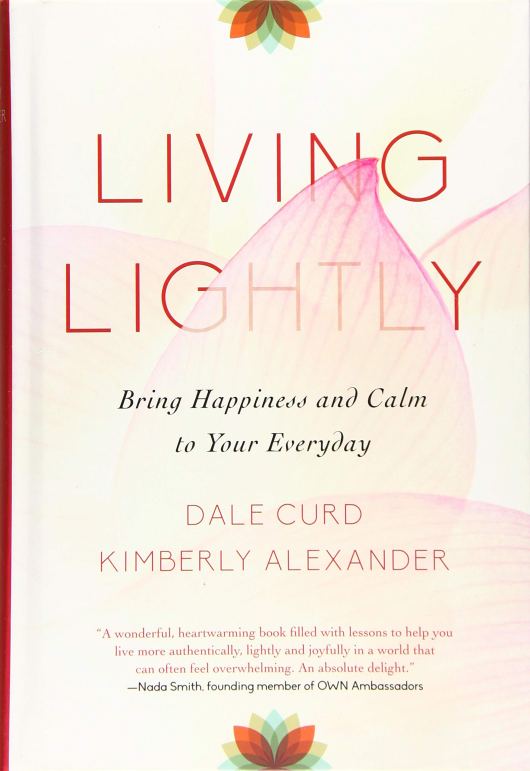
I’m happy to welcome therapists and authors Kimberly Alexander and Dale Curd. Today, Kimberly and Dale share their new release, Living Lightly.
Blurb
Living Lightly is a daily devotional that offers a year’s worth of opportunities to commune, in the deepest and most beautiful sense of that word, with your self and your life. Partners and therapists, Dale and Kim Curd step through the universal doorways of life and offer us a nudge to slow down and experiences to help return us to our selves. Their personal reflections invoke gentle introspection, and come from their own healing journeys and from being active therapists. Living Lightly invites you to explore how your mind works, understand and express your feelings and be reminded that you are much, much stronger than you realize. Living Lightly is a great way to start or end the day.
Excerpt From July 14, Living Lightly
When we wrote this piece, we imagined all of our self in a beautiful bubble ~ our hopes, needs, feelings, wounds and energy ~ in the bubble, all the time. And others having their bubbles too. Today, imagine feeling safe and wondrous interacting with other bubbles. With love, Kim and Dale.
Withholding or oversharing information can reveal our problem with boundary setting. Healthy boundaries give our sense of ease and peace in life a quantum boost, and in our interactions we learn to focus our energy on managing our own state, rather than trying (impossibly) to manage others’.
In thinking about boundaries, I realize how little I share during times of crisis, when I am focused on the critical decisions and actions that need to be taken. People who are directly able to assist are involved with me very intimately, yet it may take several days, or even longer, before I share what is happening with my friends and family. Because of this I find myself sharing and recounting and reliving the episode after the fact. And others are left to experience, process and resolve the shock, the ups and downs and the resolution of the story in one telling. The whole process feels draining to me—both because I don’t enjoy reliving the experience and because I have to answer questions so that others can fill in the gaps in their knowledge.
My withholding the information in real time has blocked loved ones from sharing in my life and being connected to me. When I’m in crisis mode, I withhold information by default, to control my environment as well as other people. This tendency is rooted in my childhood—adults would pin their emotional needs onto me and I felt unprotected and unable to separate myself from the other. Without healthy boundaries, I am blocked as an adult from experiencing the support and love of others; I am simultaneously on the defensive while I go on offence, patrolling for non-confirming ideas or behaviours. It is exhausting and draining for me and for the people around me. While my withholding behaviour is most evident when I’m in crisis, I always behave this way.
At the other end of the scale are people who overshare, speaking compulsively and repetitively to relieve or soothe themselves without showing any awareness of the other. They shift their state by using the energy of someone who allows their energy to be drawn.
The way through is to practise setting healthy boundaries. For the most part, withholding and oversharing are done unconsciously. By making ourselves aware of our state, we can intentionally empower and enhance ourselves, our relationships and our interactions.
For me, healthy boundaries start with being aware of my own feeling state and being self-responsible for my needs, energy and actions—and seeing all of these create a bubble around me. When I meet another person, they have their own bubble. Healthy boundaries allow us to be together with our own bubbles intact. We can connect and interact, each of us having our unique experience in life, in parallel, free to choose for ourselves. Sounds idyllic, doesn’t it?
Yet not everyone we meet in life is self-aware or self-responsible. Some people open their bubbles and their energy and emotions spill out, looking to flow into another. Or they pull energy away from another to fill themselves up. We can’t manage or control such behav- iours, but we can monitor, care for, advocate for and trust ourselves. In a moment of crisis I can be aware that I am feeling sad or fearful, that my emotions are heightened and that I am tense from lack of sleep and an adrenaline rush, so I can be responsible for my actions. I can let people know this is the state I am in. Ultimately, it is my responsibility, not theirs, to steer myself back towards a healthy, positive state.
Sleeping, eating, resting, getting support, taking breaks, asking for help, surrounding myself with helpful, positive people—these are all ways I use to get myself back. I shift my own bubble.
Mastering our own bubbles is a wonderful way to live. Awareness is the key factor. Instead of assessing others to make ourselves safe, let us first assess our own states and see to our own needs. That way we will be able to be with others, maintaining our energy. Acceptance, empathy, community, forgiveness, peace all become possible when our emotional safety no longer depends upon the other.
Buy Links – Print
Indigo | Amazon (CA) | Amazon (US) | Harper Collins
Buy Links – Digital
Kobo | Amazon (CA) | Amazon (US) | Google | Apple

Kim and Dale have created a much-needed “self-help” guide filled with powerful starting points for each day of the year. I immediately connected with their objective in writing this devotional: “We can remember a time long ago when we felt like we were floating, and we want to feel light again.” The authors start each snippet by identifying an issue and then offering anecdotes, quotations, poetry, and practical strategies. While I read the entire book in two sittings, I plan to revisit many of the reflections throughout 2020 and beyond.
Well done!
About the Authors
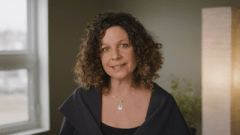

Kim Alexander spent twenty years in the tech start-up world, has travelled extensively and considers travel one of her greatest pleasures. In 2014 she completed her training as a therapist, merging her worlds of technology and therapy, by offering clients online video counselling. Kim is a lifelong learner, always engaged in activities and ventures that expand her self-awareness, from writing, raising animals, to listening to horses and trees.
Dale Curd is a mental health professional, the host of CBC TV’s Hello Goodbye and a co-host of Life Story Project on the Oprah Winfrey Network. The creator of an acclaimed Empathetic Listening Method, Dale leads specialized workshops for law enforcement, hospitals and corporations across North America.
Dale and Kim founded The Child Therapy List and The Men’s List, two global, online mental wellness professional directories, to help normalize therapy and end mental health stigma. They created LivingLightlyToday.com as an online community to acknowledge and connect with readers and inspire people to share in their passion for beauty. In 2015 Dale and Kim left city life to live on a historic farm in Muskoka.
http://www.livinglightlytoday.com is a growing online community of souls committed to living fully, exploring new experiences, making new discoveries in our inner and outer landscapes. Dale and Kim are so excited for your images and stories, of beauty and connection. Come join the journey—we are waiting for you!
Social Media Links
Manifest “Tiny, Little Miracles” In Your Life
On Wednesdays, I share posts, fables, songs, poems, quotations, TEDx Talks, cartoons, and books that have inspired and motivated me on my writing journey. I hope these posts will give writers, artists, and other creatives a mid-week boost.

In the following segment from a Super Soul Sunday session with Oprah, Michael Beckworth explains how intention can help manifest the kind of life you want to live.
Spotlight on Halycon
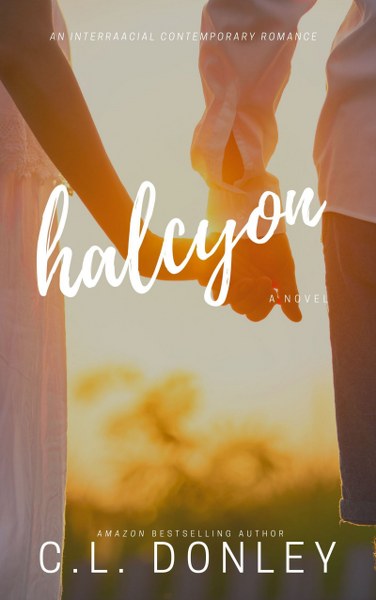
I’m happy to welcome author C.L. Donley. Today, she shares her latest release, Halycon.


The Halcyon program has only grown in respect and mystique over their now fifteen years of matchmaking. When I went through it six years ago, they were still boasting 100% success of all the participants. Single, usually hopeless, candidates leave the program as part of a couple. The foolproof methods Halcyon uses to guarantee a soulmate comes from a blend of technology, biology, psychology, and, of course, sex. Naturally, with its high price tag, extensive, invasive testing, and painstaking process, only serious participants make it through, and everyone found success. Until us.

What inspired you to write this book?
This book is about two characters that go to a program called Halcyon, which is this sort of intensive matchmaking service that’s 6-months long and is pretty expensive, so only well-to-do people can afford it, which both of these characters are. It really started out as a small kernel of an idea in my mind, and it’s the first book I’ve done that isn’t directly inspired by an existing trope. Which gave me a pretty big challenge because it’s much harder to get an audience to connect with a concept they haven’t seen before. Being original is not exactly a walk in the park! It’s much easier and simpler to write something already in line with people’s interests and expectations.
Which of your novels can you imagine made into a movie?
I’m very visual in my approach to writing, so I imagine all of my books as movies, down to the trailer and score, haha.
Where did you come up with the names in the story?
You know, I thought the names were really clunky at first, and I still do in some ways. The hero’s name is Cliff, and his best friend’s name is Felix. I have no idea where those names came from, but they started out as placeholders and never changed. I went through a few names for Bria, the heroine, before I settled on it. It was actually Nia for awhile. And her last name is Forrester. It took me a minute to Google that name because it was naggingly familiar. Turns out Nia Forrester is the name of another romance author. Who’s great, by the way. And then, while I was writing Bria’s mom’s dialogue, I just heard the nickname “Bri.” And I thought, “well Bria’s a pretty name.”
If your book was made into a film, who would you like to play the lead?
I used Adam Driver as the inspiration for the hero in Halcyon. For the heroine, I used a plus-size model by the name of Precious Lee. I spend a lot of time finding real-life inspirations for the physical descriptions of my characters, and sometimes to inspire their personalities. I use Pinterest to find visual inspiration for places and people. You can check some of them out at pinterest.com/cldonleyauthor/book-inspirations.

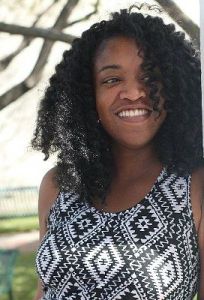 C.L. Donley is a future New York Times and USA Today Bestselling Author of multicultural and interracial romance, who believes romance novels that are impossible to put down are the only kind that should exist! Armed with a B.A. in English and M.A. in Writing, she is new to the romance game, having written her first novel, Amara’s Calling, after discovering the romance genre in September 2017. Donley writes in a style she calls “romantic realism” that is sophisticated yet simple, grounded yet unaplogetically escapist, and character-driven rather than plot-driven. This style creates a unique, modern reading experience ideal for book club discussions, personal epiphanies, satisfying re-reads, and the occasional spiraling reviewer! Love it or hate it, fans and critics alike can’t deny her talent, and always find themselves coming back for more!
She loves hearing from readers and discussing her favorite parts of her own books, so feel free to indulge her.
Website * Facebook * Twitter * Bookbub * Amazon * Goodreads

Follow the tour HERE for special content and a giveaway!
It’s Never Too Late
Welcome to my Second Acts Series!
Today, we have award-winning author Barbara Bettis sharing her multi-act life.
Here’s Barbara!
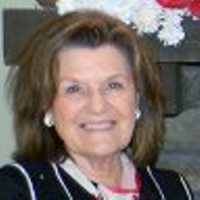 Thanks for having me today on your wonderful blog, Joanne. I’m sharing a little about my several acts in life, and a bit about my book that’s about to celebrate its First Birthday—For This Knight Only.
Act One
As a recently single mother of two sons and having just graduated with my bachelor’s degree, I was lucky enough—quite serendipitously—to stumble on a job with a daily newspaper in a town near where I’d gone to high school. The lure of small town (less than 6,000) life for growing children sealed and the fact my parents owned a farm near there were enough to seal the deal, so to speak. Didn’t matter that I’d always envisioned writing fiction.
There followed 12 years as reporter/photographer/sometimes editor. Although the town was relatively small, the paper served a large rural area comprising several other communities and schools. I have to admit, I absolutely loved the job, which included ‘stringing’ for the Kansas City papers and the Associated Press.
As my sons approached high school graduation, the intensity of the daily job after a dozen years began to tell. Small town life was a microcosm of city life and the demands could be stressful. I felt a change might be due. But what to do?
The years of newspapering added to my love of reading and made the decision pretty easy. I wanted to teach. So when my second son graduated, I moved to the other end of the state to return to school.
Act Two
Returning to college was a challenge. I had to remember how to write differently. That meant in essay form, with proper introductions and conclusions, and proper paragraphing. None of those one sentence paragraphs! Learning to writing newspaper style had been difficult—I had to give up the academic form and learn a whole new style. Now I had to relearn the academic format—but remember the journalistic format for my journalism classes and for teaching. And no matter how much I lobbied my literature professors, they weren’t favorably disposed to Associated Press style. (That blasted Oxford Comma!)
Two years later, though, I claimed my master’s degree and promptly found a job substituting for an English professor on sabbatical from an area four-year college.
Act Three
Luckily, when that professor returned from sabbatical, I was hired full time for English and journalism. The next several years were wonderful. I loved teaching and I continued to write occasional feature and news stories for area newspapers and magazines. Never thinking I would remarry, I met a great guy with whom I had so much in common. He was a retired newspaper editor and taught journalism at a nearby school. He supported me in a way I’d never experienced before. (He even joined me in some of my classes as I studied for my doctorate.)
Act Four
Much too soon, my husband fell ill and later died. As soon as possible thereafter I took early retirement from teaching, thinking I’d love the ‘life of ease.’ Not!
It wasn’t long before a friend and former student persuaded me to join her critique group. “You need something to do,” she insisted. So in self-defense, I began writing fiction. I’d always loved history, myths, learning about people who’d lived in earlier times. And, yes, some of the earliest tales I can remember reading were children’s stories about King Arthur and his Knights of the Round Table. So crafting a medieval book came naturally.
In the past few years I’ve taught English part time at a different local college, and have begun some editing for others. But best of all, I’ve continued to write historical stories about adventure, love, and happily ever after. Best of all, not one of my heroes dies way too early in life.
Any Affirmations or Quotations You Wish to Share?
Three, I think.
The first has been attributed to several people so I’ll just say it: Writing is easy. You just sit down at a typewriter (computer now) and open a vein.
The second is a paraphrase: Trust in God’s timing.
Third, from me: It’s never too late.
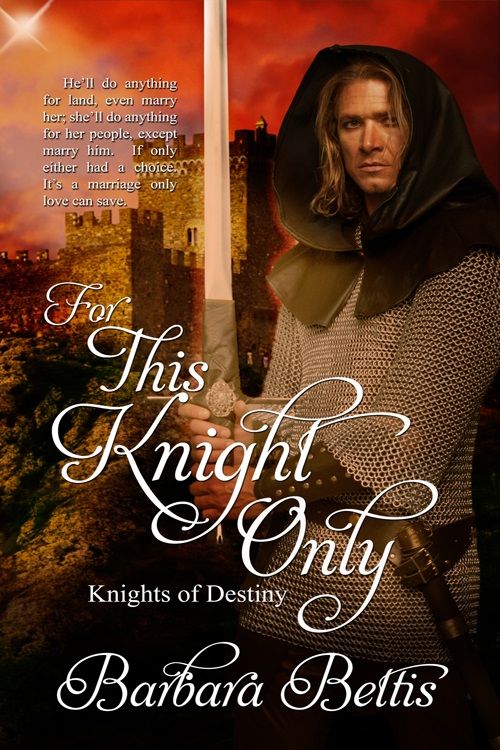
Blurb
He’ll do anything for land, even marry her; she’ll do anything for her people, except marry him. If only either had a choice. It’s a marriage only love can save.
Sir Roark will do anything to gain land, even beguile an unwilling lady into marriage. He knows she’s much better off with a man to take control of her besieged castle, to say nothing of her desirable person. But it isn’t long before he discovers that, although her eyes sparkle like sunlight on sea waves, her stubbornness alone could have defeated Saladin.
Lady Alyss is determined to hold her family’s castle, protect her people, and preserve her freedom— until her brother’s dying wish binds her to a stranger. Still, she’ll allow no rugged, over-confident, appealing knight to usurp her authority, even if she must wed him. Especially since he thinks a lady’s duties begin and end with directing servants. Alyss has a few surprises for her new all-too-tempting lord.
But when a common enemy threatens everything, Roark and Alyss face a startling revelation. Without love, neither land nor freedom matters.
Buy Links
Barb’s Books to Date
Knights of Destiny Series:
Silverhawk | The Heart of the Phoenix | The Lady of the Forest | For This Knight Only | A Winter Knight
Where to find Barb
Bookbub | Facebook | Twitter | Blog/Website
11 Steps to Writing a Bestselling Novel
On Wednesdays, I share posts, fables, songs, poems, quotations, TEDx Talks, cartoons, and books that have inspired and motivated me on my writing journey. I hope these posts will give writers, artists, and other creatives a mid-week boost.
I found this infographic created by Jodie Archer and Matthew Jockers interesting.

How to Interact with People Who Are Deaf or Hard of Hearing
I’m happy to welcome ASL Interpreter and author Kelly Brakenhoff. Today, Kelly shares valuable tips and advice about interaction with people who are deaf or hard of hearing.
Here’s Kelly!
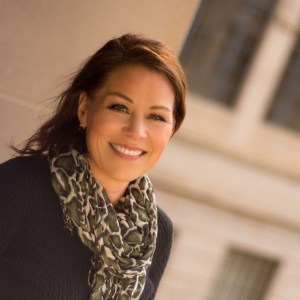 As an American Sign Language Interpreter with more than twenty years of experience, I’ve worked in college classrooms for fifteen different majors. I actually attend classes with the deaf students and overhear both the most inspiring and the most inane professors you could imagine. The academic world is the setting for my Cassandra Sato Mystery Series because it’s such a ripe environment for murder and mayhem. Today, I’d like to share tips and advice for anyone interacting with people who are Deaf or Hard of Hearing, and for writers who want to write about a character with a hearing difference.
1. USE the words “Deaf or Hard of Hearing” when referring to a person who was born deaf or hard of hearing or who lost their hearing later in life. Avoid using the words “Hearing Impaired” because calling someone impaired isn’t a positive description and can be offensive. My Deaf friends sometimes say, “I’m not hearing impaired. You are sign impaired.”
2. In your job, or when interacting on social media, consider whether your content is accessible to people with hearing differences. Caption your YouTube videos, please. Auto-captions are horribly inaccurate. Captions are very easy to add manually before you upload your videos and YouTube provides step by step directions on their help pages. An alternative is to provide a written transcript.
3. Not all deaf people can lipread. They do not have special visual superpowers because they can’t hear. Lipreading is hard and even the most skilled people catch an average of 30% of the conversation. Try turning off your TV volume and watching the news. How much do you understand what the announcer is saying without the volume?
4. People who are Deaf and Hard of Hearing are interested in more than just their ears. People who are born deaf don’t know anything different. They aren’t necessarily upset that they don’t hear music, birds, etc. They can drive. They have families. They can be doctors, lawyers, etc. Many of my friends say, “I can do anything except hear.”
5. Regarding technology: People who use hearing aids and cochlear implants are not cured. They use technology to maximize the benefit of what hearing they have left. Once the device’s batteries die or they remove the technology to go swimming, shower, or to sleep, they are still deaf or hard of hearing.
6. If you’ve met one deaf or hard of hearing person, you’ve met one deaf or hard of hearing person. Each person is an individual with different skills, needs, and communication styles. Most Deaf/Blind people can either see some or hear some. Helen Keller was very unique in that she didn’t see or hear at all. If you don’t know how they like to communicate, ask. Don’t be shy or afraid to approach them. Even fingerspelling your name and knowing how to sign “please” and “thank you” is appreciated.
7. Where can you learn American Sign Language and how hard is it to learn? Check out your local community college, or school continuing education program. Some churches with a large number of deaf members have classes or clubs and would welcome you. Learning ASL is just like learning any second or third language like Spanish or French. With practice you can learn everyday phrases for conversation, although it takes years of study to become fluent.
8. How can writers understand what it feels like to have a disability if they don’t personally experience that disability? For example, I’m short and left-handed. Neither of those are disabilities but thinking about it helps me write accurate characters. Could I imagine how it would feel to be turned down for a job because I’m short? Would I feel angry and frustrated because there’s nothing I can do about my height? As a left-handed person, do I understand what if feels like when the whole world is set up for other people and not for me? Yes, I do. Do people tease me or was I bullied as a child for being small? Yes. Use those feelings when you write characters who aren’t like you. Your feelings are real and universal, even if you experience them to a smaller degree. Amplify them for your story.
9. Should you use a sensitivity reader on your writing project? In my second book, I was worried that I’d gone too far by choosing controversial topics. I wrote strong dialogue for my Deaf characters, but I didn’t want them to come off like jerks. When I showed those sections to my Deaf friends, they overwhelmingly said, “Yes! This is exactly how we feel.” A friend gave me more stories to illustrate the point. One of those stories ended up in the book. I’m very grateful for their viewpoint and advice.
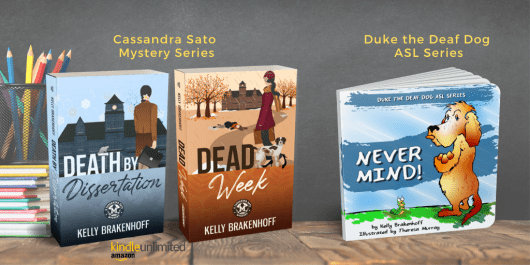
10. What’s the big thing I wish people understood about deafness? As a group, deaf and hard of hearing people are tired of always being the ones to bend to the majority of people who can hear. They feel like hearing people rarely bend to accommodate them. An example of how you can be more accommodating to people with differences is found in my children’s picture book, Never Mind. Duke the Deaf Dog doesn’t like it when people tell him “never mind” when he asks them to repeat something he missed. Maybe we could all be more patient instead of brushing aside people who have a hard time keeping up with the conversation.
Kelly’s Books
Buy Links
Death by Dissertation | Dead Week
Bio
KELLY BRAKENHOFF is an American Sign Language Interpreter whose motivation for learning ASL began in high school when she wanted to converse with her deaf friends. Her first novel, DEATH BY DISSERTATION, kicked off the Cassandra Sato Mystery Series, followed by DEAD WEEK. She also wrote NEVER MIND, first in a children’s picture book series featuring Duke the Deaf Dog. She serves on the Board of Editors for the Registry of Interpreters for the Deaf publication, VIEWs. The mother of four young adults and two dogs, Kelly and her husband call Nebraska home.
Website | Facebook Page | Goodreads | BookBub
On Writing Romantic Suspense
 Writing romantic suspense involves the skillful juggling of romantic elements and nail-biting suspense. A daunting task but so rewarding when all the essential ingredients come together in a well-crafted, character-driven novel.
Here are eight tips:
• Ask yourself: what is intriguing about the premise? What will attract readers to the book? In Sue Grafton’s Alphabet Series, protagonist Kinsey Millhone is a twice-divorced private investigator who is permanently stuck in the 1980s. In the Gilda Greco Mystery Series, the protagonist is a teacher turned lottery winner who moves back to her hometown and then finds herself embroiled in murder investigations.
Continue reading on the Sisterhood of Suspense blog.
Get in the Ring and Wrestle with Life
On Wednesdays, I share posts, fables, songs, poems, quotations, TEDx Talks, cartoons, and books that have inspired and motivated me on my writing journey. I hope these posts will give writers, artists, and other creatives a mid-week boost.
I receive a daily dose of inspiration from bestselling authors and coaches Marc and Angel Chernoff. Here’s a thought-provoking segment from last week’s email:
Far too often we think mental strength is all about how we respond to extreme circumstances…
• How did she perform on stage during that nationally televised event?
• Did he bounce back from that heart-wrenching divorce?
• Can she keep her life together even after suffering from a major, debilitating bodily injury?
There’s no doubt that extreme circumstances test our bravery, determination and mental strength, but what about common, daily circumstances?
Just like every muscle in the body, the mind needs to be exercised to gain strength. It needs to be worked consistently to grow and develop over time. If you haven’t pushed yourself in hundreds of little ways over time, of course you’ll crumble on the one day that things get really challenging.
But it doesn’t have to be that way…
Choose to go to the gym when it would be more comfortable to sleep in. Choose to do the tenth rep when it would be more comfortable to quit at nine. Choose to create something special when it would be more comfortable to consume something mediocre. Choose to raise your hand and ask that extra question when it would be more comfortable to stay silent. Prove to yourself, in hundreds of little ways, that you have the guts to get in the ring and wrestle with life.
Mental strength is built through lots of small, daily victories. It’s the individual choices we make day-to-day that build our “mental strength” muscles. We all want this kind of strength, but we can’t think our way to it. If you want it, you have to do something about it ritualistically. It’s your positive daily rituals that prove your mental fortitude and move you forward over the long-term.
The bottom line is that when things get difficult for most people, they find something more comfortable to do. When things get difficult for mentally strong people, they find a way to stay on track with their positive daily rituals.
Note: I highly recommend subscribing to Marc & Angel’s website.
Movie Reviews: Harriet, Parasite, and 1917
Each year, I try to watch all the nominated films before award season. I fell short this year but made up for it last week when I watched three of the Oscar-nominated movies: Harriet, Parasite, and 1917. Inspired and impressed by this diverse trio of movies, I decided to write and share my reviews:
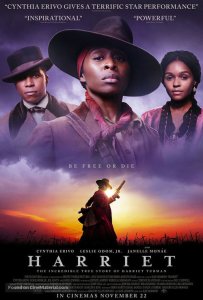 Actress, singer and songwriter Cynthia Erivo delivers a stellar performance, one that is truly worthy of the nominations garnered during the recent award season. Erivo embraces the multi-faceted role of the legendary Harriet Tubman, a woman who is considered one of America’s greatest heroes
Born a slave on a Maryland plantation and known by the name Araminta “Minty” Ross, she decides to flee to the North. Miraculously, she survives the journey (over 100 miles) and makes her way to Philadelphia. There, she is assisted by abolitionist William Still (Leslie Odom Junior) and boarding-room owner Marie Buchanon (Janelle Monáe).
After taking the “freedom” name of Harriet Tubman, she becomes part of the Underground Railroad, repeatedly risking her life to return to the South and ferry over 70 slaves to freedom.
I was most impressed by the scenes showcasing Harriet’s ability to hear nothing other than her own inner voice. In stressful situations, Harriet loses consciousness as she slips into spells, which she describes as “consulting with God.” Afterward, she emerges with an ironclad sense of the action and direction to be taken during rescue missions. These amazing feats earned her nickname “Moses.”
An extraordinary tale of an American freedom fighter!
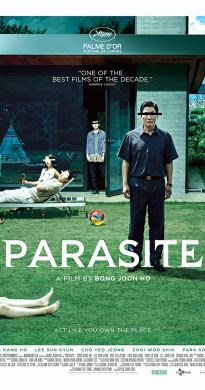 Described as a “pitch-black modern fairy tale,” Parasite has won numerous awards, among them four Oscars for Best Picture, Best Director, Best Original Screenplay, and Best International Feature Film.
Interested in examining relationships between different classes under capitalism, director and screenwriter Bong Joon Ho created an upstairs-downstairs tale involving the wealthy Parks and the street-smart Kims.
A twenty-something drifter Kim Ki-woo jumps at the chance to teach English to the teenage daughter of Mr. Park, a celebrated tech entrepreneur. Renamed Kevin by his status-conscious employers, Ki-woo hatches a plan to bring the rest of his unemployed family into the Park’s spacious, multi-level house. Father Ki-taek is the new driver, mother Chung-sook is the new housekeeper, and sister Ki-jung is the art tutor/therapist.
Determined to maintain their anonymity and successfully “con” the Parks, the Kims forge documents, invent aliases, and rehearse their lines. Bordering on preposterous, these schemes provide much of the dark humor in the film.
Gainfully employed, the Kims dare to dream about a different kind of future, one worlds away from their stinkbug and mildew-infested basement apartment. Unfortunately, those hopes and aspirations are quickly shattered. Without giving too much away, I will only say that several unexpected (surprising, shocking, and even horrific) twists to the storyline alter the trajectories of all the characters.
In a recent interview, Bong Joon Ho discussed the significance of the title. While most people would attribute the word “parasite” to the poor Kim family that has infiltrated the rich household, the director has a different viewpoint. He suggests that the members of the rich Park family could also be considered parasites. Unable to drive, cook, wash dishes, or study independently, they are forced to leech off the poor.
A must-see film that will linger in consciousness.
 Director Sam Mendes has incorporated anecdotes from his grandfather, Alfred Mendes, who fought in World War 1.
Two young British soldiers, Schofield (George MacKay) and Blake (Dean-Charles Chapman), are given a seemingly impossible mission: Cross enemy territory and deliver a message that will stop the following day’s deadly attack on 1600 soldiers. General Erinmore (Colin Firth) has selected Blake because his brother is part of that battalion.
What follows is a journey into a wasteland of twisted barbed wire, corpses, and shell craters as Schofield and Blake make their way deep into the German trenches. While the former front line has been abandoned, there are still many dangers the two men must face.
It seems like only one camera has been used, closely following Blake and Schofield as they embark on this perilous journey. I could feel the tension and suspense as they sidestepped booby traps, encountered German soldiers, and ran through burning buildings.
While the story of two young men attempting to stop a doomed attack is a compelling one, it would have helped to include more historical context. Also, I would have liked more scenes with the senior officers and the Frenchwoman in the deserted building. Those cameos moved a bit too quickly.
A dramatic and powerful film!
Movie Trailers
Note: Harriet and Parasite are available on DVD.
 Joanne Guidoccio