Author Archives: Joanne Guidoccio
Book Review: Don’t Go
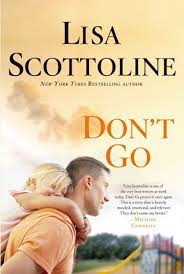 It had been a while since I read Lisa Scottoline’s books. I expected a legal thriller with a gutsy female protagonist. Instead, Scottoline introduces Mike Scanlon, a podiatrist in crisis.
While serving on a surgical team in Afghanistan, Mike receives a devastating message from home. His wife Chloe has died in her kitchen, a victim of a household accident. Upon his return, Mike discovers that his wife had a problem with alcohol, drinking vodka even while driving her car. Probing further, he learns that she was pregnant with another man’s child.
As he searches for explanations, his life continues to spiral downward.
His medical practice is in jeopardy and his infant daughter Emily screams uncontrollably whenever he approaches. Confused and angry, Mike returns to Afghanistan. While there, he is wounded and becomes dependent upon prescription painkillers. He returns to the United States, broken and unsure of how to proceed. More devastation follows and Mike faces a custody battle for his beloved Emily.
Throughout the novel, there is ample evidence of Scottoline’s intensity and accuracy. The horror of the battlefield comes alive and we can easily imagine scenes such as the following: “Black smoke flooded the interior. Joe and Dermot became frantic shadows trying to get out of the vehicle. Flames licked under the dashboard, superheating Mike’s face, searing his lungs. He gasped for breath. They’d burn alive if they didn’t get out.”
Mike’s inner struggle with Oxycontin as he faces the new “normal” dominates the second half of the book. We can empathize and understand the circumstances that would drive Mike to illegally prescribe opiates to himself.
A page turner that could be read in one sitting.
Movie Review: The Hangover Part III
Knowing that it was the final instalment in Todd Phillips gold-plated franchise made the 100 minutes of film seem extra long. The laughs were few and far between in The Hangover Part III and many of us left, firmly convinced that the party is indeed over.
The film started on a humorous note with Alan (Zach Galifianakis) off his meds and out of control as he drives a giraffe into a highway bridge, resulting in its decapitation. After his father dies, the other Wolf Pack pals, Phil (Bradley Cooper), Stu (Ed Helms) and Doug (Justin Bartha) stage an intervention and convince Alan that he needs rehab at a treatment center in Arizona. A road trip follows with an unexpected detour staged by mobster Marshall (John Goodman) who has learned that Alan has been texting gangster Leslie Chow (Ken Jeong).
More adventures follow as Alan, Phil and Stu search for Chow in Tijuana and Las Vegas.
Flashbacks and characters from the previous instalments insert bits of humor in an otherwise bland film. The funniest scene involves Alan and a pawn shop owner (Melissa McCarthy) flirting with a shared sucker. And if you’re not in a rush to leave, you will catch another funny scene as the end credits start to roll.
Oprah and the Bigger Picture

Yesterday on Super Soul Sunday, Oprah sat down with three of her favorite thinkers—Rev. Ed Bacon, Elizabeth Lesser and Mark Nepo—to deep dive into the news and look at the bigger picture. Using a different lens, this soul spiritual team addressed prescription drugs, gun violence, celebrity culture, gay marriage, and pets.
Prescription Drugs
The 2011 statistics are alarming: nearly 4 billion prescriptions were filled; 16 million Americans use painkillers; 5 million use sleep aids; and 18 million use antidepressants.
Oprah asked, “Do these numbers point to a collective hole in the soul of the country?
Rev. Ed was the first to respond. He revealed that he had experienced clinical depression and spent eight years in psychotherapy during his thirties. He carefully laid out a foundation of respect for anyone who has a chemical imbalance. According to Rev. Ed, these pills are okay if they help you enter life. They are not okay if they help you avoid life. Question to ask: Are you isolating yourself or living in community?
Elizabeth Lesser shared her marital problems and commented, “If I had medicated myself, I would not have had the courage to change.” Many people are replacing journeys of self-discovery with medication and choosing to stay asleep.
Mark Nepo’s wife also experienced depression. Mark thinks of medication as necessary aids and tools and strongly advocates psychotherapy which he believes is “attention to the soul.”
Gun Violence
With over 250 million guns in the United States, Americans are the most well-armed civilian population in the world. In 2010, there were 31,672 gun deaths; more than 19,000 of these were suicides. Unfortunately, it took the death of children to trigger a turning point in the gun control debate.
Rev. Ed believes that the Connecticut effect is here for a long time. In less than five minutes, 154 bullets emptied into the bodies of innocent children and adults. Elizabeth Lesser admits that we are hard-headed as a species and need big things to wake us up.
Oprah asked, “Why is arming ourselves so important?”
Mark Nepo believes there is an epidemic of fear and self-centeredness in our culture. People are arming themselves instead of facing their fears head-on. According to Rev. Ed, there is definite tension between the myth of the separate self and an understanding that we are all connected. He advised us to really listen to our adversaries and people who have a different perspective on the gun control debate.
Celebrity Culture
Oprah calls it the fallen celebrity syndrome.
Mark Nepo believes that people are obsessed with celebrity while quietly aching for things to celebrate. They want to pull people up so they can knock them down later. Rev. Ed referred to the shadow side of the celebrity syndrome. Many people prefer to avoid their own lives and project themselves in the scripts of others. Elizabeth Lesser suggested that when celebrities fall, people take comfort in the fact that everyone suffers in this life.
Gay Marriage
Public opinion has definitely shifted. In 1996, 27 percent of Americans supported gay marriage. In 2012, 53 percent supported gay marriage.
Elizabeth Lesser was educated through love. Growing up, she had no encounters with the gay population, but after nursing a friend with AIDS, she became more open and accepting. Rev. Ed believes that where you stand on this issue depends on where you sit Sunday mornings. According to Rev. Ed, gay marriage will enrich the institution of marriage. Everyone agreed that the institution of marriage was in trouble long before the advent of gay marriage.
Pets
Americans spend $53 billion annually on their pets. These animals bring delight, comfort and joy along with unconditional love and acceptance.
The three spiritual teachers were not surprised by this statistic. Mark Nepo shared an insight about the predominance of animals in Native American storytelling. An elder informed him that the Great Spirit, in his wisdom, realized that animals never forget their original instructions while human beings do.
Oprah asked, “Are we using our pets as a substitute for human interaction?”
Rev. Ed admitted this is the shadow side of having pets. They can keep us from the pain and messiness of human relationships. He ended on a lighter note by describing the Blessing Ceremony on St. Francis Day. When people bring their pets to church, they are really bringing more of themselves.
Book Review: The Other Typist
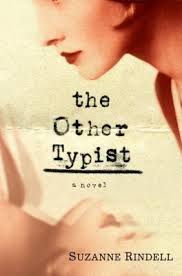 While I didn’t like any of the characters in The Other Typist, I couldn’t put the book down. It reminded me of the obsessions, misplaced passions, betrayals and unreliable narrators of Gone Girl (Gillian Flynn) and The Silent Wife (A.S.A. Harrison).
In The Other Typist, Rose Baker is the narrator who is slightly off and not to be trusted with her rendition of the facts. Efficient and organized, she is proud of her well-honed typing skills and admits that she doesn’t “know much about the business of forgiveness” as her job deals with the other end of it. One of three typists at a Manhattan police station, Rose transcribes the confessions of criminals brought in for interrogation.
The arrival of the mysterious Odalie Lazare changes everything. According to Rose, everyone from her beloved Sergeant to the other typists fall under the spell of the beautiful young woman with the bobbed hair and stylish clothes. Before too long, Rose and Odalie become the best of friends and end up sharing an apartment. They spend their days at the police station and their evenings visiting speakeasies.
Throughout the narrative, Rose hints at chinks in Odalie’s armor and her own ambivalence: “There was something chilling in her voice as she pronounced this last statement. For a moment, I had a flash of myself as the man who decides to paint the floor of his house and somehow manages to paint himself into a corner.” Without revealing too many other details, suffice it to say that Rose did paint herself into an unexpected and unfortunate corner.
As author Suzanne Rindell guides us through the twists and turns of this unusual tale, we are left guessing right to the end. And even then…
Oprah and Dr. Maya Angelou
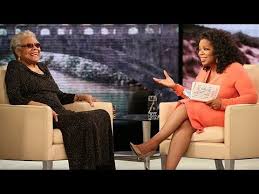
On yesterday’s Super Soul Sunday, Oprah sat down with Dr. Maya Angelou. At age 85, this gifted literary mother, grandmother and great-grandmother is still taking the world by storm.
Her latest memoir, Mom & Me & Mom, focuses on the deep spiritual connection between Dr. Angelou and her beautiful mother Vivian Baxter. A spitfire with a larger than life presence, Baxter loved and encouraged her daughter throughout her life. Dr. Angelou is grateful for the love she received from her mother, grandmother and son. She strongly believes that kind of love heals the wounds left by a larger society.
Best advice she received—Forgive
Best advice she gave—Have a pristine place deep inside that no one else can touch
Definition of God—All
Definition of Soul—The spirit that longs for All
Quotable Quotes…
Nobody makes it alone.
I had a lot of clouds, but I have had so many rainbows in my clouds.
Thriving is elegant.
Religion is only the map. Spirituality is surrender.
The caged bird sings because it must.
Fun Friday
Book Review: While We Were Watching Downton Abbey
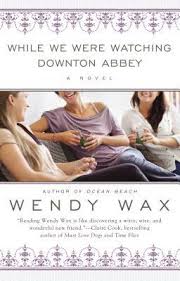 Three women and a concierge. All residents of the Alexander, a historic apartment building in downtown Atlanta. Each with their own story and set of problems.
Indebted to her husband for his generosity and financial support, Samantha Davis lives a life of routine and self-imposed expectations. Each morning, she wakes up and renews “her vow to make Jonathan Davis happy, his life smooth, and his confidence in his choice of her unshaken.” In addition to the beauty maintenance and hours of volunteer work, Samantha also includes a “much-dreaded-but-never-complained-about weekly lunch with her mother-in-law. Which would last exactly one hour but would feel more like three.”
Claire Walker is seeking a fresh start. In between “sixteen years of single parenthood on a shoestring” and caring for aging parents, Claire managed to write two Highland romances. After her daughter left her college, Claire sold her house and rented a studio apartment in the luxury high-rise. She gave herself exactly one year to write the breakout novel that would launch her career to the next level.
Divorced with two children, Brooke MacKenzie struggles with daily sadness and frustration as she watches her plastic surgeon husband take up residence with his reconstructed new girlfriend in another apartment of the Alexander.
Under normal circumstances, these women would never meet, let alone become friends. But with Edward Parker’s gentle prodding, they meet on Sunday evenings for weekly screenings of Downton Abbey, the period drama that has sparked a worldwide frenzy. I enjoyed revisiting many of the episodes and watching as the women peeled back facades and forged friendships.
Some of my favorite scenes from While We Were Watching Downton Abbey…
“When the doors slid open, she nodded as regally as she could and then swept out of the elevator, channeling not just Scarlett O’Hara, but Downton Abbey’s Countess Cora, Lady Mary, and the dowager countess all rolled into one.”
“He allowed himself to wonder why he’d turned being a concierge into the god-damned Holy Grail. Just like Downton Abbey’s Carson and even Mrs. Hughes, he’d given everything up in the service of others. How could he let all those sacrifices be for naught?”
An excellent read and beautiful tribute to the transformative power of friendship.
Book Review: The Magician’s Assistant
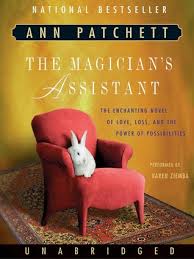 The novel opens with two short definitive statements. “Parsifal is dead. That is the end of the story.” Unique but not unexpected from best-selling author Ann Patchett.
In The Magician’s Assistant, Parsifal turns out to be a gay magician, successful rug merchant and AIDS sufferer who has just died of a ruptured aneurysm while holding hands with Sabine, his assistant and wife of less than a year. Shock intermingles with grief as Sabine discovers the rude surprise delivered posthumously in Parsifal’s will: His mother and two sisters whom he always spoke of as dead are alive and well in Nebraska.
Lonely and paralyzed with grief, Sabine becomes involved with the Fetters women. She leave sunny California and ventures out to the bleak, wintry plains of the Midwest. There, she peels back the layers of her late husband’s life and starts her own healing process. At night, she is visited in her dreams by Phan, Parsifal’s Vietnamese lover, who provides guidance and reports on the afterlife.
As the members of Parsifal’s family seek her help, she realizes that she is no longer just an assistant. Using her new-found strength and confidence, she is able to work her own brand of magic and unchain her husband’s family from a painful past. Dot, Parsifal’s mother, often comments on her ability: “I don’t mean to compare, but you’re a lot better at this magic stuff than he ever was…you’ve got something extra.”
Published over fifteen years ago, The Magician’s Assistant addresses several social issues, among them homosexuality and abuse, that are still relevant today.
Movie Review: The Big Wedding
Awkward. Vulgar. Tedious. Predictable. A crowd, but no pleaser. The reviews were definitely not kind.
But I couldn’t resist a film with such heavyweights as Robert DeNiro, Susan Sarandon, Diane Keaton and Robin Williams. And while I agree it wasn’t the best film of the season, it certainly wasn’t the worst wedding comedy on record.
The Big Wedding is based on the Swiss/French film, Mon Frère Se Marie, released in 2006. In the original film, the adopted Vietnamese son of a well-to-do divorced Swiss couple is preparing to marry. The son’s biological mother, long out of the picture, travels to unite with her son for the wedding. To appease the traditional Vietnamese mother, the entire wedding party pretends the adoptive parents are still married.
In The Big Wedding, adopted son (Ben Barnes) is Colombian and has two siblings: an attorney with marital problems (Katherine Heigl) and a doctor saving his virginity for marriage (Topher Grace). The virtuous Catholic mother (Patricia Rae) arrives with her other child, the sexually precocious Nuria (Ana Ayora). Add in Robin Williams as Father Moinighan to officiate the ceremony and all the ingredients for a chaotic farce are in place.
At barely ninety minutes, the film does not require a major time commitment. But I would wait for the DVD.

