I’m happy to welcome multi-published author Mary Lawlor. Today, Mary shares her creative journey and new release, Fighter Pilot’s Daughter.

Here’s Mary!
What was your inspiration for this book?
I grew up in a military family. We moved every two years or so, according to the Defense Department’s demands—packed up every cup, plate, sweater and picture and put them in boxes. The movers would come and take everything out of the house, our furniture too, and there we’d be, in an empty house for a day or two until we drove or flew away to the next posting. We mostly lived in military quarters and never had our own home. My father was a pilot in the Marine Corps and the Army, so we had to go wherever the government determined he was needed—Miami, Alabama, North Carolina, California, and several other places. By the time I was ready for college, I’d been to 14 schools—a bewildering way to grow up.
Initially my mother thought it was an adventurous life—she was always meeting new people, and seeing different parts of the country. She felt there was a certain glamor to being a fighter pilot’s wife. Over time, she grew more frustrated with the moving and never having a house of her own. And our family was totally identified with my Dad’s work. Mom had a very strong personality, was well-read, smart and funny, but she couldn’t work, couldn’t have a career of any kind, and really had to follow the orders sent down from the Pentagon that determined my father’s moves. There was a lot of tension in our house because of that. And my father was away from home a lot of the time—on a ship off the coast of Guatemala waiting an invasion to begin, or in northern Turkey investigating a fly-over of the Soviet border, or somewhere close to the border with East Germany, keeping tuned to news from the Fulda Gap. In these and other situations too frightening for my sisters and I to know about, he kept us in suspense from far away. We were happy when he came home, but without meaning to, he frightened us. He’d walk through the door, his head nearly touching the ceiling, his blue eyes lit with a long-distance gaze. It was like he hadn’t really landed. He had gifts. He told stories. But he wasn’t really home yet, and we weren’t sure who he was.
Outside our household, the Cold War climate kept fear hovering in the air all the time. We were constantly afraid the Russians would invade or set of a nuclear weapon, and the earth would become a nightmare of emptiness, hunger, vicious competitions for survival. Of course, I grew out of those fears and away from the tensions between my parents. By the time I went to college, I no longer took my parents’ religious or social or political beliefs for granted. And college, in Paris, gave me the opportunity to develop and express different ways of thinking and seeing myself. I thought a great deal about the tremendous break I made from my parents. And I thought a lot about the ways their visions stayed with me, in spite of my efforts to lead a different kind of life.
I went to graduate school and got a PhD in literature, which I then taught at university for many years. Through all the phases of my career, the echoes of that upbringing stayed in the background but kept determining patterns in the foreground. I moved a lot. I had tense relationships with boyfriends. I wanted to express myself in writing but didn’t have the confidence. Finally, after studying narratives long enough, I felt I knew how to make one of my own. I needed to sort out my complicated past and make sense of it. The best way to do that was to write it, and thus Fighter Pilot’s Daughter was born.
Which authors have inspired you?
Everybody I read inspires me—the way they clip or supercharge a sentence, the subtlety of their characters’ gestures, the ability of some writers to draw out time and then pace the action so effectively. There’s magic in every book. I’ve learned a lot from two writers whose styles are really quite opposite: Henry James and Ernest Hemingway! James has a great way of detailing a single psychological moment in a character’s perception, while Hemingway knows how to clip language so its sound and rhythm work to make the idea he’s conveying very striking. In both writers, thought, you find a lot of interesting ambiguities—gray areas that make their characters seem all the more human.
More contemporary favorites of mine are Don DeLillo, an amazingly sharp literary artist; and I love the work of Anna Burns, the Irish writer who won the Booker Prize in 2018. She has this wonderful way of creating characters through distinctive voices and tells moving, frightening, instructive tales of life in Northern Ireland. My family heritage is pure Irish, and I’ve lately found myself curious about literature from the island. I’ve found a trove of wonderful writers there: Paul Murray, James Martin Joyce (note the middle name!), Niambh Boyce, Mary Dorcey and others.
Besides writing and reading, what are some of your hobbies?
I like to swim. Since I was very young I’ve been swimmer and still do laps as often as I can. It helps clear my mind and refreshes my body. Walking is another of my favorite things to do. I like to walk uphill for an hour or so at a time, to really get the breathing going. It’s great for thinking and figuring out problems with writing. When I swim, I don’t think. My mind really takes a break. But when I walk, I figure out all kinds of things. It’s a very important way for me to process my stories.
Any advice for aspiring writers?
If you want to write, there’s likely something in your brain that stores language and stories in playful, artful ways. Try to get to know that about yourself and trust it. Educate yourself by reading good writers and by practice. Keep at it, every day. Listen to the words that sail through your mind, however briefly or dimly. They’re worth listening to and using. Remember doubt is part of the process: don’t let it stop you or get you down.
What are you working on next?
I’ve just finished a historical novel called The Translators, based on the actual lives of two medieval priests who traveled from England and Croatia, respectively, to northern Spain in the 1140s. There they met and became intimate friends, learned Arabic and translated works in the libraries that once belonged to the emirs of al-Andalus (what the southern part of the Iberian Peninsula was called when it was Arab and Muslim). I’ve fictionalized much of the priests’ lives for the novel but relied on extensive research on the history of the time. A lot of the tension in the story arises from the Church’s attitude toward the books the priests translate for Christians to read. The climax involves the English priest’s sister, who escapes the chaos of home to meet her brother in France, where she helps him and his friend overcome their personal tensions and, indirectly, resolves their struggles with the Church.
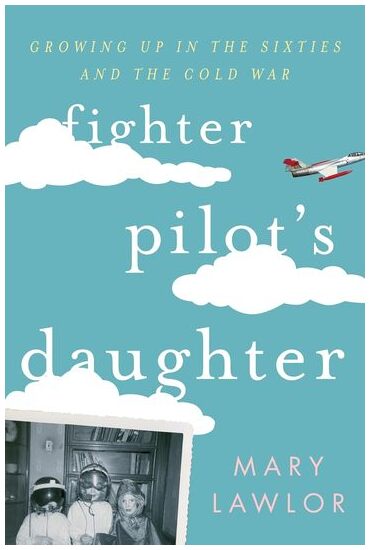
Blurb
FIGHTER PILOT’S DAUGHTER tells the story of the author as a young woman coming of age in an Irish Catholic, military family. Her father, an aviator in the Marines and later the Army, was transferred more than a dozen times to posts from Miami to California to Germany as the government demanded. For her mother and sisters, each move meant a complete upheaval of ordinary life. The car was sold, bank accounts closed, and of course one school after another was left behind. Friends and later boyfriends lined up in memory as a series of temporary attachments. The story highlights the tensions of personalities inside this traveling household and the pressures American foreign policy placed on the Lawlors’ fragile domestic universe.
The climax happens when the author’s father, stationed in southeast Asia while she’s attending college in Paris, gets word that she’s caught up in political demonstrations in the streets of the Left Bank. It turns out her strict upbringing had not gone deep enough to keep her anchored to her parents’ world. Her father gets emergency leave and comes to Paris to find her. The book narrates their dramatically contentious meeting and the journey to the family’s home-of-the-moment in the American military community of Heidelberg, Germany. The book concludes many years later, after decades of tension that had made communication all but impossible. Finally, the pilot and his daughter reunite. When he died a few years later, the hard edge between them had become a distant memory.
Fighter Pilot’s Daughter is available at Amazon.
Here’s what readers are saying about Fighter Pilot’s Daughter!
“Mary Lawlor’s memoir, Fighter Pilot’s Daughter: Growing Up in the Sixties and the Cold War, is terrifically written. The experience of living in a military family is beautifully brought to life. This memoir shows the pressures on families in the sixties, the fears of the Cold War, and also the love that families had that helped them get through those times, with many ups and downs. It’s a story that all of us who are old enough can relate to, whether we were involved or not. The book is so well written. Mary Lawlor shares a story that needs to be written, and she tells it very well.” ―The Jordan Rich Show
“Mary Lawlor, in her brilliantly realized memoir, articulates what accountants would call a soft cost, the cost that dependents of career military personnel pay, which is the feeling of never belonging to the specific piece of real estate called home. . . . [T]he real story is Lawlor and her father, who is ensconced despite their ongoing conflict in Lawlor’s pantheon of Catholic saints and Irish presidents, a perfect metaphor for coming of age at a time when rebelling was all about rebelling against the paternalistic society of Cold War America.” ―Stars and Stripes
Book Excerpt
The pilot’s house where I grew up was mostly a women’s world. There were five of us. We had the place to ourselves most of the time. My mother made the big decisions—where we went to school, which bank to keep our money in. She had to decide these things often because we moved every couple of years. The house is thus a figure of speech, a way of thinking about a long series of small, cement dwellings we occupied as one fictional home.
It was my father, however, who turned the wheel, his job that rotated us to so many different places. He was an aviator, first in the Marines, later in the Army. When he came home from his extended absences—missions, they were called—the rooms shrank around him. There wasn’t enough air. We didn’t breathe as freely as we did when he was gone, not because he was mean or demanding but because we worshipped him. Like satellites my sisters and I orbited him at a distance, waiting for the chance to come closer, to show him things we’d made, accept gifts, hear his stories. My mother wasn’t at the center of things anymore. She hovered, maneuvered, arranged, corrected. She was first lady, the dame in waiting. He was the center point of our circle, a flier, a winged sentry who spent most of his time far up over our heads. When he was home, the house was definitely his.
These were the early years of the Cold War. It was a time of vivid fears, pictured nowadays in photos of kids hunkered under their school desks. My sisters and I did that. The phrase “air raid drill” rang hard—the double-A sound a cold, metallic twang, ending with ill. It meant rehearsal for a time when you might get burnt by the air you breathed.
Every day we heard practice rounds of artillery fire and ordinance on the near horizon. We knew what all this training was for. It was to keep the world from ending. Our father was one of many dads who sweat at soldierly labor, part of an arsenal kept at the ready to scare off nuclear annihilation of life on earth. When we lived on post, my sisters and I saw uniformed men marching in straight lines everywhere. This was readiness, the soldiers rehearsing against Armageddon. The rectangular buildings where the commissary, the PX, the bowling alley, and beauty shop were housed had fallout shelters in the basements, marked with black and yellow wheels, the civil defense insignia. Our dad would often leave home for several days on maneuvers, readiness exercises in which he and other men played war games designed to match the visions of big generals and political men. Visions of how a Russian air and ground attack would happen. They had to be ready for it.
A clipped, nervous rhythm kept time on military bases. It was as if you needed to move efficiently to keep up with things, to be ready yourself, even if you were just a kid. We were chased by the feeling that life as we knew it could change in an hour.
This was the posture. On your mark, get set. But there was no go. It was a policy of meaningful waiting. Meaningful because it was the waiting itself that counted—where you did it, how many of the necessities you had, how long you could keep it up. Imagining long, sunless days with nothing to do but wait for an all-clear sign or for the threatening, consonant-heavy sounds of a foreign language overhead, I taught myself to pray hard.
– Excerpted from Fighter Pilot’s Daughter by Mary Lawlor, Rowman and Littlefield, 2013. Reprinted with permission.
About the Author

Mary Lawlor is author of Fighter Pilot’s Daughter (Rowman & Littlefield 2013, paper 2015), Public Native America (Rutgers Univ. Press 2006), and Recalling the Wild (Rutgers Univ. Press, 2000). Her short stories and essays have appeared in Big Bridge and Politics/Letters. She studied at the American University in Paris and earned a Ph.D. from New York University. She divides her time between an old farmhouse in Easton, Pennsylvania, and a cabin in the mountains of southern Spain.
You can visit her website at https://www.marylawlor.net/ or connect with her on
X or Facebook.
 Joanne Guidoccio
I thought my own childhood was bad enough, yours sounds like a nightmare!