The Headmaster’s Wager

At age fifteen, Vincent Lam knew that he wanted to be a writer. And the first book he wanted to write was one inspired by his grandfather, William Lin, a headmaster of an English school in Cholon who “had a taste for gambling, women, the finer things of life.”

Lam started writing The Headmaster’s Wager over a decade ago, but put it aside to finish medical school and complete his award-winning short story collection, Bloodletting and Miraculous Cures.

In a recent interview, Lam claims that The Headmaster’s Wager took ten years of toil. More than 1,000 pages were tossed as he experimented with different points of view: four different narrators, third person, first person and back to third person. He commented, “It would be awfully nice to be more efficient, but I haven’t figured out away to do it yet.

The novel opens in 1966, just as the Vietnam War is escalating. Chen Pie Sou, also known as Percival, is the headmaster of an English academy in Cholon. Determined to play all sides, this Chinese expat businessman negotiates relationships with the Vichy French, Japanese, South Vietnamese, Americans and North Vietnamese forces. Throughout the novel he reiterates the simple Chinese business strategy of remaining indifferent to politics.

When his son, Dai Jai, broadcasts his Chinese patriotism, Percival realizes he cannot keep his son safe in Viet Nam. Using all his connections, he sends Dai Jai to China at the height of the Cultural Revolution. To console himself, Percival turns to gambling and enters a relationship with Jacqueline, a mixed-race Vietnamese-French prostitute. On the eve of the Tet Offensive, Jacqueline bears Pericival a son.

As the fighting in Viet Nam intensifies, Percival tries to protect both sons, but quickly discovers that the rules have changed. He must now risk more than his fortune; he must risk his very life to save his own flesh and blood.

Salmon Fishing in the Yemen

From the trailer, I gathered there would be a romance between Fred Jones (Ewan McGregor) and the beautiful Harriet Chetwode-Talbot (Emily Blunt). And Patricia Maxwell (Kirstin Scott Thomas) would provide comic relief as the over-the-top press secretary to the British prime minister.

But there is more to this movie that combines the screenwriting talents of Simon Beaufoy (Slumdog Millionaire) and the directorial abilities of Lasse Hallström (Chocolat).  The end result is an inspiring movie  about making the impossible possible.

A visionary sheik (Amr Waked) wants to stock the Yemen River with North Atlantic salmon. Desperate for a positive human interest story from the Middle East, Patricia Maxwell sets in motion a chain of events involving Britain’s leading fisheries expert, Fred, and the sheik’s attaché, Harriet.

At first skeptical, Fred admits that the idea is “theoretically possible” and then adds the qualifier: “the way a manned mission to Mars is theoretically possible.” But after meeting the sheik and spending time under the desert sun, Fred becomes enthusiastic about the project. Together, Fred, Harriet and the sheik embark on an upstream journey of faith and fish.

Inspired by Nicole Abouhalka

I was curious about the elegant soft-spoken woman who sat across from me at the table. While she said very little during the first session of the writing workshop, I sensed that she was working on an amazing life story.

In fact, Nicole Abouhalka had already written several anecdotes, stories and poems in a published collection entitled Oh! Canada.

Nicole did not discover her writing abilities until 1982. While travelling from Lebanon to Cyprus, she wrote poetry to keep awake. After a two-year stop in Montreal, the Abouhalka family moved to Guelph and made a decision to open a Lebanese restaurant.  Nicole took creative writing courses at the University of Guelph and tried her hand at short stories.

Fast forward to 2004…

After undergoing brain surgery , Nicole lost all her capacities. Her sons urged her to write about her experiences since leaving Lebanon. Slowly, Nicole regained most of her coordination and the use of her analytical mind as she wrote this entertaining collection.

Her humor is evident throughout the book, especially when she discusses the diagnosis of meningioma. She asked the neurosurgeon the following questions:

“Could my tumour be due to all the chocolate I ate and am still eating?”

“Could it be the Black Box of my life?”

“Could it be a concentration of all the negative energies that I have been channeling?”

After learning that the tumour was large—120 ml—she asked: “Would I be called an air-head?”

Nicole Abouhalka is now working on a memoir for her grandchildren.

Oprah and Jean Houston

On yesterday’s Super Soul Sunday, Oprah sat down with  Jean Houston, one of the elders of the personal growth movement. Asked to describe herself, the American scholar, lecturer, author and philosopher came up with the following:   “an evocateur of the possible and midwife of the soul.” Throughout the telecast, she impressed Oprah and all of us with her optimism and insights. I am looking forward to reading her latest book,  The Wizard of Us,  where she interprets the deeper messages within the The Wizard of Oz and leads us along the Hero’s journey that awaits each of us.

While she has met with some of the great citizens of the world, she finds greatness in everyone she meets. In particular, she is ignited by her encounters with young people. She is very optimistic about our world and believes that more people are becoming more conscious.  When asked to define soul, she came up with three definitions: essence of who and what we are, lure of our becoming, and sometimes a pain in the neck.

The seventy-five-year-old Houston does not look her age and attributes her youthfulness to her Sicilian roots. She has never thought too much about the aging process; there’s so much to do and to be. She finds the second half of her life most interesting and believes that her own life started to get really good at age sixty.

Quotable Quotes…

You’re always wearing those red shoes.

I have a passion for the possible.

Guru—Gee, you are YOU!

We are sourced in spirit and we are adequate to the challenge of the times.

If you don’t accept the yearning, you end up dying inside. Joseph Campbell

We are the heroes of our own life’s journey. Joseph Campbell

Movie Review: Flight

As I watched veteran pilot Whip Whitaker (Denzel Washington) consume large quantities of alcohol and cocaine just before takeoff, I expected the worst. Surprisingly enough, Whitaker takes charge during a mechanical failure and executes a daring manoeuvre to slow down the plane’s descent and regain stability.

Afterward, Whitaker is proclaimed a hero until a post-crash blood test reveals a blood alcohol count of 0.24, well above the legal limit.  As he fights to defend his actions and avoid a jail sentence, he must  come to terms with a lifestyle of excess and denial.

Along the way, Whitaker connects with a romantic fellow addict (Kelly Reilly) and comic enabler (John Goodman) whenever he needs a quick fix.  Union rep (Bruce Greenwood) and lawyer (Don Cheadle) round out the list of supporting actors who don’t get too much screen time in this intense character drama.

Denzel Washington’s portrayal of a deeply flawed character who flew too close to the sun (both literally and figuratively) is definitely worthy of an Oscar nomination.

A must-see movie…Just don’t watch it before boarding a plane.


Book Review: Thirst by Shree Ghatage

The opening is unsettling.

A wounded man has lost his memory and is being nursed by a kind Samaritan and his mentally ill daughter in North Wales. A connection to India is established and the amnesiac is given an alias, Hari.

When Hari regains his memory, he recalls the picture-perfect fairy tale life he left behind. Hari is really Baba Chafékar, the youngest son of a wealthy Hindu family, who grew up on a lush Indian estate complete with servants, horses, tennis and badminton courts, and a swimming pool. After reluctantly agreeing to an arranged marriage with the beautiful and recently orphaned Navasanti, Baba falls passionately in love with her.

Prior to the marriage, Baba had already made the decision to study law in England. A worthy goal for many Anglophiles in British India, but not a practical one in the middle of World War II. Motivated by a desire to punish his father for an unforgiveable act, Baba ignores his father’s plea, “Don’t let my life affect your decisions,” while Christopher, his British friend, writes and suggests that Baba postpone his educational plans. His wife’s uncle advises: “If London is bombed again, or threatened in any way, or for any reason things don’t work out, don’t hesitate—just return home.”

As the departure date nears, Baba is torn by his love for Vasanti and hopes she will ask him to reconsider. But the orphan has matured and accepted her new husband’s decision. Her parting words would ring in Baba’s ears long after he left India: “I began to say goodbye the very day you told me you were leaving. That was also the day I began awaiting your return.”

After a difficult sea voyage, Baba arrives alone in a Blitz-besieged London. His spirits sag as he experiences the cold dampness, bombed out buildings, rationing of food, and a disappointing encounter with Christopher. Alone and friendless, Baba cannot satisfy his thirst and hunger. A vegetarian, he rejects the usual British fare of liver sausages, beef and lamb and has unappetizing meals consisting of soup, scrawny potatoes and dirty brown bread. Desperate to flee the inhospitable city, he embarks on a hiking excursion to the Scottish Highlands where he has an unfortunate accident and is rescued by Mr. Owens and his daughter, Catherine.

As his circumstances continue to spiral downward, Baba gradually releases the stubborn pride that has alienated him from his father and acknowledges that he has participated in a transgression similar to the one he once found so unforgiveable. Throughout the novel, Baba refers to an inscription written by his mother in her prayer book: “It is no use asking why the small stream is not the might Ganges, or why the sparrow does not fan its feathers like the peacock, or why the coconut palm does not provide shade as does the banyan tree. Each is what it is and so it is with humankind: all His creation, we are what we are.” Baba comes to terms with the new normal, the turbulent normal that has replaced his once charmed life.

While we are aware of Baba’s changing circumstances in England, we know little about Vasanti’s life during those two years. Some chapters are written from Vasanti’s point of view, but the majority of the book focuses on Baba. In the last chapter, we get a glimpse of her life, but it is too rushed. I wanted to read more about the anger and frustration she experienced when there were no letters from Baba. How was she treated after Baba left? Did she continue to enjoy the same privileges as her sisters-in-law? Did she reconnect with her own relatives or continue to depend only on her in-laws?

The title is an unusual one and, at first, I wondered about its suitability for a historical novel based in India and England. But after reading the entire novel, I realize that Thirst is really about the different forms of desire—physical and emotional—that abide within all of us and the tragic consequences that can occur when that thirst is not properly quenched. While Baba enjoys many privileges in India, he has a prolonged desert experience during his two-year stay in war torn England.

Canadian writer Shree Ghatage has created a compelling novel with a conflicted character, set against the backdrop of World War II. Born in Mumbai, Ghatage grew up in a society characterized by the rhythms of British India. In writing this novel, she drew upon those early memories and her own experiences as a new immigrant in Canada.

The ending is unexpected and I wonder what Shree Ghatage has in store for us next. Thirst is the second in a trilogy of books that are loosely connected, but can easily stand alone.

Oprah and the Next Generation

On yesterday’s Super Soul Sunday, Oprah featured three up-and-coming thought leaders: Gabrielle Bernstein, Mastin Kipp and Marie Forleo.

I was impressed by their voices and platforms.

At age 32, Gabrielle is a life coach, speaker, and best-selling author of Spirit Junkie. She reaches thousands of listeners with her weekly show on Hay House Radio. Open and psychically aware as a child, Gabrielle had an existential crisis at age sixteen. After her mother taught her how to meditate, she experienced shifts in her being and felt as sense of peace. For ten years, she traveled in the wrong direction, but found her way back at age twenty-five.

Thirty-year-old Mastin is the founder of The Daily Love, a newsletter, website and twitter feed. Considered the fasted growing inspirational site on the web, his followers increased from 1000 to 10,000 in one week after Kim Kardashian tweeted one of his posts. In his mid twenties, he experienced a divine storm that served as a wake-up call.

As author, speaker, life coach and entrepreneur, thirty-six-year-old Marie has empowered thousands of women around the world.  If Oprah, Tony Robbins, Jay-Z and Richard Branson had a child, Marie claims she would be that child.

Having unlocked the door to spirituality at such young ages, they are more than willing to share their experiences and help others awaken. When Oprah asked them to give three steps that anyone could follow, they came up with the following:

From Gabrielle…

1. Be willing to see things differently. When this happen, books start falling off the shelf and the right people appear in your life.

2. Pay attention to the opportunities, teachers and assignments that come your way.

3. Show up for these assignments

From Mastin…

1. Pay attention to the moments when you feel bliss.

2. Take action in that direction.

3. Trust as you step: something will arrive to support you.

From Marie…

1. Start with gratitude for everything you have in your life. When you are grateful, you change at the cellular level.

2. Be present to everything in your environment.

3. Bring passion to everything that you do.

Quotable Quotes…

Everyone has a God-size hole inside that they try to fill with food, shopping, drugs and other addictions. (Mastin Kipp)

Gratitude is a life saver whenever I feel frustrated or annoyed. (Marie Forleo)

We are not mystics in a monastery; we are mystics in the Western World. We must be able to monetize our gifts and skills. (Mastin Kipp)

We are compensated financially to the degree that we add value to the world. (Mastin Kipp)

Everyone is entitled to miracles. Miracles occur naturally and when they don’t, something has gone wrong. (Gabrielle Bernstein)

Inspired by Vicki Delany

Fifteen years ago, Vicki Delany started writing on Sunday afternoons. Living in Oakville, she was working full-time as a computer programmer and raising three daughters on her own. In spite of those challenges, she managed to write three suspense novels that were published to critical acclaim by Poisoned Pen Press of Scottsdale, Arizona.

In 2007, she took advantage of early retirement, sold her house and travelled around North America for an entire year. Afterward, she settled in rural Prince Edward County. Somehow, this prolific writer found the time to write twelve more books during the past five years. Her latest in the Klondike gold Rush Series, A Cold White Sun is forthcoming in 2013 and Gold Web in 2014.

Last evening, she led an informative and entertaining workshop on “Creating Realistic Characters” at  the Waterloo Community Arts Centre.

Some of her tips…

A good mystery novel isn’t really about the crime. It should be chock full of psychology.

Separate yourself from the character. If she resembles you too much, you will find it difficult to make her face conflict.

Always ask…What is the worst thing that can happen to the protagonist?

Make the conflict personal for all your characters.

Sidekicks work well if they’re opposite to the protagonist.

When creating a villain/antagonist, ask…What sort of person believes the solution to their problems lies in killing someone?

The villain must be believable. Avoid falling into melodrama and stereotypes.

A good villain could be a flawed hero.

Don’t provide too many details about secondary characters who appear only once.

Every suspect must have a reason to lie. In order to know why they are lying and what they are lying about, you have to know a lot about their background and personality.

Send your completed manuscripts to publishers in Canada and the United States.

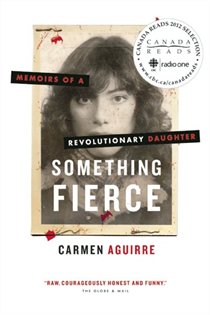
Book Review: Something Fierce by Carmen Aguirre

At last night’s book club, we had a lively discussion about Carmen Aguirre’s memoir, Something Fierce: Memoirs of a Revolutionary Daughter. While most of us were fascinated by the book and welcomed the opportunity to learn more about Chile, we had different opinions regarding the parenting of Carmen and her sister, Ale.

When Carmen was five years old, her family left Chile and began a new life in Vancouver. Six years later, her mother (Mami) decided to return and join the revolutionary movement against Pinochet’s dictatorship. Separated from her husband, Mami decided to take her two daughters with her.

What follows is Carmen’s coming of age story set against the frightening backdrop of Chile in the 1980s. Moving from city to city and country to country across South America, the children were left with a revolving door of babysitters as Mami and her partner, Bob, were on assignment. At one point in the story, Carmen is left alone too long and her money runs out. She hides in the apartment and morphs into an “agoraphobic 15-year-old skeleton with obsessive compulsive disorder.” Interestingly enough, Carmen thought life in the Resistance was normal and decided to become a revolutionary at age eighteen.

While some of the other club members made allowances for Mami, feeling that she authentically cared for her children and wanted them to experience her love and passion for Chile, I tend to agree with Ale’s comment: “Here’s a revolutionary thought: provide for your children and pay attention to them.”

In a CBC interview, Carmen spoke of her love and admiration for Mami. While Carmen would never put her own child through that experience, she did offer insight into her mother’s behavior. Born in an upper middle class home, Mami was not raised in the Resistance movement and had no clue about its effects on young children. Mami took to heart the words of her Resistance oath: “I am committed to giving my life to the cause. I will die for the cause if need be. From now on, my entire life is dedicated to the cause, which takes precedence over everything else.”

To date, very little has been written about the Chilean revolution in English literature. In writing Something Fierce, Carmen Aguirre has filled that void.

An excellent read that will  evoke strong feelings.