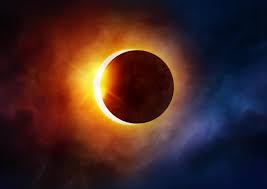
 Today, millions of people across North America will gather to watch as the moon passes in front of the sun and casts a shadow over a 112-kilometer-wide cross-section of the continent.
Some cities will see the eclipse in its totality while others will see a partial eclipse. But everyone from Maine to Alaska will be able to experience it.
Throughout history, eclipses have evoked feelings ranging from morbid fear to avid curiosity. As a result, many myths and superstitions have sprung up, some of which still linger in 2017.
Here are ten examples:
1. According to Hindu mythology, the deity Rahu was beheaded by the gods for drinking their nectar. Rahu’s head flew off into the sky and swallowed the Sun, causing an eclipse.
2. Ancient Greeks believed eclipses were messages from the gods: You have done wrong.
3. The Pomo, an indigenous group of people who live in the northwestern United States, share a story of a bear that started a fight with the Sun and took a bite out of it. The Pomo name for solar eclipse is Sun Got Bit By a Bear. After resolving its conflict with the Sun, the bear then took a bite out of the Moon, causing a lunar eclipse.
4. Korean folklore suggests that solar eclipses occur because mythical dogs are trying to steal the Sun.
5. The Batammaliba, who live in Togo (Africa), used a solar eclipse as a teaching moment. According to their legends, a solar eclipse is an indication of conflict between the Sun and Moon. Humans can end this conflict by resolving all conflicts with each other.
6. The Arapahyo Plains Indians (Colorado and Wyoming) saw the celestial bodies as siblings—brother sun and sister moon—and were alarmed when they suddenly converged. An obvious question (from their perspective): Are they having sex in the sky?
7. The Mayans believed a solar eclipse that lasted more than a day would herald the end of the world. The Ch’orti predicted that the spirits of the dead would come to life and eat those on earth while the Lacandón expected the earth would split and jaguars would emerge and eat most of the people.
8. In India, people believe that any food cooked during an eclipse will be poisonous. To avoid any mishaps, they fast.
9. A popular misconception exists in many cultures: Solar eclipses can be a danger to pregnant women and their unborn children.
10. Italians believe that flowers planted during a solar eclipse will be brighter and more colorful than flowers planted any other time of the year.
Note: There is no scientific basis for any of these myths or superstitions. Nor is there any evidence that solar eclipses can affect human behavior, health, or the environment. But scientists do emphasize the need for proper eye protection.

 Joanne Guidoccio