Category Archives: Nature
Happy Birthday, David Suzuki!
Today is Dr. Suzuki’s 90th birthday. Born in Vancouver (British Columbia), he is a renowned Canadian scientist, environmentalist, university professor, and broadcaster known for his work in promoting sustainability and raising awareness about climate change.
A geneticist with a PhD in zoology, he became widely recognized for his long-running television series, The Nature of Things, in which he explained complex scientific topics. He is also the co-founder of the David Suzuki Foundation, which focuses on environmental conservation and climate solutions.
Voted one of the Top Ten Canadians, he has published more than fifty books. He is celebrating his birthday with the release of Lessons from a Lifetime: Ninety Years of Inspiration and Activism.
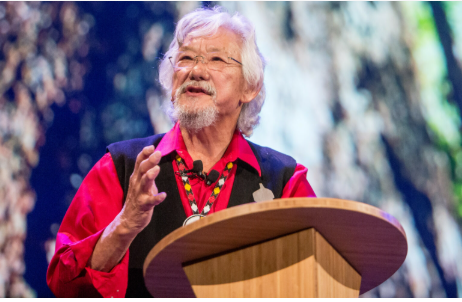
My favorite quotes from David Suzuki:
My parents survived the Great Depression and brought me up to live within my means, save some for tomorrow, share, and don’t be greedy, work hard for the necessities in life, knowing that money does not make you better or more important than anyone else. So, extravagance has been bred out of my DNA.
I can’t imagine anything more important than air, water, soil, energy, and biodiversity. These are the things that keep us alive.
Ultimately, we need to recognize that while humans continue to build urban landscapes, we share these spaces with other species.
Nature surrounds us, from parks and backyards to streets and alleyways. Next time you go out for a walk, tread gently and remember that we are both inhabitants and stewards of nature in our neighbourhoods.
Our personal consumer choices have ecological, social, and spiritual consequences. It is time to re-examine some of our deeply held notions that underlie our lifestyles.
Change is never easy, and it often creates discord, but when people come together for the good of humanity and the Earth, we can accomplish great things.
We are in a giant car heading towards a brick wall, and everyone’s arguing over where they’re going to sit.
We must reinvent a future free of blinders so that we can choose from real options.
Scientists have been warning about global warming for decades. It’s too late to stop it now, but we can lessen its severity and impacts.
The human brain now holds the key to our future. We have to recall the image of the planet from outer space: a single entity in which air, water, and continents are interconnected. That is our home.
Interview on The Social
Welcoming Spring
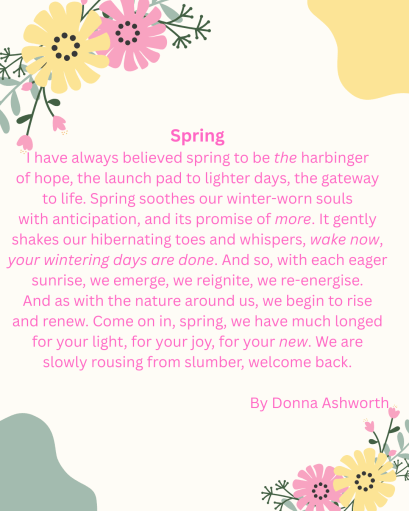
Known as the UK’s best-selling living poet, Donna Ashworth first rose to prominence during the 2020 lockdown, when her poem “History Will Remember When the World Stopped” went viral and helped raise funds for the NHS. In the years since, her work has continued to resonate, offering reflections on resilience, connection, and hope.
Here’s one of my favorites…perfect for the season:
Fun Friday!
On a Lighter Note…
This month has been challenging, with colder-than-usual temperatures and ever-changing global dynamics. Against that backdrop, it was a delight to hear about a wee celebrity who is creating a stir in Montreal, Quebec.
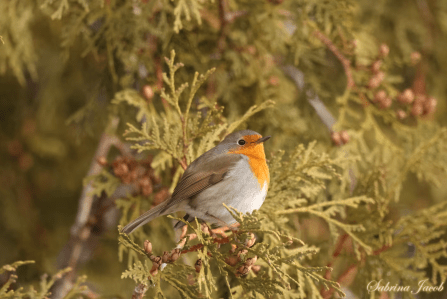
Last week, Sabrina Jacob was taking out her garbage when she spotted a rare bird perched nearby—a European robin. A hearty little bird, it is native to Europe and can be found as far north as the Scandinavian countries.
After Sabrina shared pictures and videos online, word spread quickly. Bird enthusiasts from across Canada and the United States flocked to Montreal, hoping to catch glimpses of this visitor so far from home.
How did the bird end up in Canada?
According to bird behaviourist Joel Coutu, one possibility is that the bird fled harsh European cold fronts and somehow crossed the Atlantic Ocean. Another theory suggests it may have arrived during fall migration and has, until now, gone unnoticed, living among us for weeks or months.
Here’s one of Sabrina Jacob’s pictures:
Welcoming the Winter Solstice
Known as the UK’s best-selling living poet, Donna Ashworth first rose to prominence during the 2020 lockdown, when her poem “History Will Remember When the World Stopped” went viral and helped raise funds for the NHS. In the years since, her work has continued to resonate, offering reflections on resilience, connection, and hope.
Here’s one of my favorites…perfect for the season:

Honoring Dr. Jane Goodall
Dr. Jane Goodall, the renowned primatologist and conservationist, passed away yesterday at the age of 91.
From a young age, she was fascinated by animals, dreaming of living in Africa and studying wildlife. In 1960, without formal scientific training, she traveled to Gombe Stream National Park in Tanzania to observe wild chimpanzees under the mentorship of anthropologist Louis Leakey. Her discoveries revealed astonishing behaviors: chimpanzees use tools, show emotions, and live in complex social groups.
She later earned a Ph.D. from the University of Cambridge, becoming one of the few people at the time to do so without an undergraduate degree. Over the decades, Dr. Goodall shifted her focus from observation to global advocacy, raising awareness about habitat destruction, animal welfare, and environmental sustainability. She founded the Jane Goodall Institute and created Roots & Shoots, a program that empowers young people to address environmental and humanitarian issues.
She has traveled the world, inspiring audiences with her message of hope, responsibility, and respect for all living beings.

My favorite quotations from Dr. Jane Goodall:
What you do makes a difference, and you have to decide what kind of difference you want to make.
The greatest danger to our future is apathy.
Every individual matters. Every individual has a role to play. Every individual makes a difference.
You cannot get through a single day without having an impact on the world around you.
Hope is what enables us to keep going in the face of adversity. It is what keeps us motivated.
The least I can do is help people see the interconnectedness of all life.
Chimps, more like us than any other creature, have helped us to understand what it means to be human.
You cannot share your life with a dog or a cat and not know perfectly well that animals have personalities and minds and feelings.
My mission is to create a world where we can live in harmony with nature.
We still have a window of time. Nature is amazingly resilient. If we give her a chance, she will recover.
Happy Autumn!

Fun Friday!

A Monarch’s Journey Inspires My Own
I’m happy to welcome author and editor Amy R. Kaufman. Today, Amy shares her creative journey and new release, The Monarch’s Message.
Here’s Amy!
I founded Stories magazine when I was 30, after making a devastating error in life. This creative venture was a way to carry on. Believing I was not ready to write seriously, I chose to edit. I drafted my concept for a national short story magazine on a piece of green paper. In reaction to trends in literature, I was seeking universal, timeless short stories. The magazine, produced in my typesetting shop in Boston, ran for 12 years.
Forty years later, during the pandemic, I began to write a story about the monarch butterfly as a gift for my niece. It was less intimidating than “serious” literature, so I assumed the children’s book would soon be finished. There was so much to learn that it took three years to complete. I realized how arrogant I had been to think I could meet the literary standards I had set for others.
It would have been impossible for an illustrator to draw the monarch with forests, deserts, and volcanoes in the background. During a thrift-store hunting trip, I discovered a 1983 photography magazine with a magnificent image of monarchs. I was able to reach the photographer, George D. Lepp, recently named a Canon Legend for his lifetime achievement, and purchased the right to publish several of his images. From thousands of portfolios, I selected 20 images depicting phases of the monarch’s life, from birth to an overwintering colony blanketed with clustering butterflies.
Everyone is inspired by the monarch; it seems to carry a message. With my book “The Monarch’s Message” I was entering a crowded field. To distinguish my concept, I made several decisions. First, the story is not merely plotted; its power derives from natural phenomena as they unfold. Second, as far as possible, the point of view is confined to the butterfly’s observations. Third, each paragraph reveals the character’s dedication to a purpose and her resilience to obstacles in changing terrain. I became more aware of my own resilience after this study, and I hope readers of all ages will experience the same awakening.
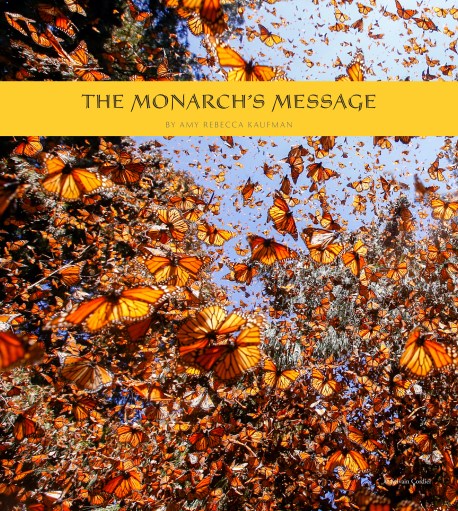
“The Monarch’s Message,” a photographic storybook, focuses on the capabilities of a monarch who embarks on the migration alone. Acclaimed photographers–notably George D. Lepp, a Canon Legend–offer spectacular views of stopping places along the trail. The story depicts natural phenomena rarely seen by human eyes. Sensory impressions create the feeling of flying with the butterfly as she navigates mountain ranges and deserts. Each environment reveals an aspect of her resilience.
Author Bio and Links
Amy R. Kaufman is an author and developmental book editor in Portland, Oregon. Stories, her Boston-based magazine for the short story, received several honors during its twelve-year run.
Writings World Literature | Amazon
The book is available to teachers and librarians through Follett Content Solutions.

Ms. Kaufman has created a photographic storybook for young and young-at-heart readers who are fascinated by monarch butterflies. Proud to proclaim myself a member of this group, I enjoyed reading this inspirational tale about Lita, a young butterfly, who sets off on an extraordinary journey from her home in North America to the Transvolcanic Range near Mexico City.
A gifted storyteller, Ms. Kaufman has a wonderful eye for detail and a gift for creating a strong sense of place. I could easily imagine myself traveling with Lita as she navigated mountain ranges and deserts. Her unwavering optimism and perseverance in the face of challenges is truly inspiring. One of my favorite quotes: “Even in the desert there was nectar for butterflies. Lita drank from yellow flowers and dropped pollen into each one. For a long way there was no sign of water, only cactus on each side…She knew her home could not be in that gray wasteland.”
Kudos to the photographers who shared their breathtaking images. These images, captured in vivid detail, depict the monarch’s transformation from a tiny egg to a majestic butterfly and its awe-inspiring journey across the continent.
 Joanne Guidoccio