Poetry Collection Review: How to Fly (In Ten Thousand Easy Lessons)

April is National Poetry Month, a month set aside to celebrate poetry and its vital place in our society. Launched by the Academy of American Poets in 1996, this month-long celebration has attracted millions of readers, students, teachers, librarians, booksellers, and poets.

Each Friday of April, I will share a favorite poetry collection.

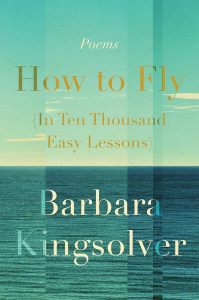
Today’s pick is How to Fly (In Ten Thousand Easy Lessons) by Barbara Kingsolver, a collection described as “reflections on the practical, the spiritual, and the wild.”

Having enjoyed reading Kingsolver’s novels, I was delighted to discover that she also writes poetry. In this collection, she explores everyday life with warmth and insight.
The book opens with a series of “how to” poems that range from the intimate—marriage and divorce—to the unexpected, like shearing a sheep or doing nothing at all. Her poem “How to Survive This” was featured in The New York Times during the pandemic.

The second set, “Pellegrinaggio,” follows a family trip to Italy with her mother-in-law. I could easily visualize the following scene in “On the Train to Sicily:”

“In a family compartment we take the long
road south, down the coast and across the channel
to the patria of her father. She is so tired.
We’ve lifted her onto the sill of this urbane clatter,
tucked ourselves in a cupboard of relative
peace, but now her small frame finds no resting
place on the great square seats. We offer
pillows, sips of water. She only says, Don’t worry.

Next come four sets of poems about making peace (or not) with our families and friends, aging, grief, and mortality. The final set celebrates the natural world–ruthless ants, clever shellfish, coral reefs, haunting deserts, and ghost-flowers. While reading this set, I was reminded of Mary Oliver’s poems.

I recommend taking your time to read and reflect on each poem. Seven sets in seven days—one possibility. Or simply devour them in one or two gulps and then return to the ones that resonate most with you.

One of my favorites:

How to Do Absolutely Nothing

Rent a house near the beach, or a cabin
but: Do not take your walking shoes.
Don’t take any clothes you’d wear
anyplace anyone would see you.
Don’t take your rechargeables.
Take Scrabble if you have to,
but not a dictionary and no
pencils for keeping score.
Don’t take a cookbook
or anything to cook.
A fishing pole, ok
but not the line,
hook, sinker,
leave it all.
Find out
what’s
left.

Lean Into the Darkness

On Wednesdays, I share posts, fables, songs, poems, quotations, TEDx Talks, cartoons, and books that have inspired and motivated me on my writing journey. I hope these posts will give writers, artists, and other creatives a mid-week boost.

In his recent release, The Art of Doing, Jesse Lipscombe shares simple and straight-forward tools that can help transform our lives. Here’s an inspiring excerpt:

Sometimes life hands us major opportunities—some people call them problems or obstacles. Whatever you call them, when they show up, we often steer away from the things that bring us joy. Maybe we stopped painting because life got heavy. Maybe we have writer’s block due to stressors in our lives. Whatever the reason, we tend to wait until the dark clouds pass before we get back into doing the things we love. I suggest we do the exact opposite: Lean into the darkness. Reframe those problems and obstacles as opportunities. Make it a habit to look at life through those lenses.

Some people want to wait for inspiration before they start something. They want to wait until they feel motivated or see a spark. Other people do not wait to begin. They do things when they are happy, they do things when they are sad, they do things when they are mad. They do things when they are stressed out, when they feel unmotivated, when they are tired—they do not let their current mood influence they dedication to act.

I think songwriters do it best. Both Beyoncé and Adele have made a living writing about heartache and pain. Most of the country music genre is littered with regret and loss. The Blues expressed the struggles of the time, and rap music offered a vehicle for narrating the hardships of a singer’s life. We celebrate and enjoy the fruits of that labor, the labor of leaning into the darkness.

When I think of some of the hardest times of my life, I know that it’s highly unlikely that I’ll ever be in that exact emotional state again. Those moments were rare, and so are the feelings I was steeped in at the time. I like to ask myself, How can you use those feelings to create something you can be proud of, something that will resonate with everyone who experiences it? When you find yourself running away or avoiding the things you love in the presence of pain, shift and do the opposite. Let painful moments become a beacon of creation. If you perceive greatness in your creations, remind yourself that few people celebrate the achievements of average folks. No one writes about the mundane; no one reveres art that doesn’t evoke real emotion. When you are in an irregular, emotionally charged, dark place, use it, lean into it, and be courageous enough to keep creating through it. Not only will you be proud of what you made, but you’ll find the entire process very therapeutic.

Source: The Art of Doing, pp. 152-153

Poetry Collection Review: Instructions for Traveling West

April is National Poetry Month, a month set aside to celebrate poetry and its vital place in our society. Launched by the Academy of American Poets in 1996, this month-long celebration has attracted millions of readers, students, teachers, librarians, booksellers, and poets.

Today, and for the next two Fridays, I will share my favorite poetry collections.

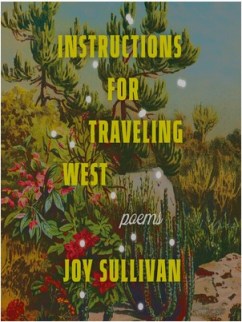
Today’s selection, Instructions for Traveling West, has been described as “a lush debut collection that examines what happens when we leave home and leap into the unknown.”

A master wordsmith, Joy Sullivan possesses that rare ability to transform life’s most ordinary moments into dazzling poetry that brims with emotion and insight. I was impressed by her vivid imagery, fresh metaphors, and the threads of humor and compassion that run throughout the collection.

Underlying each poem is the importance of listening to our deepest desires and embracing the call to reinvent ourselves. This is something Sullivan understands very well. In the midst of the pandemic, she left the man she planned to marry, sold her house, quit her corporate job, and drove west.

These poems, with their deeply personal and universal relatable themes, will resonate with women at every age and stage of life. A must-read book for anyone seeking clarity, courage, or a spark of reinvention.

Here’s one of my favorite poems:

Giving Notice

One day soon, you’ll rise from your desk or quietly excuse yourself
from the meeting or turn the car around in the middle of the street.
Anything may trigger it. An open window. A sunny day in April.
Daffodils panting in a mason jar. Call it madness. Call it glorious

disappearance. Call it locomotion. Do what you should have done
years ago. Let your body out to pasture. Fill your calendar with
nothing but sky. Surrender to the woods. To cicadas and sap
beetles. To the moths, the color of memory and dream. Wear
dusk like an ancient cloak. Hurry—

there’s still time to creature—to pluck all the wild cloudberries
and carry them home. Even now, you can hear coyotes crying
at the canyon’s edge. Find your first fang. Grow back your hackles
and howl. This was always your chorus, the mother tongue, a feral
hymn you know by heart.

Be As You Are

On Wednesdays, I share posts, fables, songs, poems, quotations, TEDx Talks, cartoons, and books that have inspired and motivated me on my writing journey. I hope these posts will give writers, artists, and other creatives a mid-week boost.

In her recent release, Consider This: Reflections for Finding Peace, bestselling author Nedra Glover Tawwab shares inspiring advice for setting boundaries, rising above drama, and expressing ourselves with clarity and integrity. Here’s a thought-provoking reflection:

It’s a lifelong learning process to become acquainted with who you are. After all, you are constantly learning and changing even if you don’t realize it.

On average, I read about forty books a year. I love to read, and books have been my companion since childhood. When I share how many I read, some people say they’d like to read more. But reading for pleasure is not the same as having to read for school. People are uncomfortable acknowledging that they only read for utility purposes. But no one has to read unless they truly enjoy it.

Perhaps you don’t like to try new things as much as you’d like to be seen as someone who wants to try new things.

Perhaps you don’t like being in a group setting despite wanting to be more social.

Perhaps you are not as much of this or that as you’d like.

You are who you are, and you may not fit the ideal of who you’d like to be. But embracing who you are will simplify your journey in life.

Change is possible if it’s what you really want to do. However, accepting yourself is freeing. Sometimes, becoming yourself is about simply allowing yourself to be as you are.

Source: Consider This, p. 258.

Poetry Collection Review: All Along You Were Blooming

April is National Poetry Month, a month set aside to celebrate poetry and its vital place in our society. Launched by the Academy of American Poets in 1996, this month-long celebration has attracted millions of readers, students, teachers, librarians, booksellers, and poets.

Today, and for the next three Fridays, I will share my favorite poetry collections.

Today’s selection, All Along You Were Blooming, has been described as “a love letter from the poet to your heart, to your soul, and to your body.”

There is so much to like here, starting with the title and subtitle. These initial messages are reassuring, reminding us that we have been blooming for a while and that we can enrich our lives with “thoughts for boundless living.” I was also impressed by the striking colors and illustrations that accompany each piece of poetry and prose.

Morgan Harper Nichols—a multi-talented artist, musician, and poet—does more than create art. She also gives meaning to each season of our lives. Her work gently encourages us to live fully in the present moment and own our unique stories. Her backstory is an intriguing one. An introvert, she didn’t believe she could show up in the world. All that changed on a cold autumn day when Morgan took a deep breath and wrote an Instagram message to her followers. She invited them to share their stories, and one by one, she responded with a personalized poem, forging a deep and authentic connection with her audience.

Beautifully written and aesthetically pleasing, this book is a versatile gift for many occasions. Whether it’s for Mother’s Day, Valentine’s Day, birthdays, or holidays, this collection will delight the poetry readers in your circle.

One of my favorite poems from the collection:

You find yourself
beneath a canopy of trees
with broken branches,
covered with moss tangled at your knees.

Rest assured
the forest does not crawl on forever,

But you must begin the journey
here.

For this is the time,
this is the time to come alive,
to walk tall with a beating heart
and wide-open midday eyes,
to surrender,
here in the green,
for you are still free
to travel free,
without knowing
everything,
humbly following the traces of daylight,
even though the path is unmarked,
even though this was not a favored start,
this is your only Hope
to make it through
precisely here,
pushing through the land of the unknown
you will find your home
in Hope.

So for now,
while you are here,
turn your attention
to the lessons of strength
this present forest offers.

If You Are Feeling Lost…

On Wednesdays, I share posts, fables, songs, poems, quotations, TEDx Talks, cartoons, and books that have inspired and motivated me on my writing journey. I hope these posts will give writers, artists, and other creatives a mid-week boost.

In a recent interview, bestselling author Brianna Wiest shared the following advice for anyone who may be feeling lost:

If you are feeling lost, you’re actually making way more progress than you think you are. And you’re doing a lot better than you think you are. Most people don’t even let themselves get to the point of feeling or admitting that they are lost. They are gripping so tightly to the old narrative and the old programming to even stop and say, ‘I don’t know what’s next. I feel lost.’ So, if you feel lost right now, that is your first signal that you have left the life that was wanting to go behind. So, step one is to acknowledge that Feeling lost is a victory, even though it doesn’t feel like it right now.

The second part is in that space of not knowing, anything becomes possible. You have no idea what kind of miracle is at your feet right now. You have no idea what you’ve actually opened up within your life.

Also, part of that feeling lost is the grieving and mourning of what you’ve had to let go of, and that’s okay, too. That’s a process that takes time.

It’s also about coming up with your vision. I think it’s about finding your next muse and figuring out What inspires me now. We’re meant to evolve, and I think people miss that. When we don’t move with life, ultimately, things do come to a grinding halt, and then we’re forced to let go. So, if you’re feeling lost, there’s nothing wrong with you. Actually, there’s something very right with you.

Brianna Wiest’s latest release, The Life that’s Waiting, is now available.

Be the Genie

On Wednesdays, I share posts, fables, songs, poems, quotations, TEDx Talks, cartoons, and books that have inspired and motivated me on my writing journey. I hope these posts will give writers, artists, and other creatives a mid-week boost.

In his recent release, The Art of Doing, Jesse Lipscombe shares simple and straight-forward tools that can help transform our lives. Here’s an inspiring excerpt:

I’m sure all of us, at some point, have fantasized about stumbling upon a genie in a bottle. I know I have. What would your three wishes be? Would you wish for a billion dollars? World peace? Good health?

If only life worked that way.

This is just another example of how we keep looking outward for ways to fulfill our dreams when we should be looking inward. You and only you are the magical vessel you need to find to achieve your goals. And the coolest part about this realization is that you’re not locked into the whole three-wish paradigm. You can grant yourself as many wishes as you like. You simply need to give yourself permission to do it first.

For some of us, that’s the hardest thing in the world. It has been ingrained in us from our very beginnings that we have to look externally for permission.

Parents are the first people to give us permission, and the first people we have to ask for permission when we want something. If we wanted a second helping of dinner, we had to ask. If we wanted to watch TV or stay out late, we had to ask. Learning to give ourselves permission is a process that happens as we grow. The more we practice doing it, the easier it becomes.

We live in a world that promotes hustle culture, where working every waking hour with few breaks is seen as the norm. We complain about our co-workers, our bosses, and the fact that we never have enough time off or don’t get paid what we’re worth. We lament that there is never enough time. What we fail to do is give ourselves permission to change it all.

I like to put it this way: A person wouldn’t ask a professional hockey player how to fix their car, so why would you ask anyone else to “fix” your life? Granting ourselves permission—permission to do something new, to act differently, to change our circumstances, even to disappoint others or fail at something—is the key to being the genie of our own bottle.

Source: The Act of Doing, pp. 107-109

While Practicing Patience

On Wednesdays, I share posts, fables, songs, poems, quotations, TEDx Talks, cartoons, and books that have inspired and motivated me on my writing journey. I hope these posts will give writers, artists, and other creatives a mid-week boost.

In her recent release, Consider This: Reflections for Finding Peace, bestselling author Nedra Glover Tawwab shares inspiring advice for setting boundaries, rising above drama, and expressing ourselves with clarity and integrity. Here’s a thought-provoking reflection:

Time can’t be rushed.

Patience is the only choice, even when you don’t like it. People lament, “I need to be patient.” But you actually have no choice. You will either wait calmly, or you will wait in a mood. Either way, you will wait. Perhaps, what you need is to feel calmer or less moody.

Sometimes, this means allowing for extra time when you plan.

Traffic will take time.

Waiting on others will take time.

Progress on a goal will take time.

Who you become while waiting matters. Do you complain? Do you pace? Do you check the time repeatedly? Do you try to speed things up secretly, knowing you can’t? How do you handle something you can’t control?

You will have to wait on some things. Your job is determining who you will be while practicing patience.

Source: Consider This, p. 171.