On Becoming Aware and Present

On Wednesdays, I share posts, fables, songs, poems, quotations, TEDx Talks, cartoons, and books that have inspired and motivated me on my writing journey. I hope these posts will give writers, artists, and other creatives a mid-week boost.

In 2008, I participated in a ten-part series presented by Oprah Winfrey and spiritual teacher Eckhart Tolle. Oprah and Eckhart took millions of viewers on a chapter-by-chapter journey through A New Earth: Awakening to Your Life’s Purpose (Eckhart’s seminal work).

Their intention: To teach viewers how to focus and become more aware and present.

Since that time, I have reread A New Earth several times and also picked up Eckhart Tolle’s other book, The Power of Now. I highly recommend both books.

Whenever Oprah hosts Eckhart on Super Soul Sunday, I make a point of watching and taking notes. I was inspired and entertained by the following interview segment from the November 12, 2012 broadcast:

Oprah: How do you accept an unpleasant situation, if change is not possible?

Eckhart: You must accept a situation, even if change is not possible. The basis for effective enlightenment is to come in alignment with the present situation. When you accept the “isness” of life, greater intelligence arises. If you are angry and resist the unpleasant situation, you will remain stuck in it.

Oprah: How do you calm the voice in your head?

Eckhart: This question implies you know that your mind can’t stop. This is a good first step. Take the energy away from these thoughts, by asking yourself if you can feel the energy in your hands. Wait and you will feel it. Then move to your legs and other body parts. The inner body serves as a wonderful anchor for a sense of presence. This allows you to be distracted from your other thoughts.

Oprah: How does one clear the mind of bad memories?

Eckhart: Recognize that these memories are thoughts only in your head. They are not realities because they have already happened.

Oprah: How do you have fun?

Eckhart: I enjoy the present moment wherever I am and that’s fun for me.

Oprah: Are you happy?

Eckhart: I am in a state of peaceful aliveness.

Oprah: What do you believe in?

Eckhart: I believe in nothing in particular. LOL

Oprah: What are you grateful for?

Eckhart: I am grateful for always this moment…the now, no matter what form it takes.


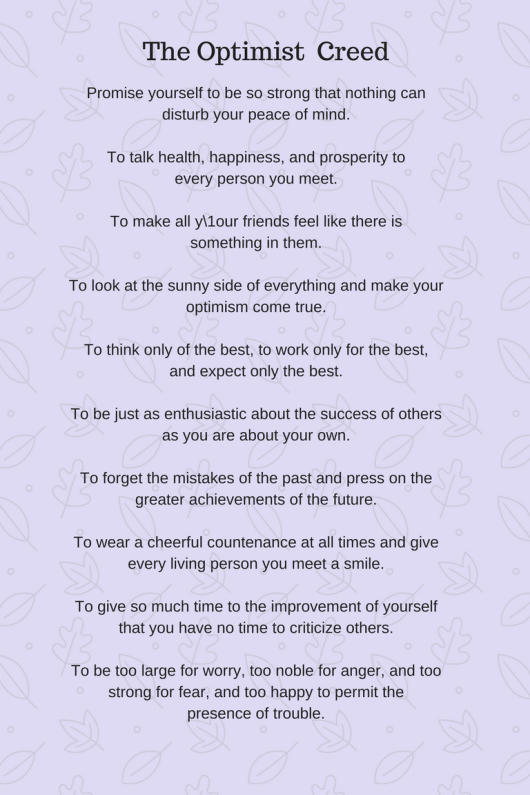
The Optimist Creed

On Wednesdays, I share posts, fables, songs, poems, quotations, TEDx Talks, cartoons, and books that have inspired and motivated me on my writing journey. I hope these posts will give writers, artists, and other creatives a mid-week boost.

While February is the shortest month of the year, it can be the most challenging, especially if winter persists. I turn to “The Optimist Creed” by Christian D. Larson whenever I need an extra dose of positive energy.


Let Go and Let God

On Wednesdays, I share posts, fables, songs, poems, quotations, TEDx Talks, cartoons, and books that have inspired and motivated me on my writing journey. I hope these posts will give writers, artists, and other creatives a mid-week boost.

Australian singer Olivia Newton John released Let Go and Let God on her twenty-second studio album, Grace and Gratitude, in 2006. The song has been described as “meditative mood music”…an apt description for a song that has benefited several cancer charities. The hauntingly beautiful music and lyrics resonate with me at the soul level. It’s my go-to song whenever I need to uplift my spirits.


A Three-Step Remedy from Warren Buffett

On Wednesdays, I share posts, fables, songs, poems, quotations, TEDx Talks, cartoons, and books that have inspired and motivated me on my writing journey. I hope these posts will give writers, artists, and other creatives a mid-week boost.

In his latest book, When: The Scientific Secrets of Perfect Timing, author Daniel H. Pink devotes an entire chapter to Midpoints. At the end of the chapter, he shares several strategies and anecdotes from well-known high achievers. I was impressed by this advice from Warren Buffett:

One day Mr. Buffett was talking with his private pilot, who was frustrated that he hadn’t achieved all he’d hoped. Mr. Buffett prescribed the following three-step remedy.

First, he said, write down your top twenty-five goals for the rest of your life.

Second, look at the list and circle your top five goals, those that are unquestionably your highest priority. That will give you two lists–one with your top five goals, the other with the next twenty.

Third, immediately start planning how to achieve those top five goals. And the other twenty? Get rid of them. Avoid them at all costs. Don’t even look at them until you’ve achieved the top five, which might take a long time.

Doing a few important things well is far more likely to propel you out of the slump than a dozen half-finished projects.


Inspired by the Real Rocky Story

On Wednesdays, I share posts, fables, songs, poems, quotations, TEDx Talks, cartoons, and books that have inspired and motivated me on my writing journey. I hope these posts will give writers, artists, and other creatives a mid-week boost.

In mid January, it’s very easy to start feeling down and less productive. Whenever that happens, I turn to several real-life stories that inspire and motivate me to get back on track. Here’s one of my favorites:

In 1974, Sylvester Stallone was a broke, discouraged actor and screenwriter. While attending a boxing match, he became inspired by a “nobody” boxer who “went the distance” with the great Mohammed Ali.

Stallone rushed home and, in a three-day burst of creative output, produced the first draft of the screenplay entitled Rocky.

Down to his last $106, Stallone submitted his screenplay to his agent. A studio offered $20,000 with either Ryan O’Neal or Burt Reynolds playing the lead character. Stallone was excited by the offer but wanted to play the lead himself. He offered to act for free. He was told, “That’s not the way it works in Hollywood.” Stallone turned down the offer though he desperately needed the money.

Then they offered him $80,000 on the condition that he wouldn’t play the lead. He turned them down again.

They told him that Robert Redford was interested, in which case they’d pay him $200,000. He turned them down once more.

They upped their offer to $300,000 for his script. He told them he didn’t want to go through his whole life wondering “What if?”

They offered him $330,000. He told them he’d rather not see the movie made if he couldn’t play the lead.

They finally agreed to let him play the lead. He was paid $20,000 for the script plus $340 per week minimum actor’s scale. After expenses, agent fees, and taxes, he netted about $6,000 instead of $330,000.

In 1976, Stallone was nominated for an Academy Award as Best Actor. The movie Rocky won three Oscars: Best Picture, Best Director, and Best Film Editing. The Rocky series has since grossed almost $1 billion, making Sylvester Stallone an international movie star!

Source: The One Minute Millionaire by Mark Victor Hansen and Robert G. Allen (2002)


The Fringe Benefits of Failure

On Wednesdays, I share posts, fables, songs, poems, quotations, TEDx Talks, cartoons, and books that have inspired and motivated me on my writing journey. I hope these posts will give writers, artists, and other creatives a mid-week boost.

Best known for writing the Harry Potter fantasy series, J.K. Rowling has experienced a “rags to riches” life in which she progressed from living on state benefits to multi-millionaire status. She is the United Kingdom’s best-selling living author, with sales in excess of £238M.

In her inspiring and entertaining commencement address to the class of 2008 at Harvard University, J.K. Rowling offered powerful advice to dreamers and overachievers, including one hard-won lesson that she deems “worth more than any qualification I have ever learned.”


This Year is Yours

On Wednesdays, I share posts, fables, songs, poems, quotations, TEDx Talks, cartoons, and books that have inspired and motivated me on my writing journey. I hope these posts will give writers, artists, and other creatives a mid-week boost.

At the beginning of each new year, I reread the following poem for inspiration:

God built and launched this year for you;
Upon the bridge you stand;
It’s your ship, aye, your own ship,
And you are in command.

Just what the twelve months’ trip will do
Rests wholly, solely, friend, with you.

Your logbook kept from day to day
My friend, what will it show?
Have you on your appointed way
Made progress, yes or no?

The log will tell, like guiding star,
The sort of captain that you are.

For weal or woe this year is yours;
Your ship is on life’s sea
Your acts, as captain, must decide
Whichever it shall be;

So now in starting on your trip,
Ask God to help you sail your ship.

By Alfred Lord Tennyson


Life Advice from Unexpected Sources

On Wednesdays, I share posts, fables, songs, poems, quotations, TEDx Talks, cartoons, and books that have inspired and motivated me on my writing journey. I hope these posts will give writers, artists, and other creatives a mid-week boost.

I’ve always enjoyed this short period between Christmas and New Year’s. With most of the holiday madness out of the way, it’s a good time to reflect upon the past twelve months and start making plans for 2018. A self-help junkie, I like to reread my favorite books, but I’m also open to advice from unexpected sources.


Advice that resonates with me…

The Flash, Merida, Patrick Star, The Fairy Godmother, Chef G

Which advice speaks to you?


Just Let It Be

On Wednesdays, I share posts, fables, songs, poems, quotations, TEDx Talks, cartoons, and books that have inspired and motivated me on my writing journey. I hope these posts will give writers, artists, and other creatives a mid-week boost.

December can be stressful. Searching for that perfect gift…preparing that perfect meal…creating that perfect Christmas Day. All that perfection takes away from the spirit of the season. Whenever I feel stressed or overwhelmed, I take time to read and reflect upon the following Zen parable:

Buddha was walking from one town to another town with a few of his followers. While they were traveling, they happened to pass a lake. They stopped there and Buddha told one of his disciples, “I am thirsty. Please get me some water from that lake.”

The disciple walked up to the lake. When he reached it, he noticed that some people were washing clothes in the water and, right at that moment, a bullock cart started crossing the lake right at the edge of it. As a result, the water became very muddy, very turbid. The disciple thought, “How can I give this muddy water to Buddha to drink?” So, he came back and told the Buddha, “The water is very muddy. I don’t think it is fit to drink.”

The Buddha said, “Let us take a little rest here by the tree.” After about half an hour, Buddha asked the same disciple to go back to the lake and get him some water to drink. The disciple obediently went back to the lake. This time he found that the lake had clear water in it. The mud had settled down and the water above it looked drinkable. So he collected some water in a pot and brought it to the Buddha.

The Buddha looked at the water, and then he looked up at the disciple and said, “You let the water be, and the mud settled down on its own. You got clear water. It didn’t require any effort.”

Moral: Your mind is also like that. When it is disturbed, just let it be. Give it a little time. It will settle down on its own. You don’t have to put in any effort to calm it down. You can judge and make the best decisions of your life when you stay calm.

Source: Moral Stories


On Success and Failure

On Wednesdays, I share posts, fables, songs, poems, quotations, TEDx Talks, cartoons, and books that have inspired and motivated me on my writing journey. I hope these posts will give writers, artists, and other creatives a mid-week boost.

Whenever I need a strong dose of reality, I listen to the following TED Talk by Elizabeth Gilbert. The best-selling author of Eat, Pray, Love (Over 11 million copies were sold), Elizabeth was catapulted into instant success. But there is life after success, and sometimes it takes the form of failure. In this entertaining Talk, Elizabeth shares her brushes with success and failure.