Covering All the Bases

On Wednesdays, I share posts, fables, songs, poems, quotations, TEDx Talks, cartoons, and books that have inspired and motivated me on my writing journey. I hope these posts will give writers, artists, and other creatives a mid-week boost.

I couldn’t help chuckling as I read this story about a little boy’s baseball practice.

A little boy was overheard talking to himself as he strode through his backyard, baseball cap in place and toting ball and bat. “I’m the greatest baseball player in the world,” he said proudly. Then he tossed the ball in the air, swung and missed.

Undaunted, he picked up the ball, threw it into the air and said to himself, “I’m the greatest baseball player ever!” He swung at the ball again, and again he missed.

He paused a moment to examine bat and ball carefully. Then once again he threw the ball into the air and said, “I’m the greatest baseball player who ever lived.” He swung the bat hard and again missed the ball.

“Wow!” he exclaimed. “What a pitcher!”

Source: Chicken Soup for the Soul, 101 Stories to Open the Heart and Kindle the Spirit, Page 74

Try Something Different

On Wednesdays, I share posts, fables, songs, poems, quotations, TEDx Talks, cartoons, and books that have inspired and motivated me on my writing journey. I hope these posts will give writers, artists, and other creatives a mid-week boost.

Last week, I reread some of the stories in the first book of the Chicken Soup for the Soul series (1993).

Here’s one of my favorites from Price Pritchett:

I’m sitting in a quiet room at the Milcroft Inn, a peaceful little place hidden among the pine trees about an hour out of Toronto. It’s just past noon, late July, and I’m listening to the desperate sounds of a life-or-death struggle going on a few feet away.

There’s a small fly burning out the last of its short life energies in a futile attempt to fly through the glass of the windowpane. The whining wings tell the poignant story of the fly’s strategy: Try harder.

But it’s not working.

The frenzied effort offers no hope for survival. Ironically, the struggle is part of the trap. It is impossible for the fly to try hard enough to succeed at breaking through the glass. Nevertheless, this little insect has staked its life on reaching its goal through raw effort and determination.

This fly is doomed. It will die there on the window-sill.

Across the room, ten steps away, the door is open. Ten seconds of flying time and this small creature could reach the outside world it seeks. With only a fraction of the effort now being wasted, it could be free of this self-imposed trap. The breakthrough possibility is there. It could be so easy.

Why doesn’t the fly try another approach, something dramatically different? How did it get so locked in on the idea that this particular route and determined effort offer the most promise for success? What logic is there in continuing until death to see a breakthrough with more of the same?

No doubt this approach makes sense to the fly. Regrettably, it’s an idea that will kill.

Price Pritchett’s Advice: Sometimes we need to do something radically different to achieve greater levels of success. We need to break out of our paradigm prisons, our habit patterns, and our comfort zones.

Source: Chicken Soup for the Soul, 101 Stories to Open the Heart and Kindle the Spirit, pp. 222-223

Start With Yourself

On Wednesdays, I share posts, fables, songs, poems, quotations, TEDx Talks, cartoons, and books that have inspired and motivated me on my writing journey. I hope these posts will give writers, artists, and other creatives a mid-week boost.

The following words were written on the tomb of an Anglican Bishop in the Crypts of Westminster Abbey:

When I was young and free and my imagination had no limits, I dreamed of changing the world. As I grew older and wiser, I discovered the world would not change, so I shortened my sights somewhat and decided to change only my country.

But it, too, seemed immovable.

As I grew into my twilight years, in one last desperate attempt, I settled for changing only my family, those closest to me, but alas, they would have none of it.

And now as I lie on my deathbed, I suddenly realize: If I had only changed my self first, then by example I would have changed my family.

From their inspiration and encouragement, I would then have been able to better my country, and, who knows, I may have even changed the world.

How to Overcome Writer’s Block

On Wednesdays, I share posts, fables, songs, poems, quotations, TEDx Talks, cartoons, and books that have inspired and motivated me on my writing journey. I hope these posts will give writers, artists, and other creatives a mid-week boost.

In her book, How I Write: Secrets of a Bestselling Author, Janet Evanovich recommends writing something every day, even it means just a few sentences on the screen. And not getting too hung up on rewriting the first page or chapter. Rewriting and polishing should be done only on a completed manuscript.

Here are Janet’s suggestions…

Do it by time. Start with five minutes and increase the time by five minutes a day. In two weeks, you will be sitting at your desk for about an hour a day.

Do it by pages. Start with one paragraph a day and work towards a page a day. By year’s end, you will have written 365 pages.

Do it by word account. Plan to write a specific number of words each day. Hemingway wrote around 500 words a day–approximately 2 pages. Those two pages a day produced nine novels and a number of short stories–with plenty of time out for game hunting and fishing.

Do it by appointment. Carve out a place and a certain time of each day for writing. Then show up for work.

About Janet…

Janet Evanovich is the #1 New York Times bestselling author of the Stephanie Plum series, the co-authored Fox and O’Hare series, the Knight and Moon series, and the Lizzy and Diesel series as well as twelve romance novels, the Alexandra Barnaby novels, Troublemaker graphic novel, and How I Write: Secrets of a Bestselling Author.

Hold On and Don’t Give Up

On Wednesdays, I share posts, fables, songs, poems, quotations, TEDx Talks, cartoons, and books that have inspired and motivated me on my writing journey. I hope these posts will give writers, artists, and other creatives a mid-week boost.

Zen Buddhist monk Haemin Sunim shares his trademark spiritual wisdom in his latest bestseller, Love for Imperfect Things: How to Accept Yourself in a World Striving for Perfection.

Here’s one of my favorite passages:

Know that your continuous and accumulated efforts will eventually help to turn your circumstances around. The pitcher Chan Ho Park, the first Korean-born Major League Baseball player, once told me something that sums this up: Whether you are in a slump or riding high, whether fans are cheering or heckling, the only thing you can control is the ball you are about to throw. And though no single ball can do much on its own, taken together, all the balls you throw are enough to bring about a big change.

Your efforts, however small, are never in vain. Even the most vicious storm runs its course eventually; as long as your hold on and don’t give up, you’ll be able to see the sun come out again…We can do it, all of us!

Source: Love for Imperfect Things, p. 249


It’s Time to Let GO

On Wednesdays, I share posts, fables, songs, poems, quotations, TEDx Talks, cartoons, and books that have inspired and motivated me on my writing journey. I hope these posts will give writers, artists, and other creatives a mid-week boost.

I receive a daily dose of inspiration from bestselling authors and coaches Marc and Angel Chernoff.

Here’s a thought-provoking segment from last week’s email:

Twenty years ago, when Marc and I were just undergrads in college, our psychology professor taught us a lesson we’ve never forgotten. On the last day of class before graduation, she walked up on stage to teach one final lesson, which she called “a vital lesson on the power of perspective and mindset.” As she raised a glass of water over her head, everyone expected her to mention the typical “glass half empty or glass half full” metaphor. Instead, with a smile on her face, our professor asked, “How heavy is this glass of water I’m holding?”

Students shouted out answers ranging from a couple of ounces to a couple of pounds.

After a few moments of fielding answers and nodding her head, she replied, “From my perspective, the absolute weight of this glass is irrelevant. It all depends on how long I hold it. If I hold it for a minute or two, it’s fairly light. If I hold it for an hour straight, its weight might make my arm ache. If I hold it for a day straight, my arm will likely cramp up and feel completely numb and paralyzed, forcing me to drop the glass to the floor. In each case, the absolute weight of the glass doesn’t change, but the longer I hold it, the heavier it feels to me.”

As most of us students nodded our heads in agreement, she continued. “Your worries, frustrations, disappointments, and stressful thoughts are very much like this glass of water. Think about them for a little while and nothing drastic happens. Think about them a bit longer and you begin to feel noticeable pain. Think about them all day long, and you will feel completely numb and paralyzed, incapable of doing anything else until you drop them.”

Think about how this relates to your life.

If you’ve been struggling to cope with the weight of what’s on your mind, it’s a strong sign that it’s time to put the glass down.

It’s time to let GO…

Note: I highly recommend subscribing to Marc & Angel’s website.

A Tale of Two Cats

On Wednesdays, I share posts, fables, songs, poems, quotations, TEDx Talks, cartoons, and books that have inspired and motivated me on my writing journey. I hope these posts will give writers, artists, and other creatives a mid-week boost.

A longtime fan of Wayne Dyer, I enjoy reading his books and watching his telecasts. I especially like listening to his rendition of the following tale:


Eight Ways to Recognize a Calling

On Wednesdays, I share posts, fables, songs, poems, quotations, TEDx Talks, cartoons, and books that have inspired and motivated me on my writing journey. I hope these posts will give writers, artists, and other creatives a mid-week boost.

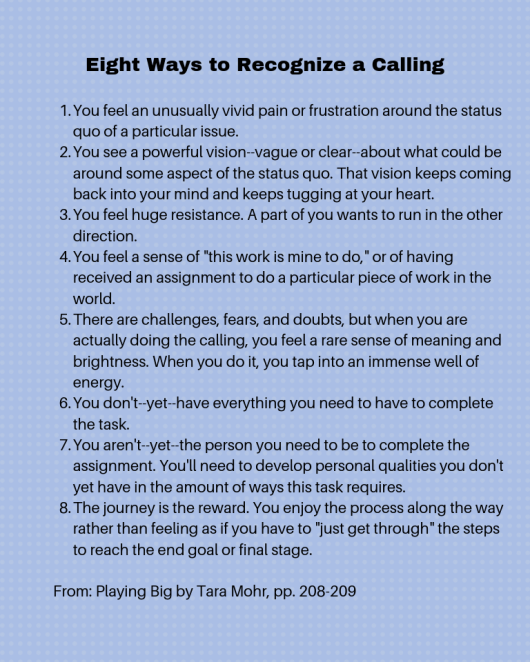
In her book, Playing Big, Tara Mohr describes a calling as “a longing to address a particular need or problem in the world.” Often elusive and buried deep within our consciousness, these callings can reveal themselves through the following patterns:


The “Lucky” Breakthrough

On Wednesdays, I share posts, fables, songs, poems, quotations, TEDx Talks, cartoons, and books that have inspired and motivated me on my writing journey. I hope these posts will give writers, artists, and other creatives a mid-week boost.

Whenever I feel like giving up on a goal or challenge, I reread this account of Leon Fleisher’s breakthrough in his seventies.

Leon Fleisher was at the height of his recording and performing career as a pianist in 1965 when two of his fingers curled as a result of a medical disorder called focal dystonia. Although he was only thirty-five years old, Fleisher’s career took a nosedive and he become unable to perform or use his right hand at all. Fleisher channeled his musical passion into teaching and conducting but never stopped looking for a cure, which he finally found after forty years of persistently trying everything from Rolfing to aromatherapy.

Shots of Botox in his hand freed up his clenched muscles, and Fleisher became a born-again star in 2004 when he released a comeback album entitled Two Hands. Although he could have given up on his forty-year search for a cure, Fleisher’s ambition, optimism, perseverance, and tenacity gave him the “lucky” breakthrough in his seventies that triumphantly returned him to the keyboard.

Source: Creating Your Best Life by Caroline Adams Miller & Dr. Michael B. Frisch, Page 143