Make Pigs Fly

On Wednesdays, I share posts, fables, songs, poems, quotations, TEDx Talks, cartoons, and books that have inspired and motivated me on my writing journey. I hope these posts will give writers, artists, and other creatives a mid-week boost.

In his book, Life is in the Transitions, Bruce Feiler writes about the power of positive language and transformative personal stories. Here’s one of my favorite excerpts:

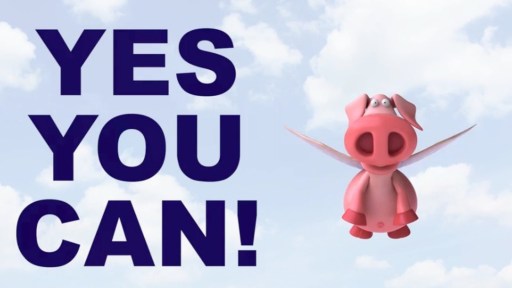
The novelist John Steinbeck had a quirky logo he drew after signing his name. It was a pig with wings. He called it Pigasus, which he wrote out in Greek letters. Late in his life, he accompanied the illustration with the Latin words Ad Astra Per Alia Porci, which he translated (incorrectly, it turns out) as “to the stars on the wings of a pig.” His explanation: We must all try to attain the heavens, even though we are bound to the earth.

For half a millennium, the expression when pigs fly has been used in multiple languages to mean a circumstance so improbable that its completion is nearly impossible. It’s a figure of speech known as an adynaton, a way of saying something that will never happen. Steinbeck adopted this phrase because he had been told by a naysayer professor that he would be an author “when pigs fly.”

More recently, neuroscientists have discovered that imagining this kind of unimaginable outcome is vital to recovering from a life interrupted. The more we are able to conjure up a future that seems out of reach—I will find another job, I will laugh once more, I will love again—the more we’re able to advance toward it. A big reason is mirror neurons, the part of our brains that mimic the actions we observe. When we see someone jump, laugh, or cry, our brains imitate the same activity.

The same mirroring happens with stories we tell. If we tell ourselves we will get better, or calmer, or happier, our minds will begin to simulate that outcome. This response doesn’t mean we’ll achieve these results right away, but it does mean we set in motion that possibility.

Steinbeck was right: We can make pigs fly.

Source: Life is in the Transitions by Bruce Feiler, p. 290.
Hobby or Identity?

On Wednesdays, I share posts, fables, songs, poems, quotations, TEDx Talks, cartoons, and books that have inspired and motivated me on my writing journey. I hope these posts will give writers, artists, and other creatives a mid-week boost.

Here is a thought-provoking reflection from Gordon Duncan of the Authors Community:

You can’t live on the street corner of inspiration.

As an artist, speaker, author, or creative, we love inspiration. It’s when the moment strikes, and we can barely make it to the computer, the canvas, or the blank piece of paper.

However, living on that corner often means that our work is created slowly or not at all.

Additionally, there are parts of creating that rarely enjoy moments of inspiration. For example, has anyone ever been inspired to edit their book? Maybe, but rarely.

No, the hidden secret behind creativity is that it is hard work. In fact, inspiration’s best friend is creativity.

It’s like the old adage, “The harder I work, the luckier I get.” For the artist, it should be, “The harder I work, the more inspired I get.”

To get us there, here are a couple of tips to help you supplement your inspiration with some sweat:

One: Schedule writing time weekly, and even daily, if you can. Prolific authors like John Maxwell and Stephen King writer everyday…every day.

Two: Create consequences and benefits for your deadlines. A deadline is only a deadline if it has consequence. Otherwise, it’s a wish. Let’s say you want to have 100 pages written by the end of the month. If you hit that number, take yourself and someone you love out to a nice dinner. If you don’t hit it, then deny yourself that extra coffee or that movie you were going to see. It doesn’t have to be painful, but it does need to be consequential.

Three: Seek out accountability. This one is huge. Very few of us have the drive of a Maxwell or King. Entrusting a friend to keep you accountable or enlisting the services of a coach will help. Give them the right to speak honestly into your life. Give them the freedom to be blunt with you.

Four: Make a decision. Is your art a hobby or an identity? Is it something you do here and there or is it part of who you are? If it is part of who you are, then you have to organize your time towards those things. Hobbies are things you just pick up here or there.

Note: I encourage authors and other creatives to visit the Authors Community website.

One Hard Thing You Have to Do to Be Mentally Stronger (and Happier)

On Wednesdays, I share posts, fables, songs, poems, quotations, TEDx Talks, cartoons, and books that have inspired and motivated me on my writing journey. I hope these posts will give writers, artists, and other creatives a mid-week boost.

A longtime fan of bestselling authors and coaches Marc and Angel Chernoff, I look forward to receiving their daily emails. Here’s some excellent advice for these challenging times:

Far too often we think that mental strength is all about how we respond to extreme circumstances. How did she perform on stage during that televised event? Did he bounce back from that heart-wrenching divorce? Can she keep her life together even after suffering from a major, debilitating injury?

There’s no doubt that extreme circumstances test our bravery, determination and mental strength, but what about common, daily circumstances?

Just like every muscle in the body, the mind needs to be exercised to gain strength. It needs to be worked consistently to grow and develop over time. If you haven’t pushed yourself in hundreds of little ways over time, of course you’ll crumble on the one day that things get really challenging.

But it doesn’t have to be that way…

Choose to lift some weights when it would be more comfortable to sleep in. Choose to do the tenth rep when it would be more comfortable to quit at nine. Choose to create something special when it would be more comfortable to consume something mediocre. Choose to raise your hand and ask that extra question when it would be more comfortable to stay silent. Prove to yourself, in hundreds of little ways, that you have the guts to get in the ring and wrestle with life.

Mental strength is built through lots of small, daily victories. It’s the individual choices we make day-to-day that build our “mental strength” muscles. We all want this kind of strength, but we can’t think our way to it. If you want it, you have to do something about it ritualistically. It’s your positive daily rituals that prove your mental fortitude and move you in the direction of your dreams over the long-term.

The bottom line is that when things get difficult for most people, they find something more comfortable to do. When things get difficult for mentally strong people, they find a way to stay on track with their positive daily rituals.

Note: I highly recommend subscribing to Marc & Angel’s website.

Checking In With Your Boundaries

On Wednesdays, I share posts, fables, songs, poems, quotations, TEDx Talks, cartoons, and books that have inspired and motivated me on my writing journey. I hope these posts will give writers, artists, and other creatives a mid-week boost.

In a recent interview on Spirituality & Health magazine, therapist Nedra Glover Tawwab shared what she considers the four most important words in our increasingly chaotic world: Set Boundaries, Find Peace. Those words are also the title of her recent release.

Here’s a thought-provoking excerpt from that interview:

It is a spiritual practice to tune into yourself and consider the why of your feelings. What’s trying to come up that I may be trying to push down? What’s trying to be released that I need to let go of? Often, when we’re having uncomfortable feelings, there is a boundary that needs to be addressed.

Of course, we can’t live a life without uncomfortable feelings. But what are they trying to tell us? What things do we need to practice to deal with that feeling better, or even reconfigure the trigger for those feelings?

The real breakthrough is not, “Oh my gosh, I have an issue with anger.” The real breakthrough is realizing that when I put myself in situations where there are no boundaries, I have an issue with anger.

Source: Spirituality & Health, February 2021, p. 49

Adapt to What is Real

On Wednesdays, I share posts, fables, songs, poems, quotations, TEDx Talks, cartoons, and books that have inspired and motivated me on my writing journey. I hope these posts will give writers, artists, and other creatives a mid-week boost.

A longtime fan of acclaimed psychologist Dr. Sonya Friedman, I like to reread many of the insightful passages from her best-selling books. Here’s one of my favorites from Take It From Here

In nature, chameleons adapt to the environment by changing color, blending in, and thus fooling predators. Nothing could be more descriptive of getting real and rolling with the punches. Although we’re a much higher form of life than a chameleon, capable of thinking and having a conscience, we can essentially do the same on another level: adapt to better fit into a personal environment of family, relationships, and work. You may have had twenty jobs in your life, or three failed marriages, and your bombs may be greater than your successes, but if you stretch your ability to adapt to what is real, you can gain the courage to keep going out there and, ultimately, achieve greater success.

Sometimes Running Away Really Works

On Wednesdays, I share posts, fables, songs, poems, quotations, TEDx Talks, cartoons, and books that have inspired and motivated me on my writing journey. I hope these posts will give writers, artists, and other creatives a mid-week boost.

While cleaning out my files, I came across the following post from Elizabeth Gilbert, best-selling author of Eat, Pray, Love and City of Girls.

I know there are a lot of arguments AGAINST running away. I know that running away from your problems can be a coward’s path. I know there are some issues in life that you can’t avoid forever. I know that in the recovery world, they call running away “pulling a geographic”–and addicts are wisely advised against trying it. I now that wherever you go, there you are. I know that there are times in life when you have to stay right where you are, and deal with things bravely and head-on.

And I am certainly familiar with the old adage: “You can’t change deck chairs on the Titanic.”

But you know what I always think when I hear that adage? THERE WERE SOME PEOPLE ON THE TITANIC WHO SURVIVED. And largely, the people who survived did so based upon where they were placed, geographically, on that ship. (Which had a lot to do with social class and injustice, I know–but for the sake of my argument, just go along with me on this…) In other words, there actually WERE some deck chairs on the Titanic that were better placed than others.

Which means: Sometimes there IS a better place for you to be, geographically, than where you are right now.

Sometimes there IS a safer place.

Sometimes there IS a more inspiring place.

Sometimes going two or three thousand miles away and changing your name really CAN change things–helping you to get away from bad old habits and bad old influences, and letting you become somebody new.

Sometimes running away CAN offer you a better chance of surviving your own life–getting you out of third-class steerage, let us say, and moving you closer to the front of the ship, to the top of the ship, where the light and the lifeboats are.

I truly believe this.

Sometimes running away really, really, really does work.


How to Make Calmness Your Superpower

On Wednesdays, I share posts, fables, songs, poems, quotations, TEDx Talks, cartoons, and books that have inspired and motivated me on my writing journey. I hope these posts will give writers, artists, and other creatives a mid-week boost.

A longtime fan of bestselling authors and coaches Marc and Angel Chernoff, I look forward to receiving their daily emails. Here’s a recent message that articulates the importance of self-love.

The ability to not overreact or take things personally keeps your mind clear and your heart at peace.

And yes, by being a conscious witness of your thoughts, YOU CAN get rid of all the stress inside you created by others, the past and uncontrollable recent events…

It’s about sitting quietly and witnessing the thoughts passing through you. Just witnessing at first—not judging—because by judging too rapidly you have lost the pure witness. The moment you rush to say, “this is good” or “this is bad,” you have already jumped head first into the stress.

Of course, it takes a little time and practice to create a gap between the witnessing of thoughts and your reaction to them. Once the gap is there, though, you are in for a great surprise—that you are not the thoughts themselves, nor the stress influencing them. You are the witness, a watcher, who’s superpower is changing your mind and rising above the turmoil.

This process of thought-watching is the very alchemy of true mindfulness. As you become more and more deeply rooted in witnessing, the stressful thoughts start disappearing. You are thinking, but the mind is empty of senseless chatter. It’s a moment of enlightenment—a moment that you become, perhaps for the first time, an unconditioned, sane, truly free human being.

So today, let this be your reminder to let all the small annoyances go. Move through your day consciously. Notice at least one insignificant little frustration that you would normally get frustrated about, then do yourself a favor and simply let it go. Experience, in this little way, the freedom of being in control of the way you feel. And realize that you can extend this same level of control to every situation you encounter in life.

At almost any given moment, the way you feel is the way you choose to feel, and the way you react is the way you choose to react.

When you think better, you live better.

Note: I highly recommend subscribing to Marc & Angel’s website.


The Space to Grow

On Wednesdays, I share posts, fables, songs, poems, quotations, TEDx Talks, cartoons, and books that have inspired and motivated me on my writing journey. I hope these posts will give writers, artists, and other creatives a mid-week boost.

In her recent post, “Six Writing Lessons from an Actual Backyard Gardner,” Kelsey Allagood shared the following anecdote:

I have an aloe vera plant in my office. Her name is Alice. Alice came to me in a cute little terra cotta pot, and has followed me from sunny windowsill to sunny windowsill through a move across state lines. You could say we’re pretty close.

A few months ago, I noticed Alice wasn’t doing well. She was wilting, and the tips of her leaves were turning yellow and withering. She wasn’t growing at all.

After some experiments in watering and sunlight levels, I gently picked Alice up out of her pot to look at her roots. It turns out Alice was rootbound, and the thin white threads of her roots were filling up the potting soil and beginning to curl around the bottom of the pot itself.

Once I realized that Alice was root-bound, I quickly transferred her to a bigger pot, about three times the diameter of her first pot, and filled with new soil formulated specifically for succulents.

The next day, Alice was a new plant.

She’d perked up. Her leaves were now a vibrant green. I snipped off the ends that had turned yellow, and they healed themselves up. Her leaves are reaching up toward the sun and spreading wide, and she’s sprouting new ones.

Be like Alice.

And by that, I mean give yourself and your work the space to grow.

Read the rest of Kelsey’s post here.