The author of more than thirty books—fiction and nonfiction—Julia Cameron is best known for her international bestseller, The Artist’s Way, which has helped millions of people realize their creative dreams. While conducting lectures and facilitating workshops over a thirty-five year period, Cameron discovered that many of her students did not want to talk about money and felt they could handle anything but money. She decided to write The Prosperous Heart, a book that would give her students “the tools to address their money issues directly while maintaining spiritual balance and an active creative life.”
Fans of Cameron’s books will recognize two of the tools: Morning Pages (three hand-written stream-of-consciousness journal pages written each morning) and a twenty-minute daily walk. New tools include Counting, recording each penny earned and saved in a small journal; Abstinence, a complete abstaining from any further debt; and Time-Outs, two five-minute periods of sitting quietly to consciously count your blessings or simply rest.
Cameron provides short exercises to complete as we go through the 12-week program and at the end of each chapter (week), there is a check-in and a list of “prosperity points.” She advises us to “choose the exercises you are most attracted to and the ones you are most resistant to. Our resistance often points us toward ‘pay dirt.’”
While guiding us through the prosperity plan, Cameron encourages us to be open to the unexpected gifts and answers that may appear along the way. In describing her recent move from New York to Santa Fe, Cameron demonstrates what can happen when we step out of our comfort zones. She explains, “I often find when my students shake the apple tree, oranges fall. And oranges may have been just what they were looking for after all.”
She stresses the need to accept even the smallest steps as progress and makes comparisons to other 12-step programs. In the chapter on forgiveness, she advises us to let go of “feelings, beliefs, and circumstances that do not serve you” and “open the door to allow the Higher Power to co-pilot your life.” While she liberally uses the word God throughout the book, she encourages readers to make their own substitutions.
Unlike other financial gurus, Julia Cameron does not preach or scream her message as she addresses the practical side of the creative life. The tone is a much gentler one which recognizes the greyness that often surrounds money issues. When outlining the prosperity plan, she reminds us that we will “slip backward and revert to old spending habits.” But the important thing is not to be discouraged. She ends the book with the following message: “Living a prosperous life means living a day at a time. It means starting over each morning, forgiving ourselves and beginning anew when we make mistakes, picking ourselves up when we fall, keeping on track.”
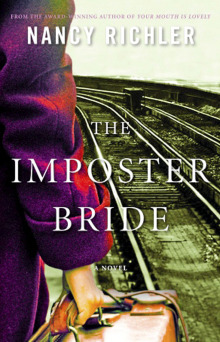
Book Review: The Imposter Bride
It is a woman’s worst nightmare.
After she crosses two oceans, Lily Azerov learns that her prospective husband no longer wants her. Fortunately, his brother steps in and offers to marry her instead.
But Lily, the imposter bride, has more pressing problems. Described as a “broken bird” by her mother-in-law, this fragile woman cannot adapt to her new life in post-WWII Montreal. She has stolen a dead woman’s identity and feels survivor’s guilt as she absorbs memories, dreams and fantasies that do not belong to her. After giving birth to a daughter, Lily leaves Montreal.
The book alternates between chapters told in third person and those narrated by Lily and her daughter, Ruth. As Ruth matures, she becomes more curious about the mysterious mother who left behind an uncut diamond and a Yiddish notebook.
The larger cast of characters includes other broken souls, among them Bella, who lost three children during the Russian Revolution, and Ida Pearl, a local jeweller who was abandoned by a philandering husband. Each of the characters claims to have some insight into why Lily really left.
Canadian novelist Nancy Richler has written a compelling story that will keep you reading well into the night.
Book Review: Tell It to the Trees
Set outside the fictitious town of Merrit’s Point in northern British Columbia during the 1970s, the story begins with the discovery of a tenant’s frozen body in the backyard of the Dharma family’s isolated home. Montreal-based writer Anita Rau Badami uses four shifting narrators to slowly unveil the sequence of events that led to this tragic death.
We hear from Varsha, the troubled teenage daughter, who was abandoned by her birth mother. Her stepmother, the sweet and gentle Suman, dreams of escaping from Vikram, her abusive husband, while managing the bleak reality of her life with excessive cooking and cleaning. Hemant, the sensitive seven-year old son, is haunted by ghosts and feels burdened by the many secrets floating in the multi-generational Indian home. We also hear from the dead tenant, Anu Krishnan, through her journals.
When Anu Krishnan first arrived at the Dharam home, she enjoyed Suman’s delicious Indian cooking and sat for hours listening to the tales told by Akka, the family matriarch. She welcomed the isolation and felt inspired to write short stories. Soon, however, the perfect facade of the Dharma family unravels and Anu becomes wrapped up in the drama.
The family’s chilling secrets start to come out, despite everyone’s efforts to maintain appearances. While Akka complains about their life in Jehannum (hell), she is fiercely protective of the family and urges the children to hold it in. If the secrets threaten to come out, Varsha and Hemant must tell only the trees.
Another character occupies center stage in this novel: Winter. In a recent interview, Badami admitted to this guilty little secret, “I dread the white nothingness that creeps into my soul and stays there for six long months…It’s not the cold that gets to me as much as the lack of colour. Having grown up in India where colour is overwhelmingly present, my longing of it reaches its zenith during our winters.”
Her dislike of the Canadian winters is apparent in the vivid descriptions throughout the novel. When Suman arrives in Canada, it is late March, “a time when the ground is knee-deep in snow, and your breath hangs like a ghost before your face.” Later, Suman names her son Hemant for winter, the season in which he was born.
Anita Rau Badami skilfully describes the cycle of abuse and how it is passed down through the generations. Many of us have asked the questions: Why doesn’t the woman just leave? Why does she continue to make excuses for the man’s behaviour?
This book provides the answers.
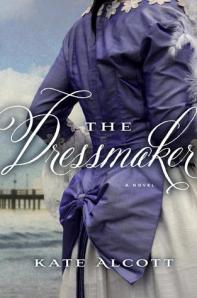
Book Review: The Dressmaker
Why did only one lifeboat make an attempt to save those dying on the water?
This question sparked Kate Alcott’s interest and the result is The Dressmaker, a riveting novel which peers into the lives of those who survived the sinking of the Titanic.
The story is mainly about Tess Collins, a wannabe dressmaker who was forced by circumstances to become a housemaid. Deciding she could no longer tolerate the conditions of her life, she packed her bags and headed for the dock where the Titanic was set to sail for its maiden and only voyage. She talks her way into going on the boat as a maid for the famous dress designer, Lady Lucille Duff Gordon. Four days later, Tess finds herself in a lifeboat with the unsinkable “Molly Brown.”
Thanks to James Cameron, we are all familiar with the Titanic story. But this book provides insight into what happened when less than eight hundred survivors arrived in New York City. Alcott addresses the aftermath of this tragedy by using documentation of real testimony, skillfully recreating the senatorial hearings and the public outcry that followed many of the revelations. I could actually imagine myself in the room as Lady Duff Gordon and the seamen tried to justify ordering a lifeboat to leave with fifty seats empty. And I could empathize with another survivor as she revealed the details of her husband’s suicide.
I was left wondering how I would act in a similar situation. Would I be courageous and try to help those drowning in the water? Would I welcome extra people into my lifeboat, all the while wondering if it would sink? Or would I let someone else make the decision to sail safely away?