Focus on Progress

On Wednesdays, I share posts, fables, songs, poems, quotations, TEDx Talks, cartoons, and books that have inspired and motivated me on my writing journey. I hope these posts will give writers, artists, and other creatives a mid-week boost.

Best-selling author Brianna Wiest inspires readers to reclaim their power and improve their lives in The Mountain is You. Here’s a thought-provoking excerpt:

Don’t worry about doing it well; just do it.

Don’t worry about writing a bestseller, just write. Don’t worry about making a Grammy-winning hit, just make music. Don’t worry about failing, just keep showing up and trying. At first, all that matters is that you do what your really want to do. From there, you can learn from your mistakes and over time get to the place where you really want to be.

The truth is that we actually do not accomplish great feats when we are anxious about whether or not what we do will indeed be something impressive and world-changing. We accomplish these sorts of things when we simply show up and allow ourselves to create something meaningful and important to us.

Instead of perfection, focus on progress. Instead of having something done perfectly, focus on getting it done. From there, you can edit, build, grow, and develop it to exactly what your vision is. But if you don’t get started, you’ll never arrive.

Source: The Mountain is You, p. 37

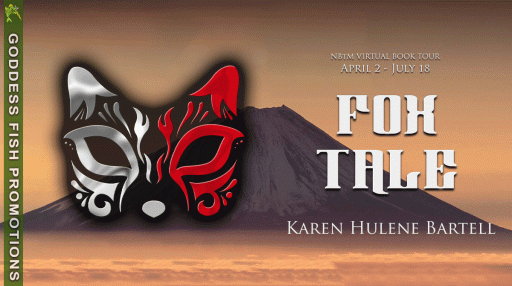
Spotlight on Fox Tale

I’m happy to welcome best-selling author Karen Hulene Bartell. Today, Karen shares her new release, Fox Tale.

Blurb

Heights terrify Ava. When a stranger saves her from plunging down a mountain, he diverts her fears with tales of Japanese kitsune—shapeshifting foxes—and she begins a journey into the supernatural.

She’s attracted to Chase, both physically and metaphysically, yet primal instincts urge caution when shadows suggest more than meets the eye.

She’s torn between Chase and Rafe, her ex, when a chance reunion reignites their passion, but she struggles to overcome two years of bitter resentment. Did Rafe jilt her, or were they pawns of a larger conspiracy? Are the ancient legends true of kitsunes twisting time and events?

Excerpt

“Ava, are you all right?”

“Yes…” His anxious eyes cleared my mind like fog lights cutting through mist. “I am all right…no thanks to you.”

“I deserve that.” His chin dropped on his chest.

“That and so much more.” This time, anger rose in my throat like acid reflux.

After the breakup, I couldn’t mention the bastard’s name for a year. Always questioning what I’d done wrong, I finally realized his leaving was his flaw–not mine. Then I fantasized telling him off, rehearsing what I’d say and how I’d say it…

But now, face to face, the bluster left me.

Worry lines radiated from his glistening eyes.

Mute testament to what? Grief? Remorse? Like drops of water eroding stone, what thoughts etched those furrows? His face was haggard. His looks have changed, but has he?

“Your behavior two years ago was unconscionable.” I pressed five, and the elevator doors started to close. “I shouldn’t have come.”

He intercepted, and the doors reopened. “Please stay…”

I took a deep breath, debating. Then rather than hold up the car again, I stepped into the vestibule.

“Can you forgive me?” A deep V showed between his red-rimmed eyes.

“No. Standing me up on my birthday was bad enough, but eloping…That was unforgiveable–and crocodile tears won’t help.”

“Yet here you are…” A light flickered in his moist eyes.

“I know.” I glared at my nemesis in a silent standoff, annoyed as I stifled a sigh. “What I don’t know is why.”

Author Bio and Links

Author of the Trans-Pecos and Sacred Emblem series, Karen is a best-selling author, keynote speaker, wife, and all-around pilgrim of life, who writes multicultural, offbeat love stories. Born to rolling-stone parents who moved often, Bartell found her earliest playmates as fictional friends in books. Paperbacks became her portable pals. Ghost stories kept her up at night—reading feverishly. The paranormal was her passion. Novels offered an imaginative escape. An only child, she began writing her first novel at the age of nine, learning the joy of creating her own happy endings. Professor emeritus of the University of Texas at Austin, Karen resides in the Texas Piney Woods with her husband Peter and her “mews”—three rescued cats and a rescued *Cat*ahoula Leopard dog.

Facebook | MeWe | Twitter | Instagram | Goodreads | Website | Instagram | BookBub | LinkedIn | Amazon Author Page | Email

Giveaway

A randomly drawn winner will be awarded a $25 Amazon/Barnes & Noble Gift Card. Find out more here.

Follow Karen on the rest of her Goddess Fish tour here.

Getting Started (Or Restarted)

On Wednesdays, I share posts, fables, songs, poems, quotations, TEDx Talks, cartoons, and books that have inspired and motivated me on my writing journey. I hope these posts will give writers, artists, and other creatives a mid-week boost.

A long-time fan of bestselling author Claire Cook, I look forward to reading her monthly newsletter. Here’s an excerpt from her creativity self-help book,
Life Glows On:

Being creative is not about being discovered or getting famous or becoming rich or producing a mountain of award-winning work. Not that there’s anything wrong with those things, but I think they’re different goals altogether. Or at least add-ons, like extra cheese and guacamole.

Sometimes the creative goal or project is secondary to the creative journey it takes us on. Sometimes it’s all about the goal, and we just want the satisfaction of hitting that creative finish line.

One person’s creativity is not another person’s creativity. There are no rules. But even though I can’t find your creativity for you, the good news is you can find it for yourself.

Being creative is about touching hearts. It’s about finding our own heart. It’s about tapping into our past and remembering the unique experiences and insights that make us who we are. It’s about flipping our adversity and challenges and experiences into a point of view, a vision, a style, a voice. It’s about standing strong in our authenticity and individuality and distinctiveness.

Being creative is about reaching forward and seeing things in new ways. It’s about growing and learning new skills. It’s about sharing not only what we create but also how we create it, as a way of providing value to others, because we can, because we want to.

Creativity is a habit, a practice, a style of living. It’s a way to find and refine your story, to share what you have to share with the world. It’s a safe haven, a place that is always there for you when you need to get away from it all.

Once we decide to let creativity in, it’s ours. To find it, we don’t even have to click our ruby slippers like Dorothy did in The Wizard of Oz.

We simply have to keep doing creative things until creativity becomes a habit that enhances our life. Our creative pursuits can be as simple or as complicated as we want them to be. One way of being creative isn’t better than another way of being creative.

We can play. We can dabble away to our heart’s content. We can choose a goal and then put a structure in place to reach that goal. We can go the professional route and earn money from our creativity. We can shoot for the moon and go as big as we can go. Or keep it small and close. It’s up to us.

I think it’s basically a matter of finding the approach that suits our personality as well as our goals and priorities. One approach can eventually lead to another. Or not. It’s all about choice.

But thinking it through ahead of time and being intentional about the creative path we’re choosing, at least as a jumping off point, is important. It can make a huge difference in terms of both getting where we want to go and enjoying our journey along the way.

You can follow Claire on her website.

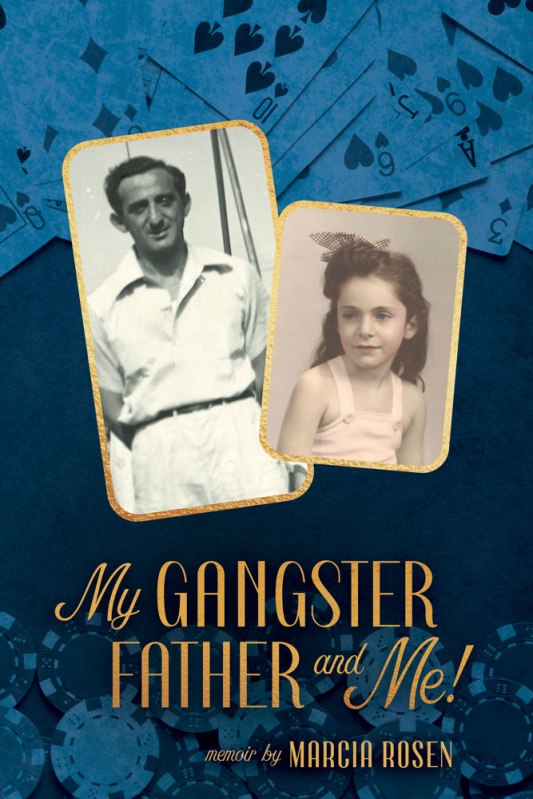
Blurb Blitz: My Gangster Father and Me!

I’m happy to welcome award-winning author Marcia Rosen. Today, Marcia shares her recent release, My Gangster Father and Me!

Blurb

Happy Fathers Day.

Our history and experiences can define us, inspire our actions and as writers impact our words and stories. Mine most definitely has. My father was a gangster. Really!

This is my story about my relationship with my father and how his profession affected me and my life, “He called me Sugar Plum. Both a blessing and a burden, I learned interesting lessons from my father: about generosity and determination, taking risks, and certainly finding the willingness to live life as an adventure.”

Excerpt

You can command respect by your actions and deeds. You most certainly can’t demand love. I’m pretty sure my father never really felt loved by his family or by my mother, except perhaps briefly when they were dating and first married.

My father showed me by example the importance of helping someone who is homeless and hungry. He often bought a meal for those in need. I watched him do those things. One time, I was walking with him on Main Street in downtown Buffalo, past the five and dime store. A man, who looked like he was around fifty, asked for money. My father said, “Let’s go inside and I’ll buy you something to eat.” I can still picture us going inside to buy him a meal.

I grew up learning to be tolerant, yet at times he was intolerant. He taught me to believe in the necessity of fairness and justice, yet he himself did not always demonstrate those traits. He taught me to respect others, yet from my point of view he showed a lack of respect for some people. I believe he was a racist and told him so. His own history figured largely in his feelings and way of thinking.

My father’s attitude towards Black people had its source when he was in his early twenties. He and my grandfather had a small, thriving business providing farm-grown produce to some of the larger grocery chains in the city. Several times a week, leaving well before dawn, they would drive outside of the city to buy fruits and vegetables, often returning after dark.

Tired and in need of some rest, a young Black man who worked for them took over the driving. He too must have been tired and fell asleep at the wheel. There was a serious accident killing my grandfather and sending my father to the hospital for several months. He was lucky to have survived, as was the driver. My dad was not told about his father until the doctors were sure about his recovery. He spent the rest of his life taking a small white pill each day to stop him from shaking; he had nerve damage from the accident. He rarely spoke about it. Yet it affected his entire life.

We strongly disagreed about his being a racist. He would always say, “I’m not racist.” I think he was. When I became very friendly with the daughter of a Black family who moved in next door to us, we moved. As a teenager, when my African American boss drove me home from work one day, my father had a fit. “What if someone sees you? What will they think?” It was the 1950s and people thought all sorts of illogical and irrational things.

There was more of this type of attitude and comments from both my father and mother. I was not at all happy with them, and they were not too pleased with me. This was a frequent topic of controversy between us.

For me, like many others in this country, I cried tears of hope on November 4, 2008, when it was announced an African American was elected President of the United States of America. Tears were on my cheeks, as they were on thousands of others: leaders and everyday Americans, white and Black. We voted and sent an important message. Not everyone heard it, but on that day reasonable voices prevailed.

Author Bio and Links

Marcia Rosen is an award-winning author of twelve books including nine mysteries, the most recent is An Agatha, Raymond, Sherlock, and Me Mystery: Murder at the Zoo. She is also the author of The Senior Sleuths, the Dying to Be Beautiful Mystery Series, and The Gourmet Gangster: Mysteries and Menus (Menus by her son Jory Rosen). She wrote The Woman’s Business Therapist and My Memoir Workbook and has given Memoir Writing presentations and classes for close to twenty years. Her Memoir Blog can be found on her website. For twenty-five years she was owner of a successful national marketing and public relations agency.

Marcia has frequently been a featured speaker at organization meetings, bookstores, libraries, and Zoom Programs presenting talks on Encouraging the Writer Within You, Marketing for Authors, Writing Mysteries…Not A Mystery and A Memoir Detective…Writing Your Life Story. She has also helped numerous writers develop and market their books.

She is a member of Sisters in Crime, Southwest Writers, New Mexico Book Association, Public Safety Writer’s Association, International Memoir Writer’s Association, Women’s National book Association and National Association of Independent Writers and Editors—for which she is also a board member.

Website

Giveaway

Marcia Rosen will award a $25 Amazon/Barnes & Noble gift card to a randomly drawn winner. Find out more here.

Follow Marcia on the rest of her Goddess Fish tour here.

Remember Your First Love

On Wednesdays, I share posts, fables, songs, poems, quotations, TEDx Talks, cartoons, and books that have inspired and motivated me on my writing journey. I hope these posts will give writers, artists, and other creatives a mid-week boost.

Whenever I need a boost, I reread Write Smart, Write Happy by award-winning author Cheryl St. John. Here’s an uplifting excerpt:

Sometimes a book is merely a job. Sometimes a book is not enjoyable to write. But we love being writers, or we wouldn’t do this. We love having written something that will touch and inspire others. We love the magic of stories and creating worlds and people we can manipulate to draw emotions from our audience. We love being writers.

Sometimes it’s an effort, but we must remember our first love; we must transport ourselves back to those days when we first knew we had to put those people in our heads on paper and create stories for them. Whenever I’ve been discouraged or questioned my choices, I’ve always asked myself the same question: What would I rather be doing?

Even before I was published, I was frustrated and wondered if I should keep pursuing this dream of being a writer. I sometimes wished I could be content to do something else, something with a quicker payoff and a visible reward for the effort. But in my heart of hearts, I knew I would not be satisfied until I’d given writing my very best and written stories that touched readers the way so many books have touched me.

So, if you believe you’ve lost your love of writing or have become discouraged, ask yourself, What would I rather be doing? If there’s something else that fills that place in you, by all means do that thing. If not, remember your first love. Find the joy, the awe, and the inspiration and discipline to move forward.

Source: Write Smart, Write Happy by Cheryl St. John, p. 78

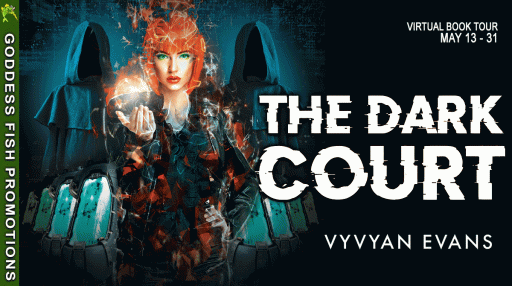
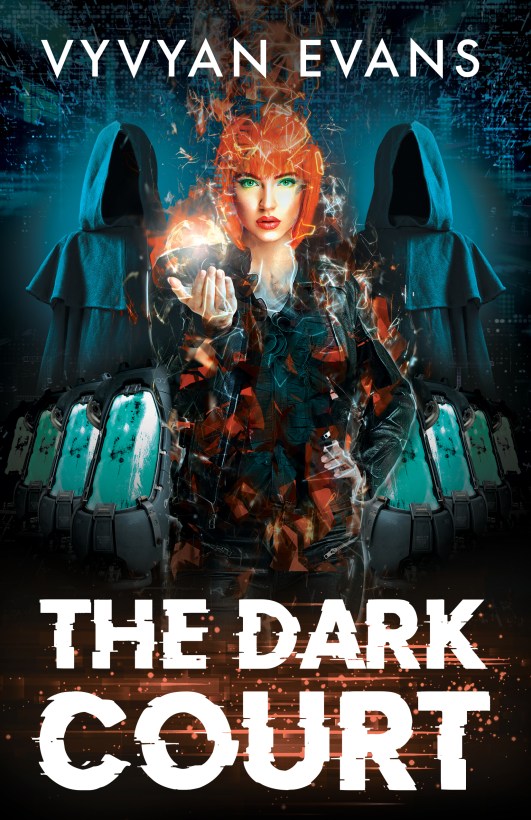
Spotlight on The Dark Court

I’m happy to welcome award-winning linguist and author Vyvyan Evans. Today, Vyvyan shares his creative journey and new release, The Dark Court.
Interview

What was your inspiration for this book?

The Dark Court is book #2 in the Songs of the Sage book series. The books imagine a future in which we stream language directly to neural implants in our heads.

Today, we stream anything from movies, to books, to music, to our ‘smart’ devices, and consume that content. Smart devices use streaming signals—data encoded in IP data packets—encoded and distributed via wi-fi internet. Language streaming would work, in principle, in the same way. With a ‘language chip’ implanted in our brains, we will be able to ‘stream’ language from internet-in-space on demand, 24/7.

Moreover, based on an individual’s level of subscription to a language streaming provider, they would be able to stream any language they chose, with any level of lexical complexity. This means that someone could, potentially, apply for a job in any country in the world, without needing to be concerned about knowing the local language. Rather, the individual would just draw upon the words and grammar they need, to function in the language, by syncing to a language database, stored on a server in space. And call it up, over the internet, in real time, as they think and talk. It means that everything someone needs to know, to be able to use a language, is streamed over the internet, rather than being stored in someone’s head. Language learning, thus, becomes obsolete.

I have a research background in linguistics and cognitive science, with a PhD in linguistics, and having worked for many years as a professor of linguistics. Over the years it increasingly struck me, what if language were no longer learned but streamed. The rise of intelligent AI and ChatGPT makes there seem more plausible. And the technology is currently being developed, to make neural implants for humans possible, to create a so-called “transhuman”.

I wrote The Dark Court because, in the near future, such developments may even put language under threat. Hence, the inspiration for the book was that it should serve as a warning: when we lose language we all lose.

What is the best part of being an author? The worst?

The best part of being an author is the writing. And that’s also the worst part. But the hardest part is the marketing that follows the writing.

Which authors have inspired you?

Given I am a trained linguist, there are two books, by two quite different authors that have inspired me. Both these books ingeniously explored the impact of language on how we think and experience (illustrated through the conceit of a protagonist learning an entirely new, and alien, language).

The first, Babel-17 is by Samuel R. Delany. It was first published in 1966 and was joint winner of the Nebula Award for best novel in 1967.

The eponymous Babel-17 is a language that alters the perceptions and worldview of any who speak it. This is a conceit that draws upon the principle of linguistic relativity.

Linguistic Relativity holds that divergence in the grammatical organization and lexical structure of the language we speak alters the habitual perception of the world around us, even dramatically changing how we think. As an example, we now know that the brains of Greek speakers perceive certain colours differently from speakers of English because of how Greek labels for colour divide up the colour spectrum. This is an unconscious consequence of speaking Greek versus English.

In the novel, Babel-17 is the language spoken by Invaders, as they wage an interstellar war against the Alliance. The novel’s protagonist, Rydra Wong, is a linguist and cryptographer who possesses a rare ability to learn languages. She is recruited by the Alliance to try and decode the language of the invaders, Babel-17, to uncover clues for attack vectors.

Babel-17 is an exemplar of a very high-concept conceit. When Delany was writing the novel, linguistic relativity was still only a hypothesis, first dubbed the Spair-Whorf hypothesis in 1954.

Delany asks a classic ‘what if’ question: What if the language we speak fundamentally changes the way we see the world, the way we feel, our belief systems, the way we act? Babel-17 then explores the logical, and extreme consequences of this proposition.

In the novel, as Rydra Wong learns the strange, alien tongue, she starts to see the world, and think as the invaders do. And the consequence is that she starts to become one of them. She ultimately betrays her own command and her government, acting as an agent of the Invaders.

And in this way, Delany shows that in the context of warfare, when the notion of linguistic relativity is taken to its logical extreme, language can serve as the most powerful weapon of all.

The second is the novella, Story of Your Life, written by Ted Chiang and first published in 1998. This story was subsequently adapted as the major motion picture Arrival.

Again, this story features a linguist as its main protagonist, Dr. Louise Banks. The story involves Banks narrating the events that led to the arrival of her new-born daughter. In so doing, she explains how her work, translating the language of the alien Heptapod species, led her to understanding time in a new way, where she could perceive her past and future simultaneously.

The consequence is that as learning a new (alien) language transforms thought, the novella explores issues relating to linguistic relativity, determinism and freewill.

Any advice for aspiring writers?

Hone your craft, be consistent in setting writing goals, never give-up, rejection is part of the process. And finally, no one ever wrote a masterpiece in one go. It takes time, sometimes years, to get a manuscript right—be kind to yourself during this process. Everything is a learning opportunity.

What are you working on next?

The Dark Court is the second instalment in the Songs of the Sage book series. There are six projected books in the series which, in increasing turns, examine the role and nature of language, and communication. The thematic premise is that, in the wrong hands, language can serve as a weapon of mass destruction. This overarching motif is explored, across the six books, both from Earth-bound and galaxies-wide bases.

As language involves symbol use and processing, the book series, perhaps naturally, also dwells on other aspects of human imagination and symbolic behaviour, including religious experience and belief systems, themselves made possible by language.

The Dark Court, is set five years after the events of the great language outage depicted in the first book, The Babel Apocalypse. It explores how the language chips in people’s heads can themselves be hacked, leading to a global insomnia pandemic.

Blurb

A genre-blending dystopian, sci-fi mystery-thriller that will make you think about communication in a whole new way.

Five years after the Great Language Outage, lang-laws have been repealed, but world affairs have only gotten worse. The new automation agenda has resulted in a social caste system based on IQ. Manual employment is a thing of the past, and the lowest soc-ed class, the Unskills, are forced into permanent unemployment.

In a world on the brink of civil war, a deadly insomnia pandemic threatens to kill billions. Lilith King, Interpol’s most celebrated detective, is assigned to the case.

Together with a sleep specialist, Dr. Kace Westwood, Lilith must figure out who or what is behind this new threat. Could the pandemic be the result of the upskilling vagus chips being offered to the lowest soc-ed class? Or are language chips being hacked? And what of the viral conspiracy theories by the mysterious Dark Court, sweeping the globe? Lilith must work every possible angle, and quickly: she is running out of time!

While attempting to stop a vast conspiracy on an intergalactic scale, Lilith also faces shocking revelations about her origin, coming to terms with her own destiny.
Excerpt

Her father then turned back to Lilith, gazing at her with the kindness she loved. “I have to go away.” He gulped. “You must be very brave, Lily. Because what I’m doing is for you. You’re very special. I believe you will change everything. Not just here, but everywhere.” With that he reached into his jacket and pulled out a small bracelet from inside his breast pocket. He handed it to Lilith.

“Another gift?” she asked, with cautious excitement. Lilith turned it over in her hand. It was silver, with a small, strange-looking screen on the outer side. The screen was narrow and black, and numbers were spinning in iridescent green, fleetingly across the screen.

“I guess it is. This is a SwissSecure bracelet. It will live with you, expanding as you grow.”

“Is it alive?” Lilith asked.

Her father chuckled. “In a way, I suppose it is. When you’re older, after you’re chipped, the numbers will stop spinning. And then you’ll receive a message from me—two, in fact.”

“Memoclips?” Lilith asked, confused. She knew that was what the chipped adults called them.

Her father dipped his head. “Actually, faceclips. They will explain things … when the time is right. For one thing, where the music comes from, the Nunciature Evangelion—the Tower of Songs.”

“Music?”

“It will come to you, later today. This music will help you become your potential, but it will also be your one Achilles heel …”

Author Bio and Links

Dr. Vyvyan Evans is a native of Chester, England. He holds a PhD in linguistics from Georgetown University, Washington, D.C., and is a Professor of Linguistics. He has published numerous acclaimed popular science and technical books on language and linguistics. His popular science essays and articles have appeared in numerous venues including ‘The Guardian’, ‘Psychology Today’, ‘New York Post’, ‘New Scientist’, ‘Newsweek’ and ‘The New Republic’. His award-winning writing focuses, in one way or another, on the nature of language and mind, the impact of technology on language, and the future of communication. His science fiction work explores the status of language and digital communication technology as potential weapons of mass destruction.

Book Website | Author Website | Youtube Channel | Twitter | Facebook | Instagram

Giveaway

The author will award a randomly drawn winner paperback copies of both book 1 and book 2 on the series – a Rafflecopter giveaway. Find out more here.

Follow the author on the rest of his Goddess Fish tour here.
Spotlight on Mike Martin

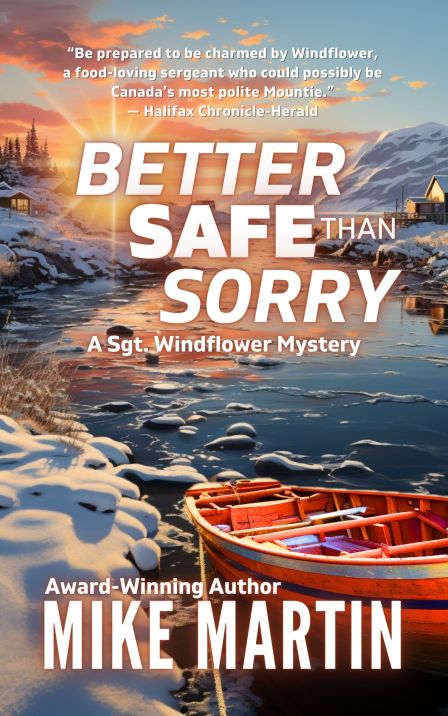
I’m happy to welcome back multi-published Canadian author Mike Martin. Today, Mike shares his writing journey and new release, Better Safe Than Sorry.

Here’s Mike!

I have always been a writer. As long as I can remember. And I was a reader before that. I grew up with three older sisters, two of whom were teachers, so I could read before I went to school. Every week they would drag me along to the library where I got my books. I am so grateful to them and to libraries. They opened up a brand-new world where I could travel, explore and find out about the world and myself.
My first published article was an opinion piece I wrote for the local newspaper on the dangers of caffeinated beer. They paid $25 and I thought I was rich. Thousands of articles and 14 books later I think I’m a better writer. Although the pay is still not great.

I write a book every year and have done that for the last thirteen years. This year Better Safe Than Sorry is the 14th book in the Award-Winning Sgt. Windflower Mystery series. It usually takes me about 3-4 months to get a good first draft and then it will go to beta readers and my editor for their input and polishing. While I’m waiting for it to come back, I usually get my promo plan together and do outreach to my Social Media connections to get ready for the new book. When the book comes out it’s a whirlwind of activity that doesn’t really subside until it’s time to start a new book.

When I am writing a book I start early in the morning with my coffee and a quiet location. I write for about an hour and then leave it alone to percolate. I have a word count for the day. Monday-Friday 1,500 words a day. If I don’t get that number in the morning, I come back to it later in the day. Like I said earlier, after 3-4 months I have a good first draft to work with.

I never edit my day’s work. I keep writing page after page until I have about 10,000 words. Then I review for spelling and grammar and to see if the story line works. I do the same after 25,000 words. Then I print that off and see if it all makes sense. If not, I rewrite. If yes, I keep moving to 50,000 words and then again at the end. Then it’s off to the beta readers first because they give me the full honest truth about whether it is any good and if it true to the Windflower story line.

I am what they call a pantser. That means I don’t outline or do a plot for the books I write. I start writing from what I call the creative flow and keep going until I’m happy with the story. Here’s the great news about that approach. I never know how the story will end until I come to the end of the story. Just like the reader.

Holding a book with your name on the cover is almost like holding a baby. Certainly, the first book was. Seeing your book in a bookstore for the first time gives you the shivers. Still does. Every time a new book comes out it feels like a cause for a great celebration. Publishing Better Safe Than Sorry is almost as exciting as the first one. It truly never gets old.

Did I make mistakes along the way? Too many to count. I think my biggest mistake was to not invest enough initially in editing and proofreading. That meant my product was not my best and it turned off some readers. Now I invest as much in the front end as I do in promotion and marketing. It seems to work better, and my readers are happier. So am I.

My goal as a writer is to create great stories that people can read for their pleasure and enjoyment. I give them the gift of my book and they return it with the time they spend reading it. It’s a fair exchange. My advice to any new writer is to read. A lot. And not just what you think you like. Read great authors of today and yesterday. Write the best book you can and let the universe decide what happens next. It won’t hurt to spend a few dollars to help the universe spread the word about your book either.

Blurb

When danger threatens Grand Bank, will Sgt. Windflower step back into the line of fire?
Winston Windflower is sort of enjoying his retirement from the RCMP in Grand Bank, Newfoundland, happily spending time with his young family, but feeling a little restless. Corporal Eddie Tizzard is running the Marystown detachment and struggling with the demands of the role while his own family grows. When a new kind of drug threatens the community, a body (the wrong body) is found dead in a hearse, and then another drug-connected mysterious death occurs, Tizzard knows he’s dealing with a deadly menace in their quiet, close-knit community.

Windflower finds himself inexorably and not unhappily drawn back into the action, first in an unofficial role to help snare the dealers and then back to active duty in a community that desperately needs his steady hand and good judgement.


Our favorite Mountie, Sgt. Windflower and his fellow courageous cops in small-town Grand Bank, Newfoundland are back to fight a new threat in this compelling page-turner. Award-winning author, Mike Martin once again brings us a stirring story, blending down-home Newfoundland charm with the warmth of family life.

Buy Links

Amazon CA | Amazon US | Amazon UK | Amazon AU

Bio

Mike Martin was born in St. John’s, NL on the east coast of Canada and now lives and works in Ottawa, Ontario. He is a long-time freelance writer and his articles and essays have appeared in newspapers, magazines and online across Canada as well as in the United States and New Zealand. He is the award-winning author of the best-selling Sgt. Windflower Mystery series, set in beautiful Grand Bank. There are now 14 books in this light mystery series with the publication of Better Safe Than Sorry.

Mike is also a past Chair of the Board of Crime Writers of Canada, a national organization promoting Canadian crime and mystery writers and a member of the Newfoundland Writers’ Guild and Capital Crime Writers.

You can follow the Sgt. Windflower Mysteries on Facebook at https://www.facebook.com/TheWalkerOnTheCapeReviewsAndMore

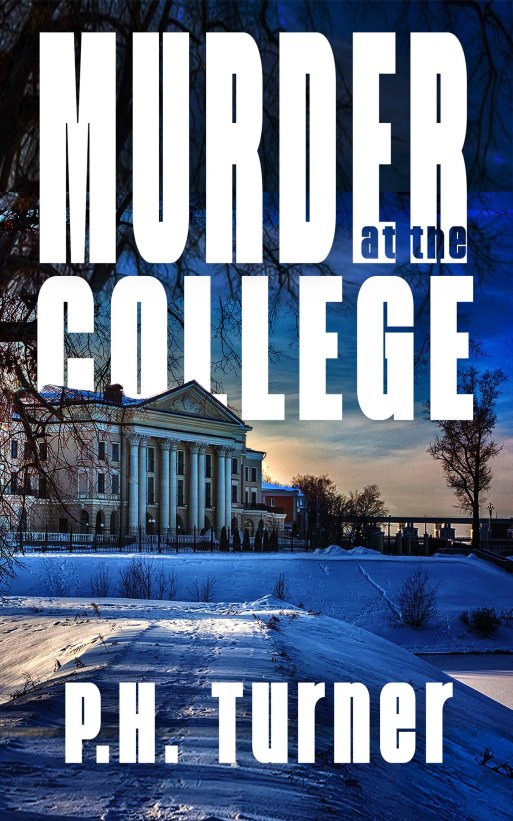
Blurb Blitz Tour: Murder at the College

I’m happy to welcome author P.H. Turner. Today, Pat shares her new release, Murder at the College.

Blurb

A detective has a smooth-talking heartbreaker for a client, but there’s a problem.

Quinn has scorch marks from her last relationship and plenty of chemistry with Ben, but he could have killed his twin brother. He demands to work the case with her, claiming it’s his life on the line.

A partner is the last thing Quinn wants. What she wants is to prove him innocent. But she’s finding plenty of evidence he isn’t.

Excerpt

Suddenly, thunder cracked so loudly that she felt the wall tremble beneath her hand. As the rumbling faded, she heard the soft scuff of a shoe and felt that awful sensation of being watched.

Even the building seemed to be holding its breath.

There, a scrape. Then, a rustle. Somewhere in the dark, someone was moving. Fear skittered down her spine. Inside the heavy drapes, she couldn’t discern whether it came from behind her or below her in the trap room.

Suddenly, the air was heavy with a malevolent presence.

Now, a rush of air from behind her. Then a hard shove, and Quinn tumbled down the stairs, whacking her head on the first curve, picking up speed as she rolled pell-mell, spiraling toward the bottom. Her left shoulder crashed into the unforgiving steel when she rounded the second turn. Sharp pain took her breath away, but she grabbed a rail, righted herself on the bottom step, and waited until her eyes grew accustomed to the dim light in the trap room.

Creak, shuffle.

Someone was hurrying across the wood-floored stage above her head. She stood and scanned the ceiling, tracking the footsteps moving above her.

With a few more steps, the person would be over the trap door in the center of the stage.

A shuffled step above her, then another. Quinn held her breath, waiting in place under the trap door.

Now! She yanked on the steel drawbar, dropping the trap door with a bang.

A screaming figure landed in a heap on a stack of old blankets at Quinn’s feet.

Author Bio and Links

P.H. Turner (Pat) writes contemporary mysteries spiked with long-held grudges, secrets, and murder. With roots in a Texas farm homesteaded in the 1850s, she calls Austin home. When she’s not writing, she’s cooking for family, or taking care of a pair of hairy mutts, or in her garden coaxing roses to bloom in the Texas heat.

Pat is a member of Mystery Writers of America, Sisters in Crime, and Romance Writers of America.

Amazon Author Page | Website | Facebook | Twitter | Pinterest | Amazon Buy Link

Giveaway

P.H. Turner will award a $20 Amazon/BN gift card to a randomly drawn winner via Rafflecopter. Find out more here.

Follow Pat on the rest of her Goddess Fish tour here.

On Staying Present and Positive

On Wednesdays, I share posts, fables, songs, poems, quotations, TEDx Talks, cartoons, and books that have inspired and motivated me on my writing journey. I hope these posts will give writers, artists, and other creatives a mid-week boost.

A long-time fan of bestselling authors and coaches Marc and Angel Chernoff, I look forward to reading their emails and blog posts. Here’s an excerpt from a recent post:

Growth can be painful, change can be painful, but in the end nothing is as painful as staying stuck somewhere you don’t belong. So be selective with your energy today. If you can fix a problem, fix it. If you can’t, accept it and change your thoughts about it. And whatever you do, don’t attempt to invest more energy than you have tripping over something behind you or something that only exists inside your head.

Of course, there will be times when it seems like everything that could possibly go wrong is going wrong. You might feel like you will be stuck in this rut forever, but you won’t. Sure the sun stops shining sometimes, and you may get a huge thunderstorm or two, but eventually the sun will come out to shine. Sometimes it’s just a matter of us staying as present and positive as possible in order to make it to see the sun break through the clouds again.

And remind yourself that the trick on the average day is to enjoy the little things. Don’t wish away all your days waiting for better ones ahead. Just do your best to appreciate where you are. You’ve come a long way, and you’re still learning and growing. Be thankful for the progress and lessons. Take them and make the best of things right now.

Note: I highly recommend subscribing to Marc & Angel’s website.