Prevent | Delay | Control

A “2009 GQ Rock Star of Science” doctor has written a provocative and inspiring book that presents a revolutionary approach to treating and preventing disease. In The End of Illness, oncologist Dr. David Agus brings his ideas out of the lab, showing us how to live healthy, vibrant lives and move gracefully into old age.

Agus starts by asking us to fill out a personal health inventory questionnaire, a four-page checklist originally designed to help patients prepare for annual check-ups. Agus is a big believer of personalized medicine, and he wants each of us to customize our health care to accommodate our physiology, genetics and value systems. He explains, “Nothing about health is one-size-fits-all, so until you know how to perform your own fitting, you won’t be able to live the long and happy life that is awaiting you.”

Genetic testing is another way we can empower ourselves to improve our health. We can currently look at genetic risk profiling for about forty conditions, ranging from multiple sclerosis to Alzheimer’s to glaucoma. Agus points out that this is not necessarily our destiny. If we use the right tools, we can shift our fate to live longer than what our DNA dictates.

Agus takes on the $25 million vitamin and supplement industry. He devotes an entire chapter entitled “Proceed with Caution” to discussing the pitfalls of Vitamin D. He argues that while Vitamin D may appear to be an anticancer miracle worker in the lab where you can control cell cultures, this effect does not replicate itself in live people. And more importantly, each of us has a genetic predisposition to maintaining a certain level of vitamin D and no number is perfect for everyone.

In a subsequent chapter, Agus gives data on the research and explains why he feels the “hype” over all vitamins and supplements is overrated. The doctor does not mince words when he makes the following claims: “Tumours devour Vitamin C like candy so you could be feeding your cancer rather than fighting it when you consume excess Vitamin C” and “To get the same amount of fish oil you would from a single serving of salmon, you would have to consume 20 to 30 fish oil capsules.” While he does not have any problems with people taking vitamins to correct deficiencies or address certain conditions such as pregnancy, Agus believes that taking vitamins generically for health makes no sense.

I was amused by the following advice: “Don’t trust anything that comes out of a blender, juicer or glass jar.” Agus wonders if the body really likes consuming ten carrots or a whole head of broccoli all at once. And he advises us to consider buying frozen fruits and vegetables instead of what looks like fresh produce at the supermarket.

To root out chronic inflammation, Agus offers many practical, easy-to-implement strategies. Wear comfortable shoes. Get an annual flu vaccine. Take a statin and baby aspirin if you are over the age of forty. The easiest but often the most challenging advice to follow is keeping a regular schedule. Agus reminds us that when we break the body’s natural rhythm, we are no longer performing optimally. Our bodies will respond positively when we stick to the same sleep-wake schedule seven days a week, eat our meals at the same time each day, and take downtime during our waking hours.

As a cancer survivor and the daughter of parents with Alzheimer’s and Parkinson’s Diseases, I appreciate the doctor’s advice to focus on the present year and not rely on a textbook to tell me something that might happen in ten years time. By the time we reach that ten-year mark, there will be “new therapies, new treatments and new roads to take.”

Dr. David Agus has written a truly motivational book that deserves a place on everyone’s bookshelf.


Nailing That First Page

At last night’s dinner meeting for Guelph Writers Ink, we discussed a variety of topics, among them the all-important first page of a novel. Opinions varied around the table with most of us agreeing that the first page must introduce the protagonist and include a crisis or conflict of some kind. While it is important to set the scene, it should be done without getting bogged down in too many descriptions.

Those of us who write crime fiction must also consider the following question: Is it necessary to place the dead body on the first page of a novel?

In a recent article, bestselling author Louise Penny offered the following advice: “If you’re writing your first work of crime fiction, place the body near the beginning of your book—preferably on the first page, perhaps the first sentence. In later books this won’t be as necessary, but agents and editors like it established early, so readers know what they’re getting.”

I am a fan of Louise Penny and inclined to follow her advice. She has walked the walk and achieved literary success with her mystery series. Her first novel, Still Life, was turned down by 50 publishers and agents before it found a home with British literary agent Teresa Chris.

In my WIP, I had originally introduced the dead body at the bottom of the second page. But after reading Louise’s article and getting advice from other writers, I reworked the first chapter and placed the dead body in the first sentence.

Any other thoughts out there?

Madonna’s Take on W.E.

Madonna spent two years researching and writing this film. She immersed herself in the lives of the Duke and Duchess, wallpapering an empty room in her house with their photographs and pictures from auction catalogs. Madonna commented, “I was trying to understand the nature of their love story and trying to figure out for myself if there is such a thing as perfect love.”

But Madonna was not interested in producing another historical movie. Instead, she created a modern-day story using the fictional character, Wally Winthrop, to present a different point of view.  Abbie Cornish plays the part of an emotionally fragile woman who is obsessed with the life of Wallis Simpson (Andrea Riseborough). While dealing with her husband’s betrayal and struggle to have a child, Wally daydreams about Wallis’ life.  Through Wally, we see another side of the Duchess.  She appears more vulnerable and conflicted as the king makes that irrevocable decision that changed the course of history. While the king gave up his throne for the woman he loved, Wallis Simpson gave up her freedom to live a life of her own choosing and became the “most despised woman in the world.”

I could feel Madonna’s presence in the lives of both women, especially in the scenes where Wallis and Wally meet.  I took note of one telling comment made by Wallis (via Madonna), “They can’t hide you unless you let them.” Truthfully, I would like to have seen more of these encounters and fewer historical clips.  Also, I felt that too much of the film centered on Wally’s life and her budding relationship with the Russian immigrant played by Oscar Isaac.

If you love history and/or Madonna, go see the film.


Book Club Night

Last evening, I met with my book club to discuss Secret Daughter, Shilpi Somaya Gowda’s debut novel.

Kavita and Jasu Merchant are a poverty-stricken Indian couple living in a society that favors boys and considers girls a burden. Having lost one daughter to infanticide, Kavita decides to take Asha,  her second daughter,  to an orphanage in Shanti. She leaves her daughter with a thin silver bracelet and the hope that she will live and experience a better quality of life.

In San Francisco, Somer and Krishnan Thakkar–she’s a pediatrician and he’s a neurosurgeon–have been unable to have a child. Krishnan asks his mother in Mumbai to arrange for the adoption of an Indian child.

The story is told from the viewpoints of the three female protagonists–Asha, Kavita and Somer–moving forward in time from 1984 to 2009. Each woman has strong feelings about motherhood and India.  As they evolve on their respective journeys, they come to appreciate that country in different ways, realizing that “Mother India does not love all her children equally.”

Gowda has effectively captured the sights, sounds and smells of India. I could easily visualize the slums of Mumbai and taste the spicy food that Krishnan and Asha craved.

An excellent read!

Dealing with Dialogue Tags

Looking back at some of my earlier work, I cannot help but cringe at my use of “said bookisms” such as roared, admonished, exclaimed, queried, and hissed. I was trying to avoid overusing the word “said” and looked for suitable alternatives. I realize now that using all those words only made it sound like I enjoyed using my thesaurus. I was annoying the reader and drawing attention away from the dialogue.

It is not necessary to help the reader interpret the dialogue, or worse, tell the reader how the words are said instead of showing him. If the dialogue is strong enough, “he said” and “she said” will do. Like other parts of speech—the, is, and, but—that are used several times on each page, “said” is invisible to the reader and allows him to concentrate on the action and dialogue.

To add variety, I have been working on using action to vary the tags. I am also trying to simplify the narrative and use taut dialogue to build up tension.

The following excerpt from Kaleidoscope,  Gail Bowen’s latest in the Joanne Kilbourn Mystery series,  illustrates the effective use of dialogue:

The news I was about to deliver was harsh, and Taylor and Zack both knew it. Zack reached across the table and took our daughter’s hand.

“So how bad is it?” he asked.

“It’s bad,” I said. “Everything in the east half of the house is pretty well gone. The bedrooms are all right. The police wouldn’t let us look at the basement, but I think it’s safe to assume there’ll be structural damage there.”

“So, what’s left?” Taylor asked, her voice small.

“Your mother’s paintings are still on loan to that retrospective, so they’re safe. And the Scott Plear and your abstract were in our bedroom, so they’re fine. Nothing in your bedroom was touched.”

“But the room where the pool was is gone?” she asked.

I nodded.

“So the fresco I painted on the wall is gone?”

“Yes.”

“And the self-portrait I gave Dad for Christmas?”

“It was in the family room.”

“And the family room is gone?” Taylor’s eyes brimmed with tears, but she set her mouth in a determined line and turned to Zack. “I’ll paint another one.”

Colliding Worlds

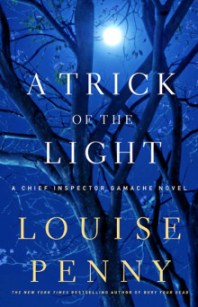
Chief Inspector Armand Gamache is back in Three Pines, the idyllic village set in Quebec’s Eastern Townships. In this seventh entry of Louise Penny’s crime-fiction series, Gamache deals with the intricacies of the art world and, of course, murder.

When A Trick of the Light opens, 50-year old Clara Morrow is standing behind the frosted glass doors of the prestigious Musee d’Art Contemporain in Montreal. Before entering the “vernissage” (preview) of her one-woman show, she envisions every possible dream and nightmare about her future in the highly competitive art world. Her friends whisper reassurances and help her get through the event. Afterward, she returns to Three Pines for a party with her friends from the village and prominent members of the art world. The celebratory mood comes to an abrupt end with the discovery of a murdered corpse in Clara’s garden.

Murder has returned to the village that “produces bodies and gourmet meals in equal proportions.”

The dead woman is identified as Lillian Dyson, a childhood friend who cruelly betrayed Clara and destroyed many careers with her stinging art reviews. Faced with a wide field of suspects, Gamache and his deputy, Jean-Guy Beavoir, start their investigation. Gamache listens carefully to the artists, the people who support them, and the people who feed off them. Envy is a persistent theme, and we watch as the ravages of this strong emotion eat away at the characters, threatening their friendships, marriages, partnerships, and even lives.

In A Trick of the Light, Penny uses the worlds of art and Alcoholics Anonymous to explain fear and pain, hope and change. As these colliding worlds intersect, the characters stumble and search for reasons to live, love and forgive. Both worlds offer many surprises and people are not always what they appear to be. Throughout the novel, Penny poses the question: What is truth and what is a trick of the light?

The characters wrestle with the concept of forgiveness. Is it possible for a woman to forgive a spouse who  undermines her talent? Can a man forgive the chief inspector who arrested him for a murder he did not commit? What happens when a recovering alcoholic jumps to Step Nine of her handbook and asks for forgiveness?

The pacing is superb and the narration is simple and direct. The intricate plot follows all the rules of mystery writing complete with red herrings, false denouements, and a few gourmet touches. While reading Penny’s previous novels would provide context, the book is strong enough to stand on its own. Fans of the series will enjoy seeing their old friends from the village and watching their lives develop and change during the course of this investigation. At the end of the book, some of the characters’ lives are in shambles as they make tentative efforts to pick up the pieces. No doubt, Louise Penny will continue their stories in her eighth novel to be released in August 2012.

The Amateur Sleuth

sleuthWhen I decided to write a murder mystery, I gravitated toward the cozies. A longtime fan of Miss Marple, Nancy Drew and Jessica Fletcher, I felt comfortable with introducing an amateur sleuth instead of a private detective or other law enforcement officer.

My protagonist, Gilda Greco, is a career development practitioner. After winning a nineteen million dollar lottery, Gilda leaves her longtime teaching career and opens a career counselling office aimed primarily at helping boomers launch their second acts. While I haven’t won a lottery (yet), I am a retired high school teacher with a post-graduate diploma in career counselling. It made sense to create a sleuth who has my  background and skill set. Whenever Gilda discovers a body or encounters an obstacle, I  ask myself what I would in that situation. Writing in the first person also helps me get into Gilda’s head.

While researching my book, I discovered the need for getting the facts straight, especially with regard to official law enforcement.  Detectives and private investigators do not readily share information, so it is necessary for the sleuth to use her intelligence and curiosity  to uncover clues and motives. Traditionally, the amateur sleuth does save the day, but I was careful not to portray the local police force as too misguided or incompetent.

Movie Review: Monsieur Lazhar

The film opens with a hanging. A Grade 6 pupil walks into a classroom and finds his teacher’s body  dangling from a light fixture. The principal played by Danielle Proulx immediately springs into action. She hires a grief counsellor and orders the classroom stripped and repainted.

Finding a substitute teacher for the stricken class is more challenging. Her only option is Bachir Lazhar, the Algerian immigrant (Mohammed Fellag)  who  gatecrashes the school in the wake of this tragedy. His formal demeanor and tentative grasp of the Quebec curriculum set him apart from the school’s mostly female staff. But his intelligence and genuine warmth gradually win over the students and staff.

As we learn more about his own personal tragedy, we realize that he is well equipped to help these children deal with their grief. He does not hesitate to question the psychologist’s methods and interfere with the school’s healing process.

It is not surprising that Monsieur Lazhar received an Oscar nomination for best foreign-language film.