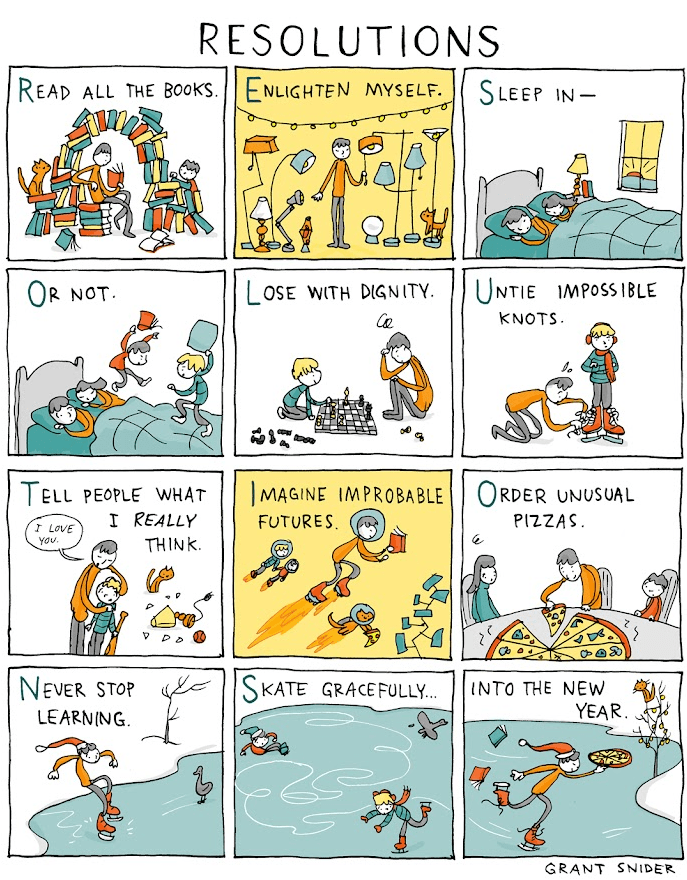
Start Being a Beginner Again

On Wednesdays, I share posts, fables, songs, poems, quotations, TEDx Talks, cartoons, and books that have inspired and motivated me on my writing journey. I hope these posts will give writers, artists, and other creatives a mid-week boost.

A long-time fan of bestselling authors and coaches Marc and Angel Chernoff, I look forward to reading their emails and blog posts. Here’s an excerpt from a recent post:

“Starting over is not an option!”

Unfortunately that’s a lie many of us hold on to until the bitter end.

The idea of starting over being a bad thing is baked right into the fabric of our society’s education system. We send our children to a university when they’re 17 or 18, and basically tell them to choose a career path they’ll be happy with for the next 40 years. “But what if I choose wrong?” I remember thinking to myself. And that’s exactly what I did, in more ways than one. Over the years, however, I’ve learned the truth through experience: you can change paths anytime you want to, and oftentimes it’s absolutely necessary that you do.

Yes, starting over and making substantial changes in your life is almost always feasible. It won’t be easy of course, but neither is being stuck with a lifelong career you naively chose when you were a teenager. And neither is holding on to something that’s not meant to be, or something that’s already long gone.

The truth is, no one wins a game of chess by only moving forward; sometimes you have to move backward to put yourself in a position to win. And this is a perfect metaphor for life. Sometimes when it feels like you’re running into one dead end after another, it’s actually a sign that you’re not on the right path. Maybe you were meant to hang a left back when you took a right, and that’s perfectly fine. Life gradually teaches us that U-turns are allowed. So turn around when you must! There’s a big difference between giving up and starting over in the right direction. And there are three little words that can release you from your past mistakes and regrets, and get you back on track. These words are: “From now on…”

So from now on what should you do?

Mix it up a little bit. Take one step at a time. Find ways to provide a healthy challenge to your current understanding of life, and you will discover and experience far more of life’s magic in the days ahead.

Note: I highly recommend subscribing to Marc & Angel’s website.

Joy and Sadness

On Wednesdays, I share posts, fables, songs, poems, quotations, TEDx Talks, cartoons, and books that have inspired and motivated me on my writing journey. I hope these posts will give writers, artists, and other creatives a mid-week boost.

In a recent post on the Writer Unboxed blog, author Kathleen McCleary offered suggestions on how to weave joy and sadness into our stories. Here’s an excerpt from that post:

Every good story has to include both joy and sadness, but it’s the challenges, the losses, the disappointments, that make the most interesting reading, as Tolstoy pointed out. (“Every happy family is alike; each unhappy family is unhappy in its own way.”) So if my suggestions here focus more on the dark side than the light, it’s because, for better or worse, that’s what drives good fiction. Consider:

The flip side of joy. Your character may be experiencing a moment of profound joy—a wedding, a coronation, the birth of a child, a retirement celebration. What else is going on? Major life milestones often involve loss as well as celebration—the loss of freedom or the road not taken or the hope for a different ending. And I don’t mean a character having reservations about a major life event (is this really the person I should marry?) as much as I mean a character’s experience of conflicting emotions at the same time (I love this person and am thrilled to be getting married, AND I want to howl with grief because my beloved father is not here).

Who or what is your character grieving? We don’t only grieve for the people we lose. We grieve the experiences we never had and maybe never will have. We grieve scenarios or lives we imagined for ourselves that suddenly bump into a reality that makes it clear those imagined lives will never happen. We grieve our own lost physical abilities or good looks or health. We grieve the loss of routines, the loss of place, the loss of the familiar. The first house I owned was next door to a five-acre forest, filled with towering Douglas Firs and hemlock and cedar trees, as well as dogwood, maples, and more. One year a developer bought that parcel of land and cut down every last tree, and believe me, I grieved the loss of those trees every time I looked out the window or stepped outside. Even in the midst of happy times, we can be suddenly rocketed back into feelings of loss.

How does your character experience joy and grief? Intense emotions are intensely personal Characters may react differently to happy events—the wedding that delights your protagonist may fill her sister with sadness, while the birth of a child may terrify a grandparent who once lost a child of their own. Similarly, if you and someone else are grieving the loss of a person dear to you both, your experiences of that person are different, and the ways you feel that loss will be different. Maggie O’Farrell’s novel Hamnet (now a movie) includes one of the most vivid, searing depictions of grief I’ve ever read. The different ways the characters grieve almost splits them apart, until one of the characters is able to see and feel the way the other has poured their grief into a different outlet, and come to a new understanding.

How will your character’s grief be revealed. over the arc of your story? Grief is an upheaval; it can lead to divorce, estrangement, reconciliation, passion. I recently finished reading The Correspondent, Virginia Evan’s surprise bestseller, which deals with a character’s intense sorrow over the loss of a child (this is not a spoiler; it’s part of the book throughout). But it’s only as the character grows and changes over the course of the book that she can fully come to terms with the real source of her sadness, and the ending is a surprise.

Read the rest of the post here.

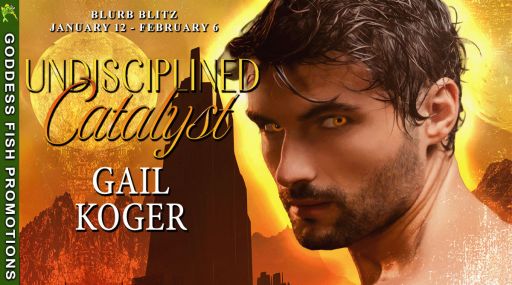
Blurb Blitz: Undisciplined Catalyst

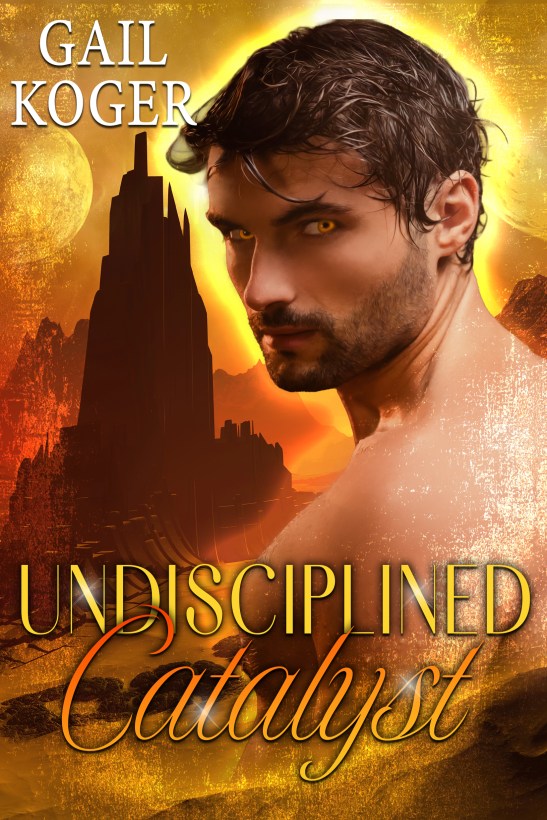
I’m happy to welcome back author Gail Koger. Today, Gail shares her new release, Undisciplined Catalyst.

Blurb

I was sixteen when I found out not only am I an alien hybrid, but monsters called the Tai-Kok were getting ready to invade our world. Guess who gets to stop them? Me! How?

My uncle, the mad scientist, created a machine called the portal that instantaneously sends a test subject from one location to another by converting them into energy. His idea is to port me onto a Tai-Kok ship. All I have to do is leave a bomb, hit the retrieval button on my spiffy traveler’s belt and poof! I’m back on Earth before the Tai-Kok ship goes kaboom. Sounds simple, right?

Wrong. Uncle Ben doesn’t have a clue where I’ll actually appear on the ship. It could be the engine room, the crew quarters, or even the bridge. It’s like playing Russian roulette. The Tai-Kok don’t like surprises or uninvited guests.

To make things even more fun, I have an alien battle commander stuck in my head and I’m related to a powerful Coletti warlord. Yippee. The chances of me living to see eighteen aren’t good.

Excerpt

“Give ‘em hell.” A wild look in his eyes, Uncle Ben tapped on the console.

The circles of light surrounded me, but this time it felt like a zillion fire ants were crawling over my body. Holy hell! Something had gone wrong! I appeared in midair and dropped like a rock. Smack! I slammed into someone, and my Glock went flying.

My eyes bugged. I was on the bridge of a futuristic warship, and the viewscreen showed one hell of a space battle going on. To make things even more fun, I was lying across the lap of a huge, muscle-bound male wearing black battle armor. Since he was sitting in the captain’s chair, I was assuming he was the boss.

A very angry-looking boss. I blinked. Holy cow was he good-looking, if you were into the whole merciless predator thing. Huh? The red chains woven into his black warrior’s braids matched the communication device on his left wrist. Who knew aliens accessorized and why did I care? I took a deep breath trying to control the panic streaking through me.

A low growl rumbled in his chest.

One look into his disturbingly hostile amber eyes and I knew I was in big trouble. I reached for my retrieval button.

His arms clamped around me painfully, and he spat a bunch of gobbledygook.

“Sorry, I don’t speak that language,” I replied mentally. Somehow, I knew he was psychic.

A harsh voice sounded in my head, “How did you get through our shields.”

“Dunno. My uncle is the scientific genius, not me. I’m just the delivery girl.”

“What do you deliver?”

Did I look stupid? The minute I told him bombs; he’d kill me. I pasted a friendly smile on my face. “Stuff. I’m Lexi and you are?”

“Battle Commander Kaelen. I serve Zarek the Coletti Overlord.”

Author Bio and Links

I was a 9-1-1 dispatcher for the Glendale Police Department and to keep from going totally bonkers – I mean people have no idea what a real emergency is. Take this for example: I answered, “9-1-1 emergency, what’s your emergency?” And this hysterical woman yelled, “My bird is in a tree.” Sometimes I really couldn’t help myself, so I said, “Birds have a tendency to do that, ma’am.” The woman screeched, “No! You don’t understand. My pet parakeet is in the tree. I’ve just got to get him down.” Like I said, not a clue. “I’m sorry ma’am but we don’t get birds out of trees.” The woman then cried, “But… What about my husband? He’s up there, too.” See what I had to deal with? To keep from hitting myself repeatedly in the head with my phone I took up writing.

Website | Facebook | Goodreads | Twitter/X | Amazon Buy Link

Giveaway

Gail Koger will award a $15 Amazon/Barnes & Noble gift card to a randomly selected winner. Find out more here.

Follow Gail on the rest of her Goddess Fish tour here.

Don’t Quit Too Soon

On Wednesdays, I share posts, fables, songs, poems, quotations, TEDx Talks, cartoons, and books that have inspired and motivated me on my writing journey. I hope these posts will give writers, artists, and other creatives a mid-week boost.

Here is a thought-provoking excerpt from Elizabeth Gilbert’s bestselling book, Big Magic: Creative Living Beyond Fear:

I think a lot of people quit pursuing creative lives because they’re scared of the word interesting. My favorite meditation teacher, Pema Chödrön, once said that the biggest problem she sees with people’s meditation practice is that they quit just when things are starting to get interesting. Which is to say, they quit as soon as things aren’t easy anymore, as soon as it gets painful, or boring, or agitating. They quit as soon as they see something in their minds that scares them or hurts them. So they miss the good part, the wild part, the transformative part—the part when you push past the difficulty and enter into some raw new unexplored universe within yourself.

And maybe it’s like that with every important aspect of your life. Whatever it is you are pursuing, whatever it is you are seeking, whatever it is you are creating, be careful not to quit too soon. As my friend, Pastor Rob Bell warns: Don’t rush through the experiences and circumstances that have the most capacity to transform you.”

Don’t let go of your courage the moment things stop being easy or rewarding.

Because that moment?

That’s the moment when interesting begins.

Source: Big Magic, p. 247

On a Lighter Note…

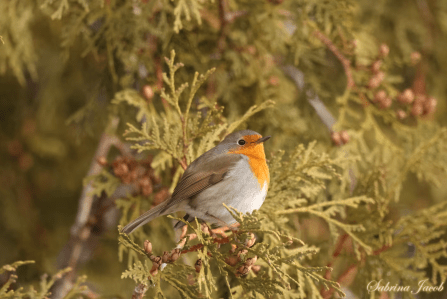
This month has been challenging, with colder-than-usual temperatures and ever-changing global dynamics. Against that backdrop, it was a delight to hear about a wee celebrity who is creating a stir in Montreal, Quebec.

Last week, Sabrina Jacob was taking out her garbage when she spotted a rare bird perched nearby—a European robin. A hearty little bird, it is native to Europe and can be found as far north as the Scandinavian countries.

After Sabrina shared pictures and videos online, word spread quickly. Bird enthusiasts from across Canada and the United States flocked to Montreal, hoping to catch glimpses of this visitor so far from home.

How did the bird end up in Canada?

According to bird behaviourist Joel Coutu, one possibility is that the bird fled harsh European cold fronts and somehow crossed the Atlantic Ocean. Another theory suggests it may have arrived during fall migration and has, until now, gone unnoticed, living among us for weeks or months.

Here’s one of Sabrina Jacob’s pictures:


On Becoming a Hero

On Wednesdays, I share posts, fables, songs, poems, quotations, TEDx Talks, cartoons, and books that have inspired and motivated me on my writing journey. I hope these posts will give writers, artists, and other creatives a mid-week boost.

Transformational teacher, Adam Markel, shares the following inspirational excerpt in his book, Pivot: The Art and Science of Reinventing Your Career and Life:

There are heroes everywhere.

We see them on the news. We read books about them and watch movies starring them. We share their stories.

Whether it’s a larger-than-life hero, such as Gandhi, or the guy who left the job he hated and thrives in his own small business, there are heroes everywhere. Heroes are real, and they’re part of every culture in every country through all of history.

They all have one thing in common: They are heroes because they live the life they dream.

A fundamental part of the hero’s journey, a term coined by Joseph Campbell, is to go from the known to the unknown. It’s about leaving the safe world that the hero knows and venturing to something new and unknown. A place to be tested. Think of Luke Skywalker leaving the farm. Bilbo Baggins leaving the Shire. Neo leaving the Matrix. They all left a comfortable, known, but ultimately unfulfilling “normal” life to find themselves and eventually to become heroes.

You don’t need to slay dragons or leave the planet to pivot. But there’s probably no better way to capture the essence of what it means to reinvent yourself.

To pivot, you’ll have to explore the unknown. I won’t ask you to burn your ships or face a dragon. But you may have to leave some of your comfortable routines and predictable patterns.

And in return?

You get to become a hero of your own life. And I believe that, deep inside, that’s what we all want. Because, deep down, we all know this truth: The only thing stopping you from changing your life is you.

The hero in this story is you. It’s your journey. No one can take it from you or do it for you. To pivot, you need to become the hero of your own life.

Because if you can pivot—if you can change your life and live your dreams…

…what can’t you do?

Source: Pivot: The Art and Science of Reinventing Your Life

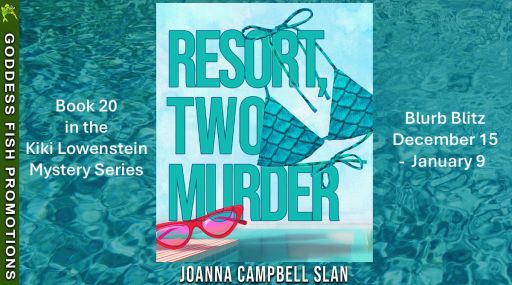
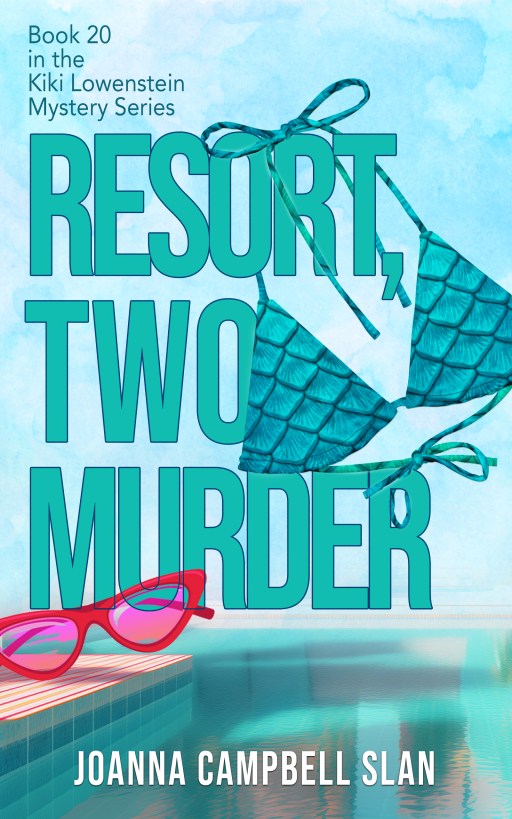
Blurb Blitz: Resort, Two, Murder

I’m happy to welcome bestselling author Joanna Campbell Slan. Today, Joanna shares her new release, Resort, Two, Murder.

Blurb

Kiki Lowenstein heads to Florida for sand, sunshine, and family time—until a shocking death pulls her into a mystery simmering beneath the resort’s perfect surface. With craftiness and heart, she dives into a dangerous tangle of lies that only she can unravel.

Excerpt

The scream ripped through the dawn and straight into my spine. I didn’t breathe until I reached the balcony.

Seven floors below, a housekeeper stood frozen at the pool’s edge, hands over her mouth. The turquoise water rippled around hair the color of fire.

Copper hair.

Floating.

Still.

My blood turned to ice.

“Mom?” Sixteen-year-old Anya whispered behind me. Pale. Too pale. “What happened?”

“I don’t know yet. Stay back. Keep your brothers inside.” My voice didn’t tremble, but everything inside me did.

I yanked the curtains closed, but not before my mind captured every detail: the purple satin gown billowing under the water, the bare feet, the drifting red hair like a drowning sunrise.

Then Brawny — my fierce, loyal Scot nanny — sprinted into the courtyard and dove in, shoes and all. She flipped the girl over, started mouth-to-mouth, refusing to accept what the water already knew.

Could this be real?

Sirens wailed in the distance. And I stood frozen on the balcony, one hand pressed to my heart, silently begging for a miracle.

It didn’t come.

The red-haired model from last night’s fashion show was gone.

Author Bio and Links

Joanna Campbell Slan is a New York Times, USA Today, and Amazon bestselling author known for her engaging women’s fiction and mystery novels. With nearly 80 books to her credit, including contributions to the original Chicken Soup for the Soul series, Joanna specializes in stories featuring strong female protagonists and the power of women’s friendships. Her tagline, “Creating a better world one story at a time” perfectly captures the spirit of her work, as she has a keen interest in presenting all sides of social issues. Joanna is best known for her Kiki Lowenstein Mystery Series, which spans 19 books and 42 short works, chronicling the growth of a widowed mother who finds new purpose through crafting and sleuthing. Living on a nearly deserted island off the coast of Florida, Joanna draws inspiration from her surroundings and her love for various crafts, including Zentangle®, crochet, and upcycling. Her accomplishments include winning the Daphne du Maurier Award for Literary Excellence for her continuation of Charlotte Brontë’s Jane Eyre. Contact her at JCSlan@JoannaSlan.com

Newsletter Sign Up | Street Team Sign Up | Website | Facebook | Facebook Group | Twitter | Amazon Author Page | Instagram | Goodreads | BookBub | LinkedIn | Pinterest

Giveaway

Joanna Campbell Slan will be awarding a $25 Amazon/Barnes & Noble gift card to a randomly drawn winner. Find out more here.

Follow Joanna on the rest of her Goddess Fish tour here.

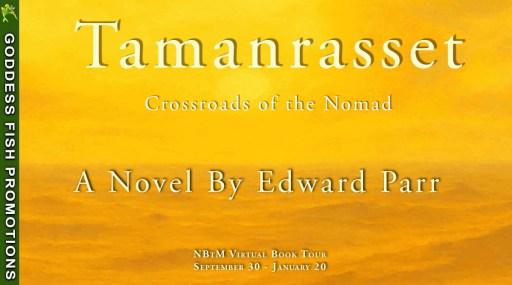
Spotlight on Tamanrasset: Crossroads of the Nomad

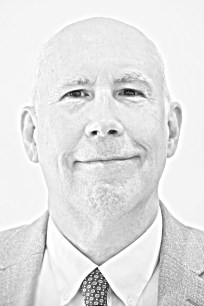
I’m happy to welcome award-winning author Edward Parr. Today, Edward shares his creative journey and new release, Tamanrasset: Crossroads of the Nomad.

Here’s Edward!
Do you ever wish you were someone else? Who?

When I’m writing, I frequently imagine I am someone else. Since I write primarily from one character’s Point of View at a time, I need, in the same way that the theater guru Konstantin Stanislavski would have required were I performing each part in a play, to imagine what I would feel and say and do if I were that character in that situation. However, while I love to dream up incredible situations and imagine being inside them, that’s a far cry from wishing I was really someone else. On the other hand, I don’t think I’d enjoy writing as much as I do if I did not sometimes feel uncomfortable being myself and find refuge in the imagined lives of others. Maybe that is common to all authors – I don’t know.

Who is the last person you hugged?

I try to hug my wife several times a day, often to her annoyance. On the other hand, our Labrador retriever is always receptive to a quick hug.

What are you reading now?

I’m trying to get a better understanding of the whole modern mystery genre and some of the earliest examples. I’ve been reading through all the works of Agatha Christie and just recently read The Moonstone: A Romance by Wilkie Collins (1868) and E.C. Bentley’s Trent’s Last Case (1913). My next book to read is probably going to be Riders of the Purple Sage, a classic Western novel written by Zane Grey (1912). I’m still trying to figure out if I like Westerns. I’m generally more interested in the camaraderie of soldiers who are bound together than in the heroism of rugged individualists.

How do you come up with the titles to your books?

When I was writing my First World War series, I knew that a major theme of the work was about the collapse of the dynastic monarchies that had ruled the world for centuries. I had actually come up with the title Kingdoms Fall as a sort of short, snappy supra-title for the series and had begun writing the second book when I finally thought to Google the phrase and discovered a biblical except that perfectly fit the title (Psalm 46:6). Ordinarily I like the title to reflect something of the heart of the book; it becomes a key for the reader to understand what the book is “about.” My newest novel, Tamanrasset: Crossroads of the Nomad, is my attempt to tell a story that reflects the amazing place and time of many classic pulp fiction stories – the Sahara desert of Africa at the dawn of the 20th century. In the novel, the lives of four protagonists become entwined, and it is only through the chance intersection of their lives that they become bound together and influence a world that stands on the brink of vanishing. It’s a novel about loss and alienation and the fragile, transitory bonds that tie people together. I came up with the main title Tamanrasset fairly early because I knew that, at the point where the climax of a book would ordinarily be, the action would take place at or near the deep-Saharan city of Tamanrasset. What I later came to understand was the extent to which the city also came to be a metaphor for the main characters, which I chose to emphasize by adding the subtitle Crossroads of the Nomad. The city itself, located in the heart of the Sahara, evolved as a crossroads where desert-crossing caravans would stop to meet and trade before continuing on, and I feel that’s a pretty good analogy for what the main characters do in the story.

Share your dream cast for your book.

I like to have specific people in mind (actors usually) when I am writing a character so that I can better envision them in my mind, but often the specific person changes or it might be an actor who died years ago or is just not available. For the four lead characters today, I would propose a great young actor named Ashton Arbab, who appeared on General Hospital, to play Ahmad al-Haybah – he has the youthful appearance I’d want to see; I don’t know much about Mr. Arbab personally, but I do think a practicing Muslim person should play the role. Julia Ragnarsson is a Swedish actor who looks like she could play the part of Isabel but I’m not very familiar with her work. Callum Turner (Masters of the Air) could be great as the ambitious archeologist Renwick Villere. And I could easily see the great Josh Hartnett (Black Hawk Down, The Trap) playing the unflappable, experienced Sergeant Demoreau.
Blurb

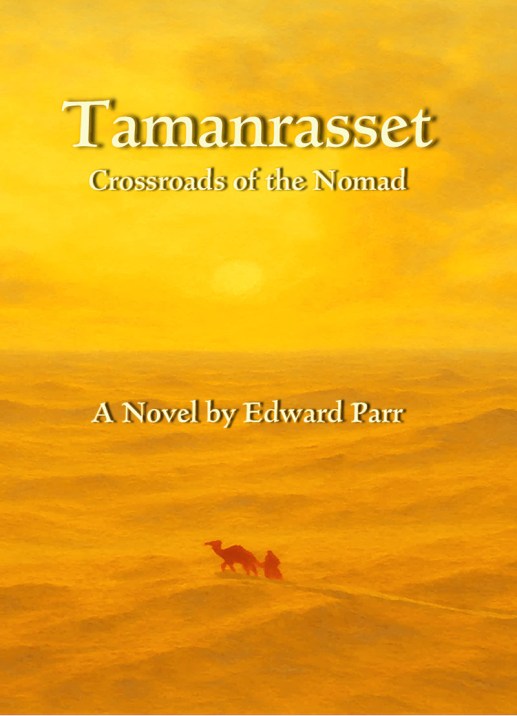
TAMANRASSET is historical fiction set on the edge of the Sahara as the ancient world begins to fade and great empires collide. Four strangers—a mature Foreign Legionnaire, a Sharif’s wrathful son, an ambitious American archaeologist, and an abandoned Swedish widow—become adrift and isolated, but when their paths intersect, the fragile connections between them tell a story of survival and fate on the edge of the abyss. Blending the sweep of classic adventure with the horror of a great historical calamities, Edward Parr’s TAMANRASSET is a saga about the crossroads where nomads meet.

Excerpt

Demoreau knelt beside Lieutenant Claussen. The Sergent had been in plenty of actions during more than twenty years of service in the Legion: The sun beating down, the barrel of his rifle smoking and hot from constant firing, the taste of sand and sulfur in his mouth as he and his comrades fought off their enraged enemy with nerves of steel and cooler heads. “Que voulez-vous? C’est la Legion!” A part of him relished it. He had a calmness of mind gained through years of experience and training. As he raised his rifle to aim at the advancing tribesmen, he recalled to his mind the melody of a fine composition, the death waltz by Saint-Saëns, which unrolled in his inner ear, turning his blood to ice. He hummed the tune as his rifle fired and his deadly accurate shooting dropped one rider after another.

Claussen was a good Lieutenant and had plenty of courage, but that did not mean he couldn’t benefit from Demoreau’s experience. The Sergent turned and faced his commander: “We’re being overwhelmed and losing too many men, Sir: We can’t maintain this position. We must move east onto the ridge where there’s cover among the rocks.”

“I know, but it may be too far, Sergent,” Claussen replied.

“Yes, it might,” the Sergent agreed, “but we still have to go: We’ll certainly all be killed if we stay here.”

Claussen looked distraught, but as he looked Demoreau in the eyes his nerve was hardened. Everything had to be done “par règlement” in the Foreign Legion. He nodded: “Yes, give the order, Sergeant. Withdraw to the ridge; smartly, now.”

Author Bio and Links

Edward (“Ted”) Parr studied playwriting at New York University in the 1980’s, worked with artists Robert Wilson, Anne Bogart, and the Bread and Puppet Theater, and staged his own plays Off-Off-Broadway, including Trask, Mythographia, Jason and Medea, Rising and an original translation of Oedipus Rex before pursuing a lengthy career in the law and public service. He published his Kingdoms Fall trilogy of World War One espionage adventure novels which were collectively awarded Best First Novel and Best Historical Fiction Novel by Literary Classics in 2016. He has always had a strong interest in expanding narrative forms, and in his novel writing, he explores older genres of fiction (like the pulp fiction French Foreign Legion adventures or early espionage fiction) as inspiration to examine historical periods of transformation. His main writing inspirations are Charles Dickens, George Eliot, Bernard Cornwell, Georges Surdez, and Patrick O’Brien.

Website | LinkedIn | Goodreads | Amazon Author Page |Facebook | Reddit | Instagram | Amazon Buy Link | Barnes & Noble Buy Link

Giveaway

One randomly chosen winner via Rafflecopter will win a $25 Amazon/Barnes & Noble gift card. Find out more here.

Follow the author on the rest of his Goddess Fish tour here.