I’m happy to welcome author donalee Moulton. Today, donalee shares her new release, Conflagration! and addresses interesting questions about justice in New France in 1734.
Here’s donalee!
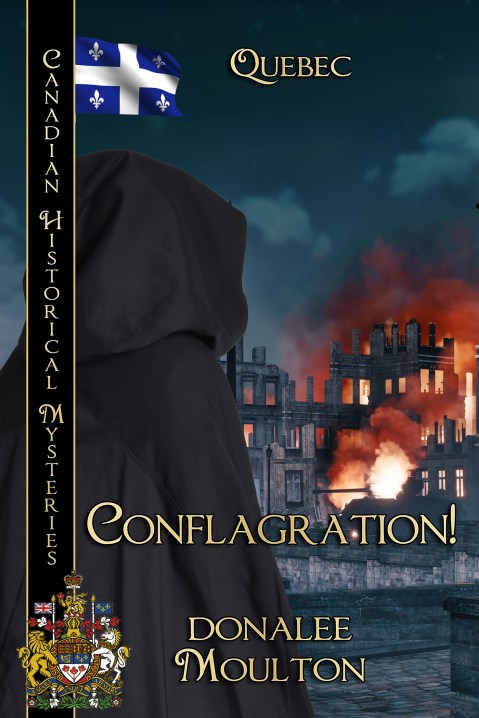
 My latest mystery book took me back in time and out of my comfort zone. Conflagration! is a historical mystery set in Montreal in 1734. It raises issues about slavery in Canada – and introduces us to a justice system that is distinctly different from 2024.
I posed 10 questions to the book’s main character Philippe Archambeau, a court clerk assigned specifically to document the case of Marie-Joseph Angélique almost three centuries ago. Here are his answers. (Hint: You can also find them in the book.)
Are lawyers a cornerstone of the justice system in New France?
Witnesses are a cornerstone of the French judicial system. We do this without lawyers. We do not allow lawyers to practice in New France. We are not English.
Is evidence critical to a conviction?
I turned to the Criminal Ordinance of 1670 and other legal documents for this question. It does not take me long to find what I am looking for. Rumor alone constitutes legal grounds for accusing, arresting, and convicting an individual.
Does the accused get to face their accusers?
Confrontation is part of the judicial process. It enables the accused to deny accusations directly. It gives witnesses the opportunity to rethink, perhaps to revise, their earlier testimony.
Is torture an acceptable punishment?
The Criminal Ordinance permits torture for serious crimes. There are reasons for this. Torture can help extract a confession. This is important to get to the truth of a matter. There is also the issue of accomplices. Torture can help to draw out names that would otherwise die on an accused’s lips.
What are brodequins?
The brodequins are very effective. Misleadingly and accurately called laced boots or tight boots, this particular form of torture involves packing a person’s legs between narrow boards tightly bound. Wooden wedges are then pounded between board and human flesh. Bone breaks. Boards do not.
Are individuals presumed innocent until proven guilty?
French law says all accused are presumed guilty. The accused must prove their innocence.
What is the punishment for a capital crime like arson?
The punishment: death, torture, or banishment. Or some combination of those. Being found guilty will mean an end to the life someone knows regardless of the punishment.
What is the Code Noir?
The Code Noir explicitly states how slaves are to be treated in New France. It discusses punishment and freedom of movement, or more accurately, lack of movement. The Code also requires all slaves convert to Catholicism. It is an owner’s responsibility to ensure this happens. Sooner rather than later.
Is there an appeal process?
Mais oui! The appeal judgment would be rendered by the Conseil Supérieur in Québec. It is the foremost judicial body in New France. Their decision will be final.
Does Montreal have its own prison? Is there a jailer?
There is a prison, of course. It is attached to the courthouse – and it is where the jailer lives.
Blurb
On a warm spring day in April 1734, a fire raged through the merchants’ quarter in Montréal. When the flames finally died, 46 buildings – including the Hôtel-Dieu convent and hospital – had been destroyed. Within hours, rumors ran rampant that Marie-Joseph Angélique, an enslaved Black woman fighting for her freedom, had started the fire with her white lover. Less than a day later, Angélique sat in prison, her lover nowhere to be found. Though she denied the charges, witnesses claimed Angélique was the arsonist even though no one saw her set the fire.
Philippe Archambeau, a court clerk assigned specifically to document her case, believes Angelique might just be telling the truth. Or not. A reticent servant, a boisterous jailer, and three fire-scorched shingles prove indispensable in his quest to uncover what really happened.
Angélique’s time is running out as Archambeau searches for answers. Will the determined court clerk discover what really happened the night Montreal burned to the ground before it’s too late?
Excerpt
Chapter 6
Accused
Wednesday, April 14, 1734
Today I will focus on the de Franchevilles. Madame will play a key role in the trial. She accused Angélique of arson shortly after the fire started and before the town crier made the accusation public. There is a reason for her assurance, and it will come out in her testimony although it is clear this belief about Angélique’s guilt and Madame’s animosity are rooted in the relationship between owner and slave.
I would like to know more about that relationship, and I will start by learning more about the slave owner. As always, there are many documents to help me in my quest.
Thérèse de Couagne was born on January 19, 1697, in Montréal. This is her home. She belongs here. I wonder if that makes the loss of her house now all the more heart wrenching. As I read, I discover Madame de Francheville has suffered more losses in her life than wood and stone.
The first great loss was likely her father, Charles de Couagne, who died in 1706. Thérèse de Couagne would only have been nine years old, a child. Admittedly, a child of wealth. Charles de Couagne had been one of the richest merchants in Montréal. His daughter would have grown up in the lap of luxury, and in 1718, when she was twenty-one, she married François Poulin de Francheville an ambitious young merchant. Her dowry was 2,500 livres.
They would be married for fifteen years. The ambitious young merchant Thérèse de Couagne wed was a very wealthy man in his own right when he died in 1733. I check the death records. No cause of death is given, but we have been ravaged by pox in New France. No one is immune.
I am sure her husband’s death devastated Madame de Francheville, but as I read through the records of her life I wonder if there wasn’t a greater devastation. The de Franchevilles had a child. The child died after only a few weeks. I sit and stare at the record of death. I know, in part, this numbness I feel is because I am about to become a father. Madeleine will shortly give birth. I continue to stare at the record of death.
The child’s name was Marie-Angélique.
Social Media/BuyLinks
Author Website | Facebook |Goodreads | LinkedIn | Twitter | Instagram |
Universal BuyLink
 Joanne Guidoccio
Joanne, this sounds like a fascinating book, and I love historical novels set in colonial times, north or south of the border!