I’m happy to feature author and humanitarian Jillian Haslam. Today, Jillian shares a thought-provoking post and her inspiring memoir, A Voice Out of Poverty.
Here’s Jillian!
 “Living with fear stops us taking risks, and if you don’t go out on the branch, you’re never going to get the best fruit.” ~Sarah Parish
It starts off as a small seed of uncertainty. Once it takes root, it begins to blossom and multiply slowly by slowly.
Over time, if left unchecked, it grows into this huge mental obstacle that gets in the way of your willingness to risk or even try, in turn casting seeds of doubt about your ability to achieve your dreams.
This is how fear holds us back and causes us to lead small lives.
Fear comes masked in different veils, but whatever the form, the common thread is that it holds us captive, crippling us into inaction.
Of course, there are other times when fear is a positive thing. This is when it serves to alert us of real danger.
In most instances, however, fear is not based on reality. Rather, it could be feeding off of negative assumptions of what we imagine could happen.
The fight and flight response works both ways, you see. Thankfully, we can learn to manipulate it to work in our favour, rather than against us.
Says Jimmy Iovine:
“Fear. Fear’s a powerful thing. I mean it’s got a lot of firepower. If you can figure out a way to wrestle that fear to push you from behind rather than to stand in front of you, that’s very powerful.”
Fear will always be there. But you have the ability within you to do something about it.
It is possible to train yourself to manage your emotions and shift your outlook into a more positive direction. And in doing so, you start to move beyond the fear and embrace new experiences and opportunities.
Confronting your Fears One Step at a Time
Fear has to be one of the strongest human emotions. Then again, being the one emotion that determines whether we live or die, it is not hard to understand why.
It has this ability to assume a life of its own to the point that it can magnify a certain area of concern and make it more menacing than it is in actual sense.
Take fear of change, for example, a fear we have to confront in almost every aspect of our lives.
Usually, trying to overcome it using broad strategies such as positive thinking or learning to embrace uncertainty can only get us so far. It helps, obviously, but such strategies in themselves are likely to fall short.
So then, where do you begin?
In just the same that you tackle your goals by breaking them into small, actionable steps, approaching fear this way is likely to yield better results.
Instead of throwing a blanket solution on your fears, attacking one specific fear at a time is likely to see you enjoy small but incremental successes that gather steam gradually, building your confidence.
Identify the Trigger
Our fears emanate from certain triggers which are activated by the fight or flight response that is inherent in all humans.
Whenever we sense or experience a situation our brain considers dangerous, the body enters into a state of fight-flight (to fend off the danger or run for our lives) until the brain receives an all-clear message to switch off the response.
We fear situations or things that make us feel unsafe or unsure, some real; others imagined.
One common fear most people have is a fear of public speaking.
Speaking in front of others – whether in class, at a meeting with colleagues or clients, giving a speech etc. – can make us feel literally sick in the stomach as we weigh our options on how to approach the whole thing.
For example, when you are called upon to speak in a business meeting, your mind could go blank once the fear of speaking in front of people kicks in.
This doesn’t mean you do not know the business – quite on the contrary actually! You might be the best in a certain area, but because fear turns you into such a nervous wreck, it becomes incredibly difficult to put your points across.
This is how fear gradually gets in the way of the success we could otherwise achieve if we managed to fight back this fear.
If you are reading this, there is a higher chance than not that you know at least a person or two whom, despite not being the brightest bunny in the hutch, has made their way up the corporate ladder or become successful in their business ventures just because they boast great public speaking skills.
These days, hard skills alone can only get you so far. Soft skills, chief among them public speaking skills, can give you an edge.
This is why it is imperative to work towards ridding yourself of this fear (and others that get in your way of success!) because all it does is curtail your efforts at becoming the person you know you could become.
Rewrite your Story
While fear could have genetic roots (innate), a large part of it (regardless of type of fear) can be attributed to a certain event or situation that happened to us earlier in life (learned).
Whichever the case, whether innate or learned, the first step to push through the fear is to identify and understand the underlying trigger(s) behind it.
Pay attention to what you are feeling and try to identify the root source of these feelings of dread.
Once you do, acknowledge it for what it is without sugar-coating. Then gradually, start shifting your mind-set with regard to how you view this fear.
You will need to summon a treasure trove of emotional and psychological resources as you make attempts to overcome your fears. A large part of this will involve positive thinking and confidence as you need to start viewing the fear in a different perspective.
That’s especially considering fear will always be there. In fact, you will never manage to wrestle it completely to the ground.
But by changing your perspective from that sickening feeling in your stomach to an attitude along the lines of “I-am-ready-to-do-this!”, you will, as Jimmy Iovine said, allow that fear to push you from behind rather than getting in your way.
This is key.
Remember, it is not fear that holds you back. It is your attitude towards fear.
Napoleon Hill summed it up perfectly when he said:
“Fears are nothing more than a state of mind.”
No one says it will be easy. But if you take action and slowly build momentum, you will get there eventually.
Blurb
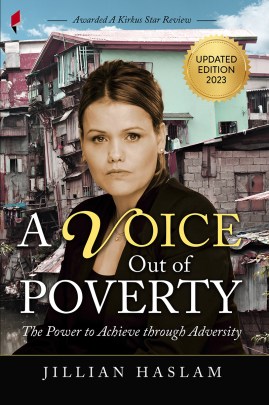 A woman’s ascent from devastating poverty and childhood trauma to international standing as a prominent advocate for the poor and helpless.
As a young girl, Jillian Haslam saved a life. Herself tiny and aching from malnutrition, she stood for hours at a tea shop, begging for a ladle of milk to try and prevent her newborn sister from dying of starvation.
From the slums of Calcutta to the executive floors of a global bank, A Voice out of Poverty offers an unflinching look at one woman’s journey from destitution to success.
Throughout, Haslam demonstrates an inexhaustible drive to rise above adversity and find beacons of positivity in impossible circumstances. But her rise doesn’t stop at the top; she returns to her roots again and again to extend a hand to those left in the impoverished communities that she so narrowly escaped.
British by ancestry and born in India after its independence, Haslam and her family suffered degradation and prejudice. They were forced to live on the streets, flee danger in the middle of the night, and face persistent abuse and starvation.
This treacherous environment is the backdrop of an unlikely story of resilience and an unshakable family bond. From squalor and powerlessness, Haslam finds countless moments of grace, community, gratitude, and love.
A Voice out of Poverty is a raw and inspiring memoir that shows how beauty can be found in improbable places, and how “success” is not just the act of making it through. Rather, it is the act of reaching back to bring others with you.
Excerpt
A bristly, grey rat jutted its head through a wide crack in the peeling stucco wall, its long tail draped behind and hidden. It squinted its beady eyes and sniffed the air, as a light drizzle started to dampen the ground.
A few feet away, an older homeless woman, sitting under a precarious building canopy, shifted her eyes towards the rat, without moving her head. A stray dog nestled next to her, one of three gathered snuggly around her, bared its teeth, and growled at the rodent, without rising.
The woman swiveled her head in the rat’s direction and shooed it away with a claw-like hand slicing the air. The rat withdrew, vanishing inside the wall. The dog returned its head to rest on its paws and closed its eyes.
The drizzle turned into a light rain.
My mother and I took in the rat scene side by side as we ambled down the street. My eyes remained riveted on the homeless woman. I wondered if she had a family or young children like me. Then, the noisy “pop-pop” of a Vespa flew near my eyes and broke my concentration, causing me to pull my head back abruptly. I gripped my mother’s hand as tightly as I could.
The rain was now steady but not enough to flood the crowded streets or inhibit the pace of the fast-moving foot and vehicle traffic. I looked up to see an old man pulling a rickshaw coming towards us. I stared at him. His emaciated body looked as if his skin could peel off in thin layers, like a stale onion. He stared at me, sharing his single black tooth. I held my stare.
The rickshaw puller veered off the line of his path, forcing a dilapidated scooter that packed an entire family to swerve near us. The scooter splashed mud onto my legs and dress, and I started to cry. My only proper dress was drenched with filth. I now would have to undress to underclothes while it got washed. My mother stopped and crouched in front of me. I didn’t hide my disgust.
Author Bio and Links
Jillian Haslam was born in 1970 and raised primarily in the slums of Calcutta. Despite the severe devastation of her family’s living circumstances, she completed her education and landed her first major employment as a personal assistant to the CEO at Bank of America in India.
Jillian rose through the ranks, and Bank of America appointed her president of its Charity and Diversity Network in India, where she spearheaded charitable work in four different cities. This led her to receive three philanthropic awards from Bank of America: the Star Recognition award, the Service Excellence award, and The Individual Achievement award.
In 2011, she published the first version of her memoir, Indian. English, which chronicles her life growing up amid dreadful poverty, abuse, and tragedy. The book sold over 150,000 copies, mostly while she was on the speaking circuit. Her story also incited interest from Hollywood and British film directors and producers, leading to the development of a feature film.
Charitable giving became Jillian’s life work. In 2012, she received the first runner up award for The Asian Woman of the Year in the “Social and Humanitarian” category. In early 2015, The Telegraph of Calcutta presented Jillian with the True Legend award for her exceptional contribution to social and humanitarian causes. In mid-2015, she was recognized as a finalist for the Role Model of the Year award for her work delivering speeches in educational institutes across the UK. In late 2016, she received an award for Excellence in Humanitarianism. And, in 2017, she received her greatest accolade, the Mother Teresa Memorial International Award.
Jillian became a speaker in demand and is a Distinguished Toastmaster (DTM). She has delivered several TEDx talks, among other prestigious speaking engagements, on various topics that flow from her life story. Jillian speaks on topics that include entrepreneurialism, the power of the mind, and human resilience.
She has also been featured on various TV networks, including Channel 5 and the BBC, and a wide range of print media, including The Independent, The Pioneer, The Times, The Telegraph, The Metro, Gulf News, and other major media outlets. Jillian’s charitable work continues under the auspices of the Remedia Trust where she oversees several separate charities: Ageing Smiles (for the elderly poor), Happy Hearts (for children), Empowering Girls (for teaching various workable skills), India’s Disabled (for building a mobile medical unit), E3 Growth (focused on education, employment, and employability), and the Mother Teresa Project (for women and single mothers).
Jillian currently lives in London with her husband.
Website | Goodreads | Facebook (Jillian) | Facebook (Film) | Twitter | Instagram | Amazon Buy Link
Giveaway
One randomly chosen winner via Rafflecopter will win a $25 Amazon/Barnes & Noble gift card. Find out more here.
Follow Jillian Haslam on the rest of her Goddess Fish tour here.

 Joanne Guidoccio
This sounds like a great book. Thanks for sharing
Great excerpt and giveaway. 🙂
interesting
Thank you for hosting today!
I am more than grateful to you not just for putting out this blog but also for choosing such an important chapter in the book (ow to deal with fear)!! To be honest, there have been times when I have been ever so close to giving up only because I didn’t think is was possible to fight my fears after being locked in a toilet infested with huge cockroaches at a very young age and then to go on to qualify as a professional motivational speaker took nerves of steel, buckets of tears and resilience of a very different kind but the conclusion I came to is that “it’s not what happens to you, it’s what you do about it”!! I know that this piece is going to help so many people. Thank you again. Jillian
Honored to feature your inspiring story. Best of luck with sales. 🙂