The Power of Training

On Wednesdays, I share posts, fables, songs, poems, quotations, TEDx Talks, cartoons, and books that have inspired and motivated me on my writing journey. I hope these posts will give writers, artists, and other creatives a mid-week boost.

I enjoy receiving weekly doses of inspiration and motivation from a British writer and blogger named Lucy Mitchell. She has a delightful blogging voice that brings a smile and a thought-provoking pause to my day. Here’s an excerpt from a recent blog post:

For years, my social media feed has been a stream of writing advice, trending writer quotes and hacks on how to write more words. I have followed countless authors and writing coaches. I have spent hours celebrating their book successes, admiring their book covers, and appreciating their writing practices.

One day over the summer, I found myself spending more time scrolling through their feeds looking for motivation to write, but I wasn’t actually writing.

So, I made an odd decision. I started following professional athletes and filling up my social media feeds with their training vlogs. I still followed the authors, but I shifted my focus.

In my youth, I was a long-distance runner, so watching athletes train for the 800m and 1500m events felt like reconnecting with that younger version of myself. I started following GB athletes like Keely Hodgkinson, Georgia Hunter-Bell, Laura Muir and Jemma Reekie. I also followed American sprinters such as Melissa Jefferson-Wooden and Sydney McLaughlin-Levrone.

I began watching their training vlogs on YouTube and their Insta reels, where they discuss discipline and the mental battles they face. I admired their physical dedication, the way they tracked progress, and their calm acceptance of failure as part of the growth process. I admired them for showing up to train in the pouring rain, the suffocating heat, and the times when they faced personal issues off the track. They persevered through the training despite the challenges.

Soon, something shifted inside me.

Athletes made me view discipline in a new light. Watching athletes train reframed discipline for me. They don’t just “feel like” going to training, they go because that’s who they are. Their discipline isn’t glamorous; it’s about repetition, consistency, and patience, in all weathers. Writing is not glamorous. I write books, and they often feel like marathons. My books require me to show up regularly, not when I feel like it.

Progress became about progress, not about perfection. Athletes celebrate small milestones, such as shaving off a second or two, achieving a better sprint, overcoming the little things in the finish, and improving their running style. I started celebrating the little wins with my writing. It became less about the outcome and more about the process.

The Power of Training. I have started viewing my writing sessions as my own form of training with adequate periods of rest afterwards. Instead of searching for motivation, I have begun building discipline. Instead of waiting for creativity to strike, I have trained for it.

Writing is a sport of endurance and a test of patience and mental toughness. It’s about showing up every day and trusting that repetition makes us stronger.

You can follow Lucy here.

The Secret Ingredient to Finding Your Writing Voice

(Hint: It’s Not What You Think)

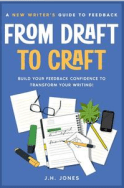
I’m happy to welcome author J.H. Jones. Today, she shares her experiences with writing groups and her recent release, From Draft to Craft.

Here’s J.H. Jones!

I’ve belonged to several writing groups over the years. With each group, I’ve been privileged to learn something important about the craft of writing or the business of being an author. But in 2024, the feedback process with my writing buddies dramatically shifted my work.

Let me be clear: there was no miraculous moment where violins played in the background and my fingers suddenly wrote perfect sentences and my brain came up with flawless plots. What happened was I developed my writing voice.

My writing voice reflects my unique personality, experiences, word choices and purpose. A writing voice isn’t something you learn from a book or in a webinar. Instead, it’s about gaining an understanding of your authentic self, coming to acceptance, and exposing it with intention on the page.

Before joining writing groups and online communities, I wrote sporadically in isolation, second-guessing every word, making assumptions about what people wanted to read, and trying to fit into certain story categories that I didn’t even like.

But something magical happened when I started sharing my work and reading the manuscripts of fellow writers. I realized what made a story interesting to me, and I learned what writing skills I was good at.

Through my writing buddies’ eyes, I saw patterns in my writing I’d never noticed before—the rhythms that felt natural to me, the subjects that made my stories come alive, the characters who tugged at my heart, the moments where my authentic self glowed. And just as importantly, I learned from their work. Even though my buddies’ styles differed from mine, each manuscript I read opened a new door, leading me to different approaches, varied techniques, and countless possibilities I’d never considered.

Thanks to my writing group, I started reading more widely instead of focusing on what I thought I should read. I also experimented with my writing. I tried new genres and formats, and tested various points of view. Some attempts fell flat, but others touched my writing buddies.

And to my delight, my jottings sparked something genuine inside myself, something that felt like me. With each experiment, I moved closer to discovering what I really wanted to say and how I wanted to say it—in other words, my writing voice.

Today, my writing voice is still a work in progress. Yet, my confidence is growing with every story I get down on paper. And I’ve learned an important lesson: the more I write, the clearer my voice becomes. It’s like tuning an instrument—each writing session brings me closer to the right pitch, the right tone, the authentic sound that is uniquely mine.

My writing buddies have been essential to me on this journey. They see potential in my work that I can’t always see myself, and they remind me to keep going when doubt creeps in.

If you’re searching for your writing voice, my advice is this: find your group or community and exchange your works-in-progress, write as often as you can, and be patient with yourself. Your voice is already there, waiting to be discovered. It just takes practice, some writing-buddy support, and your personal courage to keep showing up to the page.

J.H. Jones Bio

J.H. Jones (she/her) is the author of The Write Group, which helps writers tap into the power of writing groups, and From Draft to Craft: A New Writer’s Guide to Feedback which helps writers with the feedback process. For creative fiction, she experiments with dark gothic-vibe stories and paranormal romance, while she works on her debut gothic horrormance set in New York State in the 1850s. Visit her at www.jhjones-author.com and connect with her on Bluesky, Facebook and Instagram.

You can purchase her latest nonfiction ebook, From Draft to Craft, here:


Accepting Rejection

On Wednesdays, I share posts, fables, songs, poems, quotations, TEDx Talks, cartoons, and books that have inspired and motivated me on my writing journey. I hope these posts will give writers, artists, and other creatives a mid-week boost.

In a recent post on the Writer Unboxed blog, award-winning author Greer Macallister shared advice on accepting rejection. Here’s an excerpt from that post:

If you don’t learn to accept rejection gracefully early in your writing career, you’ll end up fighting a lot of unnecessary battles later. Which is bad for you on many different fronts.

Because while there are some battles worth fighting in publishing–fight for the right editor, for marketing, for the right cover and title–there are a lot more that you can only win by not fighting at all.

Editor doesn’t want your book? Accept it. A major bookstore isn’t stocking it? Accept it. Your friend’s book seems to be getting all the book clubs and TV options and buzzy-buzzy Most Anticipated coverage? Accept it, and wish them well. Bad Goodreads reviews? Accept them and move on (or don’t read them at all.)

Does this bent toward acceptance fly in the face of the wisdom that persistence is the writer’s most important trait? I’ve thought about it, and I don’t think so.

Persistence, after all, is not just pushing forward. It involves flexibility. Adaptation. Persistence doesn’t mean you send your first manuscript to 100 agents, and then another 100, then another 100. It means you query widely to agents you’ve researched, take a look at the responses, and decide how to move forward from there. Maybe you edit that first manuscript, or maybe you write a different one. Folded into that process is acceptance. You explore, you try, you fail, you accept, you adapt, you try again, and if everything comes together just right, you succeed.

You can read the rest of the post here.


I Couldn’t Do It Alone

When I retired in June 2008, I launched my second act as a writer. I started with articles and book reviews, slowly finding my footing as my work appeared in newspapers, magazines, and online publications.

Buoyed by this early success, I began to dream bigger. Why not a novel? My original plan was to write and edit the novel, find an agent or publisher, and surprise everyone with a grand reveal at my launch party.

That was the dream.

The reality was very different.

I quickly discovered that writing and publishing a novel was very different from writing articles and book reviews. The scale was larger, the doubts louder. I couldn’t do it alone. I needed help, guidance, and boatloads of encouragement.

Continue reading on J.H. Jones blog.


All About Moodling

When I first heard the word “moodling” at a writing workshop, my thoughts turned to zucchini noodles. A bit off base, but considering it was close to lunchtime, I assumed there might be a culinary connection.

The facilitator quickly put an end to that line of thinking. A long-winded explanation followed with brief mentions of famous moodlers: Isaac Newton, Napoleon Bonaparte, and Albert Einstein. My appetite shifted from food to curiosity.

Intrigued, I decided to do my own research. Here’s what I discovered:

Moodling is primarily a solitary pursuit, one that defies formal instruction. You won’t find any university or college courses devoted to moodling. Nor will you find it in the Pocket Oxford English Dictionary (2013 edition) on my desk.

Continue reading on Lynn Slaughter’s blog


10 Lessons Learned from a Published Author

On Wednesdays, I share posts, fables, songs, poems, quotations, TEDx Talks, cartoons, and books that have inspired and motivated me on my writing journey. I hope these posts will give writers, artists, and other creatives a mid-week boost.

I enjoy receiving a weekly dose of inspiration from a British writer and blogger named Lucy Mitchell. She has a delightful blogging voice that brings a smile and a thought-provoking pause to my day. Here’s an excerpt from a recent blog post:

My first book was published in 2023 with Bloodhound books.

Here I am today, with five published books behind me, and I am ready to share the lessons I have learnt.

1. Every book teaches you something different. It could be plot, character, setting or something about yourself. Book ideas don’t always come to you because they are meant to be turned into books. Most ideas come to teach you something.

2. Every book will break you in some way. It’s true. They will either break you emotionally or mentally. At some point you will want to lie down by your desk, curl up in a ball and weep. Every book of mine has done this to me. Some break me at first draft stage, some second draft however most break me when I have to make harsh changes like deleting characters, large chunks of my plot and my book no longer feels like the one I first wrote.

3. Editors are wonderful people. They are the unsung heroes of the book world,

4. A book is never finished. I still think about my 5 books and what I would do to improve them.

5. Promoting books never gets easier. To be an author you have to find new ways of promoting your book and you will have to be okay when your carefully crafted social media posts don’t perform.

6. Reading is your rocket fuel. If you can’t write – read!

7. Writer’s block is more likely to be due to tiredness, exhaustion, stress, burnout. Always try resting or taking a break first before you try and alleviate your writer’s block.

8. Honest beta readers are invaluable. If you can find honest beta readers you are onto something good.

9. Rejection never goes away. This is true. Rejection still happens even when you are an established author.

10. Conflict. It’s all about the conflict. This is the secret sauce for any book. If you want to write a good book – add a good spoonful of conflict,

And I still feel like a beginner when it comes to writing a book.

You can follow Lucy here.

How to Take Criticism

On Wednesdays, I share posts, fables, songs, poems, quotations, TEDx Talks, cartoons, and books that have inspired and motivated me on my writing journey. I hope these posts will give writers, artists, and other creatives a mid-week boost.

In a recent post on the Writer Unboxed blog, author Jeanne Kisacky shared advice on accepting and processing criticism. Here’s an excerpt from that post:

When you receive the critique, don’t just dive in as soon as you get it. Set aside a quiet chunk of time, sufficient to get through all the critique in one session (if possible), and then just read the comments. You will feel emotions while you read the reviewer’s responses; some positive, but many possible negative ones as well. I have been angry, delighted, depressed, affronted, despondent, entertained, even incensed after reading criticism. It’s normal. Criticism is hard to take. Tackling edits while in the thrall of that emotional response is a great way to get off track and subvert the tone of the writing.

Once you’re done reading the comments, set them aside and do something, anything, other than re-reading your draft or trying to start revising. Go for a walk. Do the dishes. Do some gardening. Do whatever activity lets your mind wander. Do this for a day or two, or for as long as it takes for your brain to process the criticism. Let the criticism sink in, let it percolate. This breathing space lets you weigh what you wanted the book to be against what you just found out wasn’t working. It also gives you the chance to refine your own understanding of your work, so that you don’t lose the heart and soul of it while revising based on someone else’s comments. In my experience, if you jump right into revisions, chances are you are going to go some wrong directions, because you need the time to internalize their comments and figure out how to fix the stated problem your way, not their way.

You can read the rest of the blog post here.

Achieving the “Impossible”

On Wednesdays, I share posts, fables, songs, poems, quotations, TEDx Talks, cartoons, and books that have inspired and motivated me on my writing journey. I hope these posts will give writers, artists, and other creatives a mid-week boost.

A long-time fan of bestselling authors and coaches Marc and Angel Chernoff, I look forward to reading their emails and blog posts. Here’s an excerpt from a recent post:

When I was a high school freshman, a 260-pound freshman girl showed up for track and field tryouts right alongside me. Her name was Sara, and she was only there because her doctor said her health depended on it. But once she scanned the crowd of students who were on the field, she turned around and began walking away. Coach O’Leary saw her, jogged over, and turned her back around.

“I’m not thin enough for this sport!” Sara declared. “And I’ll never be! It’s impossible for me to lose enough weight. I’ve tried.”

Coach O’Leary nodded and promised Sara that her body type wasn’t suited for her current weight. “It’s suited for 220 pounds,” he said.

Sara looked confused. “Most people tell me I need to lose 130 pounds,” she replied. “But you think I only need to lose 40?”

Coach O’Leary nodded again.

Sara started off as a shot-put competitor, but spent every single afternoon running and training with the rest of the track team. She was very competitive, and by the end of our freshman year she was down to 219 pounds. She also won 2nd place in the countywide shot-put tournament that year. Three years later, during our senior year, she won 3rd place in the 10K county run. Her competitive weight at the time was 132 pounds.

There was a time when Sara was convinced that it was impossible to lose weight because, in her past experience, it had never worked out the way she had hoped. She had failed a few times and eventually lost faith in herself. But with consistency — with the right daily habits and willingness to try again — she restored her faith and achieved the “impossible.” And when Sara showed up to my poolside birthday party in Miami recently, I smiled when I overheard another guest compliment her on her bathing suit and physique.

Of course, Sara still works really hard — she chooses wisely — every single day to maintain what she has achieved.

And, so do I…

Note: I highly recommend subscribing to Marc & Angel’s website.

Dealing with Setbacks

On Wednesdays, I share posts, fables, songs, poems, quotations, TEDx Talks, cartoons, and books that have inspired and motivated me on my writing journey. I hope these posts will give writers, artists, and other creatives a mid-week boost.

In a recent Writer Unboxed blog post, author Harper Ross shared the following advice on how to weather the emotional ups and downs of the writing life:

There’s a Japanese art called kintsugi where broken pottery is repaired using gold. The cracks aren’t hidden. They’re highlighted, honored, and made beautiful. That’s a lovely way to think of the writing life. It’s not about being unbreakable. It’s about letting your setbacks become part of the story… and then getting back to work with a little more sparkle in your seams.

Here’s what that looks like for me.

Rejection

It’s inevitable that, at some point in your career, you’ll face less-than-glowing beta or critique feedback, unanswered queries, and page requests that result in polite rejections. Each one lands differently, but every rejection stings.

My process for overcoming defeat? I grieve. For an hour, a day, or even a week, depending on the weight of the blow. Then I remind myself: this is one person’s opinion, not a universal verdict. With distance, rejection becomes what it really is—data. Sometimes useful, sometimes not. Always temporary.

I also try to reframe things by empathizing with agents and editors: of all the books I’ve read, how many would I bet my career on? Maybe forty. And yet, I’ve loved hundreds more. That’s how subjective this business is. Somewhere out there, your future reader is waiting for exactly the story only you can tell.

So, I dust off my ego and write anyway. Because my voice matters—even when some people don’t hear it yet.

Jealousy

Nothing quite matches the ache of seeing someone else get what you want. The deal. The review. The spotlight. I’ve felt it. I’m not proud—but I’m not ashamed, either.

Jealousy is just information. It reveals what you hunger for. If you can resist letting it fester into bitterness, you can use it to clarify your goals and fuel your next step. Envy, repurposed, becomes motivation.

Waiting

Nobody tells you how much of this “author’s life” is just…waiting. For responses. For edits. For launch dates. For signs from the universe.

Coming up in this industry during the age of instant everything, I find myself acting like a flustered teen when confronted by even a mild delay in getting a response. To combat my impatience, I’ve started to rebrand those lulls as bonus hours. That simple mental shift motivates me to walk the dog, call a friend, bake cookies, or binge-watch something ridiculous and delightful. Not only do those activities make the waiting bearable—they also refill the creative well. That last part is critical for the hard work of writing the next chapter or next idea.

Creative Drain

Creativity isn’t a faucet you turn on and off on a whim. It’s a fragile ecosystem—and publishing can be a storm. To protect it, you need boundaries.

If a negative review sends you into a days-long negative spiral, avoid checking your book’s Goodreads page. If each political volley reported in your Bluesky feed sends you hiding beneath the covers, limit exposure to social media with apps like Freedom. Stuck in a story rut? Write nonsense scenes just for fun. The best antidote to burnout isn’t a new productivity hack—it’s joy.

Community

I’ve written before about the power of community, but it bears repeating: I wouldn’t still be here without my writing friends. The ones who cheer the wins, sit with the losses, and read the messy drafts without judgment.

Find your people. Writing may be solitary, but survival is not.

If you’re in that murky middle—rejected, exhausted, or just plain stuck—you’re not failing. You’re feeling. You’re human. And you’re still here. Hopefully, some of these tips will keep you going!

Source: Writing Unboxed

Embrace Your Other Passions

On Wednesdays, I share posts, fables, songs, poems, quotations, TEDx Talks, cartoons, and books that have inspired and motivated me on my writing journey. I hope these posts will give writers, artists, and other creatives a mid-week boost.

In a recent post on the Writer Unboxed blog, award-winning author Julie Carrick Dalton shared several examples of creative cross-pollination. Here’s an excerpt from that post:

I’ve always admired writers who abide by the butt-in-chair ethos. You know who I’m talking about, the writers who get up every day at 5 am, or who dedicate themselves to a regular writing practice that sustains them.

But this article is for the rest of us, all of us other writers who can’t always adhere to a regular writing discipline, because we crave creativity in other places – in the kitchen, art studio, dance floor, or garden.

Consider this your creative hall pass: step away from the laptop, embrace your other passions, and know that every pursuit—whether it’s painting, dancing, or growing herbs—can supercharge your writing and nourish your spirit.

I spend a lot of time in my garden where I grow dozens of herbs, flowers, and fruits that I harvest, dehydrate, and blend into teas. Some of my best writing ideas arrive when I’m elbow-deep in chamomile, or when I’m blending up the perfect balance of mint, lemon balm, lemon verbena, and bee balm to settle a loved one’s upset stomach.

I often indulge my tea-blending hobby when I’m having a tough time writing. I used to think of it as a distraction, a form of procrastination—but I’ve decided to reframe it as creative cross-pollination. Sometimes, the boldest move for our writing is a strategic retreat—leaning into a new kind of making, so ideas can sprout in unexpected places.

Read the rest of the post here.