I’m happy to welcome award-winning linguist and author Vyvyan Evans. Today, Vyvyan shares his creative journey and new release, The Dark Court.
Interview
What was your inspiration for this book?
The Dark Court is book #2 in the Songs of the Sage book series. The books imagine a future in which we stream language directly to neural implants in our heads.
Today, we stream anything from movies, to books, to music, to our ‘smart’ devices, and consume that content. Smart devices use streaming signals—data encoded in IP data packets—encoded and distributed via wi-fi internet. Language streaming would work, in principle, in the same way. With a ‘language chip’ implanted in our brains, we will be able to ‘stream’ language from internet-in-space on demand, 24/7.
Moreover, based on an individual’s level of subscription to a language streaming provider, they would be able to stream any language they chose, with any level of lexical complexity. This means that someone could, potentially, apply for a job in any country in the world, without needing to be concerned about knowing the local language. Rather, the individual would just draw upon the words and grammar they need, to function in the language, by syncing to a language database, stored on a server in space. And call it up, over the internet, in real time, as they think and talk. It means that everything someone needs to know, to be able to use a language, is streamed over the internet, rather than being stored in someone’s head. Language learning, thus, becomes obsolete.
I have a research background in linguistics and cognitive science, with a PhD in linguistics, and having worked for many years as a professor of linguistics. Over the years it increasingly struck me, what if language were no longer learned but streamed. The rise of intelligent AI and ChatGPT makes there seem more plausible. And the technology is currently being developed, to make neural implants for humans possible, to create a so-called “transhuman”.
I wrote The Dark Court because, in the near future, such developments may even put language under threat. Hence, the inspiration for the book was that it should serve as a warning: when we lose language we all lose.
What is the best part of being an author? The worst?
The best part of being an author is the writing. And that’s also the worst part. But the hardest part is the marketing that follows the writing.
Which authors have inspired you?
Given I am a trained linguist, there are two books, by two quite different authors that have inspired me. Both these books ingeniously explored the impact of language on how we think and experience (illustrated through the conceit of a protagonist learning an entirely new, and alien, language).
The first, Babel-17 is by Samuel R. Delany. It was first published in 1966 and was joint winner of the Nebula Award for best novel in 1967.
The eponymous Babel-17 is a language that alters the perceptions and worldview of any who speak it. This is a conceit that draws upon the principle of linguistic relativity.
Linguistic Relativity holds that divergence in the grammatical organization and lexical structure of the language we speak alters the habitual perception of the world around us, even dramatically changing how we think. As an example, we now know that the brains of Greek speakers perceive certain colours differently from speakers of English because of how Greek labels for colour divide up the colour spectrum. This is an unconscious consequence of speaking Greek versus English.
In the novel, Babel-17 is the language spoken by Invaders, as they wage an interstellar war against the Alliance. The novel’s protagonist, Rydra Wong, is a linguist and cryptographer who possesses a rare ability to learn languages. She is recruited by the Alliance to try and decode the language of the invaders, Babel-17, to uncover clues for attack vectors.
Babel-17 is an exemplar of a very high-concept conceit. When Delany was writing the novel, linguistic relativity was still only a hypothesis, first dubbed the Spair-Whorf hypothesis in 1954.
Delany asks a classic ‘what if’ question: What if the language we speak fundamentally changes the way we see the world, the way we feel, our belief systems, the way we act? Babel-17 then explores the logical, and extreme consequences of this proposition.
In the novel, as Rydra Wong learns the strange, alien tongue, she starts to see the world, and think as the invaders do. And the consequence is that she starts to become one of them. She ultimately betrays her own command and her government, acting as an agent of the Invaders.
And in this way, Delany shows that in the context of warfare, when the notion of linguistic relativity is taken to its logical extreme, language can serve as the most powerful weapon of all.
The second is the novella, Story of Your Life, written by Ted Chiang and first published in 1998. This story was subsequently adapted as the major motion picture Arrival.
Again, this story features a linguist as its main protagonist, Dr. Louise Banks. The story involves Banks narrating the events that led to the arrival of her new-born daughter. In so doing, she explains how her work, translating the language of the alien Heptapod species, led her to understanding time in a new way, where she could perceive her past and future simultaneously.
The consequence is that as learning a new (alien) language transforms thought, the novella explores issues relating to linguistic relativity, determinism and freewill.
Any advice for aspiring writers?
Hone your craft, be consistent in setting writing goals, never give-up, rejection is part of the process. And finally, no one ever wrote a masterpiece in one go. It takes time, sometimes years, to get a manuscript right—be kind to yourself during this process. Everything is a learning opportunity.
What are you working on next?
The Dark Court is the second instalment in the Songs of the Sage book series. There are six projected books in the series which, in increasing turns, examine the role and nature of language, and communication. The thematic premise is that, in the wrong hands, language can serve as a weapon of mass destruction. This overarching motif is explored, across the six books, both from Earth-bound and galaxies-wide bases.
As language involves symbol use and processing, the book series, perhaps naturally, also dwells on other aspects of human imagination and symbolic behaviour, including religious experience and belief systems, themselves made possible by language.
The Dark Court, is set five years after the events of the great language outage depicted in the first book, The Babel Apocalypse. It explores how the language chips in people’s heads can themselves be hacked, leading to a global insomnia pandemic.
Blurb
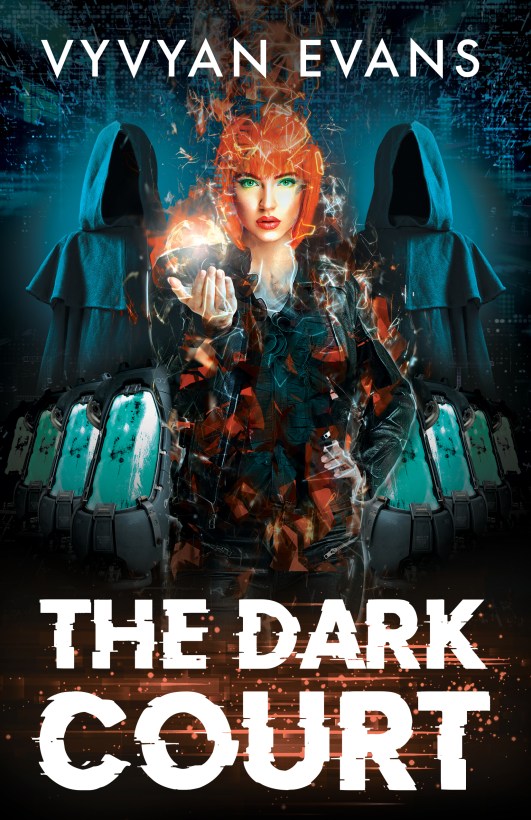
A genre-blending dystopian, sci-fi mystery-thriller that will make you think about communication in a whole new way.
Five years after the Great Language Outage, lang-laws have been repealed, but world affairs have only gotten worse. The new automation agenda has resulted in a social caste system based on IQ. Manual employment is a thing of the past, and the lowest soc-ed class, the Unskills, are forced into permanent unemployment.
In a world on the brink of civil war, a deadly insomnia pandemic threatens to kill billions. Lilith King, Interpol’s most celebrated detective, is assigned to the case.
Together with a sleep specialist, Dr. Kace Westwood, Lilith must figure out who or what is behind this new threat. Could the pandemic be the result of the upskilling vagus chips being offered to the lowest soc-ed class? Or are language chips being hacked? And what of the viral conspiracy theories by the mysterious Dark Court, sweeping the globe? Lilith must work every possible angle, and quickly: she is running out of time!
While attempting to stop a vast conspiracy on an intergalactic scale, Lilith also faces shocking revelations about her origin, coming to terms with her own destiny.
Excerpt
Her father then turned back to Lilith, gazing at her with the kindness she loved. “I have to go away.” He gulped. “You must be very brave, Lily. Because what I’m doing is for you. You’re very special. I believe you will change everything. Not just here, but everywhere.” With that he reached into his jacket and pulled out a small bracelet from inside his breast pocket. He handed it to Lilith.
“Another gift?” she asked, with cautious excitement. Lilith turned it over in her hand. It was silver, with a small, strange-looking screen on the outer side. The screen was narrow and black, and numbers were spinning in iridescent green, fleetingly across the screen.
“I guess it is. This is a SwissSecure bracelet. It will live with you, expanding as you grow.”
“Is it alive?” Lilith asked.
Her father chuckled. “In a way, I suppose it is. When you’re older, after you’re chipped, the numbers will stop spinning. And then you’ll receive a message from me—two, in fact.”
“Memoclips?” Lilith asked, confused. She knew that was what the chipped adults called them.
Her father dipped his head. “Actually, faceclips. They will explain things … when the time is right. For one thing, where the music comes from, the Nunciature Evangelion—the Tower of Songs.”
“Music?”
“It will come to you, later today. This music will help you become your potential, but it will also be your one Achilles heel …”
Author Bio and Links

Dr. Vyvyan Evans is a native of Chester, England. He holds a PhD in linguistics from Georgetown University, Washington, D.C., and is a Professor of Linguistics. He has published numerous acclaimed popular science and technical books on language and linguistics. His popular science essays and articles have appeared in numerous venues including ‘The Guardian’, ‘Psychology Today’, ‘New York Post’, ‘New Scientist’, ‘Newsweek’ and ‘The New Republic’. His award-winning writing focuses, in one way or another, on the nature of language and mind, the impact of technology on language, and the future of communication. His science fiction work explores the status of language and digital communication technology as potential weapons of mass destruction.
Book Website | Author Website | Youtube Channel | Twitter | Facebook | Instagram
Giveaway
The author will award a randomly drawn winner paperback copies of both book 1 and book 2 on the series – a Rafflecopter giveaway. Find out more here.
Follow the author on the rest of his Goddess Fish tour here.
 Joanne Guidoccio
This sounds like an amazing read!
We appreciate you hosting today.