
Monthly Archives: September 2012
Meeting Your Rhinoceros
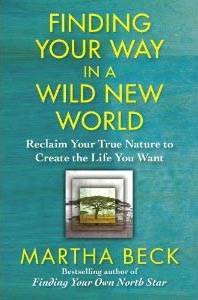 Each month, I look forward to reading Martha Beck’s column in Oprah Magazine. The Harvard-educated psychologist uses her extraordinary storytelling ability to help her readers create more satisfying and meaningful life experiences.
In Finding Your Way in a Wild New World, Beck urges us to embrace our wildness and carve out different lives for ourselves as she addresses two basic questions: “How the hell did I get here?” and “What the hell should I do now?”
Having read her previous bestsellers—Finding Your Own North Star, Steering by Starlight, Expecting Adam—I knew enough not to expect another pop cultural self-help book. And I wasn’t disappointed. This book has all the ingredients necessary to create positive change in your life, whether you are new to the spiritual path or a seasoned traveler.
Beck walks the walk and she crosses an ocean to do so. The book is based on her experiences in Londolozi, a game preserve in South Africa. Throughout the book, she talks about her encounters with the animals and the lessons she learned along the way.
Her excellent command of the language is evident in the following descriptions: “The rhino, half hidden behind a thorn bush, cocks her primordial-looking head—which is roughly the size of a grocery cart—and swivels her satellite-dish ears toward us” and “Because cheetah’s tongues are like industrial-grade sandpaper, it’s physically excruciating; with every kiss, the cheetah seems to be removing significant layers of skin.”
She does not hesitate to point out her own personal foibles, reflecting a self deprecating sense of humour. After providing us with the healthy ingredients for a green “gorilla” smoothie, she adds the following instructions: “Throw all this stuff in a blender, where it will form a lovely still life of deeply saturated color. Then push the button and wait until the whole thing looks as if you already ate it, then threw up. Really, it might not be pretty, but your body will love it.”
This book is intended for wayfinders, “people who feel an internal call to heal any authentic part of the world, beginning with their own true nature.” Throughout the book, Beck talks about gathering a team of these people. She demonstrates four simple tools for transformation—wordlessness, oneness, imagination, creation—and includes step-by-step instructions and guided reflections designed to get us out of our mental ruts.
As Martha Beck Beck says, “If you’re a born mender, you’ll pursue this in spite of yourself. And as you find it, you’ll automatically become the change you wish to see in the world, healing the true nature of the people and things around you.”
It’s the kind of book you don’t read in one sitting. Instead, you reflect on each chapter and then at the end, go back and reread it, gaining new insights along the way.
Writing On The Nose
 When I first heard the expression “writing on the nose,” I thought it was a good practice for all writers to follow.
Why shouldn’t characters speak their mind?
Isn’t that what we should all be doing in real life?
While this would make for more honest relationships, it is rare to find people saying exactly what they are feeling. Instead, they use sarcasm, drop hints, clam up or use a variety of passive-aggressive tactics to mask their true feelings. So, it makes sense for writers to use subtext, body language and tone of voice in their works of fiction. Adding those extra layers ensures that the characters are believable while fully engaging the reader.
Consider the following excerpt from the opening chapter of The Unlikely Pilgrimage of Harold Fry. Author Rachel Joyce effectively uses subtext to convey volumes about the relationship between recently retired Harold and his wife Maureen.
“Well?” said Maureen again.
“Good lord. It’s from Queenie Hennessy.”
Maureen speared a nugget of butter with her knife and flattened it the length of her toast. “Queenie who?
“She worked in the brewery. Years ago. Don’t you remember?
Maureen shrugged. “I don’t see why I should. I don’t know why I’d remember someone from years ago. Could you pass the jam?”
“She was in finances. She was very good.”
“That’s the marmalade, Harold. Jam is red. If you look at things before you pick them up, you’ll find it helps.”
Harold passed her what she needed and returned to his letter. Beautifully set out, of course; nothing like the muddled writing on the envelope. Then he smiled, remembering this was how it always was with Queenie: everything she did so precise you couldn’t fault it. “She remembers you. She sends her regards.”
Maureen’s mouth pinched into a bead. “A chap on the radio was saying the French want our bread. They can’t get it sliced in France. They come over here and they buy it up. The chap said there might be a shortage by summer.” She paused. “Harold? Is something the matter?”
He said nothing. He drew up tall with his lips parted, his face bleached. His voice, when at least it came, was small and far away. “It’s—cancer. Queenie is writing to say goodbye.” He fumbled for more words but there weren’t any. Tugging a handkerchief from his trouser pocket, Harold blew his nose. “I um. Gosh.” Tears crammed his eyes.
Moments passed; maybe minutes. Maureen gave a swallow that smacked the silence. “I’m sorry,” she said.
He nodded. He ought to look up, but he couldn’t.
“It’s a nice morning,” she began again. “Why don’t you fetch out the patio chairs?” But he sat, not moving, not speaking, until she lifted the dirty plates. Moments later the vacuum cleaner took up from the hall.
Oprah and Llewellyn Vaughan-Lee
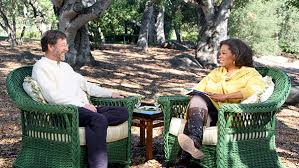
At age sixteen, author and Sufi mystic Llewellyn Vaughan-Lee experienced a shift in consciousness when he read the following Zen koan: The wild geese do not intend to cast their reflection, and the water has no mind to retain their image.
Afterward, a door opened up within him and suddenly there was joy.
On yesterday’s Super Soul Sunday telecast, he spoke with Oprah about Sufism and the universal longing for love. It was interesting to learn that Sufism is inclusive of all religions and helps bridge the gap between the East and West.
I was impressed by this articulate mystic who is concerned with the state of our world. He believes that we are in a state of crisis, much deeper than Wall Street. He spoke at length about the three journeys: from God, to God and in God. Unfortunately, too many people ignore their divine natures and focus primarily on material accumulation. To get on the journey to God, something, usually tragedy, must wake them up. While describing the journey in God, he used Rumi’s words: a return to the root of the root of your own being.
When Oprah mentioned that many of her guests and viewers just want to be happy, Vaughan-Lee replied, “I think they want to be loved.”
Quotable Quotes…
If you go into the core of your being, there is only love or the longing for love.
In order to know God, the ego must be crucified.
For the Sufi, the heart has to break open. Most people are so closed, so contracted; it’s all about “me.”
In God I move and breathe and have my being. (One of Oprah’s mantas)
We are a feather on the breath of God. Hildegard of Bingen
 Joanne Guidoccio